Over $12,018 M in transactional value has moved through decentralized applications built on Binance Smart Chain blockchain, according to BscScan, and BSC consistently ranks in the top three chains by daily active users, recording over 1.2 million unique wallet interactions every single day. That’s not hype, that’s an infrastructure layer proving itself under real, sustained volume.
Most founders don’t pick the wrong chain on purpose. They often choose what seems secure, typically Ethereum, but encounter obstacles as soon as the product begins to scale, as gas fees climb, transactions lag, and users leave mid-journey. By the time the team figures out what’s wrong, six months of product work is already on the line.
The BSC blockchain development solutions conversation needs to happen before the first contract is written. This article walks you through why BSC holds up for high-volume Web3 products, how the architecture actually works under pressure, and what the real development process looks like, from a company that’s built and shipped on it.
Key Takeaways
- The Problem: Teams often choose the wrong blockchain early, only to face performance bottlenecks and expensive rebuilds 6–12 months into production when usage grows.
- The Solution: BSC’s EVM compatibility keeps migration paths flexible while still delivering low fees and high throughput, reducing long-term technical and financial risk.
- How SoluLab Helps: As a blockchain solution provider, we consult before we build by taking an architecture-first approach to align chain choice, product design, and future scalability, not just code delivery.
Why High-Volume Web3 Products Fail Without a Scalable Blockchain Like BSC?
It’s rarely the idea that breaks. It’s almost always the stack.
A lot of teams reach for Ethereum because it feels like the safe choice. Ethereum boasts a large ecosystem, a credible reputation, and a deep talent pool of developers. Those are real advantages, but Ethereum was designed with security and decentralization as the primary goals. Throughput was always secondary.
Push real volume through it, and the economics stop working at a speed most founders don’t anticipate. A DeFi product with 50,000 daily users on Ethereum L1 can hit $200,000+ in daily gas costs during congestion. You either pass those costs to users, who leave, or absorb them, which bleeds the business.
Neither is a path to sustainability. This is exactly the friction that drives why developers choose BSC over Ethereum, not as an ideological statement, but as a practical infrastructure decision when volume is the core business metric.
The failure pattern is consistent across teams: wrong chain, good product idea, broken unit economics. Most figure it out six to twelve months too late, when rebuilding costs more than building right the first time would have.
Why Developers Choose BSC Over Ethereum for High-Volume dApp Development?
Why developers choose BSC over Ethereum stopped being a debate somewhere around 2022. For most product categories where throughput matters, it’s become a practical infrastructure call.
The EVM compatibility piece is genuinely underrated. BSC runs the same Ethereum Virtual Machine, which means any Solidity developer can write for it without learning a new stack.
Metamask works. Hard hat works. Truffle works. OpenZeppelin libraries work.
Your security auditors already know the attack vectors. You’re not asking the team to start over, you’re asking them to deploy on a different network with better economics.
What you get in return is significant:
- Transaction finality in 3 seconds: Ethereum averages 12–15 seconds per block.
- How BSC reduces transaction fees: It’s a structural like PoSA consensus, predictable block time, and a fee market that doesn’t spike the way Ethereum’s does during congestion. Average fees stay at $0.10–0.30 even under heavy load.
- A live, liquid DeFi ecosystem: PancakeSwap, Venus Protocol, and ApeSwap all run on BSC, meaning integrations and liquidity exist from day one rather than needing to be built from scratch.
For enterprise blockchain solutions and early-stage startups alike, the fee comparison matters in rooms where CFOs and CTOs are making infrastructure decisions. BSC makes that conversation simple.

What Is BSC Development in the Context of Web3 Applications?
What is BSC development is a question worth answering precisely, because it covers a lot more than just “writing Solidity contracts on a different chain.”
What is BSC development is the end-to-end process of designing, building, testing, securing, and deploying decentralized applications, tokens, DeFi protocols, NFT platforms, and blockchain-native products on the Binance Smart Chain network. It starts with architecture decisions, which token standards to use (BEP-20, BEP-721, BEP-1155), how cross-chain bridges are structured, how smart contracts interact with the BSC ecosystem, and runs through to post-launch monitoring and maintenance.
The nuance matters. What BSC development in practice means is navigating a deployment environment that’s subtly different from Ethereum’s mainnet in ways that show up at scale like gas optimization patterns, validator behavior, and mempool dynamics. Solid blockchain development services account for all of this before a single line of production code is written.
Binance Smart Chain Blockchain Architecture Explained for Web3 Builders
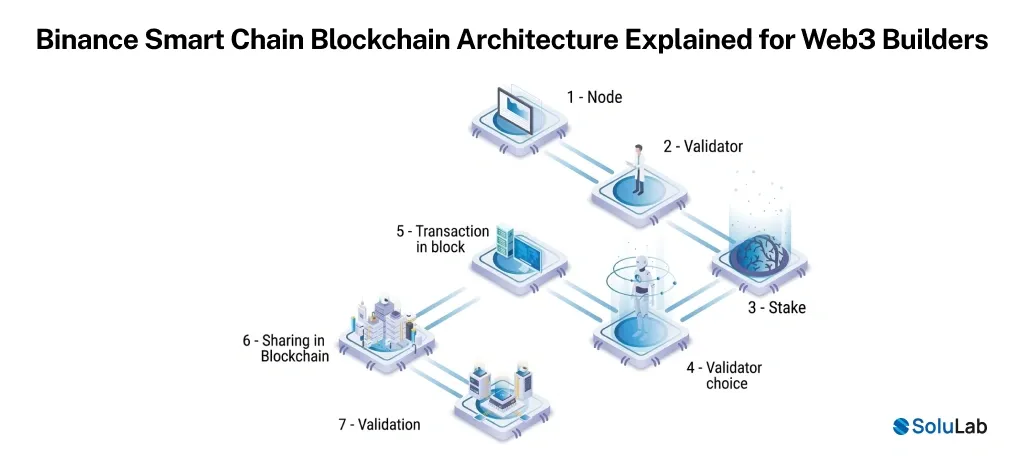
BSC blockchain architecture explained starts with the foundational design decision: Proof of Staked Authority (PoSA). Rather than Ethereum’s decentralization-first model, BSC uses 21 elected validators, each staked with BNB, who rotate block production in a fixed schedule. This is a deliberate and documented tradeoff, as Ethereum is less centralized than BSC. In exchange, you receive consistent finality, predictable fees, and higher transaction throughput.
BSC blockchain architecture also includes a dual-chain design with Binance Chain, where asset trading and smart contract execution happen on separate but connected rails. This separation reduces congestion on the smart contract layer during high-traffic periods, which matters when you’re running a high-volume DeFi product or a consumer dApp with thousands of simultaneous transactions.
The piece that enables everything else, though, is EVM compatibility. BSC blockchain architecture explained means full compatibility with the Ethereum toolchain, audit frameworks, and security practices, which means the ecosystem of developer tools, test suites, and vulnerability databases built for Ethereum works directly on BSC without translation.
Binance Smart Chain Development Tools Developers Use to Build and Scale Web3 Apps
Binance Smart Chain development tools closely mirror the Ethereum stack, and that’s by design.
- Remix IDE — browser-based Solidity development environment, well-suited for prototyping and quick testing
- Hardhat / Truffle — local development environments with full test framework support and deployment scripting
- OpenZeppelin Contracts — audited, production-ready contract libraries for BEP-20, BEP-721, and access control patterns
- BscScan API — block explorer with a developer API for transaction data, contract verification, and event monitoring
- Web3.js / Ethers.js — JavaScript libraries for frontend-to-chain interaction and wallet connectivity
- The Graph — decentralized indexing protocol for querying on-chain BSC data efficiently without overloading RPC nodes
Binance Smart Chain development tools also include BSC-specific additions: PancakeSwap SDKs for DeFi product integrations, Venus Protocol interfaces for lending and borrowing features, and BNB Chain’s Bridge SDK for cross-chain asset transfers between BSC and other networks.
Knowing Binance Smart Chain development tools in depth is what separates teams that ship on schedule from teams that spend weeks debugging environment-specific issues. Good blockchain development services keep live tooling environments maintained across projects, so setup doesn’t eat sprint time.
Step-by-Step BSC dApp Development Process on Binance Smart Chain
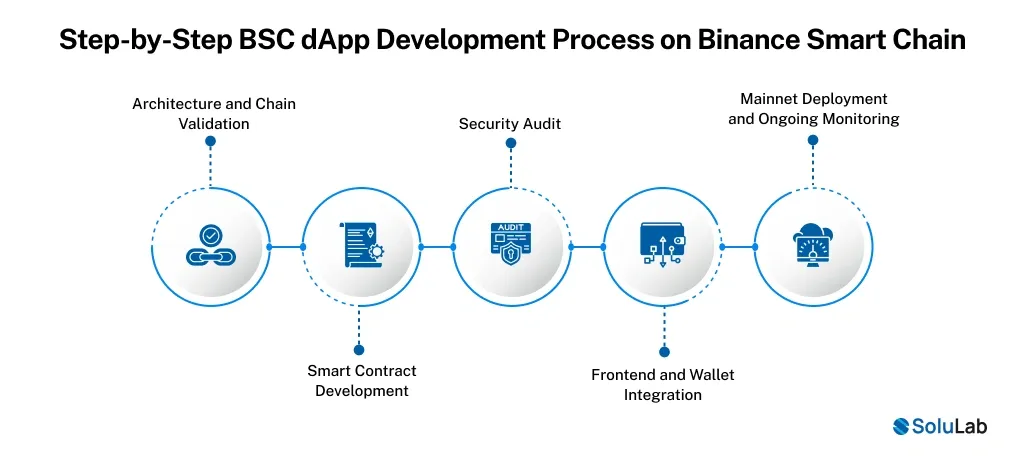
The step-by-step BSC development process follows a structure that experienced teams will recognize, but the sequencing matters more for BSC than most founders expect.
1. Architecture and Chain Validation
Before writing a line of code, reputable blockchain consulting services map your product requirements against chain capabilities. Volume projections, fee tolerance, cross-chain needs, and regulatory constraints all of this should inform the decision before any development starts.
2. Smart Contract Development
Solidity contracts are written and tested in Hardhat or Truffle. BSC’s Chapel testnet serves as the staging environment before the mainnet. The BSC dApp development process lives and dies at this stage, where contracts need to be gas-optimized, modular, upgrade-friendly where needed, and ready for audit.
3. Security Audit
It is essential, not just a formality. The blockchain development use cases that became cautionary tales, such as Ronin Bridge ($625M) and Nomad Bridge ($190M), failed at the contract security layer. Third-party audits from CertiK, Hacken, or PeckShield are standard practice before any mainnet deployment.
4. Frontend and Wallet Integration
Web3.js or Ethers.js connects the user interface to the chain. Wallet support like Metamask, Trust Wallet, and WalletConnect needs to be smooth and tested across device types. Friction at this layer kills conversion even when everything else is working.
5. Mainnet Deployment and Ongoing Monitoring
Deployment to BSC mainnet followed by real-time event monitoring via BscScan, custom dashboards, and automated alerting on contract-level events.
The step-by-step BSC development process is iterative, not linear, as teams loop between steps, especially between contract development and auditing. A reliable BSC development company builds this discipline into the engagement structure from day one.

Key Benefits of BSC for Web3 Applications Building at Scale
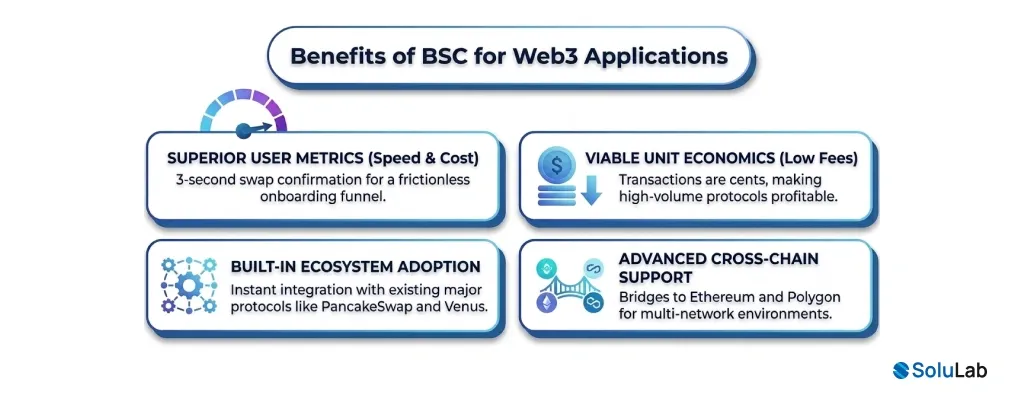
The benefits of BSC for Web3 applications are most visible in product metrics, not benchmark reports.
A user completing a swap on a BSC-based DEX pays roughly $0.15 and waits 3 seconds. The same transaction on Ethereum L1 during peak hours could cost $20 and take a minute.
- For consumer products, that’s the difference between a smooth onboarding funnel and a 60% drop-off.
- For DeFi products processing tens of thousands of trades daily, it’s the difference between a viable unit economics model and a loss-making one.
Beyond cost and speed, the benefits of BSC for Web3 applications extend into the ecosystem layer.
- PancakeSwap handles billions in daily trading volume.
- Venus Protocol provides on-chain lending infrastructure.
- ApeSwap adds liquidity depth for smaller token pairs.
Building on BSC means your product integrates with financial infrastructure that already has users, not building into a quiet network waiting for adoption.
Cross-chain support rounds out the picture. BSC’s bridge infrastructure connects to Ethereum, Polygon, and other major chains important for application of blockchain technology in multi-network environments and for products where users hold assets across chains.
Benefits of BSC for Web3 applications ultimately add up to this: BSC is the best blockchain for scalable Web3 apps when your primary constraints are cost efficiency, confirmation speed, and developer velocity.
Binance Smart Chain Use Cases Across High-Volume Web3 Applications
Binance Smart Chain use cases span every major Web3 vertical, and the breadth is part of what makes the ecosystem valuable.
1. DeFi Protocols
Decentralized exchanges, lending platforms, yield aggregators, and stablecoin protocols. BSC’s fee structure makes micro-transactions economically viable, a product category that simply doesn’t work on Ethereum L1 when a $5 trade costs $15 in gas.
2. GameFi and NFT Platforms
Low minting costs and fast confirmation times make use cases of Binance Smart Chain in gaming genuinely user-friendly. Play-to-earn economies, in-game asset marketplaces, and digital collectibles become sustainable when per-transaction costs stay below a cent.
3. Enterprise Tokenization
Supply chain provenance tokens, loyalty reward systems, digital certificates, and invoice tokenization. Enterprise blockchain solutions on BSC benefit from public blockchain infrastructure with private-key access controls, which gives enterprises the transparency of a public chain without open read access to sensitive data.
4. Cross-Border Payments
Stablecoin transfers on BSC cost fractions of a cent and settle in seconds. For emerging market remittance products, the blockchain development cost comparison against SWIFT or correspondent banking is compelling at scale.
Binance Smart Chain use cases in 2025–2026 are expanding into Real World Asset (RWA) tokenization, one of the fastest-growing institutional blockchain categories. WEF’s 2024 Digital Assets Report projects the tokenized RWA market at $16 trillion by 2030, and BSC’s combination of low fees, fast settlement, and institutional-grade tooling positions it well for that wave.
Blockchain use cases across all these verticals share one underlying requirement: a chain that’s fast, cost-effective, and battle-tested in production.
Web3 Development on Binance Smart Chain for High-Performance dApps
Web3 development on Binance Smart Chain is the most accessible entry point for teams coming from traditional software backgrounds or migrating from Ethereum. The documentation is comprehensive, the developer community is active across GitHub, Discord, and Stack Overflow, and the tooling has been in production long enough that most common issues are well-documented.
What differentiates Web3 development on Binance Smart Chain from building on newer chains is the density of live, production-grade DeFi infrastructure already running. Your product doesn’t launch into a vacuum, waiting for users, it launches into an ecosystem with billions in existing liquidity and millions of active wallets.
For blockchain solution providers in USA evaluating chain recommendations for client projects, BSC consistently wins on the three criteria that drive commercial decisions: blockchain development cost efficiency, transaction throughput, and developer availability.
Web3 development on Binance Smart Chain has earned its place as a first-tier product category in the Web3 stack, not just an Ethereum alternative .
Future of Binance Smart Chain in Web3 Ecosystems and Product Development
The future of Binance Smart Chain in Web3 has a funded, active roadmap behind it, which matters more than most ecosystem narratives.
BNB Chain’s 2024–2026 development plan includes opBNB — a zkEVM-based Layer 2 that brings significantly higher transaction throughput to the BSC ecosystem while maintaining full EVM compatibility. This means the performance ceiling increases without fragmenting the existing developer ecosystem or requiring teams to learn a new environment.
The future of Binance Smart Chain in Web3 also includes deeper RWA tokenization infrastructure and institutional-grade compliance tooling, aimed directly at the enterprise market that’s currently evaluating blockchain deployment. Forbes reported in late 2024 that institutional blockchain adoption is growing at 34% year-over-year, and the tooling improvements BNB Chain is shipping are clearly designed for that buyer.
The top blockchain trends driving 2025–2026 are AI and blockchain convergence, tokenized real-world assets, and cross-chain DeFi interoperability, all of which have clear BSC strategies behind them. The future of Binance Smart Chain in Web3 isn’t speculation. It’s a chain with an active production ecosystem, an organized development foundation, and a roadmap aligned with where institutional capital is moving.
Choosing the Right BSC Development Company to Avoid Costly Rebuilds
Picking the right BSC development company is as consequential as picking the chain, and most teams get it wrong by optimizing on price.
A cheaper build that ships a vulnerable smart contract can cost you your entire treasury and your product’s reputation in a single exploit. The right blockchain development company brings architectural depth, embedded security practice, and post-launch support, not just Solidity developers billing by the hour.
What actually matters when evaluating a BSC partner:
- Audited contract portfolio — Ask for CertiK, Hacken, or PeckShield reports on prior production contracts. If they haven’t shipped audited work, that’s a signal.
- Vertical experience in your category — A team that’s built DeFi protocols understands things a team that’s only built NFT platforms doesn’t, and vice versa.
- Blockchain consulting — embedded in the engagement — Not just execution. A trustworthy partner raises architecture concerns before they become deployment problems.
- Transparent blockchain development cost modeling — Scope, milestones, and cost ranges defined before contracts are signed. Vague timelines lead to cost overruns.
A trustworthy BSC development company also knows when BSC isn’t the right answer for your specific product and says so. SoluLab, as a Blockchain app development company with genuine expertise recommend the right chain for the product requirements, not the chain their team has the most existing code for.
The BSC blockchain development solutions conversation should start with your requirements, not with a pitch. Blockchain consulting at the front end of an engagement is what separates an architecture that scales from one that needs rebuilding.
Conclusion
Building for volume in Web3 is an infrastructure decision first and a product decision second. The chain you pick shapes your cost structure, your developer options, your audit complexity, and how long it takes to get to market. BSC isn’t the universal answer, but for products where transaction cost, confirmation speed, and developer velocity are the binding constraints, it’s difficult to make a better case for another chain at this stage of the market.
The question isn’t whether BSC can handle your product. With the architecture it’s running and the ecosystem it’s built, it almost certainly can. The question is whether your team knows how to build on it well and whether your development partner has enough production experience to keep you away from the decisions that cost real money to undo.
If you’re seriously evaluating BSC blockchain development solutions, start with the architecture conversation and then build the second.
FAQs
With over 3 years of experience, I specialize in breaking down complex Web3 and crypto concepts into clear, actionable content. From deep-dive technical explainers to project documentation, I help brands educate and engage their audience through well-researched, developer-friendly writing.