

Blockchain security tools fall into four categories: static analyzers, dynamic fuzzers, formal verification frameworks, and real-time monitoring services. Slither and Mythril run static analysis on Solidity bytecode to catch reentrancy, overflow, and access-control bugs before deployment. Echidna uses property-based fuzzing to find edge cases under adversarial input. Certora Prover applies formal verification to prove contract invariants mathematically. On the monitoring side, platforms like Forta and Chainalysis flag anomalous on-chain activity in production.
Why does blockchain security matter so much? Because it protects the integrity and confidentiality of whatever is stored on-chain. Financial transactions, blockchain in supply chain information, personal data, all of it depends on the system holding up. Break that trust once, through a hack, a leak, a bug, and the fallout is rarely just financial. Reputations take the hit too.
Blockchain long ago outgrew cryptocurrency. Finance, healthcare, supply chain, they’re all building on it now, chasing efficiency and accountability they couldn’t get otherwise. The pitch is simple: a decentralized, tamper-resistant ledger cuts out fraud, trims intermediaries, and keeps records honest.
How Do Blockchain Security Testing Tools Play a Vital Role in Identifying Vulnerabilities within Decentralized Networks?
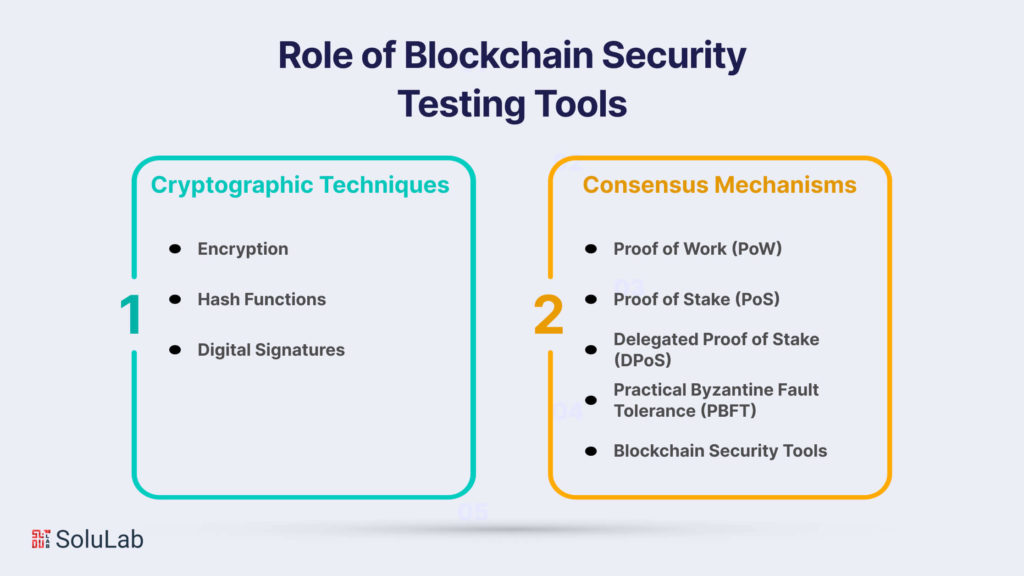
Blockchain reshaped how industries handle secure, transparent transactions. That reputation only holds if the underlying security does its job. Two things carry most of the weight here: the cryptographic techniques baked into the protocol, and the consensus mechanisms that keep everyone agreeing on the same version of the truth. Both are worth understanding before you pick a tool to defend either.
A. Cryptographic Techniques
Encryption
Encryption keeps blockchain data confidential and tamper-proof. It’s the base layer everything else sits on. Transaction data gets scrambled with cryptographic algorithms strong enough that unauthorized access is effectively off the table. Without it, none of the privacy or integrity guarantees blockchain promises would hold up.
Hash Functions
Hash functions turn data blocks into unique, fixed-size codes. Change one character in the original data, and the hash comes out completely different, which is exactly what makes tampering so easy to spot. Blockchain chains these hashes together block by block, building an immutable record one link at a time.
Digital Signatures
Digital signatures confirm two things: who sent a transaction, and whether it was altered in transit. Asymmetric cryptography does the verification work behind the scenes. The result is a stronger foundation of trust across the whole network, transaction by transaction.
B. Consensus Mechanisms
Proof of Work (PoW)
PoW is the original consensus model. Miners solve computationally expensive puzzles to validate transactions and add new blocks. It’s energy-hungry by design, and that’s the point: attacking the network becomes too costly to bother with.
Proof of Stake (PoS)
PoS swaps out PoW’s energy bill for a stake-based system. Validators get picked to create blocks based on how much cryptocurrency they’ve locked up and are willing to risk. It’s lighter on the environment and still holds its own against malicious actors.
Delegated Proof of Stake (DPoS)
DPoS adds a voting layer. Token holders elect a small group of delegates who handle transaction validation and block creation on everyone’s behalf. That keeps things fast and scalable, while the vote itself acts as a check on who gets that authority.
Practical Byzantine Fault Tolerance (PBFT)
PBFT is built for speed. A fixed set of nodes reaches consensus among themselves, which suits permissioned blockchain setups well. Even if some of those nodes act up or fail outright, the network keeps running without losing its footing.
Related: Decentralized Physical Infrastructure Networks (DePIN)
Blockchain Security Tools
A whole toolset has grown up around fortifying blockchain networks: vulnerability scanners, penetration testing frameworks, smart contract auditors. Security-conscious teams reach for these to catch weak points before they become incidents, especially when the implementation work is backed by trusted providers like Software Secured.

What are Threats to Blockchain Security?
Decentralized and secure doesn’t mean immune. As blockchain adoption climbs, so does the pressure to stay ahead of the vulnerabilities that come with it. A cyber threat intelligence platform helps catch emerging risks early, with defense strategies built specifically for how blockchain environments behave. A handful of threats deserve real attention, each chipping away at the ledger’s integrity in its own way.
51% Attacks
A 51% attack happens when one entity, or a coordinated group, grabs control of more than half a network’s computing power. That’s enough to manipulate transactions and double-spend at will. Consensus algorithms and monitoring tools are the front line here, keeping power spread thin enough that no single actor can take over.
Double-spending
Double-spending is exactly what it sounds like: spending the same coin twice. It strikes at the core promise of blockchain, that consensus alone validates a transaction. Strong consensus algorithms, PoW or PoS among them, are what stand between this attack and a working ledger, by keeping transaction history transparent and verifiable.
Sybil Attacks
Sybil attacks flood a network with fake identities, exploiting the anonymity that makes blockchain work in the first place. Testing tools built for this job watch node behavior closely, flagging anomalies so each node on the network is confirmed as a real, unique participant.
Smart Contract Vulnerabilities
Smart contracts add power, and risk, in the same breath. Bugs hide in the code and can compromise everything downstream. Tools built specifically for smart contract auditing dig through that code line by line, checking that contracts execute the way they were meant to and hold up against exploitation attempts.
Malicious Nodes
Every node validating transactions is a potential weak point if it turns malicious. Testing tools solve this by watching node behavior around the clock, catching deviations from the norm before they turn into real damage. That constant vigilance is what keeps the network’s integrity intact and unauthorized access out.
Regulatory and Compliance Challenges
Not every threat is technical. Regulations around blockchain keep shifting, and staying compliant takes purpose-built security tools of its own. These help organizations line up their implementations with legal frameworks, avoiding the kind of trouble that shows up in courtrooms rather than code.
What are the Blockchain Security Tools?
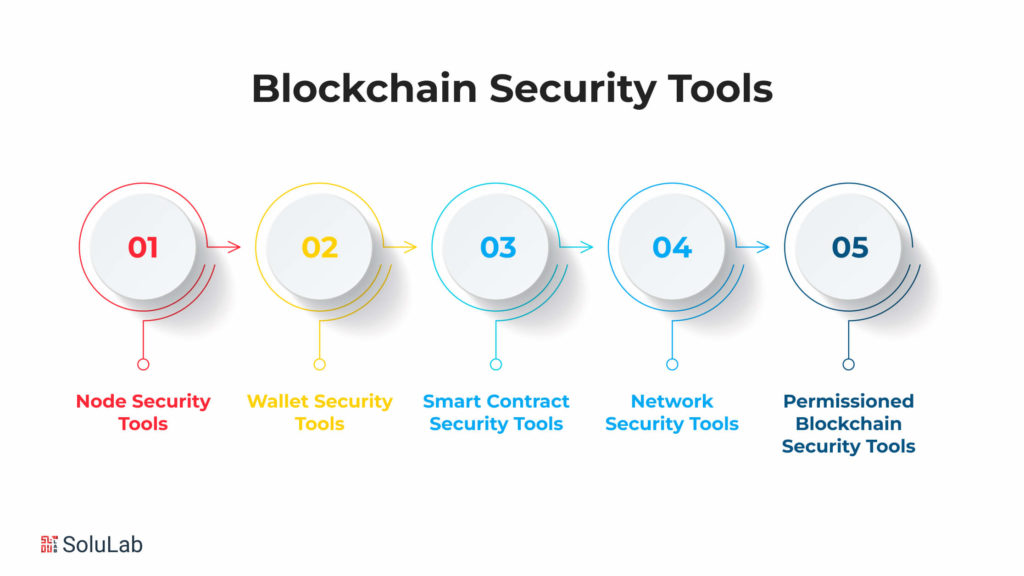
Blockchain’s decentralized, transparent design changed how industries operate, and it dragged a new set of security concerns along with it. A whole category of specialized tools has emerged to answer those concerns, each one built around a different piece of the problem.
A. Node Security Tools
NodeWatch
NodeWatch is built to harden blockchain node security. It watches for unusual activity and potential threats across the node infrastructure, catching problems while they’re still small enough to fix quietly.
Nodestalker
Nodestalker picks up where NodeWatch leaves off, tracking node behavior in real time. Heuristic algorithms spot the patterns that usually precede a breach or point to something suspicious, which means risks get flagged early rather than after the fact.
B. Wallet Security Tools
Ledger Nano S
Ledger Nano S is a hardware wallet, so private keys stay offline and out of reach of anything happening on the internet. That isolation, backed by strong encryption, is why it’s a staple for anyone serious about wallet security, individuals and businesses alike.
Trezor
Trezor takes a simpler approach without cutting corners on security. Open-source design plus PIN protection makes it a go-to for people who want their digital assets locked down. Support for multiple cryptocurrencies makes it flexible too.
C. Smart Contract Security Tools
MythX
MythX runs deep security analysis on Ethereum smart contracts, checking for vulnerabilities and exploit paths across a wide range of scenarios. Fold it into the development pipeline and the whole project’s security posture improves, with fewer expensive surprises down the line.
Securify
Securify’s specialty is formal verification, checking that a smart contract actually meets the security specs it was written against. Its methodical, formal-methods approach makes it a systematic way to hunt for vulnerabilities and confirm the code does what it claims.
Oyente
Oyente hunts for the common security issues that show up in Ethereum smart contracts. Its static analysis catches vulnerabilities before deployment, which matters, because those same flaws are what lead to financial losses or open the door to exploits.
D. Network Security Tools
Blockscan
Blockscan is a network security tool built for blockchain protocols.. It watches network traffic, flags potential threats, and checks that data transmissions stay intact. Handling network-level vulnerabilities proactively is what makes Blockscan a solid piece of a more resilient blockchain setup.
EtherScan
EtherScan gives real-time visibility into the Ethereum blockchain. As a network security tool, it lets users track transactions, contract interactions, and network stats all in one place, which makes spotting and dealing with threats to the Ethereum network a lot more practical.
E. Permissioned Blockchain Security Tools
Hyperledger Caliper
Hyperledger Caliper benchmarks the performance and security of permissioned blockchains. Running various use cases through it, and stress-testing the network directly, gives organizations a real read on how resilient and secure their permissioned setup actually is.
Chaincode Security Analyzer
Built specifically for Hyperledger Fabric, the Chaincode Security Analyzer scrutinizes chaincode, Fabric’s version of a smart contract, through static analysis. It catches vulnerabilities early, tightening the security around Hyperledger Fabric-based permissionless blockchains.
How Can the Incorporation of Blockchain Security Testing Tools Complement the Use of Cryptographic Tools?
Blockchain gave industries a decentralized, secure way to transact, and that popularity brought a matching demand for stronger security measures. Cryptographic tools carry most of that load, keeping blockchain networks confidential and intact. Here’s a look at three that matter most: OpenSSL, HashiCorp Vault, and Amazon Key Management Service (KMS).
A. OpenSSL for Blockchain Security
OpenSSL is the open-source toolkit most developers reach for when implementing cryptographic protocols, blockchain included. It slots SSL/TLS protocols, cryptographic algorithms, and key management functions into blockchain applications without much friction. Secure communication and data integrity are the payoff, which is why it’s hard to build a blockchain security stack without it somewhere in the mix.
B. Key Management Tools
HashiCorp Vault
Key management is where a lot of blockchain security either holds or falls apart, and HashiCorp Vault handles it well. It centralizes cryptographic keys, secrets, and other sensitive data in one secure place. Dynamic secret generation and rotation cut down the risk of unauthorized access, tightening the security posture of whatever network sits behind it.
Amazon Key Management Service (KMS)
Amazon KMS is a cloud-based key management tool that plugs directly into blockchain applications running on AWS. It’s a scalable way to create, store, and control cryptographic keys, with key rotation and audit trails built in. That combination keeps keys managed properly and in line with industry standards, without extra tooling on top.
How does its Automated Scanning Contribute to the Security of Decentralized Applications?
Keeping decentralized networks secure and intact isn’t a one-time job, it’s constant. That’s why monitoring and auditing tools keep multiplying to match the challenges specific to blockchain. Two categories cover most of the ground here: Security Auditing Platforms and Blockchain Network Monitoring Tools.
A. Security Auditing Platforms
Quantstamp
Quantstamp is one of the better-known security auditing platforms for blockchain systems. It runs advanced security analysis to deliver thorough audits of smart contracts.
Automated scanning catches vulnerabilities and protects the integrity of decentralized applications (DApps) built on blockchain platforms. That’s the core of what Quantstamp does: cut the risk tied to smart contract vulnerabilities and, by extension, strengthen the security of the networks running on top of them.
Certik
Certik pairs formal verification with static analysis to cover blockchain security from two angles. It’s built for auditing smart contracts, catching vulnerabilities, and confirming code integrity.
What sets Certik apart is its use of mathematical proofs to validate smart contract correctness, not just testing but proving it. That’s why projects looking for a high bar of assurance tend to land on Certik, and why it contributes meaningfully to safer, more reliable decentralized applications.
B. Blockchain Network Monitoring Tools
Chainkit
Chainkit is a blockchain network monitoring tool built for security and performance together. It monitors blockchain transactions in real time, which means anomalies or suspicious activity get caught quickly, not after the damage is done.
It also handles data integrity verification and threat identification, which makes it hard to skip if you’re serious about keeping a blockchain network resilient. A user-friendly interface and customizable alerts round out what makes it practical day to day.

Alethio
Alethio covers analytics and monitoring for blockchain networks, with Ethereum as its main focus. It goes deep on network activity, smart contract interactions, and transaction histories.
That depth is what makes it useful for spotting abnormalities, tracking how assets move, and keeping tabs on overall network health. A clean dashboard and customizable reporting make it a tool blockchain security teams actually want to use.
Conclusion
Put it all together, and blockchain security tools form a real framework for protecting the integrity, confidentiality, and availability of blockchain-based systems. They’re what keeps a decentralized network trustworthy in practice, not just in theory, by catching vulnerabilities before they turn into incidents.
SoluLab has built a name for itself in blockchain development, with real depth in the technology behind it. As a blockchain development company, SoluLab pairs practical engineering with the right security tooling to build blockchain solutions that hold up at scale. That shows up most in how the team handles the security challenges that keep shifting under everyone’s feet.
For organizations looking to strengthen their blockchain projects, the option to hire blockchain developers from SoluLab is a solid move. These are engineers who know the current security tooling well and know how to apply it to a live blockchain application. Hand the development work to SoluLab, and the security measures get built in from the start rather than bolted on later.
FAQs
Shipra Garg is a tech-focused content strategist and copywriter specializing in Web3, blockchain, and artificial intelligence. She has worked with startups and enterprise teams to craft high-conversion content that bridges deep tech with business impact. Her work translates complex innovations into clear, credible, and engaging narratives that drive growth and build trust in emerging tech markets.

![How to Choose a Blockchain Development Company [2026 Edition]](https://www.solulab.com/wp-content/uploads/2026/09/Banner-Before-You-Hire-Check-These-Blockchain-Essentials.webp)