



Key Takeaways
- The Problem: Most founders pour capital into blockchain without a measurement framework and, six months later, can’t tell their board what they got for it. ROI stays invisible because nobody built a system to track it.
- The Solution: A structured, phased ROI framework that ties every blockchain investment decision to a measurable business outcome like cost savings, operational speed, compliance reduction, or new revenue.
- How SoluLab Can Help: As a leading blockchain consulting company, SoluLab builds the framework before the code by helping founders define, track, and prove returns at every stage of the project.
By 2027, blockchain is expected to store nearly 10% of global GDP, according to the World Economic Forum. That sounds inevitable, which is almost boringly obvious. What doesn’t get said as often is that nearly 90% of enterprise blockchain initiatives never make it to production, as they don’t fail loudly; they stall and get paused. They quietly disappear after months of spending, meetings, and optimistic dashboards.
That gap is the real issue.
It’s not the technology or the market, it’s the disconnect between what blockchain promises and what businesses actually measure as ROI. Many organizations move forward without the right evaluation frameworks or without partnering with an experienced blockchain development company, leading to unclear outcomes and delayed execution.
If you’re a founder or decision-maker about to approve a blockchain budget or already deep into one, this is where clarity becomes critical. Because this is the stage where real money is being spent, timelines are slipping, and no one can clearly define whether the project is delivering value.
Why Most Blockchain Investments Fail on Paper Without Clear ROI Measurement?
Here’s something most vendors won’t say out loud: the majority of blockchain development projects don’t fail because the technology didn’t work. They fail because nobody could prove it did.
Deloitte’s 2023 Global Blockchain Survey found that 39% of senior executives named unclear ROI as their number one reason for killing a blockchain initiative. That’s a measurement problem, not an engineering problem.
When a company picks a blockchain solution provider for business without first defining what success looks like in numbers, they’re flying without instruments. Development runs for six months, and integration takes another three, and when the CFO asks what the company got for $400,000, as nobody has a clean answer. The gains are real but scattered across departments that don’t talk to each other, buried in process efficiencies that nobody formally documented before the project started.
That’s the trap. And it’s almost entirely avoidable.
The Challenges in Measuring Blockchain ROI are real, but they’re organizational more than technical. Blockchain touches multiple teams simultaneously, like procurement, finance, compliance, and operations, and none of those functions are built to share credit for outcomes. So the value gets diluted across departments and never shows up cleanly in a single line of any report.
What Blockchain ROI Really Means for Businesses?
Standard ROI is simple math: (Net Benefit / Total Cost) × 100.
But blockchain doesn’t always behave according to standard rules, and plugging it into a simple formula too early is how you end up with numbers that don’t tell the whole story.
When you measure blockchain ROI, there are three layers, and most finance teams only measure one.
1. Direct ROI is the easy one.
Cost reduction, faster settlements, fewer intermediaries, and a lower headcount on manual reconciliation. This shows up within months, and it’s the one your board will ask about first.
2. Indirect ROI is slower but arguably more valuable.
Better data integrity, fewer disputes, audit readiness, and stronger partner trust. It takes 6 to 18 months to materialize, but in regulated industries, it often represents the most significant financial impact.
3. Strategic ROI is the hardest to quantify and the most undervalued.
New business models are enabled as it creates faster entry into new markets. The ability to onboard partners at scale can create competitive differentiation.
Blockchain’s Impact on Business compounds across all three layers. Founders who measure only the first layer and declare failure at month four are making an honest but costly mistake. The companies that track all three and set realistic timelines for each are the ones that actually defend their investment.

The Founder’s Blockchain ROI Checklist for Enterprise Blockchain Solutions
Before you green-light a budget or hire blockchain consultants for ROI evaluation, run through this honestly:
- Do you have a documented baseline? What are the current process costs, time per transaction, error rate, and headcount involved?
- Have you identified the specific problem that blockchain solves, rather than just stating that we want more efficiency?
- Is there a measurable outcome tied directly to that problem?
- Have you calculated the full blockchain development costs, not just the build but also integration, testing, training, and ongoing maintenance?
- Is there a clear timeline for when you expect to see returns?
- Does your internal team agree on what success looks like in numbers, not adjectives?
If three or more of those are unclear, you’re not ready to invest yet. That’s not a failure, that’s exactly where blockchain investment consulting begins: helping founders build this foundation before a single developer writes a line of code.
A Proven Blockchain ROI Framework Used by Enterprise Blockchain Consulting Teams
There are plenty of frameworks floating around. Most of them are academic. Here’s the one that actually holds up when a board asks challenging questions.
Step 1 — Baseline Everything.
Document the current state in detail. Cost per transaction, processing time, error rate, and staff hours involved. This is your control group, and without it, you have nothing to measure against.
Step 2 — Write a Specific Hypothesis.
Blockchain will not improve our supply chain. Something like this: Smart contracts will reduce our invoice reconciliation from 14 days to 3, saving approximately $180,000 annually in labor. Specific, testable, and tied to a number.
Step 3 — Run a Blockchain PoC
Test the hypothesis on a single, controlled workflow with a Blockchain PoC before committing to a full build and measure everything. This is the step that separates founders who spend smart from founders who spend fast.
Step 4 — Calculate blockchain ROI at Pilot Scale.
Take your pilot results and project them across full implementation. Factor in integration complexity, change management, and maintenance. Please verify those projections against industry benchmarks.
Step 5 — Set Milestone Reviews.
ROI doesn’t arrive as one event. We set 3-month, 6-month, and 12-month review points with specific metrics at each checkpoint. Experienced blockchain developers who’ve done this before build this review structure into the delivery plan from the start.
The Metrics That Actually Determine Blockchain ROI
The Key Metrics to Track Blockchain ROI will vary by industry, but these come up consistently across almost every use case:
Operational Metrics
- Transaction processing time (before vs. after)
- Error and dispute rate
- Number of manual touchpoints eliminated
- Reconciliation cycle time
Financial Metrics
- Cost per transaction
- Float savings from faster settlement
- Fraud and chargeback reduction
- Staff reallocation vs. new hire costs
Strategic Metrics
- Time to audit readiness
- New revenue streams unlocked
- Partner onboarding speed
- Regulatory compliance cost reduction
For supply chain specifically, real-world blockchain ROI examples from Forbes and Gartner show 30–50% reductions in documentation errors. In trade finance, settlement times have dropped from 3–5 business days to under 4 hours. These aren’t projections; they’re reported outcomes from companies that built right and measured from day one.
It’s also worth noting that Enterprise risk detection platforms integrated with blockchain infrastructure have significantly cut fraud detection time, which feeds directly into the financial ROI calculations most CFOs care about.
How to Measure Realistic ROI in Blockchain Use Cases?
Not all blockchain use cases with high ROI perform equally. Founders who go in with the wrong timelines end up pulling the plug too early. Here’s an honest picture:
1. Supply Chain & Provenance Tracking
- ROI Timeline: 6–18 months.
- What drives it: reduced counterfeit losses, faster dispute resolution, and lower audit costs.
- Realistic outcome: 15–35% reduction in verification process costs.
2. Trade Finance & Cross-Border Payments
- ROI Timeline: 3–9 months.
- What drives it: settlement speed, fewer banking intermediaries, and forex efficiency.
- Realistic outcome: 20–40% reduction in transaction cost.
3. Healthcare Data Management
- ROI Timeline: 12–24 months.
- What drives it: data integrity, interoperability, and HIPAA compliance.
- Realistic outcome: 10–25% reduction in administrative overhead.
4. Tokenization & Digital Assets
- ROI Timeline: Highly variable, depending on adoption.
- What drives it: a higher ceiling and risk.
- The public sector isn’t the ideal place to establish your initial blockchain business case.
The benefits of blockchain for businesses are real, but they’re also use-case specific. A supply chain company and a healthcare network are measuring against entirely different baselines, which is why generic industry ROI benchmarks are often useless. Your business needs its own model.
Staying current on Top blockchain Trends like tokenization of real-world assets or zero-knowledge proof applications also matters here, because some of the highest-ROI opportunities are use cases that didn’t exist two years ago.
If you’re scoping a project in 2026 using 2022 benchmarks, your projections are probably off.
Common Blockchain ROI Measurement Mistakes That Kill Real Business Value
1. Measuring at the wrong time.
Blockchain infrastructure takes time to embed into existing workflows. Pulling ROI numbers at month two is like measuring crop yield the week after planting. Set your first meaningful measurement checkpoint at month six, not month two.
2. Missing change management in the cost model.
The build is one line item. But if your team isn’t using the system correctly, you won’t capture the returns. Training, process redesign, and adoption support are real costs that belong in every blockchain development cost calculation from day one.
3. Comparing to the wrong baseline.
Don’t compare blockchain cost to zero. Compare it to what your current process costs at scale, including full overhead. That’s where the Challenges in Measuring Blockchain ROI actually hide.
4. Undervaluing network effects.
Most Enterprise Blockchain Solutions deliver more value as more participants join. If you’re measuring ROI with three suppliers on-chain when your full deployment targets fifty, you’re significantly undervaluing the project and potentially making the wrong call based on incomplete data.
5. Skipping the pre-build blockchain development company ROI analysis
This one is surprisingly common. Founders assume the vendor has already built a business case for them; most haven’t. The vendor’s job is to build the product. Your job is to know what return you need from it before the contract is signed.
How Blockchain Consultants Measure and Present ROI for Investors and Boards?
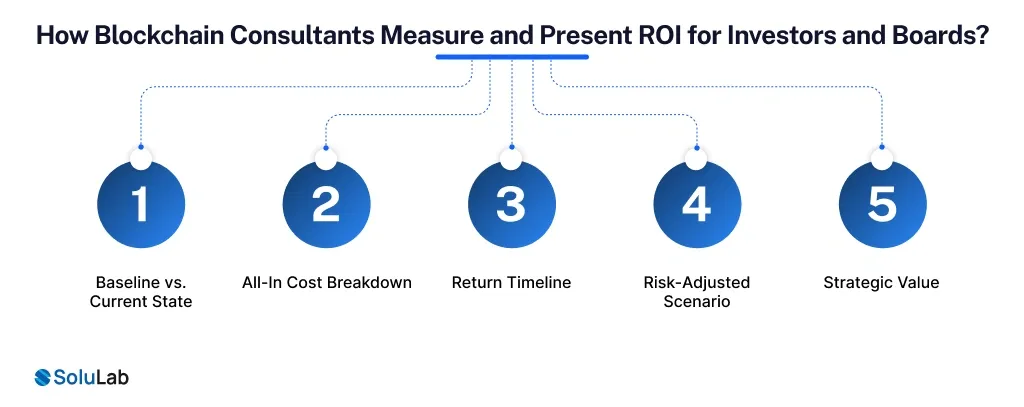
Boards don’t want to hear about distributed ledger architecture. They want three things: what it cost, what it returned, and when.
Here’s a structure that consistently works:
- Baseline vs. Current State — Show the before/after with hard numbers, not percentages alone
- All-In Cost Breakdown — Including integration, training, and maintenance, not just licensing and development
- Return Timeline — When did or will the investment pay back, and what are the milestones?
- Risk-Adjusted Scenario — What’s the conservative case? What’s the downside?
- Strategic Value — What does this enable beyond direct cost savings?
When you measure the ROI of blockchain implementation properly and present it this way, the conversation shifts from is this worth it to how do we scale it. That’s the position you want to be in when the next budget cycle opens up.
When to Bring in a Blockchain Development Partner like SoluLab?
There’s a point in every serious blockchain initiative where internal resources hit their ceiling, not because the team isn’t capable, but because blockchain app development at enterprise scale requires depth that’s genuinely hard to build in-house quickly without significant ramp time.
The right blockchain consulting company doesn’t just build. They help you
- define how to measure ROI in blockchain projects,
- design architecture that makes ongoing measurement possible
- ensures governance supports long-term tracking rather than one-time reporting.
Blockchain Development Services delivered by a partner who understands both the technology and the business context will consistently outperform a pure-engineering build team that’s learning the domain on the job.
And the blockchain solution provider for business you choose needs to speak both languages of technology and finance fluently. If your blockchain consulting partner can’t explain your returns to a CFO, that’s a problem.
When you’re ready to scale, being able to Hire Blockchain developers who’ve already deployed production systems across industries means your timeline to ROI compresses significantly. You’re not learning what works, rather you’re executing what’s proven.
SoluLab’s delivery team has built and measured blockchain development projects across supply chain, DeFi, healthcare, and fintech, from early Blockchain PoC engagements through to full Enterprise blockchain solution deployments. We also help clients evaluate blockchain development use cases before a dollar is committed to development, so the investment is scoped against realistic outcomes from the start.
The blockchain ROI consulting services model we use starts with your numbers, like your current process, scale, and timeline before any architecture conversation begins.

Conclusion
The founders who get blockchain solutions right aren’t the ones with the biggest budgets. They’re the ones who built measurement into the project from the beginning, not as an afterthought, but as the foundation the entire initiative is built on. That’s why we suggest you
- Start with your baseline.
- Define a testable hypothesis.
- Run a controlled pilot.
- Measure the right metrics at the right time.
And when the numbers prove out, which they will if you’ve built this correctly, scale with confidence.
The blockchain ROI consulting services that drive long-term returns are the ones that start with your business, not with the technology. Enterprise Blockchain Solutions aren’t a gamble when you measure the ROI of blockchain implementation with discipline.
They’re a competitive edge.
If you’re still early in the decision, that’s exactly the right place to be. Build the measurement framework now, and the rest of the project will be far easier to defend and far more likely to deliver.
Our blockchain investment consulting is worth having, as it always provides clarity on returns.
FAQs
Shipra Garg is a tech-focused content strategist and copywriter specializing in Web3, blockchain, and artificial intelligence. She has worked with startups and enterprise teams to craft high-conversion content that bridges deep tech with business impact. Her work translates complex innovations into clear, credible, and engaging narratives that drive growth and build trust in emerging tech markets.

![How to Build a Private Blockchain Like R3 Corda? [2026 Edition]](https://www.solulab.com/wp-content/uploads/2026/05/Blockchain-Like-R3-Corda.webp)
