By 2025, DAOs were already managing over $24.5 billion in on-chain capital, and that number keeps rising as investors move toward decentralized funds. But most DAOs still launch with weak governance, messy tokenomics, and no clear treasury rules. As serious capital enters the space, the gap between credible DAOs and experimental ones is becoming impossible to ignore.
The DAOs attracting real money today are the ones that look structured, transparent, and investor-ready, with clear voting systems, accountable treasury management, and incentives that actually align the community. In other words, they operate less like a Discord group and more like a transparent, on-chain investment fund. That makes investment in DAO development solutions powerful.
The real opportunity is not launching a DAO fast; it’s building one that investors trust enough to deploy serious capital into.
Key Takeaways
- The problem
- Most investment DAOs launch backwards, like token first, governance later, with no legal clarity. And Investors see the upside but hesitate because of rug-pull risk, whale-controlled voting, and unclear liability that can cause financial loss.
- The solution
- Treat your DAO like a real investment product by defining investor rights, building strong governance, and aligning tokenomics for long-term participation, not just speculation.
- Where SoluLab fits in
- As a DAO development partner, we design the full stack, from governance frameworks, legal alignment, smart contracts, and platform architecture, so your investment DAO can pass investor due diligence and actually deploy capital.
What Investors Look for in a Strong DAO Governance Model?
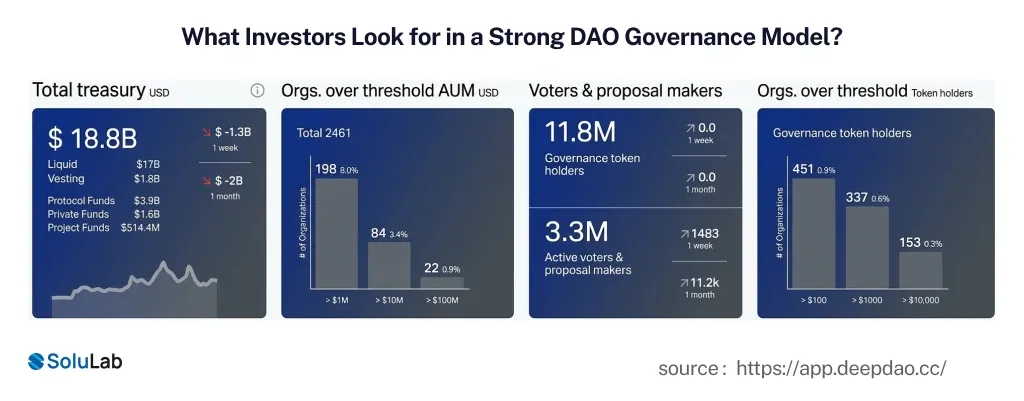
Most investors don’t wake up wanting a DAO. They want exposure to a thesis (AI, real‑world assets, early‑stage Web3, etc.) with a clear sense of risk, upside, and control.
The DAO is just one way to get there. Here’s what they quietly evaluate when they look at Investment Decentralized Autonomous Organizations (DAOs):
1. Clarity of purpose
- Is the investment scope clear (for example: early‑stage DeFi, gaming, RWA)?
- Does the DAO governance model make it obvious how proposals are made, evaluated, and executed?
2. Rights and protections
- Are there clear rules on who can vote, how conflicts are handled, and what happens in edge cases?
- Has someone thought through the Risks and benefits of DAO investment beyond number go up?
3. Execution capability
- Is this just a loose collective, or is there a real DAO development company or core team behind it?
- Do they see a working DAO governance platform development effort, with audits, documentation, and a roadmap they can actually read?
This is where professional blockchain consulting services become critical. You’re not selling a token; you’re selling a structure that can handle real capital and real disagreements without blowing up.
Why the DAO Governance Model Determines the Success of Investment DAOs?
Governance is not the boring part of a DAO; it is the product for investors. A slick front‑end and narrative can maybe attract early noise, but without the right Role of Governance in Investment DAOs, serious capital won’t stay.
You can think of governance in Investment Decentralized Autonomous Organizations (DAOs) like the partnership agreement and investment committee rolled into one. It controls:
- How capital is committed and deployed.
- Who screens deals and who votes.
- How contributors and lead deal‑scouts are rewarded.
- What happens when things go wrong.
Good governance doesn’t mean everything is on‑chain or public; it means the combination of on‑chain rules, off‑chain processes, and legal structuring fits your investor profile.
This is where Strategic planning for DAO launch matters – deciding which decisions should be fully decentralized, which need expert committees, and which require legal sign‑off.
Strategic DAO Development: Building an Investor-Ready DAO Governance Model from Day One
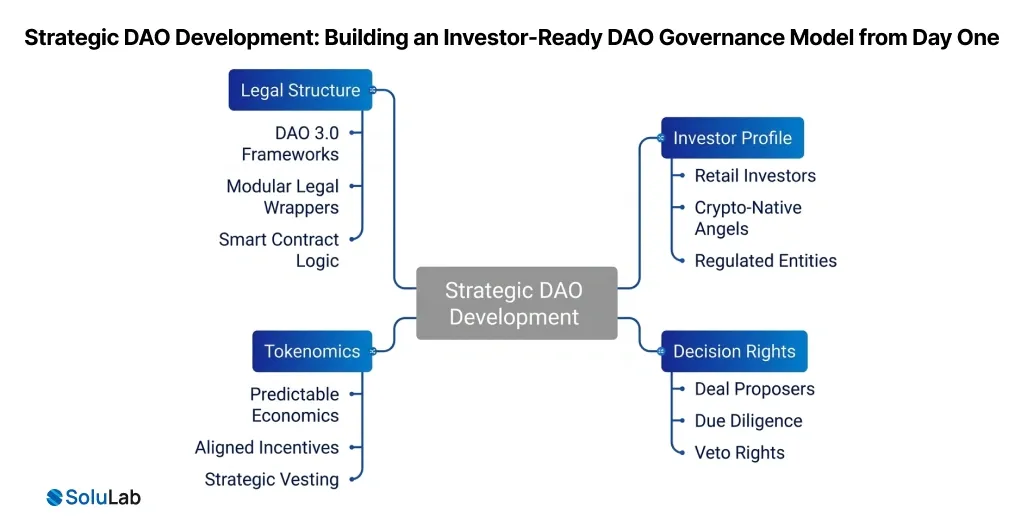
A lot of DAOs treat governance as we’ll sort it out after launch. That’s exactly how you scare away institutional or semi‑institutional investors. Strategic DAO development flips this: you start with governance and work backwards to tech.
What that looks like in practice:
1. Define the investor profile and risk appetite
- Are you targeting retail, crypto‑native angels, or regulated entities?
- The How to structure a DAO for investors question looks very different if you plan to onboard a US‑based fund versus anon retail.
2. Map decision rights and roles
- Who proposes deals?
- Who does due diligence?
- Who has veto rights?
- This is where a tailored DAO governance model and DAO governance platform development come in, so you don’t rely on 1 token is1 vote for everything.
3. Design tokenomics with investors in mind
- How DAO tokenomics attract investors is more about predictable economics and aligned incentives than clever mechanisms.
- Strategic vesting, lockups, performance‑based rewards, and fair distribution matter far more than high APY.
4. Align legal structure and on‑chain logic
- Work off frameworks like DAO 3.0 and modular legal wrappers, so your Risks and Challenges of Investment DAOs are reduced on the liability and tax side.
- Smart contracts should reflect core legal principles: who owns what, who is liable, and how treasury decisions are enforced.
A good DeFi development company will push you to do this hard thinking early, instead of just shipping a basic multisig and governance token and calling it a day.
Strategic DAO Governance Architecture for Investor-Ready DAO Development
When investors ask about governance architecture, they’re really asking: If I put money in here, how is it protected, and who is really in control?
A typical investment DAO governance architecture, designed with DAO platform development and investor safety in mind, has a few clear layers:
1. Token and membership layer
- Defines who is in the DAO, how they join, and what rights come with which tokens.
- This is where How to structure a DAO for investors becomes very concrete; some DAOs separate governance tokens from economic tokens to keep voting power aligned with responsibility.
2. Proposal and voting layer
- Handles how proposals are created, discussed, and voted on.
- A mature DAO governance platform development will support different voting methods (quorum, conviction, delegated, committees) instead of just raw token voting.
3. Execution and treasury layer
- Smart contracts that actually move funds, sign deals, or trigger payouts once governance decisions pass.
- Here, DAO development services need to integrate multi‑sig, time‑locks, and fail‑safes, so treasury actions are predictable and auditable.
4. Legal and off‑chain enforcement layer
- Legal wrappers and agreements that map on‑chain decisions to off‑chain obligations (for example, SPVs, foundations, or LLCs).
- This layer is crucial for reducing Risks and benefits of DAO investment into something traditional investors can understand and underwrite.
When these layers are coherent, the benefits of DAO development for startups and funds become obvious: lower coordination cost, faster collective decisions, and a structure that feels more transparent than a black‑box GP/LP setup.
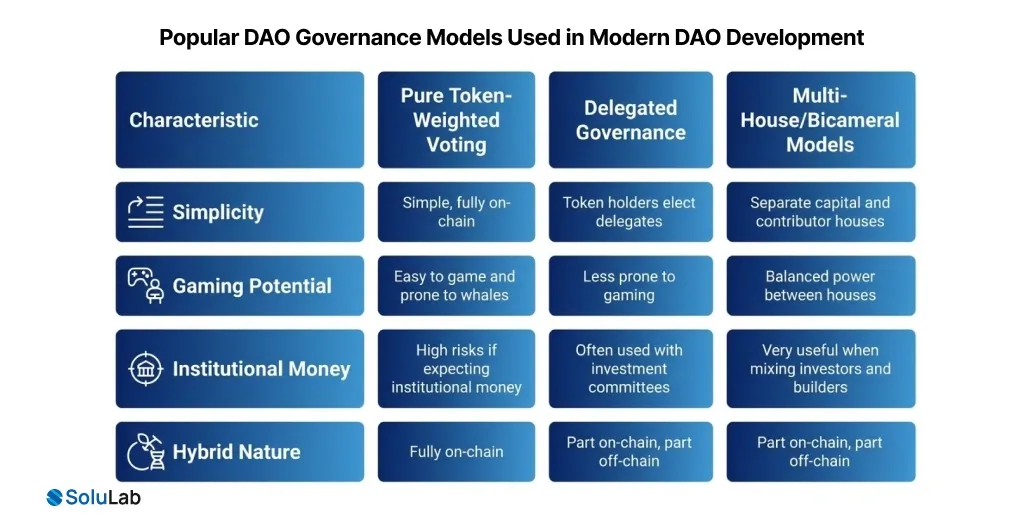
Popular DAO Governance Models Used in Modern DAO Development
Founders often ask us, What’s the right governance model?
The honest answer: it depends on who your investors are and how much decentralization they really want versus what they say they want. But there are some patterns.
A few of the most common DAO governance model types we see in Investment Decentralized Autonomous Organizations (DAOs):
1. Pure token‑weighted voting
- Simple, fully on‑chain, but easy to game and prone to whales.
- High Risks and Challenges of Investment DAOs if you expect institutional money.
2. Delegated governance
- Token holders elect delegates or councils who do most of the heavy lifting.
- Often used with investment committees, where domain experts review deals and the wider DAO ratifies major moves.
3. Multi‑house or bicameral models
- Separate capital house and contributor house, each with different powers.
- Very useful when you mix investors and builders and want to balance both.
A good DAO solution provider will help you pick and adapt a model instead of forcing one template.
The Future of DAO in venture capital is almost certainly hybrid: part on‑chain, part off‑chain, with structure evolving as the community and capital base grow.
Why Poor DAO Governance Models Create Major Risks for Investment DAOs
If you want an investor to walk away, show them a DAO that looks exciting but has no answers to basic risk questions. Poorly designed governance can make DAO fundraising strategies dead on arrival.
Key risk buckets we always highlight:
1. Legal and liability risk
- Without proper structures, DAOs can be treated as unincorporated partnerships, exposing members and even passive token holders to personal liability.
- This is one of the biggest Risks and Challenges of Investment DAOs, and why legal alignment must sit next to DAO governance platform development, not behind it.
2. Governance capture and low participation
- Whales, bots, or a small clique can effectively control decisions.
- Low voter turnout can make the DAO look decentralized on paper but centralized in practice.
3. Operational chaos
- No clear process for disputes, emergencies, or bad actors.
- Deals are stuck in limbo because governance is too slow or unclear.
Smart investors evaluate risks and benefits of DAO investment in exactly these terms. Strategic governance and professional blockchain solution development is your best option to move risk from unknown to known and priced.
The Future of DAO Governance in Investment DAOs and Web3 Venture Capital
Looking ahead, governance is where DAOs will either mature into serious infrastructure or fade into another crypto story.
The rise of investment DAOs over the last few years is already reshaping how people think about funds, syndicates, and even corporate governance.
Trends we’re watching as we advise clients:
- AI‑assisted governance and analytics, helping filter proposals and surface risk signals before votes.
- Stronger legal wrappers and DAO 3.0 structures that reduce liability and tax uncertainty.
- More enterprise‑grade DAO governance platform development to support larger tickets and regulated players.
For serious founders, the big opportunity is to be early in this next wave: design your governance so it’s ready for institutions, not just early crypto‑native backers.
That’s where professional DAO development company support becomes a strategic asset, not a cost line.
How Our DAO Consulting Services Design and Implement Investor-Ready DAO Governance?
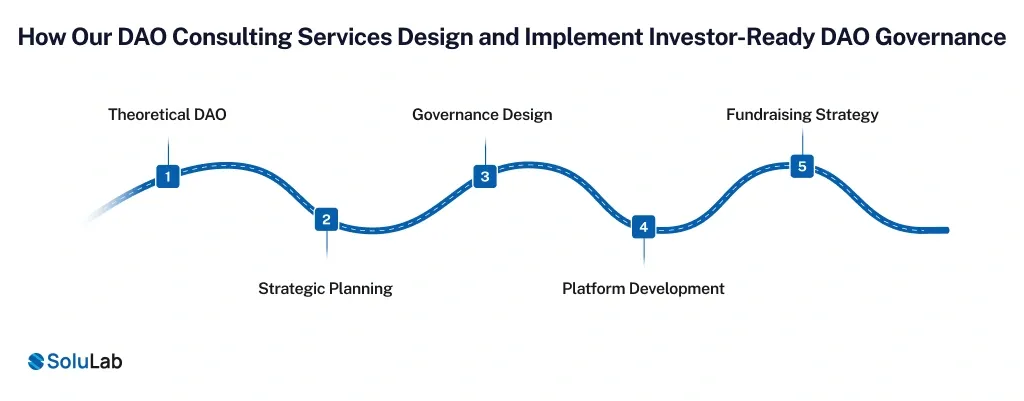
From our side, as an enterprise DAO development company, we see our job as making your DAO investable, not just technically live.
That means combining DAO consulting services, product thinking, and engineering. In a typical engagement:
- We start with strategic planning for the DAO launch – vision, investor profile, legal constraints, and governance objectives.
- We design the DAO governance model and DAO tokenomics so incentives, rights, and roles line up with the investors you want to attract.
- We handle DAO platform development: smart contracts, voting systems, dashboards, integrations, and security reviews.
- We help you refine DAO fundraising strategies so your narrative, structure, and governance all support the same story.
That’s how strategic DAO development attracts investors. So, stops being a theoretical question and becomes something you can show in a deck, a whitepaper, and a live governance dashboard.

Conclusion
Investors are fed up with another whitepaper; they need structures they can understand and trust. Strategic, governance‑first DAO development services from SoluLab can turn your idea into an investment vehicle where risk, rights, and upside are clear for more traditional capital, too.
Whether you’re building a new Investment Decentralized Autonomous Organization (DAO), experimenting with a hybrid VC/DAO structure, or exploring the Future of DAO in venture capital, the path to serious capital runs straight through governance. That’s where working with a focused DAO solution provider company gives you a real edge, and you should take a bet in 2026.
FAQs
With over 3 years of experience, I specialize in breaking down complex Web3 and crypto concepts into clear, actionable content. From deep-dive technical explainers to project documentation, I help brands educate and engage their audience through well-researched, developer-friendly writing.