
Key Takeaways
- The Problem: Startups and emerging blockchain projects struggle to access capital through traditional funding channels where conventional methods are slow, geographically restricted, and dominated by institutional gatekeepers that shut out most early-stage innovators.
- The Solution: Initial Coin Offerings (ICOs) democratize fundraising by allowing projects to raise capital globally through token sales by eliminating middlemen, reducing costs, and enabling real-time, borderless investment participation on a decentralized blockchain infrastructure.
- How SoluLab Can Help: SoluLab is a trusted ICO development company that offers end-to-end ICO development services, from smart contract creation and token development to whitepaper drafting and ICO platform development, helping you launch an Initial Coin Offering (ICO) that is secure, compliant, and built to attract investors.
Initial Coin Offerings (ICOs) have transformed how blockchain startups raise capital by enabling businesses to secure funding through digital token sales. Since the launch of the first ICO, MasterCoin, by J.R. Willet in 2013, the ICO market has evolved into a major fundraising model within the crypto economy.
In 2023, DeFi-focused projects accounted for nearly 36% of all ICO launches, while the global ICO market surpassed $3.2 billion by 2025, fueled by AI-powered blockchain platforms and tokenized real-world assets. As regulatory clarity improves in 2026, businesses are increasingly adopting ICO development solutions to accelerate fundraising, expand global investor participation, and build scalable Web3 ecosystems.
This article explores the key benefits of ICO development for modern crypto businesses.
What is an Initial Coin Offering?
An Initial Coin Offering (ICO) is a blockchain-based fundraising method that allows startups and businesses to raise capital by issuing digital tokens to investors. Often compared as ICO vs IPO, an ICO enables crypto projects to secure funding for blockchain platforms, decentralized applications, and Web3 ecosystems without relying on conventional financial institutions.
During an ICO, investors purchase newly launched crypto tokens using cryptocurrencies such as Bitcoin or Ethereum. These tokens may provide platform utility, governance rights, ecosystem access, or investment opportunities tied to the project’s growth. ICO development has become a popular approach for launching DeFi platforms, gaming ecosystems, tokenized assets, and AI-powered blockchain solutions.
As the crypto industry matures, regulatory compliance has become a major focus for ICO projects. Many token offerings now follow frameworks such as Regulation D exemptions and KYC/AML standards to improve investor trust and legal transparency. While ICOs have helped numerous blockchain startups raise significant capital, investors increasingly prioritize projects with strong utility, transparent tokenomics, and long-term business viability.
What is the Purpose of an ICO?
Many newcomers ask: What is the purpose of an ICO beyond just raising money?
The answer is multi-layered.
At its core, the purpose of an ICO is to fund the development of a new blockchain-based product or service by selling tokens to early supporters before the product launches. But the purpose extends further:
- Community Building: ICOs create a community of token holders who are incentivized to promote and use the product, forming the early user base.
- Decentralized Ownership: Unlike traditional equity, tokens can represent utility, governance rights, or access by giving holders a real stake in the ecosystem.
- Market Validation: A successful ICO signals strong market interest and can attract further venture investment or partnerships.
- Liquidity for Early Backers: Tokens can be traded on exchanges post-launch, offering liquidity that traditional early-stage equity cannot.
In 2026, the purpose of ICO fundraising has evolved to also include cross-chain interoperability funding, DAO treasury building, and protocol-level upgrades. Projects operating in the Decentralized Web3 Ecosystem increasingly use ICOs as their primary bootstrapping mechanism.
How ICO Funding Works for ICO Projects and Token Launches?
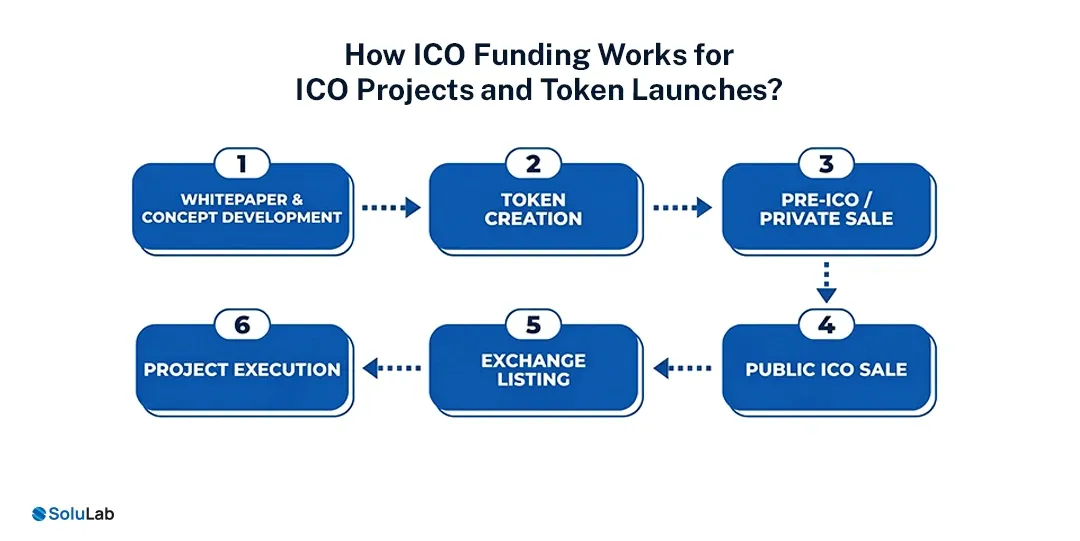
Understanding how ICO funding works is essential before you invest or launch. The process typically follows these stages:
1. Whitepaper & Concept Development:
The team prepares a detailed whitepaper outlining the project’s goals, token economics (tokenomics), roadmap, and use of funds. This is the investor’s primary due-diligence document.
2. Token Creation:
The project deploys a smart contract, which is usually on Ethereum, BNB Chain, or Solana, that defines the token’s total supply, distribution model, and vesting schedules. This falls under ICO token development services.
3. Pre-ICO / Private Sale:
Before the public launch, tokens are offered to strategic investors and partners at a discount. This phase helps validate interest and raise early capital.
4. Public ICO Sale:
The ICO goes live on an ICO crowdfunding platform, where retail and institutional investors can purchase tokens using crypto or fiat. Smart contracts automate token distribution.
5. Exchange Listing:
Post-ICO, tokens are listed on centralized or decentralized exchanges, providing liquidity and enabling price discovery.
6. Project Execution:
Funds raised are used to build and launch the product as described in the whitepaper.
Partnering with experienced ICO Consultants at each stage significantly improves the chance of a successful launch. Blockchain development services play a key role in ensuring the underlying infrastructure is secure and scalable.
If you want to understand a bit more about ICO and STO, please read this ICO vs. STO comparison.

Five Successful ICO Projects Highlighting the Advantages of ICO Development
The biggest initial coin offerings have helped millions of people and organizations to raise billions of dollars. Although the IT industry has witnessed many successful ICOs, it still provides many business opportunities. Here is the list of the top five token releases to date:
Ethereum: Known to be one of the first initial coin offerings, Ethereum has made more than digital money compared to its predecessor, Bitcoin. Using smart contracts, decentralized apps can be created using Ethereum, a blockchain technology.
IOTA: IOTA’s initial coin offering (ICO) is based on blockchain technology with the Internet of Things. Also, a cost-free, scalable environment was given via their decentralized transaction ledger.
Stratis: A software platform that supports many programming languages and enables companies to develop, test, and deploy programs. Furthermore, none of this requires the setup or administration of a development environment. Nearly 1,000 BTC were raised during their ICO, valued at $675,000 and now over $8 million.
EOS: This popular cryptocurrency raised more than $185 million in the first five days of its initial coin offering (ICO). Now, it is renowned for being the biggest ICO. EOS asserts in its white paper that its network is competitive (Alternative to Ethereum). They provide a wide range of blockchain-compatible business solutions.
NEO (formerly Antshares/NXT): Underwent two rounds of token sales. This ICO tied up with Microsoft and the Chinese government to launch at 3 cents in its initial coin offering (ICO). From October 2015 to January 2018, the cost of their coins soared to $180M. NEO is known to be one of the largest ROI coin offerings, as mentioned in its white paper.
Why the 2026 ICO Launch Process Favors Early Backers?
While the benefits of investing in ICOs have always included early access and high ROI potential, the landscape in 2026 offers a more mature set of advantages:
1. Regulated Entry Points:
With clearer regulatory frameworks now in place across the EU (MiCA), UAE, and parts of Asia, investors can participate in ICOs with greater legal clarity than in previous years.
2. Tokenized Real-World Assets:
In 2026, ICOs are increasingly integrating tokenization development solutions to launch tokens backed by real-world assets such as real estate, commodities, and revenue-sharing models, making digital investments more secure, transparent, and utility-driven.
3. DAO Governance Rights:
Many ICO tokens now come with governance voting rights within decentralized autonomous organizations DAOs, giving investors direct input on project direction.
4. Cross-Chain Liquidity:
With multi-chain ecosystems maturing, ICO tokens can be traded across multiple blockchain networks, dramatically improving liquidity for token holders.
5. Transparent On-Chain Audits:
Smart contract audits and on-chain treasury tracking are now standard practice, offering investors unprecedented transparency.
For investors exploring Top Web3 Platforms, ICOs remain one of the highest-upside entry points when proper due diligence is applied.
Advantages of ICO Development in the ICO Launch and Funding Process
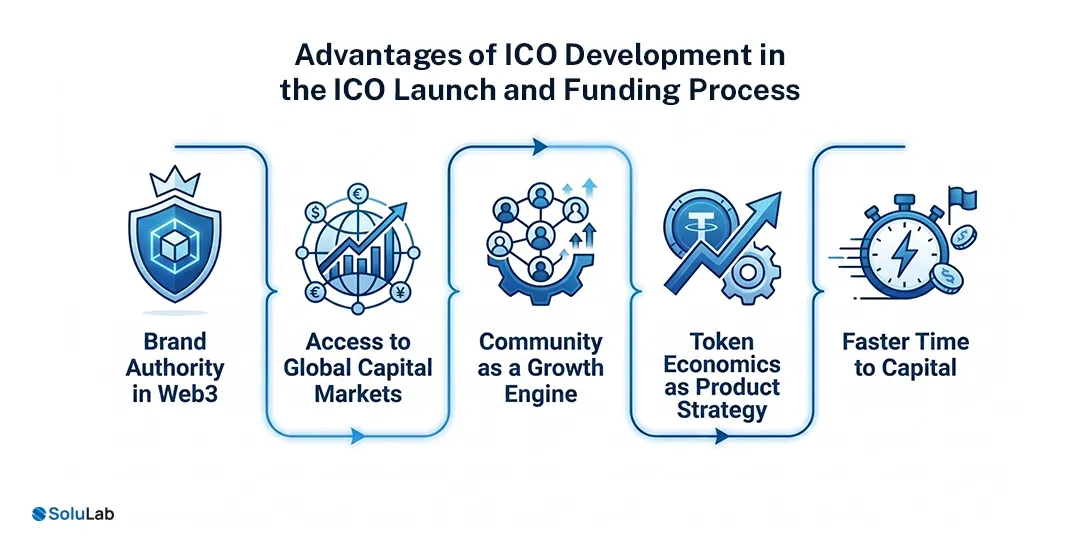
The advantages of ICO development go beyond fundraising alone. When businesses choose to launch an Initial Coin Offering (ICO), they unlock a broader set of strategic benefits:
Brand Authority in Web3:
Launching a well-structured ICO positions your brand as a credible player in the blockchain space. It signals technical depth, a clear product vision, and a commitment to the community, attributes that attract both investors and talent.
Access to Global Capital Markets:
Traditional venture capital is concentrated in a handful of cities. ICO launch services allow your project to raise capital from investors across 100+ countries simultaneously, a reach no conventional fundraise can match.
Community as a Growth Engine:
Token holders become evangelists. When people have a financial stake in your success, they promote, refer, and advocate for your project organically by reducing your customer acquisition cost significantly.
Token Economics as Product Strategy:
Well-designed tokenomics can drive product usage. Staking rewards, governance participation, and utility discounts create behavioral incentives that keep your community engaged long after the ICO closes.
Faster Time to Capital:
Compared to traditional Series A rounds that can take 6–18 months, an ICO development solution can go from concept to capital in 8–16 weeks with the right team. Web3 development company in USA partners like SoluLab specialize in exactly this kind of accelerated delivery.
Cost to Develop an ICO Platform in 2026 Across the ICO Launch Process
One of the most frequently searched questions by founders is: What is the cost to develop an ICO platform? The answer depends on the scope of your project, but here is a realistic breakdown for 2026:
| Component | Estimated Cost Range (USD) |
|---|---|
| Smart Contract Development | $5,000 – $20,000 |
| ICO Platform Frontend & Dashboard | $8,000 – $25,000 |
| KYC/AML Integration | $3,000 – $10,000 |
| Token Creation & Security Audit | $5,000 – $15,000 |
| Whitepaper & Legal Documentation | $3,000 – $12,000 |
| Marketing & Community Setup | $5,000 – $30,000 |
| Total Estimated Cost Range | $29,000 – $112,000+ |
The wide range reflects whether you are building a basic ICO crowdfunding platform or a full-featured multi-chain ICO platform development solution with staking, vesting dashboards, and DAO governance.
Choosing a white-label ICO platform (like the one offered by SoluLab) can reduce time-to-market by 40–60% while keeping costs toward the lower end of the range.
Step-by-Step Guide for ICO Platform Development Launch
Understanding the launch of the ICO process helps founders plan realistically. Here is a proven step-by-step ICO launch process used by leading ICO development solutions in 2026:
Step 1: Concept Validation & Market Research
Define your project’s core value proposition. Identify the target investor demographic, competitive landscape, and token utility model before writing a single line of code.
Step 2: Legal & Regulatory Assessment
Work with blockchain consultants to determine whether your token is a utility token or a security token, and which jurisdictions you will target. This shapes your KYC/AML strategy and whitepaper structure.
Step 3: Whitepaper Development
Write a comprehensive whitepaper covering the problem, solution, technology stack, tokenomics, team, roadmap, and fund allocation. This is your most critical investor-facing document.
Step 4: Token & Smart Contract Development
Engage ICO token development services to code, test, and audit your token smart contract. Security audits are non-negotiable because one exploit can destroy investor confidence overnight.
Step 5: ICO Platform Development
Build or deploy your crypto launchpad solution, including the investor dashboard, wallet integration, token purchase flow, and real-time progress tracking.
Step 6: Pre-ICO Marketing & Community Building
Launch your Telegram, Discord, and social channels. Publish thought leadership content. Run a private sale or whitelist to build early momentum.
Step 7: Public ICO Launch
Open your ICO to the public. Monitor smart contract activity, respond to investor queries, and track milestones in real time.
Step 8: Exchange Listing & Post-ICO Roadmap Execution
List your token on top decentralized exchanges. Begin executing your product roadmap to maintain community trust.
Specific Considerations for ICO Projects and Investors
In 2025–2026, regulatory clarity has improved significantly. The EU’s Markets in Crypto-Assets (MiCA) regulation, fully in effect since early 2025, has established a clear compliance framework for ICO projects across member states.
In the United States, ongoing SEC and CFTC guidance continues to evolve, making it more important than ever to work with qualified ICO Consultants before launch. Projects working with top ICO development companies are better equipped to navigate this landscape without legal exposure.
When considering investing in an ICO, there is no assurance that the investor won’t become the victim of fraud or a scam. However, you can follow these precautions against ICO scams:
- Make sure the project developers can articulate their objectives properly. White papers for successful ICOs often have simple and clear goals.
- Always seek transparency. Investors have to demand complete transparency from every company that runs an ICO.
- Evaluate each legal term and condition of the ICO. Since there is a lack of traditional regulators, it is the investors’ responsibility to confirm the legitimacy of an ICO.
- It is advised to keep ICO funds in an Escrow wallet. An escrow wallet protects against scams, as multiple access keys are mandatory to form and open this wallet.
- This type of wallet effectively prevents fraud and requires several access keys.
- You may have to buy more coins to invest in the project since certain ICOs use other cryptocurrencies.
Choosing the Right ICO Development Company to Launch a Successful ICO
With hundreds of firms now claiming to offer ICO development services, choosing the right ICO Service Provider is one of the most critical decisions a founder makes.
Here is what to evaluate:
Technical Depth
Your ICO development company should have a proven portfolio of smart contract deployments, security audits, and multi-blockchain ICO platform development. Ask for past case studies and audit reports.
End-to-End Capabilities
The best ICO development solutions cover the full spectrum of token creation, platform development, legal guidance, marketing, and exchange listing support. Fragmented vendors create coordination risk.
Regulatory Experience
ICO Consultants within the firm should be familiar with the SEC, MiCA, DFSA, and VARA frameworks. A technically flawless ICO that violates securities law is still a failure.
Post-ICO Support
The relationship should not end at token delivery. Your ICO development company should provide ongoing smart contract maintenance, community management tools, and roadmap execution support.
Transparent Pricing
Reputable providers publish clear scope-based pricing for their ICO launch services. Be wary of firms that quote vague “starting from” figures without itemizing deliverables.
For teams exploring cryptocurrency development services as part of a broader Web3 strategy, a provider that offers both ICO and DApp development under one roof creates the most cohesive outcome.
How Can an ICO Development Company Like SoluLab Support Your ICO Launch?
ICOs remain a proven fundraising mechanism, but growing regulatory scrutiny and investor caution demand stronger due diligence, secure token design, and compliant execution. Token buyers today expect transparency, audited smart contracts, and clear utility—not speculation.
SoluLab is a leading ICO development company helping startups and enterprises launch secure, compliant, and scalable ICOs. From ICO token development and smart contract engineering to fully customized white-label ICO platforms with multi-blockchain support, SoluLab maximizes fundraising potential while minimizing technical and regulatory risk.
Whether you are launching your first ICO or upgrading an existing platform, SoluLab’s blockchain engineers deliver end-to-end ICO development solutions built for long-term success.
Conclusion
An Initial Coin Offering (ICO) offers startups and blockchain projects a powerful way to raise capital without traditional intermediaries, while simultaneously building a global user base from day one. Beyond fundraising, ICOs enable faster market entry, community-driven growth, and early validation of a project’s utility within the broader crypto ecosystem.
When executed with strong tokenomics, security best practices, and regulatory awareness, ICOs can align incentives between builders and users, creating long-term value rather than short-term speculation. For teams willing to prioritize transparency, compliance, and technical rigor, ICOs remain a flexible and effective model for launching and scaling innovative blockchain ventures.
Got something on your mind? We are here to help!
FAQs
Shipra Garg is a tech-focused content strategist and copywriter specializing in Web3, blockchain, and artificial intelligence. She has worked with startups and enterprise teams to craft high-conversion content that bridges deep tech with business impact. Her work translates complex innovations into clear, credible, and engaging narratives that drive growth and build trust in emerging tech markets.