Lend, borrow, swap, earn. No bank in the middle, no account manager, no branch hours. That is the pitch decentralized finance (DeFi) made, and a lot of it came true. But the same openness that lets anyone join also means there is nobody to call when your funds leave your wallet at 3am. Security of DeFi assets is still the sore spot, and as more people move real money into DeFi protocols, the cost of getting it wrong keeps climbing. This guide walks through DeFi security the way a team actually has to think about it: the practices that hold up, the measures worth building, the compliance work nobody enjoys but everybody needs, and how all of that protects DeFi assets in the long run. We start with why DeFi security matters at all, and finish with where it is heading. If you build in decentralized finance, or you simply hold positions in it, the strategies below are the ones that decide whether your assets survive a bad week.
What is DeFi Security?
Strip it back and DeFi security is one question: who can move your money, and under what conditions? This section lays out the building blocks of securing assets in the decentralized finance (DeFi) space, and why those blocks matter more every year as the financial system keeps shifting on-chain.
Understanding the Importance of DeFi Security
Decentralized finance (DeFi) has pulled serious attention over the past few years, giving people decentralized alternatives to the banking and investment services they grew up with. As more users pile into DeFi platforms and protocols, strong security stops being a nice-to-have. Trust is the whole product here. DeFi security is what makes users, investors, and everyone else in the market willing to sign a transaction at all. Put it first and you protect user assets, cut down on exploitable weak points, and give decentralized financial transactions somewhere reliable to happen. Treat it as an afterthought and no amount of yield keeps people around.
Overview of Decentralized Finance (DeFi)
Decentralized finance (DeFi) describes the push to build an open, permissionless financial system on blockchain rails. DeFi platforms handle lending, borrowing, trading, and asset management with no intermediary sitting in the middle taking a cut and holding the keys. Smart contracts and decentralized applications (DApps) do that work instead, which means users transact directly rather than waiting on a traditional financial institution. The result is a system that is more open, more transparent, and easier to reach, where you hold your own assets outright. That last part is the good news and the risk, both at once.
The Need for Robust Security Measures in DeFi
DeFi keeps growing, and so does the attack surface. Because DeFi platforms are decentralized by design, they inherit a set of security problems that off-the-shelf answers do not cover, and user funds, data, and privacy all sit in the blast radius. New DeFi protocols, apps, and platforms ship constantly. Keeping user assets safe has to lead that process, not trail it. Strong measures, meaning encryption, multi-factor authentication, and password protection, are what reduce exposure to vulnerabilities, hacks, and data breaches, and what keep DeFi as a whole stable for everyone in it.
DeFi Security Measures: Best Practices and Protocols
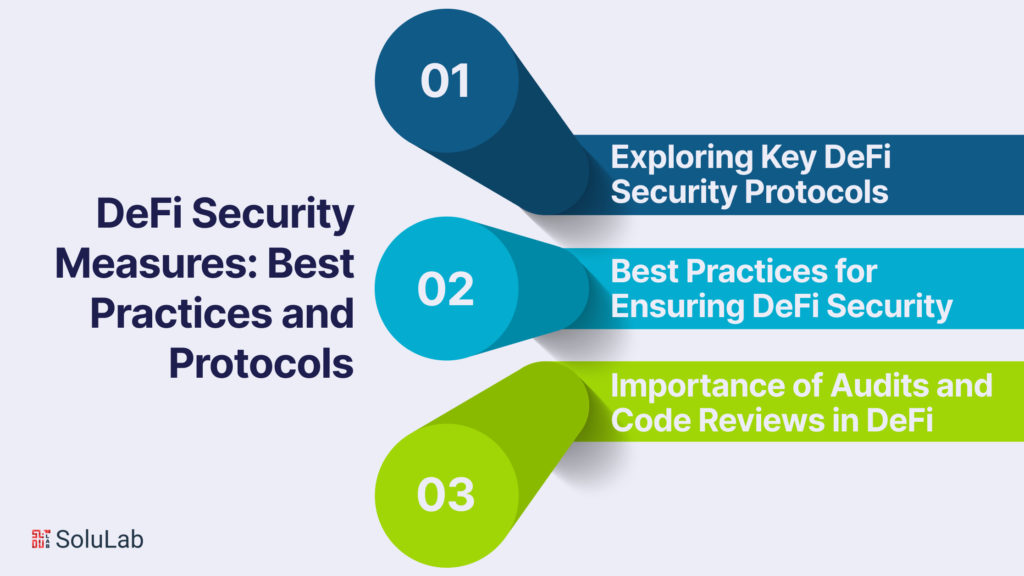
So what does good actually look like on DeFi platforms? Below are the protocols and practices the industry has settled on, and the reasoning behind each one.
Exploring Key DeFi Security Protocols
DeFi moves quickly, and security protocols are what keep user assets intact while it does. Different DeFi security protocols target different failure points, which is the whole idea: you stack them so no single miss becomes a total loss for DeFi platforms. In practice that stack usually includes multi-layer authentication, encryption, and decentralized identity management, each one making user transactions and user data harder to touch.
Best Practices for Ensuring DeFi Security
Good DeFi security is mostly discipline, repeated. A handful of habits carry most of the weight for DeFi platforms and protocols. Start with authentication: multi-factor authentication (MFA) and biometric checks make account takeover a much harder job than a stolen password allows. Then there is the code itself. Regular security audits, code reviews, and penetration testing are how weak points get found inside DeFi protocols and smart contracts before someone else finds them. None of this is exotic. It is just work that has to keep happening, and DeFi platforms that do it give users a place they can transact without holding their breath.

Importance of Audits and Code Reviews in DeFi
Audits and code reviews are where vulnerabilities inside DeFi platforms and protocols surface. An audit gives you a read on where DeFi platforms actually stand, points at the loopholes, and says what to fix. A code review is narrower and more surgical: developers and security specialists go line by line looking for the coding error, the bug, or the vulnerability that would break a smart contract or the application sitting on top of it. Do both, on a schedule. That is what keeps a platform defensible and keeps users and investors willing to leave capital in it.
Risks and Vulnerabilities in DeFi
Now the uncomfortable part. decentralized finance (DeFi) carries risks baked into how it works, and this section names the threats users and platforms run into, plus the places where breaches tend to start.
Identifying Common Risks and Vulnerabilities in DeFi
For everything DeFi opens up, it stays exposed to problems that can drain user funds and leak user data. You cannot mitigate what you have not named, so listing the risks comes first when strengthening DeFi Derivatives. The usual suspects: smart contract vulnerabilities, flash loan attacks, price oracle manipulation, and weaknesses in decentralized exchanges (DEX). Know the list, and DeFi platforms can get ahead of the attack instead of writing the post-mortem afterward.
Analyzing the Impact of Security Breaches in DeFi
A breach in DeFi rarely stays contained. User trust takes the hit, platform credibility takes the hit, and broader market stability can wobble with it. The direct damage is bad enough: funds gone, sensitive data exposed, transactional integrity in question, real money lost and a reputation that takes years to rebuild. The indirect damage lasts longer. Confidence drains away, and people who were about to try DeFi quietly decide not to, which slows the whole sector down. Working through what a breach would actually cost is what pushes DeFi platforms to fund real security measures and risk mitigation before the incident, not after.
Understanding Smart Contract Risks in DeFi Platforms
Smart contracts hold up DeFi platforms. They automate the transactions and the operations, and they run exactly as written, including the parts written wrong. That is the catch. Understanding smart contract risk on DeFi platforms means accepting that a coding error, a bug, or an overlooked edge case can break both function and safety at once. Reentrancy attacks, integer overflow, unauthorized access: each of these has cost DeFi platforms money and uptime. Which is why contract security and honest code review come before launch, not after the first exploit, and why DeFi platforms that take it seriously end up with something users can actually rely on.
Safeguarding DeFi Assets: Wallet and Asset Protection
This section gets practical about protecting DeFi assets at the wallet level: picking the right one, managing it properly, and layering on the extra measures that matter. Private keys and multi-signature wallets get most of the attention here, because they deserve it.
Securing DeFi Assets: Wallet Selection and Safety Measures
Protecting DeFi assets holds the DeFi ecosystem together. Start with the wallet. Pick one with a track record, real encryption, and security features you can name, not just an interface you like. Hardware wallets, cold storage, and well-built mobile wallets all give DeFi assets meaningfully better protection than the convenient option you clicked through in thirty seconds. Choose carefully, stay strict about the basics, and the odds of unauthorized access, theft, or a compromised position drop sharply. That is the whole game with storing and managing DeFi assets.
Importance of Private Key Management in DeFi
Your private key is your assets. Not a password to them, not a login for them. It is them, and everything about DeFi security eventually comes back to how you handle it. Lose control of a key and the funds are gone with no recovery path, which is why key management deserves more care than most users give it: secure storage, encryption, multi-signature authentication where it fits. Get that right and you keep genuine control of your DeFi assets instead of hoping nobody ever sees the phrase you screenshotted.
Read Also: 9 Best Defi Staking Platforms in 2024
Exploring Multi-Signature Wallets for DeFi Security
Multi-signature wallets add a layer that single-key setups simply cannot offer for DeFi assets, because approval becomes a group decision rather than one person’s mistake. Several private keys have to sign before a transaction goes through. That kills the single point of failure, makes an unauthorized transfer far harder to push through, and buys time when something looks wrong. Setting up multi-signature wallets is one of the few security moves that costs little and closes a lot, and it is a good default for anyone managing DeFi assets they cannot afford to lose.
DeFi Platform Security: Protecting User Funds and Information
Now shift from the user side to the platform side. Funds and information both sit with DeFi platforms, so this section covers data privacy, the security features that back it up, and what it takes to keep hacks and breaches off DeFi platforms.
Ensuring User Fund Security on DeFi Platforms
DeFi platforms earn trust from users and investors one way: by not losing their money. Secure authentication protocols, data encryption, and transaction monitoring are the practical pieces that keep funds out of reach of a breach or an unauthorized login. DeFi platforms also need infrastructure that holds under load, security protocols documented well enough that a new engineer can follow them, and encryption that is current rather than whatever shipped two years ago. Get that combination right and financial transactions stay intact. Then DeFi platforms become somewhere people transact without reading the news first.
Data Privacy Measures for DeFi Platform Users
Funds get the headlines. Data gets ignored until it leaks. DeFi platforms need real privacy controls, meaning encrypted data, access controls that are actually enforced, and privacy policies that describe what the system does rather than what a lawyer hoped it did. Put privacy first and DeFi platforms gain on three fronts at once: users trust them more, regulators have less to object to, and decentralized financial activity happens somewhere both transparent and safe. Confidentiality is not a bonus feature in DeFi. It is part of the product.
Read Blog Post: The Role of Decentralized Exchanges (DEXs) in DeFi
Mitigating Risks of Hacks and Data Breaches in DeFi Platforms
Every serious team running DeFi platforms works on the assumption that someone will try. DeFi platforms therefore need three things in place, not one: strong preventive security, threat detection that catches the odd pattern early, and an incident response plan that has been rehearsed rather than written and filed. That last one is where teams get caught out, because detecting a breach at 2am is only useful if somebody knows exactly what to do next. Cover all three and DeFi platforms cut both the odds of a hack and the damage when one lands, which is what protects user data, user assets, and the wider DeFi ecosystem. Prevention plus preparation. Nothing less works.
DeFi Exchange Security: Trading Safely in the DeFi Space
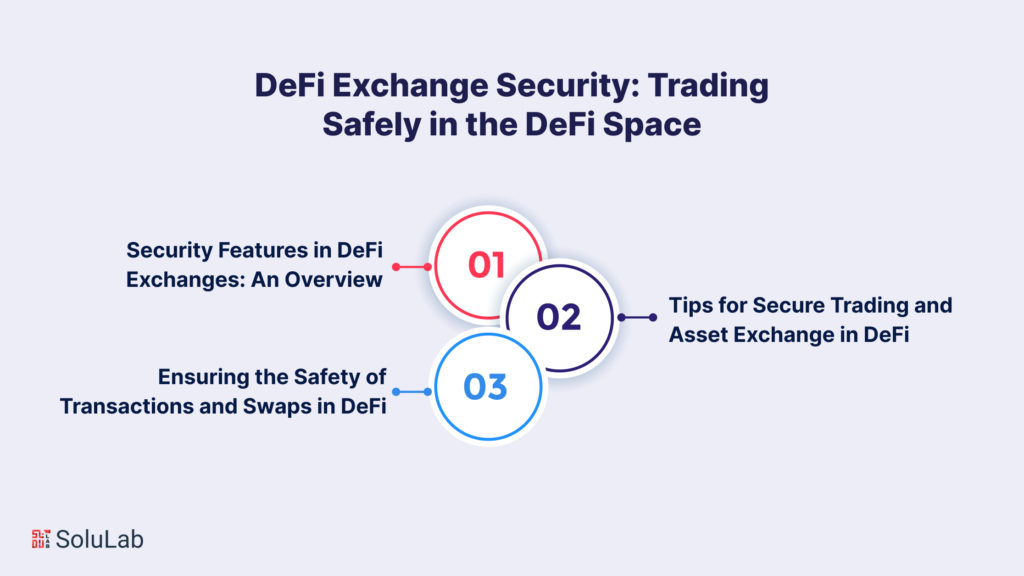
Trading is where most users meet DeFi risk face to face. Here is what DeFi exchanges put in place to keep transactions and swaps safe, and what that means for the person clicking confirm.
Security Features in DeFi Exchanges: An Overview
DeFi exchanges are where digital assets actually change hands inside DeFi, so their security is not a side concern. Solid security features keep DeFi exchanges honest, keep user funds where they belong, and keep the trading environment usable. Secure authentication, encrypted data in transit, transaction monitoring: each one closes off a common route for unauthorized access, data leaks, or outright fraud on DeFi exchanges. Build those properly and DeFi exchanges earn the trust and the credibility that make people willing to trade size rather than test amounts.
Tips for Secure Trading and Asset Exchange in DeFi
Trading safely in DeFi puts a fair amount of responsibility on you. Lock down authentication first. Then do the homework on the DeFi projects and platforms you are about to approve, because an approval is a standing permission, not a one-time click. Use a wallet you trust and an authentication method that does not depend on a single secret. Those habits are unglamorous, and they are what stops unauthorized access, a fraudulent transaction, or a compromised position from happening to you rather than to someone else. Trade carefully and DeFi stops feeling like a coin flip.
Ensuring the Safety of Transactions and Swaps in DeFi
Transactions and swaps are the moments of maximum exposure on DeFi exchanges and platforms, and nothing about them is reversible. Check before you sign. Run a real risk assessment on anything unfamiliar, and stick with DeFi platforms that have a reputation worth defending. On the technical side, encrypted data transmission, multi-factor authentication, and properly integrated wallets are what keep assets and transaction integrity out of reach of an attacker. Treat every swap as final, because it is, and DeFi becomes a place where trades settle cleanly rather than one where you learn expensive lessons.
DeFi Audits and Compliance: Ensuring Regulatory Standards
Audits and compliance are the least exciting part of DeFi and the part that decides whether a project is still operating in three years. This section covers what legal frameworks and regulatory requirements actually demand, and how they connect to the security of DeFi platforms.
Importance of Regulatory Compliance in DeFi
Compliance belongs in the security conversation, not next to it. Legal frameworks, industry standards, and regulatory guidelines are what keep DeFi operations legitimate rather than merely functional. DeFi platforms that take it seriously run an actual compliance program, audit on a schedule, and meet the standards that apply to them, which is how they avoid the legal problems and penalties that end projects outright. There is an upside beyond staying out of trouble. Compliance buys credibility with users and investors, and it makes DeFi platforms somewhere transparent enough for institutional money to consider. Meeting the standard is how a DeFi project earns a reputation instead of a reputation problem.
Read Our Blog: 7 Best Defi Trading Platforms in 2024
Role of DeFi Audits in Maintaining Security and Compliance
An audit answers a question nobody inside the team can answer objectively: is this actually safe? DeFi audits check the security, reliability, and compliance of DeFi platforms and protocols, and doing them regularly is the point. A single audit at launch tells you about code that has since changed. Recurring audits surface new vulnerabilities, test whether the platform still holds together, and confirm you are meeting regulatory standards and industry practice. DeFi platforms should pair those audits with security assessments and code reviews to reduce exposure to breaches, unauthorized access, and compliance gaps. Keep that cadence and DeFi platforms find their problems in a report instead of a headline, which strengthens both security and compliance across the DeFi sector. Audits are the routine that keeps DeFi platforms and protocols trustworthy, and users and investors notice when they happen.
Adhering to Legal Frameworks in the DeFi Landscape
Legal compliance decides whether DeFi platforms operate with integrity and credibility or spend their time managing exposure. DeFi platforms have to understand the legal requirements, regulatory guidelines, and industry standards that apply to them, and then actually follow them, which is harder than it sounds when the rules differ by jurisdiction and keep shifting. This is not a solo effort. Legal advisors, compliance specialists, and people who have done it before are what let DeFi platforms work through complicated frameworks, meet regulatory standards, and build something compliant enough to last. Respecting the legal frameworks is how the DeFi space builds a reputation worth having, one where the rules are met and participants know where they stand.
Case Studies: Successful DeFi Security Implementations
Theory only gets you so far. This section looks at how leading DeFi projects have actually implemented security, the practices and strategies that held up, and what other teams can take from them.
Analyzing Case Studies of DeFi Platforms with Robust Security
Reading how well-secured DeFi platforms got there tells you more than any checklist, because you see which practices, strategies, and technologies survived contact with real users and real money. The useful case studies are the ones covering DeFi platforms that put security, compliance, and user trust ahead of shipping speed, and they usually show the same three things: working security measures, a compliance program somebody owns, and risk mitigation planned in advance. Study them and DeFi platforms borrow hard-won answers instead of paying for the same lesson twice. That is how a stronger security posture gets built, and how DeFi as a whole gets more trustworthy. Nobody has to be original about security. Copying what worked is entirely the point.
Read Blog Post: List of Top 10 Defi Savings Accounts
Learning from Successful DeFi Security Implementations
There is a pattern to the DeFi security implementations that worked, and DeFi platforms can borrow it directly for their own security posture and compliance programs. The pattern is unremarkable: act before the incident, assess risk honestly and often, and treat regulation as part of building rather than a hurdle at the end. Follow it and DeFi platforms reduce their exposure to breaches, unauthorized access, and compliance failures, which is what makes decentralized financial activity safe to run at scale. The teams that got this right were not lucky. They just did the boring parts consistently, and DeFi platforms that copy that habit end up with user trust they did not have to advertise.
Exploring Best Practices from Leading DeFi Projects
Watch what the strongest DeFi projects do and the strategies, technologies, and priorities behind secure decentralized finance become obvious quickly. Leading DeFi projects put security, compliance, and user trust near the top of the roadmap, backed by security measures that hold, compliance programs with an owner, and risk mitigation planned before it is needed. Look closely at those DeFi projects and DeFi platforms can shortcut a lot of painful discovery: the recurring security challenges are already documented, and so are the answers. Adopting proven practice is how a platform hardens itself and how DeFi gets more dependable overall. Best practices exist because someone already paid for them, and using them is how DeFi stays a space where user safety, trust, and compliance are the default rather than the differentiator.
Future of DeFi Security: Trends and Innovations

Where does DeFi security go next? This section covers the developments and technologies taking shape now, and what they suggest about how security measures across DeFi will look in a few years.
Emerging Trends in DeFi Security Measures
The direction of travel is clear enough: security, reliability, and compliance for decentralized financial activity are all getting more sophisticated at once. The emerging trends point toward more advanced security protocols, better technology, and compliance frameworks built to reduce exposure to breaches, unauthorized access, and regulatory failure rather than to satisfy a checklist. Move with those trends and DeFi platforms stay ahead of the security challenges instead of reacting to them, which is the difference between a platform that lasts and one that makes the news once. Keeping pace here is not optional. It is what makes user safety, trust, and compliance a given in DeFi rather than a promise, and it is the foundation the next phase of decentralized finance gets built on.
Read Our Blog Post: Top 10 Decentralized Crypto Exchanges to Consider in 2024
Advancements in DeFi Security Protocols and Technologies
Protocols and technologies keep improving, and each advance moves the security measures, compliance programs, and risk mitigation strategies available to DeFi teams forward with it. The current generation draws on blockchain itself, on stronger encryption, and on authentication methods that are harder to defeat, all aimed at making decentralized financial activity more reliable. Adopt them and DeFi platforms get a better security posture, fewer openings for a breach, and a cleaner compliance story, which is what a trusted DeFi ecosystem actually rests on. Staying current with security technology is not a research project. It is basic maintenance for any platform that expects to hold user funds safely and meet the standards it is judged by.
Predictions for the Future of DeFi Security
Look at where DeFi security is heading and a few things seem likely. Advanced security technology keeps getting adopted faster. Compliance frameworks get broader and more formal. And innovative security solutions get folded into platforms as standard rather than bolted on by the teams that can afford them, which makes decentralized financial activity more reliable across the board. Teams that plan around that DeFi platforms can meet their security challenges early, pick strategies that still work in two years, and keep DeFi trustworthy while it grows. Planning for what is coming is not speculation. It is how you avoid rebuilding your security stack under pressure later, and it is what makes user safety, trust, and compliance hold as DeFi matures.

Conclusion
Everything in decentralized finance (DeFi) runs on trust, and strong security is what earns it from users and investors. Put real security protocols in place and assets and information stay out of reach of the threats and vulnerabilities that would otherwise find them. Understanding DeFi security, properly, is what makes wider adoption of DeFi applications possible at all, because the financial system around it will not accept anything less. And as DeFi keeps growing and keeps inventing, the demand for advanced security solutions and compliance measures grows right along with it.
At SoluLab, we take DeFi security seriously because the alternative is a financial system nobody can rely on. Our work in DeFi development and our full range of DeFi development services are built around the fact that every project has its own security requirements, so the solution should fit the project rather than the other way round. We build industry-leading DeFi exchange development solutions, and we stay focused on where DeFi applications are going and on keeping the global DeFi community on solid ground.
DeFi is going to keep widening, and as it does, the security features and protocols underneath DeFi platforms and exchanges are what decide which ones survive. SoluLab keeps building at that edge, with security solutions and development services meant to move decentralized finance applications forward wherever they launch. Contact SoluLab today to fortify your DeFi journey with cutting-edge solutions.
FAQs
Bhavya is driving growth through data-backed demand generation for AI and Web3 solutions. With 9+ years in digital marketing, he has spearheaded initiatives that led to a 40% increase in qualified inbound leads. Bhavya shares insights on marketing ROI and scaling a digital presence via AI workflows. He is open to connecting with startups and enterprise teams to help them overcome their challenges.