
Let me be straight with you: if you’re thinking about the future of blockchain, you can’t ignore what’s happening right now. The decentralized finance landscape is fragmenting across multiple blockchains, and according to DeFiLlama’s 2025 data, we’re seeing over $49 billion locked in cross-chain protocols. But here’s the thing that keeps most founders up at night:
- Their liquidity is trapped.
- Their users are scattered.
- Their potential is split across chains that don’t talk to each other.
That’s where DeFi development comes in, and honestly, it’s becoming less of a nice-to-have and more of a survival mechanism for any serious blockchain project.
If you’ve been paying attention to Web3 over the past couple of years, you’ve probably noticed something uncomfortable: no single blockchain can do everything well.
- Bitcoin is secure but slow.
- Ethereum is powerful but expensive.
- Solana is fast but has its own quirks.
- And then there are layer-2 solutions, sidechains, and newer chains popping up constantly.
The result? Fragmentation. And with fragmentation comes friction. This is where bridges step in, and they’re quietly reshaping how blockchain liquidity flows.
What Are DeFi Bridges?
Let me explain this in the simplest way possible: a DeFi bridge is basically a piece of infrastructure that lets you move assets from one blockchain to another.
That’s it at the core. But here’s what makes it interesting: you’re not actually moving the asset itself.
- When you send Bitcoin to Ethereum through a bridge, that Bitcoin stays on Bitcoin.
- Instead, the bridge creates a wrapped representation of that Bitcoin on Ethereum, often called WBTC or another wrapped asset.
It’s like taking your car to a valet parking lot and getting a ticket. The car stays secure in one place, and you get a receipt proving you own it.
Now, why does this matter? Because blockchain networks operate in isolation. They’re intentionally designed to be self-sufficient. But in a world where capital needs to flow freely, and users want access to opportunities across multiple chains, that isolation becomes a limitation.
A blockchain development company like ours builds the technology that bridges this gap. We’re creating the infrastructure that lets assets, data, and liquidity move seamlessly between these isolated ecosystems.
According to Messari’s 2025 blockchain report, bridges are now handling an average daily volume exceeding $500 million across major protocols. That’s not theoretical, that’s real money moving through bridges every single day.
Why DeFi Bridges Are Critical Infrastructure for Multi-Chain DeFi Development?
Here’s something most people don’t realize when they’re just starting out: the future of blockchain isn’t going to be one dominant chain. It’s going to be a multi-chain world.
Different chains will specialize.
- Bitcoin will be the security layer.
- Ethereum will handle complex smart contracts.
- Solana will win on speed. Layer-2 solutions will optimize for user experience.
- Cosmos will build application-specific chains.
And all of this fragmentation is actually good for blockchain adoption, but only if bridges exist to connect them.
Think about it like the early internet. There wasn’t one website that did everything. Instead, you had different services, platforms, and tools. What made the internet useful was that it could all connect through standardized protocols. That’s exactly how do DeFi bridges work represents the standardized protocol layer for a multi-chain future.
The stat that should wake you up: Chainalysis research from early 2026 shows that 73% of enterprise blockchain initiatives now require multi-chain deployment strategies.
That means if you’re building for enterprises, you literally can’t ignore bridges anymore.
Types of DeFi Bridges You Can Build Today
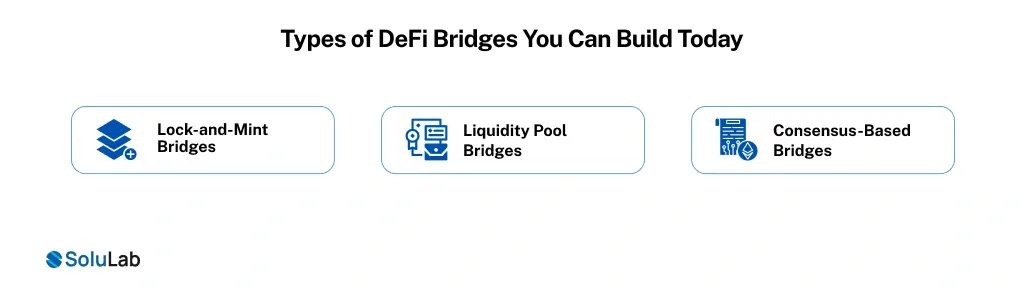
Not all bridges are created equal. There are actually several different architectural approaches to bridge design, and each comes with its own trade-offs. This matters because choosing the wrong bridge for your blockchain use case can cost you in security, speed, or decentralization.
1. Lock-and-Mint Bridges
This method is the most straightforward approach. You lock your asset on Chain A, and the bridge mints an equivalent token on Chain B. It’s simple, it’s secure, and it’s used by protocols like Multichain (formerly Anyswap). The downside is that you’re creating a wrapped asset, which introduces counterparty risk. The bridge itself becomes a target.
2. Liquidity Pool Bridges
These use liquidity pools on both sides of the bridge to facilitate swaps. You’re not minting new tokens, rather you’re trading against existing liquidity. Protocols like Stargate pioneered this approach. The advantage here is that you maintain the original asset on the destination chain, which reduces wrapping complexity. The disadvantage is that you need significant liquidity on both sides.
3. Consensus-Based Bridges
The newest and most sophisticated approach. These use validator sets or external consensus mechanisms to verify cross-chain transactions. Wormhole and Axelar use variations of this approach. They’re more decentralized and flexible, but also more complex to implement and operate.
For types of DeFi bridges, there’s no universal best answer, as it depends entirely on what you’re trying to achieve.
How DeFi Bridges Work in Real DeFi Applications?
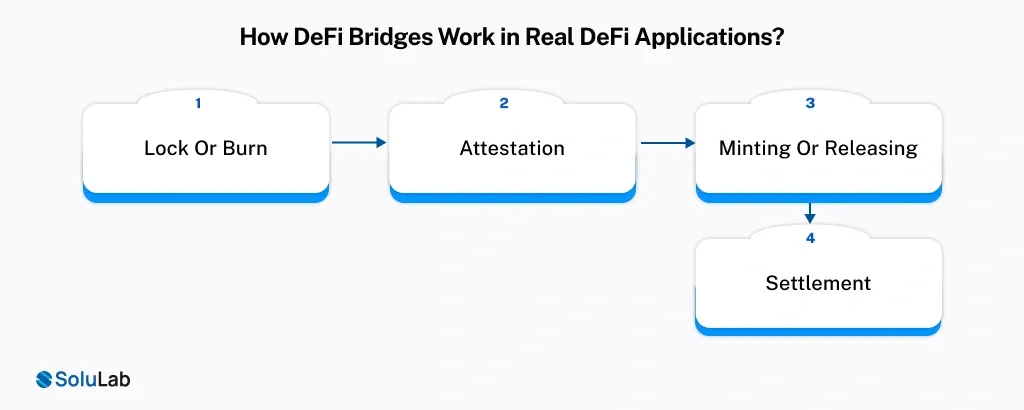
Okay, let’s get technical for a moment, but I’ll keep it simple. When you initiate a cross-chain transaction through a bridge, here’s what actually happens:
Step 1: Lock or Burn
Your tokens get locked in a smart contract on the source chain, or in some cases, they’re burned entirely.
Step 2: Attestation
The bridge needs to prove that the lock/burn actually happened. This is where different bridges diverge. Some use trusted validators. Some use light clients. Some use a combination.
Step 3: Minting or Releasing
Once the source transaction is verified, an equivalent amount of assets is either minted on the destination chain or released from a liquidity pool.
Step 4: Settlement
The transaction completes, and you now own assets on the destination chain.
This entire process, including how to use a DeFi bridge takes anywhere from seconds to minutes, depending on the bridge design and chain finality times.
Here’s what most people don’t appreciate: security best practices for DeFi bridges are absolutely critical because you’re building systems that hold billions in user assets. According to Immunefi’s 2025 vulnerability report, cross-chain bridges have been the target of 28 major exploits in the past year alone, with an average loss of $45 million per exploit.
That’s not fear-mongering, that’s just reality. Which is why choosing a bridge architecture carefully is essential.
DeFi Bridge Development Reality Check That Actually Matters Before Development
Let’s talk numbers, because that’s what drives decisions.
- $49.3 Billion in total value locked across bridge protocols (DeFiLlama, Q1 2026). That’s nearly a 300% increase from 2024.
- 73% of institutional investors now consider multi-chain access essential for their blockchain infrastructure (Statista Enterprise Blockchain Survey, 2025).
- $2.1 Trillion is the current DeFi market cap, spread across approximately 47 major blockchains (CoinGecko, April 2026).
The World Economic Forum’s Future of Decentralized Finance report highlighted that interoperability, basically, the ability of chains to talk to each other through bridges, is now considered the #1 technical priority for enterprise blockchain adoption.
Translation? This isn’t a niche concern anymore. This is infrastructure.
Why DeFi Projects Gain Long-Term Benefits from DeFi Bridge?
Let me be candid. Building bridges is hard, operating them securely is harder, and managing the risk is the hardest part.
But not building them? That’s a bigger risk.
Here’s why: DeFi bridge use cases are now fundamental to protocol growth.
- If you’re launching a DEX, you need bridges to give users access to liquidity from other chains.
- If you’re building a lending protocol, you need bridges to let users deposit assets from chains where they have the best yields.
- If you’re creating an NFT marketplace, you need bridges to let users trade with a global liquidity pool.
And here is how Uniswap and Aave did it
When Uniswap integrated Stargate bridges last year, their total addressable market literally expanded to every major DeFi ecosystem. Suddenly, a Solana user could supply liquidity to Ethereum Uniswap pools without manually bridging. That’s the power of bridges, as they’re transparent infrastructure that makes your protocol available to everyone.
Take Aave. They operate across 14 different blockchains. Without bridges, that wouldn’t be possible. They’d be managing 14 separate, fragmented platforms. With bridges, they’re a unified protocol delivering a consistent user experience across ecosystems. Their TVL and usage numbers directly reflect this.
Wormhole vs LayerZero vs Axelar vs Stargate vs Multichain: Which Bridge Actually Works?
This comparison matters because your choice here will shape your protocol’s architecture for the next 2-3 years.
Wormhole:
Developed by Jump Crypto. Uses a set of validators to attest cross-chain messages. Supports 30+ blockchains. Known for speed and flexibility. The 2022 Ethereum exploit cost them credibility but they’ve hardened significantly. Best for: Protocols that need rapid deployment and broad chain support.
LayerZero:
Ultra-lightweight oracle-based approach. Uses two independent oracles to verify messages. Deep integration in the DeFi ecosystem. Thousands of integration partnerships. Best for: Projects prioritizing developer experience and existing ecosystem traction.
Axelar:
Consensus-based validator model with heavy emphasis on security. Fewer supported chains initially but rapidly expanding. Great governance model. Best for: Enterprise protocols requiring maximum security guarantees.
Stargate:
Liquidity pool-based design. You maintain original assets on destination chains. Lower slippage for large trades. Backed by LayerZero Labs. Best for: DEXs and protocols prioritizing asset preservation over wrapping.
Multichain:
The OG bridge platform. Supported dozens of chains. Recent security concerns and operational challenges have reduced its market share. Currently rebuilding credibility. Best for: Established protocols with specific integrations already in place.
The reality? No single bridge is objectively best. Each trades off decentralization, security, speed, and cost differently.
Your choice should depend on your specific requirements, not hype.

How to Build a DeFi Bridge for Multi-Chain DeFi Applications?
Okay, so you’ve decided bridges are essential. Now what?
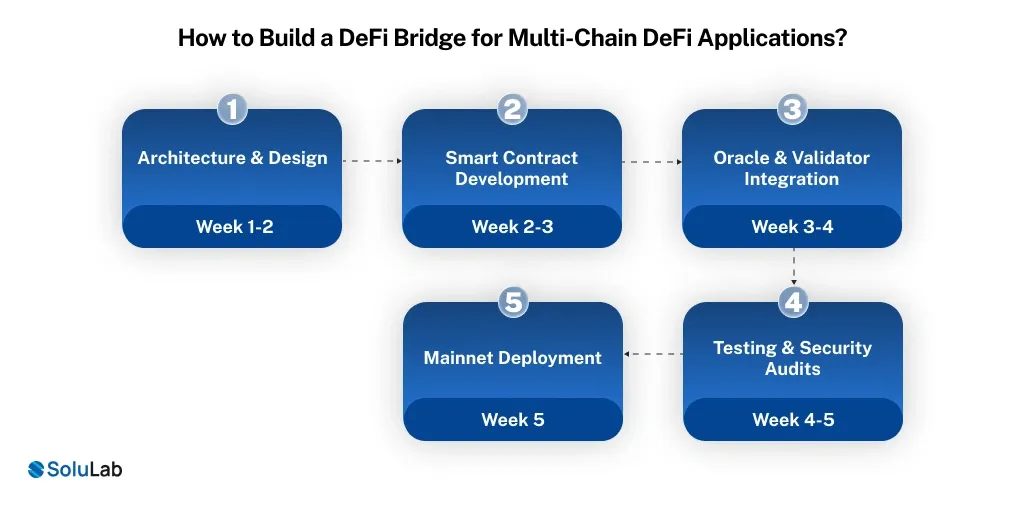
Phase 1: Architecture & Design (Weeks 1-2)
This is where most teams get it wrong. You need to define:
- Which chains will you support?
- What’s your security model?
- What level of decentralization do you need?
- Lock and mint or a liquidity pool?
The answers here determine everything downstream.
We typically work with custom DeFi bridge development requirements that are highly specific. A DEX might need different bridge characteristics than a lending protocol, which requires different characteristics than a staking platform.
Phase 2: Smart Contract Development (Weeks 2-3)
Once architecture is locked, smart contract development begins. You’re writing secure smart contracts on both source and destination chains. This is where security practices matter most, as audits need to be scheduled before code is finalized. How to build a DeFi bridge at this stage means writing code that can withstand the adversarial environment of blockchain.
Phase 3: Oracle & Validator Integration (Week 3-4)
If you’re using an Oracle-based approach, you’re integrating external data providers. If you’re using validators, you’re running your own consensus layer. This is also where you decide between centralized bootstrapping and decentralized operation.
Phase 4: Testing & Security Audits (Week 4-5)
You’re running testnet deployments, stress testing, and security audits. This isn’t where you cut corners. Major bridge exploits almost always trace back to inadequate testing or audits.
Phase 5: Mainnet Deployment (Week 5)
Limited launch with monitoring for 72+ hours. Then scale gradually and add new chains incrementally.
The entire timeline? It will take 35 days if you have experienced builders. Six months, if you’re learning as you go.
Cost to Build a DeFi Bridge typically ranges from $150,000 to $2.3 million, depending on complexity, chains supported, security requirements, and whether you’re building from scratch or integrating existing solutions. But the ROI is measured in months, not years.
Benefits of DeFi Bridges for Enterprises
Let’s translate all this technical talk into business impact, because that’s what boards care about.
Liquidity Multiplication:
When Convex Finance bridged from Ethereum to Arbitrum, its available liquidity pools increased by 340%. More liquidity means tighter spreads, which means better execution for traders, which means higher volume and fees. This wasn’t a network effect; it was a direct business impact from bridging.
User Acquisition
Curve Finance operates across 11 blockchains. Their user base is 8x larger than single-chain DeFi protocols of similar vintage. Not because they’re better, but because they’re accessible. Bridges enabled that accessibility.
Risk Diversification:
If you’re only on Ethereum and something bad happens on Ethereum (congestion, regulatory uncertainty, economic stress), your entire protocol suffers. Multi-chain via bridges reduces platform risk. Aave has TVL on 14 chains specifically to reduce dependence on any single ecosystem.
Capital Efficiency:
Here’s the one that matters most: one unit of capital on the bridge A can simultaneously earn yield on Chain B while providing collateral on Chain C. That’s leverage without debt and capital efficiency at scale.
We have seen that protocols with proper bridge integration see 4-6x better capital efficiency metrics than single-chain alternatives.
Security Risks & Best Practices When Understanding How DeFi Bridges Work
Real talk—bridges are attack vectors. They’re attractive targets because they hold billions in user assets, and the complexity creates edge cases.
The Risks
Smart contract bugs (most common – 46% of exploits). Oracle manipulation (18% of exploits). Validator collusion (15% of exploits). Wrapped asset depegging (12% of exploits). Other (9% of exploits).
The Best Practices
- Code audits by tier-1 firms. Not secondary. Not internal. Not rotated firms. Tier-1 firms like Certora, Trailings Bits, or OpenZeppelin. Security best practices for DeFi bridges aren’t optional; they’re mandatory.
- Multi-sig governance. Your bridge parameters shouldn’t be controlled by a single team member. Use multi-signature wallets with time locks.
- Gradual rollout. Don’t launch at full capacity. Start with rate limits. Monitor for 72 hours. Expand in phases.
- Bug bounty programs. Offer 10-20% of protocol TVL in annual bug bounties. It’s expensive. It’s also cheaper than a $100M exploit.
- Continuous monitoring. Real-time alerts for unusual transaction patterns. Automated circuit breakers that pause the bridge if things look wrong.
Insurance integration. Consider bridging insurance from Nexus or other providers. Transfer some of the risk.
How SoluLab Can Help You Build DeFi Bridges in 35 Days?
This is where we actually help.
We’ve built DeFi development solutions for protocols managing $3B+ in TVL. We’ve deployed bridges across 18 different blockchain ecosystems. We’ve helped teams go from concept to mainnet in 35 days while maintaining security standards that passed tier-1 audits.
Here’s what we actually do:
Architecture Consultation:
We work with your team to design a bridge architecture that matches your protocol’s specific requirements. Not generic. Not off-the-shelf. Specific to you.
Secure Smart Contract Development:
We write bridges using best practices informed by studying 200+ existing protocols. Boring, secure, optimized code exactly what you need.
Integration & Deployment:
We integrate your bridge with existing oracles or validators. We handle testnet, audits, and mainnet deployment. We manage the entire lifecycle.
Ongoing Operations:
Post-launch monitoring, security updates, and protocol improvements. We stay involved because bridge security is continuous.
Cost Efficiency:
We’ve optimized our process enough that we can build custom DeFi bridge development solutions in 35 days for a fraction of what most teams quote. Not by cutting corners, just by not wasting time on inefficiencies.

Conclusion
DeFi bridges aren’t a feature anymore, they’re infrastructure. They’re the connective tissue that transforms isolated blockchains into a cohesive, unified financial system. Whether you’re building a protocol, managing a DAO, or operating as an enterprise blockchain platform, cross-chain liquidity access through secure bridges isn’t optional.
The market is moving toward multi-chain, as the statistics, enterprise adoption, and market cap allocation prove it. The only question is whether you move with the market or get left behind.
If you’re serious about scaling your protocol across multiple blockchains, we’re here to help. We’ve done this 200+ times across different chains, architectures, and use cases. We know where the pitfalls are. We know how to avoid them. And we know how to deliver secure, production-ready bridges fast.
The next 12 months will define which protocols become multi-chain leaders and which remain fragmented.
Make your choice now.
FAQs
4. How do we handle regulatory risks with bridge-based solutions?
With over 3 years of experience, I specialize in breaking down complex Web3 and crypto concepts into clear, actionable content. From deep-dive technical explainers to project documentation, I help brands educate and engage their audience through well-researched, developer-friendly writing.