Key Takeaways
- AI-powered meeting rooms are transforming enterprise collaboration in 2026 by automating scheduling, note-taking, transcription, and decision tracking in real time. Using AI agents, voice recognition, and smart integrations, these systems reduce manual effort, improve meeting efficiency, and ensure actionable outcomes.
- For enterprises, adopting AI-enabled meeting solutions leads to faster decision-making, better team alignment, and up to 2–3x productivity gains across distributed teams. Experts like SoluLab are rendering AI native solutions to push your business to level of success without any hassle.
Hybrid work has led to more frequent meetings, but not necessarily more productive ones. Many enterprises still struggle with poor room utilization, scheduling conflicts, poor audio-video quality, disconnected collaboration tools, and no clear visibility into meeting outcomes. These issues waste time, increase operational costs, and frustrate employees across teams and locations.
AI development solutions for meeting rooms address these challenges by turning traditional spaces into scheduling, real-time transcription, occupancy insights, automated summaries, and device-integration capabilities.
In fact, the global video conferencing market is expected to reach USD 24.75 billion by 2034, driven by hybrid work and AI-enhanced collaboration demand.
This guide explains how AI-powered meeting rooms work, the business value they deliver, and what enterprises should consider when building smarter collaboration environments in 2026.
What Are AI-Powered Meeting Rooms?
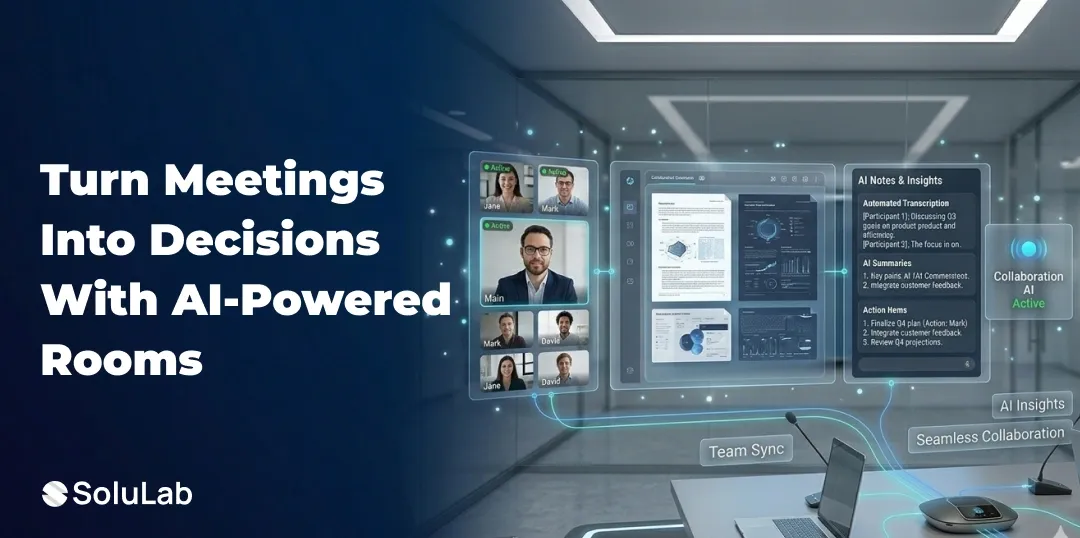
AI-powered meeting rooms are artificial intelligence collaboration spaces that use artificial intelligence, sensors, and connected workplace technologies to improve how teams schedule, conduct, and manage meetings.
Unlike traditional conference rooms, these spaces can automate tasks such as room booking, attendance tracking, voice transcription, camera framing, noise reduction, and post-meeting summaries.
By combining tools like computer vision, IoT devices, AI voice agents, and analytics platforms, intelligent meeting rooms help businesses reduce meeting friction, improve productivity, and create a more seamless workplace experience.
Why Businesses Should Invest in AI-Powered Meeting Room Solutions?
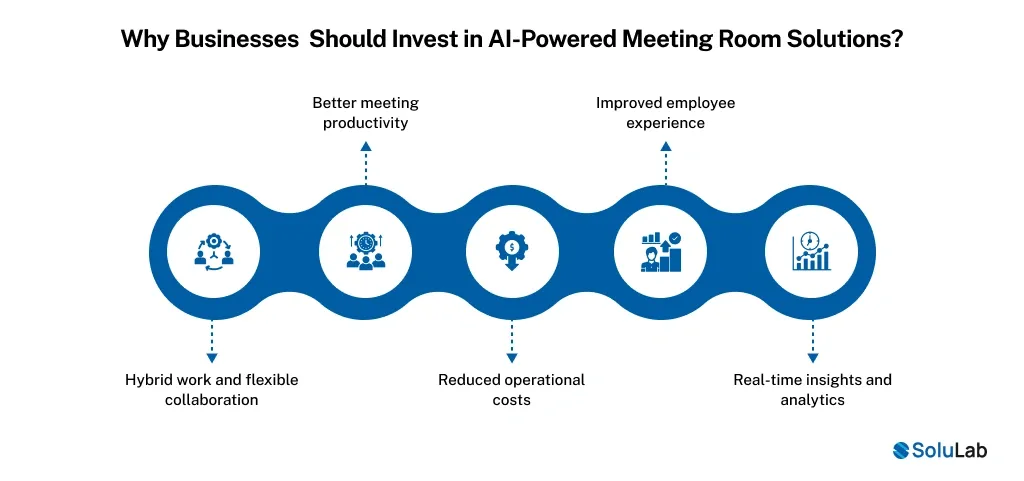
As workplaces become increasingly distributed and collaboration-heavy, modern businesses require AI-powered solutions for meeting environments that eliminate friction, enhance efficiency, and enable teams to make faster, more informed decisions every day.
- Hybrid work and flexible collaboration: AI-powered meeting assistant enables seamless participation for remote and in-office teams through smart scheduling, intelligent audio-visual systems, and real-time collaboration tools, reducing communication gaps.
- Better meeting productivity: Features like automated transcription, meeting summaries, action-item tracking, and speaker recognition help teams stay focused during discussions and reduce time spent on follow-ups.
- Reduced operational costs: Smart occupancy sensors, predictive maintenance, and automated energy controls help businesses optimize room usage, lower utility expenses, and minimize downtime caused by equipment failures.
- Improved employee experience: AI meeting assistants create smoother user experiences with touchless access, voice-enabled controls, faster setup, and fewer technical disruptions during important discussions.
- Real-time insights and analytics: AI systems provide data on room utilization, meeting effectiveness, attendance trends, and equipment performance, helping businesses improve workspace planning and resource allocation.
Benefits of AI-Powered Meeting Rooms for Enterprise

AI native strategy for meeting rooms help enterprises create more productive, seamless, and intelligent collaboration spaces by reducing friction, improving communication, and turning everyday meetings into measurable business outcomes across distributed teams.
- Improved collaboration experience: AI-enabled meeting rooms create smoother interactions through smart audio, video optimization, and live support features, making AI-powered hybrid meetings more inclusive and effective for both in-office and remote teams.
- Better meeting productivity: Automated transcription, action item tracking, and meeting summaries help teams save 3.5 hours per week on manual follow-ups, reduce missed tasks, and improve accountability across departments and project workflows.
- Smarter room utilization: AI-powered occupancy sensors and predictive analytics help enterprises track space usage patterns, avoid double bookings, and optimize office layouts for better operational efficiency and workplace planning.
- Reduced operational costs: Intelligent automation lowers energy consumption, minimizes device downtime, and reduces unnecessary support costs by proactively managing room systems and resource allocation more efficiently.
- Enhanced decision-making: Real-time meeting insights, attendance trends, and usage analytics help leadership make informed workplace decisions and improve collaboration strategies based on actual employee behavior.
- Stronger security and compliance: AI meeting rooms support secure access controls, encrypted communication, and compliance monitoring, helping enterprises protect sensitive business discussions and maintain regulatory standards.
- Scalable enterprise integration: A trusted AI meeting room solutions provider can offer AI integration in meeting rooms with enterprise calendars, communication tools, and workplace systems for long-term scalability and performance.
Key AI Technologies Transforming Meeting Rooms in 2026
Modern workplaces need more than screens and video calls. In 2026, intelligent technologies are turning meeting spaces into responsive, efficient environments that improve collaboration, reduce friction, and support better business decisions.
- AI and machine learning: The AI tech stack powers AI meeting solutions by learning usage patterns, automating scheduling, generating meeting summaries, and improving resource allocation for smoother collaboration and higher workplace productivity.
- Edge AI devices: Edge devices process audio, video, and occupancy data locally in real time, reducing latency, improving response speed, and ensuring faster actions without depending entirely on cloud connectivity.
- IoT integrations: Connected sensors and smart devices help monitor room occupancy, temperature, lighting, and equipment status, making AI-enabled meeting rooms more efficient, comfortable, and easier to manage.
- Cloud infrastructure: Cloud platforms support centralized management, secure data storage, seamless software updates, and remote access, helping businesses scale meeting room operations across multiple office locations.
- Computer vision systems: AI-powered cameras enable speaker tracking, facial recognition, attendance logging, and room utilization insights, improving meeting experiences while helping businesses optimize workspace usage.
- Digital twins for workspace management: Digital twins create virtual models of meeting spaces, allowing businesses to monitor performance, predict maintenance needs, and improve room layouts based on real usage data.
Features of AI-Powered Meeting Rooms Solutions
Modern workplaces need meeting spaces that do more than connect people. AI-led development now helps teams collaborate faster, reduce friction, improve accountability, and make every meeting more productive and secure.
- Automated Attendance Tracking: AI-driven meeting room solutions use sensors, badges, or facial recognition to log participants automatically, eliminating manual roll calls, improving records, and helping teams start meetings on time.
- Voice-to-Text Meeting Transcription: AI converts live conversations into accurate text in real time, making it easier to capture discussions, review decisions later, and support remote participants across locations.
- AI Meeting Summaries and Action Items: AI assistants can analyze conversations, highlight key decisions, assign tasks, and generate concise summaries, helping teams avoid missed follow-ups and improve accountability.
- Noise Reduction and Speaker Tracking: AI filters background noise, enhances voice clarity, and follows active speakers during calls, creating smoother communication and better audio-video experiences for hybrid meetings.
- Facial Recognition and Access Control: Smart access systems verify authorized participants before entry, improve meeting room security, protect sensitive discussions, and reduce the risk of unauthorized access or disruptions.
Step-by-Step Implementation Guide for an AI-Powered Meeting Rooms Solution
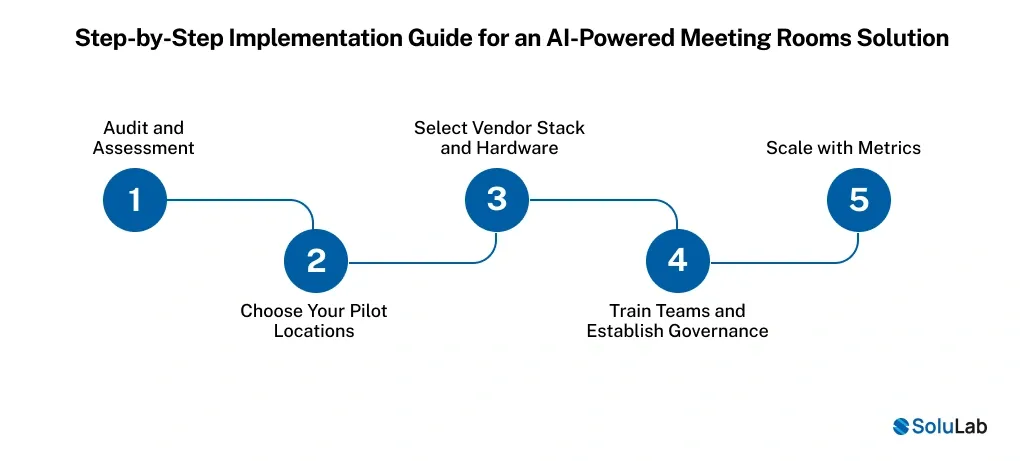
A successful AI-powered meeting room starts with a structured plan that aligns workplace goals, infrastructure readiness, and user adoption. A phased implementation reduces disruption, controls costs, and ensures long-term performance.
Step 1. Audit and Assessment
Begin by evaluating your current meeting room setup with AI consulting experts, including AV systems, room utilization, connectivity, booking workflows, and collaboration pain points. This helps identify gaps, prioritize upgrades, and define clear business outcomes.
Step 2. Choose Your Pilot Locations
Start with high-usage meeting spaces where impact can be measured quickly, such as executive boardrooms or hybrid collaboration hubs. A pilot helps validate system performance, user experience, and operational feasibility before wider rollout.
Step 3. Select Vendor Stack and Hardware
Choose the right mix of cloud software, sensors, microphones, displays, and AI-driven cameras based on room size, use cases, and integration needs. The right stack ensures reliable automation, visibility, and collaboration efficiency.
Step 4. Train Teams and Establish Governance
Provide hands-on training for employees, IT teams, and facility managers to ensure smooth adoption. Set clear policies for room usage, access controls, privacy, maintenance, and support to keep systems secure and efficient.
Step 5. Scale with Metrics
Expand AI deployment based on measurable outcomes such as room utilization, meeting quality, downtime reduction, and employee satisfaction. Continuous monitoring helps optimize performance and maximize ROI from smart meeting room solutions.
Future Trends in AI-Powered Meeting Rooms in 2026 and Beyond
As workplace collaboration becomes more intelligent, conversational AI assistants are evolving beyond automation. In 2026 and beyond, businesses will adopt smarter systems that improve communication, participation, efficiency, and workplace experience.
- Emotion-aware meeting assistants: Advanced AI systems will analyze tone, speaking patterns, and engagement levels during meetings to identify fatigue, confusion, or low participation, helping teams improve communication and outcomes.
- Real-time multilingual translation: AI will enable instant language translation during live meetings, making cross-border collaboration smoother by reducing misunderstandings and helping distributed teams communicate naturally without delays.
- AR/VR meeting collaboration: Immersive meeting environments will allow remote participants to interact with presentations, prototypes, and shared workspaces in real time, creating more engaging and productive virtual collaboration experiences.
- AI meeting coaches: Intelligent assistants will provide live recommendations on speaking balance, agenda adherence, follow-up actions, and discussion clarity, helping teams conduct more focused and effective meetings.
- Autonomous room optimization: Smart systems using AI-driven cameras and sensors will automatically adjust lighting, seating layouts, climate, audio quality, and device performance to create seamless smart meeting room solutions.
Conclusion
AI-powered meeting assistants are becoming essential for enterprises that want faster collaboration, better space utilization, and more productive hybrid work experiences.
From scheduling and real-time transcription to occupancy insights and predictive maintenance, these solutions help businesses reduce inefficiencies and improve decision-making.
As workplace expectations continue to evolve in 2026, investing in smarter meeting infrastructure is no longer optional for growth-focused organizations. If you are planning to modernize your workplace with AI meeting room technology and collaboration systems, hire experts for hassle free execituion.
SoluLab, an AI app development company, can help your business design and deploy secure, scalable AI-powered meeting room solutions tailored to your needs.
FAQs
Neha is a curious content writer with a knack for breaking down complex technologies into meaningful, reader-friendly insights. With experience in blockchain, digital assets, and enterprise tech, she focuses on creating content that informs, connects, and supports strategic decision-making.