Businesses across industries use cameras, but most of them just record. They capture footage that sits on a hard drive, rarely reviewed unless something goes wrong. That’s a massive missed opportunity.
Raw video alone can’t tell you anything unless any incident happens. And they need hours to rewatch those recorded clips to find what happened. McKinsey estimates that computer vision can automate up to 50% of manual inspection tasks in some industries.
However, an AI-powered camera doesn’t just see — it understands. By combining computer vision with deep learning, these smart devices analyze what’s happening in real time, turning everyday video into actionable insights.
Whether it’s counting people, detecting objects, or recognizing behavior patterns, AI development solutions have analytical power that traditional cameras simply can’t match. Continue reading this blog to know more about AI-powered cameras.
Key Takeaways
- The Problem: The traditional cameras merely capture images. Companies continue to use manual monitoring, slow reviews, and reactive decisions. The results are lost events, operational underperformance, increased expense, and unexploited visual information that can be leveraged to make smarter decisions.
- The Solution: AI-based cameras are computer vision and deep learning-based cameras that analyze videos in real time. They recognize the objects, patterns, spot anomalies, and transform the visual information into actionable insights that enhance security, efficiency, and profitability.
- How SoluLab Helps: SoluLab, AI native company with its expert team, develops computer vision models for edge AI optimization and AI integration for surveillance cameras to transform cameras into smart business assets and builds scalable and analytics-centric solutions.
What is a AI Powered Camera?
An AI-powered camera is a camera that doesn’t just record video. It actually understands what it sees. Unlike traditional CCTV systems that simply capture footage for later review, an AI camera uses artificial intelligence and computer vision to analyze video in real time. It can recognize objects, detect unusual activity, count people, read license plates, or even identify safety risks automatically.
The global AI camera market is projected to reach USD 47.02 billion by 2030, growing at a CAGR of ~21.6 % through 2030.
Here’s what AI Cameras Actually Do:
- Detect people, vehicles, or specific objects
- Identify suspicious behavior
- Monitor crowd density
- Track inventory movement
- Perform quality inspection in factories
- Support facial recognition or access control
And they do this without a human constantly watching screens.
How do AI security cameras work?
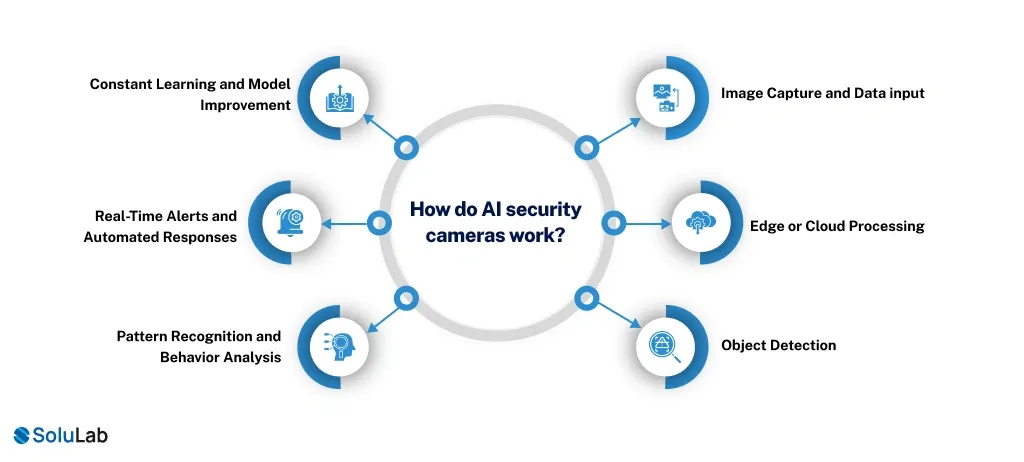
AI security cameras are not merely cameras for recording. They apply artificial intelligence to recognize and process video in real time, identify certain events, and automatically give out alerts without human supervision.
1. Image Capture and Data input: This process is initiated by the protection cameras of AI that capture high-resolution images with the help of advanced image sensors. Each frame is organized visual data that is ready to be analyzed by the system with in-built processing hardware.
2. Edge or Cloud Processing: The footage that is captured is either analyzed right on the device with edge AI chips or can be uploaded to cloud servers where more powerful computing systems process large amounts of video.
Read More: Business Guide to Edge AI Development
3. Object Detection: Deep learning models are trained to scan all frames of the video to recognize people, cars, packages, or odd motions. The models are constructed on thousands of labelled images to enhance the detection accuracy.
4. Pattern Recognition and Behavior Analysis: In addition to object identification, AI cameras can analyze the patterns of behavior. They can sense loitering, unauthorized access, suspicious activity, or movement within restricted space according to the set rules and the acquisition of behavior.
5. Real-Time Alerts and Automated Responses: When the system is alerted to some occurrence, it will automatically send alerts, notifications, or automated alarms, access control locks, or dashboard notifications to security personnel.
6. Constant Learning and Model Improvement: AI models are capable of being updated and retrained with time using new data. This enhances the accuracy, lowers false alarms, and enables the system to fit in dynamic environments or the requirements of the business.

Major Functions of a Deep Learning AI Camera
Deep learning-based AI solutions are transforming the way businesses understand visual data and convert raw video into organized, actionable intelligence that can be used in the process of automation, surveillance, and more intelligent business decisions.
1. Image Processing
This is the foundation. The camera also adds value to raw image data, lighting, noise reduction, motion stabilization, and contrast optimization. The purity and refinement of images enhance the accuracy of the model and dependable downstream analysis in real-world scenarios.
2. Image Classification
The system examines an image and classifies it into one of the pre-trained deep learning models. As an example, it is capable of identifying objects as vehicles, people, products, or defects, and can automatically be sorted and reported.
3. Image Recognition
Classification is not as deep as recognition. The camera recognizes parts of objects, faces, license plates, or patterns in a frame. This is a security feature that drives access control, threat detection, quality inspection, as well as behavior tracking in industries.
Benefits of AI-Powered Security Camera Systems
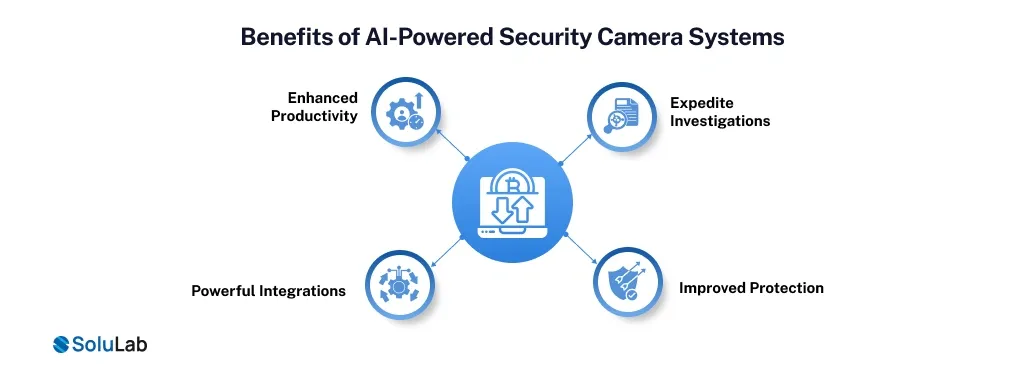
Over 60% of organizations investing in AI report measurable operational efficiency gains. The use of AI security camera systems is altering the way companies secure assets, observe operations, and make decisions by transforming ordinary video footage into real-time actionable intelligence that triggers actionable operational changes.
- Expedite Investigations: Search with AI will allow you to locate the incident within seconds, rather than spending hours of shooting hours searching the footage by hand. Innovative filters, such as person detection filters and vehicle identification filters, and time-stamped tags significantly decrease the time of investigation as well as the speed of response.
- Improved Protection: These systems identify something amiss, unauthorized access, or suspicious movement currently. Businesses are alerted instantly, which is much more beneficial than acting upon an event, which is much less effective in reducing theft, vandalism, and safety concerns.
- Powerful Integrations: AI security cameras may be linked with access control systems, alarm systems, ERP systems, and analytics dashboards. This forms the centralized ecosystem where video data helps to provide operational data, compliance data, and automated processes across departments.
- Enhanced Productivity: Teams will be able to view more valuable tasks because of automating monitoring processes and using fewer people to monitor tasks. The AI-generated reports, people counting, and workflow tracking are used to enable managers to streamline their staffing, operations, and business efficiency in general.
How AI Camera Systems are Used in Different Industries?
The AI camera systems are revolutionizing the industries as they convert simple video feeds into live intelligence, enabling businesses to automate monitoring, enhance safety, decrease losses, and make swift and more objective decisions. Expert AI consultants can be hired to plan the implementation strategies like:
1. AI-Powered Traffic Cameras
Traffic cameras equipped with AI are used to track the flow of vehicles, identify violating ones, study traffic congestion, and improve the timings of traffic lights. They are utilized by cities to minimize accidents, promote traffic flow, and create real-time analytics upon which better decisions can be made in urban planning.
2. Inventory and Factories
AI cameras are used in factories and warehouses to check the quality of products, identify defective products, monitor the safety of workers, and track the movement of inventory. A CCTV camera that is operated by an AI is capable of automatically identifying things that are out of the ordinary, reducing human error and enhancing the efficiency of the operations.
3. Sports Broadcasting Automation
AI cameras track the players, automatically track the ball, produce highlights, and stream games without human operators of the camera. This renders broadcasting of professional quality affordable to schools, leagues, and small sports organizations.
4. Medical
AI cameras are used in healthcare settings to monitor patients, identify falls, and ensure hygiene compliance. A surveillance camera with artificial intelligence will be able to notify personnel to address the issue immediately, and it will contribute to the optimization of response rates and the safety level in hospitals and clinics.
5. Education
AI cameras are used on the campuses of schools and universities to secure their campuses, automate their attendance systems, and monitor the behavior. These systems increase the safety of students, give less burden to the administration, and improve the general efficiency of the institution.
Best Practices for Implementing AI-Powered Camera Solutions
Deploying AI-powered systems goes beyond installing camera hardware or plugging in algorithms. It requires a strategic approach that balances performance, scalability, compliance, and long-term adaptability. Here are the key best practices businesses should follow:
#1. Choose the Right AI Models
The effectiveness of your AI-powered camera solution depends heavily on selecting the right models for your AI use case.
- Use object detection models for surveillance and security
- Apply facial recognition or identity models for access control
- Leverage behavioral analytics models for anomaly detection
Choosing optimized, use-case-specific models ensures higher accuracy, reduced false positives, and better real-world performance.
#2. Focus on Edge + Cloud Balance
A hybrid architecture combining edge and cloud computing is essential for efficient AI camera systems.
- Edge processing enables real-time analysis with low latency
- Cloud infrastructure supports large-scale data storage, AI model training, and analytics
Balancing both ensures faster decision-making, reduced bandwidth costs, and scalable performance across multiple locations.
#3. Ensure Compliance and Data Privacy
AI-powered camera systems often handle sensitive data, making compliance critical.
- Implement data protection frameworks like GDPR and region-specific privacy laws
- Use anonymization and encryption techniques to protect user identity
- Maintain transparent data usage policies
A compliance-first approach builds trust and prevents legal or regulatory risks.
#4. Regular Model Training and Updates
AI models require continuous improvement to stay effective in dynamic environments.
- Retrain models with updated datasets to improve accuracy
- Monitor performance and reduce bias or drift
- Update models to adapt to new scenarios, lighting conditions, or behaviors
Ongoing optimization ensures your system remains reliable and relevant over time.
#5. Work with Experienced AI Integration Partners
Implementing AI-powered camera solutions involves multiple layers—AI models, infrastructure, compliance, and integrations.
- Partnering with experienced AI integration solution providers ensures faster deployment and fewer errors
- Experts can design scalable architectures tailored to your business needs
- They also help navigate regulatory, technical, and operational complexities
The right partner can significantly reduce time-to-market while maximizing ROI.
Conclusion
AI cameras are no longer camera recorders. They converts video to practical insights. With the integration of computer vision and deep learning, businesses will be able to automate the monitoring process, identify patterns, and make more accurate and quicker decisions.
AI camera systems transform the visual data into quantifiable performance in retail stores, factories, and even in smart cities. The current state of AI-powered dash cameras is more than just recording accidents, and it includes driver behavior analysis and risk detection.
With the shift in industries towards automation and data-driven processes, AI-driven cameras are starting to become a necessity for efficiency, safety, and long-term competitive edge.
SoluLab, an AI development company, can help your business design custom AI camera solutions that automate detection, reduce risks, and improve operational efficiency. Book a free discovery call today!
FAQs
Neha is a curious content writer with a knack for breaking down complex technologies into meaningful, reader-friendly insights. With experience in blockchain, digital assets, and enterprise tech, she focuses on creating content that informs, connects, and supports strategic decision-making.