Although AI projects can involve substantial investment, in the US, almost two-thirds of AI projects do not succeed in their pilot-to-enterprise-wide implementation. Organisations invest heavily in AI projects, but most of them fail to make a tangible business difference.
This rate of AI project failure in the US is not merely a statistic but represents wasted budgets, lost time, and opportunities. The businesses have issues of low-quality data, a lack of alignment between business goals, and poor infrastructure that place AI projects in a state of stasis.
Scaling AI is good, but simply using it because every other business is doing it is the wrong decision. This is the common reason AI in US businesses is failing. Businesses should identify areas of automation and then integrate AI solutions strategically.
This blog post guides you through an exact roadmap to scale your business in the US, reasons why AI adoption is failing and more. Let’s get started!
Key Takeaways
- The Problem: In the US, 60% of AI projects do not scale as a result of the improper quality of data, undefined business objectives, organizational resistance, and inadequate technical infrastructure. A lot of pilots can make it alone but fail to make it to the enterprise level.
- The Solution: To achieve success with scaling, it is necessary to have a clear business-aligned strategy, strong data governance, scalable MLOps pipelines, and change management to make sure that it will be adopted by all the teams. Stalled deployments are avoided by constant monitoring and governance.
- How SoluLab Helps: SoluLab also offers end-to-end support in AI implementation: data strategy and MLOps architecture, enterprise deployment. Our business solutions in the US can reduce the rate of failure of AI projects by providing scalable AI solutions with ROI that do not interfere with operations.
AI Adoption Failure Statistics: Overview
In 2025–26, despite record investment and focus on AI in US business, a surprisingly high share of initiatives struggle to scale beyond small pilots or proofs of concept.
According to recent enterprise surveys, AI project failure rate in the US remains troublingly high: only about 10–15% of AI efforts reach enterprise‑wide deployment, while more than 40% of companies abandoned most of their AI projects in 2025 — a steep rise from 17% the year before.
Across industries, about 46% of proof‑of‑concept AI projects are scrapped before they reach production. Global reports also show that 80%+ of AI initiatives never deliver measurable business value, with many organisations citing poor planning, data fragmentation, and lack of strategic alignment as top obstacles.
Reasons Why Most AI Projects Fail
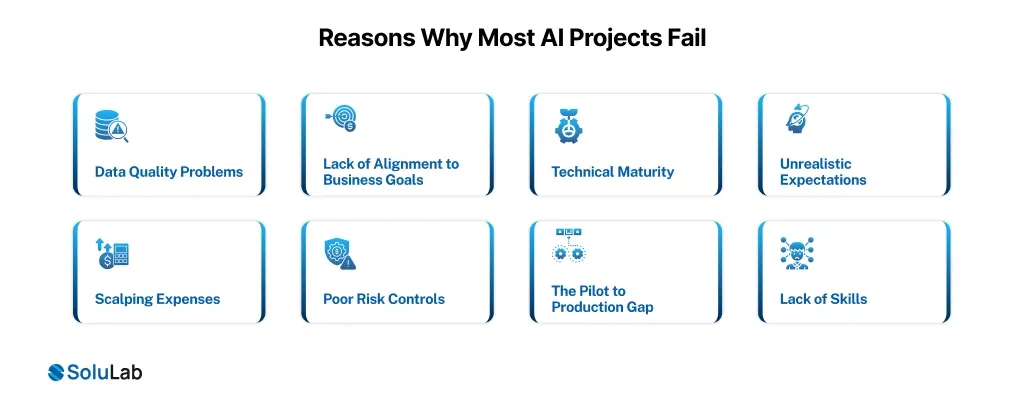
The potential of AI projects is immense, yet research indicates that most of them do not go beyond pilot. It is essential to learn the major causes of such failures to create successful, enterprise-wide AI efforts.
- Data Quality Problems: The major cause of AI failure is poor or incomplete data. More than 60% of AI models do not perform well in production because of uncontrollable and inconsistent datasets, and scaling cannot occur. Proper management of data enhances success.
- Lack of Alignment to Business Goals: AI projects are prone to failure due to the fact that projects are not aligned with the business objectives. According to Gartner, 78% of AI initiatives have no clear business outcomes, leading to squandered resources and halting deployments.
- Technical Maturity: Organizations often do not take into account infrastructure and MLOps requirements. Due to the lack of production-ready pipelines, tracking, scale-up systems, etc., 60 percent of AI pilots do not go beyond experimentation.
- Unrealistic Expectations: Executives usually have unrealistic expectations of AI, which are immediate ROI. In a survey, it was found that approximately half of AI projects are not successful because of over-promised results and under-delivered ones, which makes it necessary to have real KPIs.
- Scalping Expenses: AI projects often go over budget as they scale up. Businesses claim to spend millions of dollars on pilots that trigger during the production process, and the average enterprise AI budget is already at 4.2 million, which does not always pay off.
- Poor Risk Controls: There is no response to ethical, regulatory, and operational risks, and this leads to delays or cancellations. Governance gaps affect around 45% of AI projects, causing compliance problems and project termination.
- The Pilot to Production Gap: The vast majority of AI pilots work well in small settings but not in large ones. The percentage of enterprise AI projects that make it through pilot to production is only 27% as a result of misalignment, data problems, and infrastructure gaps.
- Lack of Skills: There is a significant bottleneck in the talent shortage. Almost two-thirds of organizations claim that small AI and data science capabilities ensure that projects do not scale well, which underscores the relevance of training and external skills.

What High Performers Do Differently?
Organizations that perform well always manage to scale AI effectively by integrating strategy and data readiness as well as operational excellence. They circumvent most pitfalls that lead to the failure of 60 percent of AI projects in the US at the enterprise level.
1. Begin With Simple Business Objectives: Best performers have measurable business objectives, and then develop AI solutions. Attainable goals establish the fact that all the models are in line with ROI, eliminating the wastage of efforts on pilots that are not able to drive impacts to the enterprise.
2. Invest in Data Quality and Governance: They emphasized clean, structured, and available data. With robust governance, models are able to be scaled and fail due to inconsistent or siloed datasets.
3. Build Cross-Functional Teams and Align Leadership: High performers end up getting executive sponsorship and developing collaboration between the technical and business teams. Alignment guarantees the availability of the required resources, buy-in, and workflow integration of AI efforts.
4. Scalable Infrastructure and MLOps: They apply strong production pipelines, monitoring, and MLOps systems. This can prevent technical stalling and enable AI solutions to be reliably scaled to multiple departments and locations.
5. Continuous Improvement and Change Management: The best organizations see AI as a system. Structured change management, regular monitoring, and retraining models make sure that the adoption is long-term and can be sustained by business value.
SoluLab’s 7 Step Prevention Framework for AI Projects
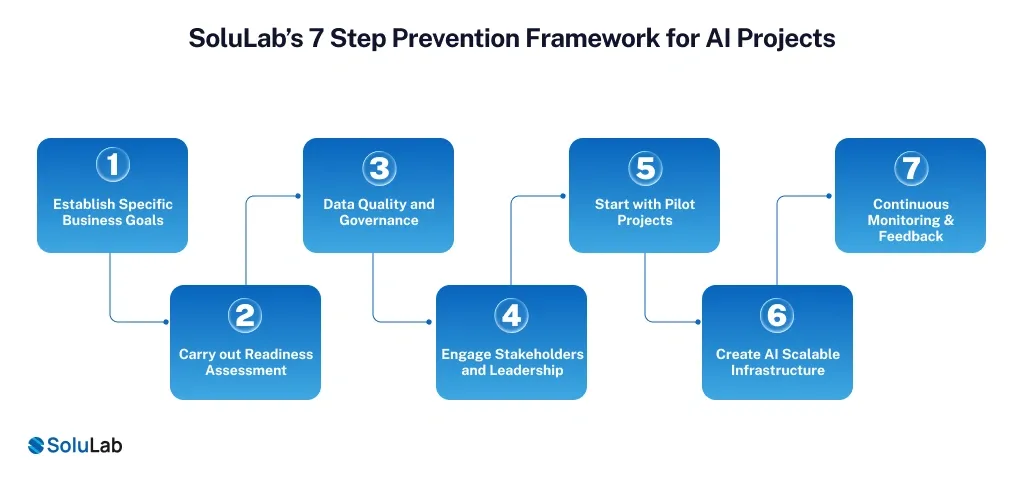
Most AI projects fail to scale because of ineffective strategy, governance, and data challenges. A 7-step prevention structure adopted guarantees a sustainable implementation, calculable ROI, and successful enterprise-wide AI implementation.
Here is a step-by-step guide on how to scale AI projects:
Step 1. Establish Specific Business Goals
Create AI measures in line with quantifiable results and KPIs with expert AI consultants. Devoid of a purpose, projects stand the potential of being turnaround experiments as opposed to solutions that generate value. Goals direct the scope, resources, and success measurements.
Step 2. Carry out Readiness Assessment
Conduct a preliminary assessment of organisational infrastructure, skillsets, and quality of data. Determine the technical maturity and cross-functionality in order to ascertain that your AI project is on a sound platform to scale.
Step 3. Data Quality and Governance
Structured, orderly, and controlled data is essential. Unreliable data results in invalid models and scaling errors. Early implementation of pipelines, validation checks, and compliance policies.
Step 4. Engage Stakeholders and Leadership
Get cross-functional and executive sponsorship. Adoption is achieved through leadership alignment that eliminates roadblocks and ensures that AI initiatives get the resources and attention needed to achieve their success.
Step 5. Start with Pilot Projects
Start with small and manageable pilots in order to test hypotheses and determine impact. Pilots assist in the detection of technical loopholes, model refinements, and proof-of-value creation prior to enterprise-wide expansion.
Step 6. Create AI Scalable Infrastructure
Establish MLOps pipelines, production environments, and monitoring. Scalable infrastructure makes the models reliable, performant, and maintainable as the adoption increases.
Step 7. Continuous Monitoring & Feedback
Monitor performance of the track model, business impact and adoption by the users. Constant surveillance assists in identifying problems, maximize production, and staying true to the business objectives.

Conclusion
The fact that AI projects in the US have a high failure rate underscores that AI scaling is not only a technical issue but also a strategic one. To successfully improve pilot deployment into enterprise-wide deployment, organisations need to deal with data quality, data governance, and cross-functional alignment.
To address these challenges, businesses interested in doing strategic execution and considering engaging AI advisory services in the USA, which will offer the frameworks, best practices, and practical guidance to transform failing AI projects into a scalable, value-creating solution.
SoluLab, an AI development company in the USA, can help businesses automate workflows and increase ROI and productivity. Book a free discovery call today!
FAQs
Neha is a curious content writer with a knack for breaking down complex technologies into meaningful, reader-friendly insights. With experience in blockchain, digital assets, and enterprise tech, she focuses on creating content that informs, connects, and supports strategic decision-making.