Surveillance has changed. AI is the reason. Feed a camera network some smart software and it stops being a passive box that records footage nobody watches. It starts flagging odd behavior on its own, matching faces, and keeping an eye on a huge area while a handful of people supervise instead of a whole room of them. Security gets sharper. And the staff you do have can spend their hours on the calls that actually matter, not on staring at a wall of monitors.
This is not a niche experiment anymore. It is spreading fast, everywhere. China, for one, runs a sprawling network of over 170 million CCTV cameras, a good number of them wired for facial recognition, and the plan is to add another 400 million cameras over the next few years.
India tells a similar story. Hyderabad has landed among the world’s 20 most surveilled cities, with roughly 30 CCTV cameras per 1,000 people as of 2020. So what does all this actually mean for how we do security? That is what this blog gets into. We will walk through how AI reshapes surveillance from the ground up, from smarter CCTV cameras to fully automated monitoring that runs itself. You will see how these tools spot threats sooner, read patterns humans miss, and cover more ground with less effort. The short version: AI makes surveillance more accurate and far less dependent on someone paying constant attention.

How AI Enhances Surveillance Systems?
AI has genuinely raised the bar for what a surveillance system can do. The old way leaned on people, on someone watching live feeds and someone else scrubbing through recorded footage hour after hour. That approach has obvious limits. AI in video surveillance flips it: the system is faster, it makes fewer mistakes, and it catches a developing threat while there is still time to respond instead of hours after the fact.
Key Benefits of AI in Surveillance Systems
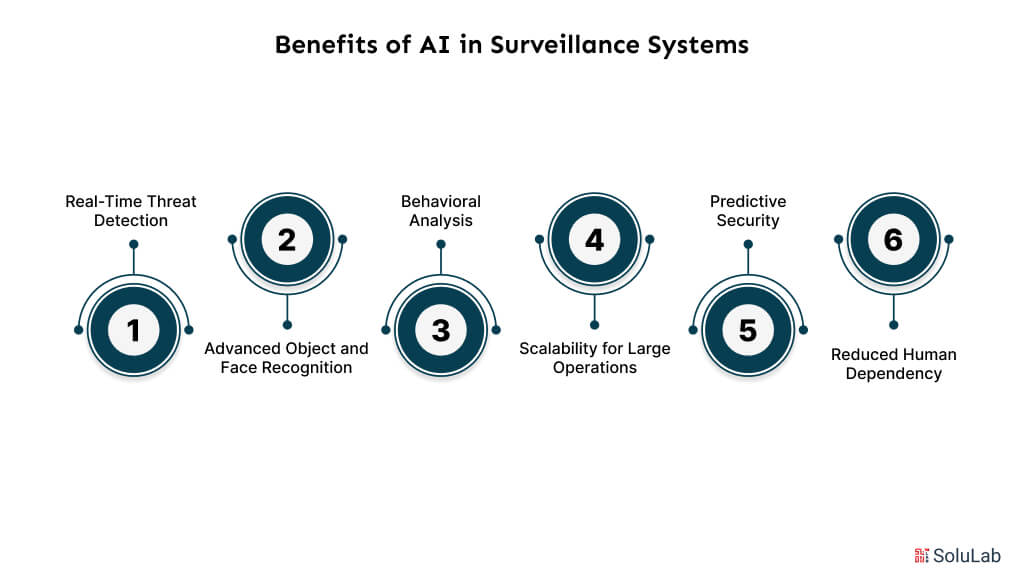
So what does a business actually get out of AI surveillance software? Here are the payoffs that tend to matter most:
Real-Time Threat Detection
The system catches trouble as it unfolds, not after. An unattended bag in a busy concourse. Someone lingering by a door they have no business near. An AI camera picks these up the moment they happen and pushes an alert out, so the people on shift can act while it still counts.
Advanced Object and Face Recognition
Faces. Vehicles. Even a specific object, like a weapon in someone’s hand. AI surveillance can pick out all of it. Progress in AI surveillance system technology pushes this further, letting the system spot a threat in real time and shave precious seconds off the response when they count most.
Behavioral Analysis
The system watches how people move and learns what normal looks like, so the abnormal stands out. Someone drifting into a restricted zone. Someone whose behavior just does not fit the room. Catching that early cuts risk and keeps the space safer.
Scalability for Large Operations
Think about an airport, a packed stadium, a corporate campus. Hundreds of cameras, all live at once. No human team can truly watch that many feeds. AI can. It reads them all in parallel, sorts the urgent from the routine, and puts the incidents that need a person in front of the security team first.
Predictive Security
Here is where it gets interesting. AI does not only report what is happening now. It reads the past and the present together and warns you about what might be coming, a likely break-in, an access attempt that fits a bad pattern, so you can head it off before it lands.
Reduced Human Dependency
People get tired. Attention drifts around hour three of a night shift, and that is exactly when something slips past. AI does not blink. It runs around the clock at the same level of accuracy, which means you need a smaller team to cover the same ground.
The Practical Impact of AI Surveillance Technology
Across a lot of industries, AI surveillance has quietly become the thing that makes monitoring useful instead of just present. The shift is subtle but real. Cameras used to capture footage. Now, backed by AI, they hand you insight, the kind that shapes a decision or prevents an incident. Here is what that looks like on the ground, sector by sector:
1. Retail Security and Customer Insights
Retail gets two things out of AI video surveillance, and they pull in different directions. One is security. The cameras catch shoplifting as it happens and cut the shrink that eats into a store’s margin. The other is business intelligence. The same feed reads how shoppers move, where they slow down, which aisles hold them and which they skip. Store owners take that data and rework the floor to improve customer experience.
2. Smart City Monitoring
A smart city runs on eyes it can trust, and AI security camera systems are those eyes. They track traffic, catch a car blowing a red light, and ping the authorities when there is a crash. They also flag a crowd getting too dense or something that just looks off in a public square, so officials can move before it turns into a problem. The payoff is twofold: safer streets, and smarter use of resources, rerouting traffic here, sending emergency crews there, exactly where they are needed.
3. Healthcare and Hospital Safety
In a hospital, the stakes are personal. AI surveillance watches over patients and staff alike. It notices when someone slips into a restricted ward, catches a patient falling, and alerts staff to an emergency the second it starts. During an outbreak it can monitor without contact, which keeps infection risk down while care carries on as normal.
Read Blog: Artificial Intelligence in Healthcare
4. Industrial and Manufacturing Efficiency
On a factory floor, safety and uptime are the same fight. AI surveillance handles both. It spots a worker skipping their protective gear, or someone wandering into a hazardous zone they should not be in. And it keeps an eye on the machines themselves, catching the early signs of trouble so maintenance happens before a breakdown, or an accident, forces the issue.
5. Educational Institutions
Schools and universities use AI surveillance to keep the campus a place where people can actually focus. The system watches for intruders, unknown visitors, and incidents on the ground, a fight breaking out, a case of bullying. Real-time alerts mean administrators are not finding out after the fact. They can step in while it is happening and keep students and staff protected.
6. Law Enforcement and Border Security
This is one of the clearest use cases. For police work and border control, facial recognition and behavioral analysis do the heavy lifting: identifying a suspect, following their movements, catching a threat as it forms. At a border, AI can sweep a large crowd fast, pick out a person of interest, and flag smuggling with accuracy a human eye would struggle to match.
7. Traffic Management and Road Safety
Out on the highways, AI surveillance keeps traffic moving. It finds the bottlenecks, catches violations, and picks up on a crash the moment it occurs. Some cities go a step further, using AI to read traffic patterns and adjust signal timing on the fly. Less congestion, safer roads, for the people driving and the ones crossing on foot.
8. Remote and Cloud-Based Monitoring
More and more, AI surveillance lives in the cloud, and that changes the geography of it. You can watch a dozen sites from one screen. For a company with locations scattered across a region, that is huge: one central view, decisions made in real time, no need to have someone physically at each door.
Applications of AI in Surveillance
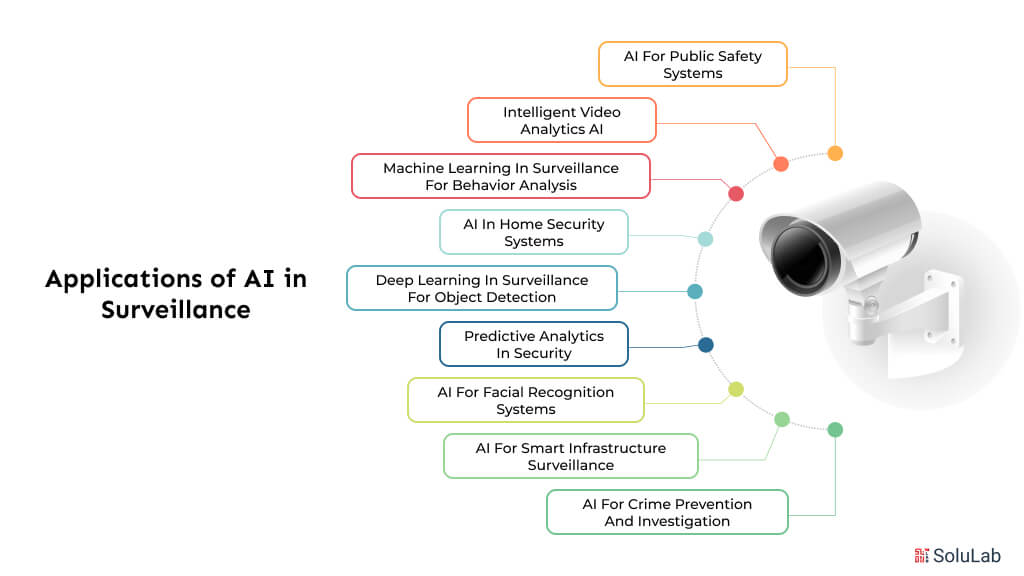
AI has worked its way into nearly every corner of surveillance, and the result is a system smart enough to keep up with what modern safety actually demands. Machine learning reads the footage. Deep learning handles the hard recognition tasks. Predictive analytics looks ahead. Put those together and AI applications in this space have expanded a lot, across sectors that used to have nothing in common. Here are the applications worth knowing:
1. AI for Public Safety Systems
In a city, public safety often comes down to seeing trouble before it spreads. That is what AI does here. Cities around the world now run smart surveillance with AI to catch suspicious behavior, overcrowding, or an emergency taking shape in a public space. It might read the traffic cameras to spot a violation, an accident, or congestion building up before anyone calls it in. The upshot is a faster response from police and emergency crews, which is the whole point.
2. Intelligent Video Analytics AI
Old-school security cameras still lean on a person to sit and review the tape by hand. Intelligent video analytics AI takes that job off their plate. The system processes and reads the feed on its own, which makes it a natural fit for watching restricted areas, catching unauthorized access, and picking up on movement that does not belong. When something predefined happens, say, a person crossing into a no-entry zone, it fires an alert. No one has to be glued to the screen for it to work.
3. Machine Learning in Surveillance for Behavior Analysis
Here is where it gets adaptive. Using machine learning in surveillance, the system learns the rhythm of a place over time, the normal flow of a mall on a Saturday, the usual quiet of an office after six. Once it knows that baseline, the odd stuff jumps out: someone loitering by an exit, erratic movement in a sensitive area. Spotting a risk before it turns into an incident, that is the real value.
4. AI in Home Security Systems
Home security got a lot smarter once AI came into it. Your camera can now tell the difference between a person, the neighbor’s cat, and a branch swaying in the wind, which means far fewer of those useless 3 a.m. alerts. With AI facial recognition it learns the faces it should know and only pings you when a stranger shows up. And because these setups plug into the rest of your smart home, you can check in or lock things down from your phone, wherever you happen to be.
5. Deep Learning in Surveillance for Object Detection
Deep learning in surveillance is what powers the harder detection work. Cameras running these algorithms can pick out a specific object in real time, a firearm, an abandoned bag, a particular vehicle. That matters most in places where a few seconds decide everything: airports, train stations, a stadium filling up before a game. Catch the threat fast, and you have a shot at preventing the incident entirely.
6. Predictive Analytics in Security
Systems built on predictive analytics in security mine the past to see the future. In an industrial setting, that might mean flagging a machine likely to fail, or an access attempt that matches a suspicious history. For law enforcement, the same logic points to where and when crime tends to cluster, so the people and resources can be there ahead of it rather than chasing it.
7. AI for Facial Recognition Systems
If you know one thing AI does in surveillance, it is probably this. Facial recognition is the most familiar of the use cases and applications of AI out there. AI for facial recognition systems shows up all over airports, border control, big public events, verifying who someone is and tightening security in the process. The system checks a face against a database of known people, which helps locate a suspect or keep tabs on a restricted area. It also runs the touchless entry systems in offices, letting in only the people who are supposed to be there.
8. AI for Smart Infrastructure Surveillance
The critical stuff, power plants, water facilities, transit networks, leans on smart surveillance with AI to stay running and stay safe. Interconnected systems keep watch and catch the anomalies: a machine overheating, a person on-site who should not be. When the service is essential, that early warning is the difference between a fix and a failure.
9. AI for Crime Prevention and Investigation
Police work runs on evidence, and AI is good at finding it in a haystack. Sift through a mountain of surveillance data and the system starts surfacing patterns, tracking one suspect as they cross from camera to camera, pulling together the footage that holds up in court. Predictive models point to the high-risk areas, which trims response times and, in the end, makes the public a little safer.
Key Technologies Driving AI in Surveillance
None of this runs on magic. A stack of specific technologies makes AI surveillance smart, quick, and dependable, each doing its part and handing off to the next. Together they give the system real-time eyes, the ability to read what it sees, and a sense of what comes next. Here is what is actually under the hood:
1. Machine Learning (ML)
Machine learning in surveillance is the backbone. It lets the system learn from data, spot patterns, and make a call without anyone hard-coding the rules. An ML model can flag unusual activity, name an object, and tell apart the normal from the suspect. And it sharpens as it goes, every new batch of footage makes the next judgment a little better.
2. Deep Learning
Deep learning, a branch of machine learning, runs neural networks over huge, messy piles of data like live video. In practice, deep learning in surveillance is what makes facial recognition, object detection, and behavior analysis actually work. A deep learning model can find one face in a packed crowd, or catch a weapon or a specific vehicle in the frame, in real time.
3. Computer Vision
Computer vision is how the system makes sense of what the camera sees. Point it at images and video and it reads movement, follows a person through a scene, and even notices the small shifts most eyes would miss. You will find it doing intrusion detection, guarding a perimeter, and reading license plates.
4. Natural Language Processing (NLP)
NLP does not touch the video, but it earns its place another way. natural language processing (NLP) works on the audio side, turning spoken words into something the system can act on. It can pick a threatening phrase or a suspicious keyword out of a recording, which adds a layer of security in a busy public space or during a big event where the sound matters as much as the picture.
5. Edge Computing
Edge computing does the thinking right where the data is born, at the camera or the sensor, instead of shipping everything to some far-off server first. That cuts the lag. An edge-enabled camera can read its own feed and fire an alert on the spot, no round trip required, which is exactly what you want when a second or two decides the outcome.
6. Internet of Things (IoT)
Internet of Things (IoT) ties the pieces together, cameras, sensors, alarms, into one connected web. The devices share what they see, and the AI reads across all of them at once instead of one feed at a time. That shared picture is what makes the whole system wider and sharper than the sum of its parts.
7. Big Data Analytics
A surveillance network throws off a staggering amount of data every single day. Big data analytics is how AI actually digests it, pulling out trends and patterns no person could ever catch by hand. Run at that scale, it can point to where crime concentrates, warn of a threat forming, and help put resources where they will do the most good.
8. Cloud Computing
Cloud computing supplies the storage and raw horsepower a modern AI surveillance system needs. Lean on it and you can crunch enormous volumes of data, reach your insights from anywhere, and scale up when the job grows. It also makes it far easier to bolt AI-driven analytics onto the infrastructure you already have.
9. Predictive Analytics
Predictive analytics reads yesterday and today to guess at tomorrow’s trouble. It shines in crime prevention: the AI spots the pattern that usually comes before criminal activity and gives the authorities the chance to move first, not react late.
10. Blockchain for Data Security
Blockchain is quietly becoming a fixture in AI surveillance, and its job is trust. By locking video footage and analysis into a record that cannot be quietly rewritten, blockchain technology blocks tampering and keeps everyone accountable. That matters a great deal when the footage is evidence, in law enforcement, in anything touching public safety.
Challenges and Ethical Concerns of AI in Surveillance Systems
AI has reshaped security, no argument there. But it drags a set of hard questions along with it, and pretending otherwise does no one any favors. Privacy. Bias. The plain limits of the technology. If AI is going to be used responsibly in surveillance, these are the things that have to be dealt with head-on, not swept under the rug.
1. Privacy Invasion
Start with the obvious one: privacy. A camera running artificial intelligence in CCTV can watch, without pause, spaces both public and private. Where is the line? The nonstop recording and analysis of what people do opens a real door to misuse, to sensitive data landing in the wrong hands. That is not a hypothetical risk. It is the central worry.
2. Misuse of AI for Facial Recognition Systems
AI for facial recognition systems draws a lot of fire, and for good reason. It is built to make people safer, but the same capability can be turned to mass surveillance or tracking someone who never agreed to it. There is also the accuracy problem. These systems have a documented habit of performing worse across different ethnicities, and when they get it wrong, the result is a biased outcome or a wrongful identification with real consequences.
3. Data Security Risks
All the data pouring out of AI in video surveillance has to live somewhere, and keeping it safe is no small task. A breach can spill sensitive footage or analysis into the open, and the fallout from that is serious. It gets riskier with the cloud: pushing intelligent video analytics AI onto centralized databases hands attackers a single, tempting target to go after.
4. Over-Reliance on Technology
AI in surveillance systems automates a lot, and that is the trap. Lean on it too hard and complacency sets in. The system can whiff on a strange scenario it never saw in training, the exact kind of edge case a person would clock instantly. Trust it blindly and you quietly strip out the human oversight that still makes the tough, in-between calls. That judgment is not optional yet.
5. Ethical Implications of Continuous Monitoring
Then there is the human cost of being watched all the time. Using artificial intelligence in CCTV for round-the-clock monitoring raises a fair question: how much is too much? Constant observation breeds distrust. In a workplace or a public square, people start to feel picked over, like they are under a scrutiny they never signed up for.
6. Regulatory Gaps
The tech moves faster than the law, and AI in video surveillance is a textbook case. It gets deployed well ahead of any rules that might govern it. Without a clear legal framework, no one is really on the hook for how the data gets collected, stored, or used. That vacuum lets surveillance spread unchecked, and unchecked is where misuse takes root.
7. Bias in AI Algorithms
An algorithm is only as fair as the data it learned from, and AI-powered surveillance inherits whatever bias sat in that data. Feed it a skewed history and it may start flagging certain groups as suspicious for no good reason. The result is unfair treatment, and worse, it cements the very inequalities it should have no part in.
8. Cost and Accessibility
Advanced tools like intelligent video analytics AI do not come cheap, and that price tag decides who gets to use them. Deep-pocketed organizations can afford it. Smaller outfits and developing regions often cannot, and so a gap opens up, one side gets AI-driven protection, the other gets left with a weaker version of security.
Types of AI in Machine Learning Security and Surveillance Systems
Not every surveillance setup is built the same. Here are the main types you will run into:
1. CCTV Systems: The classic. Analog cameras wired to a central recorder over coaxial cable, running nonstop in banks, shops, and public venues. It is stable and simple to stand up, which is why it stuck around. But it lacks the flexibility and the smarts of anything digital. Want more on this? Our blog has more examples of AI in banking.
2. IP Cameras: These are digital cameras that send video over a network, and the jump in quality over CCTV is obvious the moment you see the footage. Facial recognition, motion detection, remote access, they come standard, which is why businesses and homeowners keep reaching for them. Machine learning security and surveillance systems chew through the data these cameras produce in real time, and the threat detection gets sharper for it.
3. Access Control Systems: Pair these with your cameras and you have a handle on every door, who goes in, who comes out. The entry point might be a swipe card, a fingerprint, or a phone. And Machine learning security and surveillance systems sit on top, watching for the access pattern that does not add up.
4. Wireless Surveillance Devices: No cables. Wireless cameras beam video without them, which is a lifesaver anywhere running Ethernet would be a headache. You can stick one almost anywhere. The tradeoff: they can pick up interference from other devices, and they live or die by the strength of the network they are on.
5. DVRs and NVRs: Two recorders for two eras. DVRs (Digital Video Recorders) capture footage from analog cameras. NVRs (Network Video Recorders) are made for IP cameras. What you get for storage, playback, and remote access swings quite a bit depending on which model you buy.
6. Cloud-Based Surveillance: Here the video lives on remote servers, so viewing, sharing, and managing it is simple no matter where you are. No on-site storage box to buy or babysit, which cuts your hardware costs. And the footage stays encrypted both in transit and at rest, so security does not suffer for the convenience.
Real-World Examples of Companies Using Machine Learning Security and Surveillance Systems
Machine learning security and surveillance systems have done real work for real companies, better online safety, smoother operations, a clearer picture of what is happening on the ground. Here are a few names actually putting AI to use in their surveillance::
1. Amazon Go: You grab what you want and walk out. That is the whole idea behind Amazon Go’s “Just Walk Out” tech, which charges you automatically for what you took, no checkout line at all. Inside the 180-square-foot mini-market, AI-powered cameras and sensors keep track of who picked up what, and settle it in the background.
2. Tesla: Tesla puts AI to work on car security. Every vehicle carries cameras and sensors that watch for a break-in or anything suspicious around it, and the moment something registers, the system pings the owner. No waiting to find out later.
3. Google Nest: Google Nest brings AI to the front porch. Its cameras learn the unusual patterns and possible threats, then send a timely alert so a homeowner can keep an eye on the place from anywhere.
4. Changi Airport: Singapore’s Changi Airport runs AI-powered video analytics to keep passengers safe. It reads the crowd, catches unusual activity and unauthorized access, and makes managing all those people a far more controlled affair.
5. IBM: IBM sells AI-driven surveillance built for both security and productivity, across a wide range of industries. The analytics under the hood are tuned to catch threats without wasting time.
6. Hikvision: Hikvision builds AI video surveillance that is genuinely strong at image recognition and monitoring, the kind of system that lifts public safety and hardens commercial security. By baking machine learning security and surveillance systems into their products, these companies show, plainly, how much AI is reshaping the way security gets done.
Future of AI in Surveillance Systems
Where is this all heading? The future of AI in surveillance points toward security that is smarter, quicker, and far more predictive. As machine learning and computer vision keep maturing, these systems will stop merely watching and start stepping in, working to prevent an incident rather than just record it. The expectation is that predictive analytics will spot a threat before it materializes, reading historical and real-time data together. Picture an algorithm studying behavioral patterns to anticipate criminal activity in a given area, giving police the chance to act early. And as smart cities keep growing, these systems will knit themselves into the wider web of IoT devices, one intelligent network watching over public safety as a whole.
But there is a catch, and it is not a small one. The future asks for a real balance between what the technology can do and what it should do. The more capable AI gets, the louder the worries about privacy, misuse, and data security grow. Governments and companies will have to write clear rules, ones that let these systems protect the public without trampling the individual. There is some hope on the technical side too: privacy-preserving methods like anonymization and encryption could take the edge off the constant-surveillance problem. The real test is whether we can tap the enormous potential here and, at the same time, keep the public’s trust and answer the ethical questions honestly.
Conclusion
Step back and the shift is hard to miss. AI is rewriting how we handle security, monitoring, and public safety, one capability at a time. Real-time threat detection. Predictive analytics. Responses that are faster, more accurate, and, increasingly, ahead of the problem instead of behind it. And the reach goes well past security itself, into the day-to-day efficiency of retail, healthcare, law enforcement, urban management. The flip side stays true, though: as the tech matures, the ethical questions, data privacy, sensible regulation, individual rights, do not fade. They get more urgent. Getting the balance right is the whole job.
As a trusted AI development company, SoluLab builds practical, inventive solutions that get real mileage out of artificial intelligence. Take Gradient, one of ours: a platform that pairs stable diffusion with GPT-3 to produce sharp, accurate image and text content. It runs on a solid tech stack, hosted on Amazon Web Services (AWS), and it is a fair snapshot of how we like to build, reliable and ready to scale. We bring that same experience to surveillance, designing systems tailored to how a business actually runs, so they fit the operation, lift its performance, and never leave the ethics as an afterthought.
AI surveillance has a genuinely promising road ahead, but the promise only pays off if the technology is built to meet a real need. At SoluLab, that is the point. We make solutions that solve today’s problem and still have room to grow into tomorrow’s, smarter systems, better decisions, always with function and practicality first. The aim is simple to state and harder to do: keep these AI-driven systems effective, ethical, and easy to use, so they deliver something that actually matters, safer, more secure places to work and live.
FAQs
Shipra Garg is a tech-focused content strategist and copywriter specializing in Web3, blockchain, and artificial intelligence. She has worked with startups and enterprise teams to craft high-conversion content that bridges deep tech with business impact. Her work translates complex innovations into clear, credible, and engaging narratives that drive growth and build trust in emerging tech markets.