
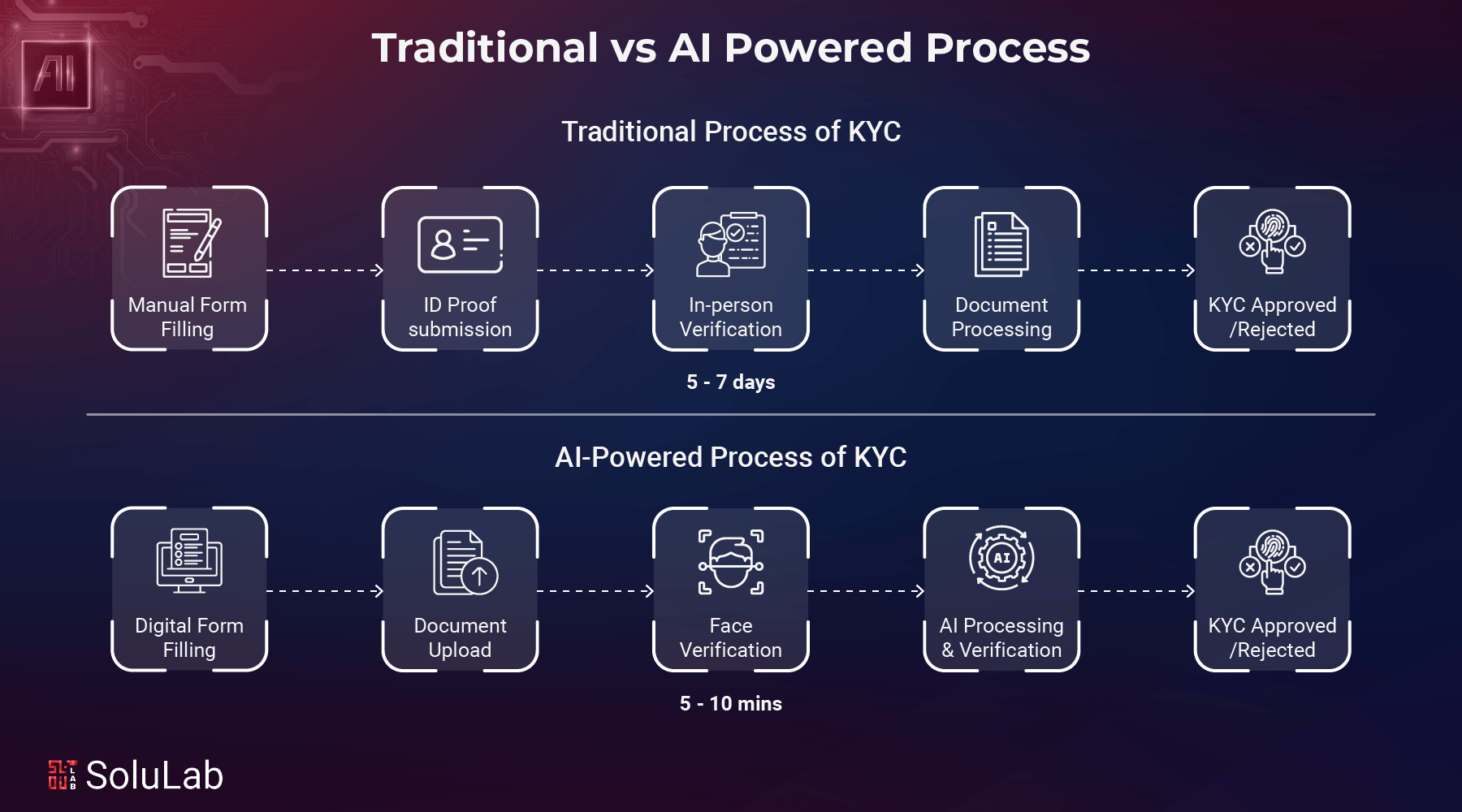
AI in KYC (Know Your Customer) is reshaping how banks onboard clients and stay on the right side of AML regulations. The change is significant enough that it has touched both the front end of customer experience and the back-end compliance machinery that financial institutions depend on.
Over the last decade, technology, especially artificial intelligence and, more recently, generative AI chatbots, has fundamentally changed what a KYC analyst actually does day-to-day. A decade ago, that role was mostly manual: sifting through client profiles, cross-referencing data, verifying ID documents by hand, screening adverse media, and tracking a regulatory rulebook that never stopped changing. It was slow, expensive, and built for a much simpler world.
So how exactly is AI for KYC closing those gaps, and what does that mean for traditional compliance workflows? That’s what this piece breaks down.
Evolution of KYC
KYC did not appear overnight. It developed in response to real criminal activity, evolving each time regulators identified a gap that bad actors were already exploiting. A few phases stand out:
1. Regulations
The US Bank Secrecy Act of the 1970s was the first major push, requiring financial institutions to keep records of cash purchases of negotiable instruments. The Bank of England followed with comprehensive KYC requirements in the 1990s.
The Financial Action Task Force (FATF) then anchored KYC firmly around money laundering and terrorism financing, turning it from a local requirement into a global standard. Know Your Customer regulations became a shared obligation, not a jurisdiction-by-jurisdiction patchwork.
Early KYC compliance was entirely paper-based. Banks verified identity documents by hand. The process was slow, yes, but the volume of financial activity at that time made it manageable, barely.
2. Essential Requirements for KYC Processes
September 11, 2001 changed the conversation entirely. Regulators worldwide launched a hard review of KYC procedures. The US Patriot Act imposed stricter obligations on American financial institutions, including mandatory Customer Identification Programs (CIP). The scope of KYC widened beyond terrorism financing to cover a broader range of financial crimes. And for the first time, digital KYC compliance technologies began appearing in the market.
3. KYC Compliance Systems
The early 2000s brought the internet, better data analysis tools, and a regulator community that was no longer willing to accept “we checked the paperwork” as compliance. Specialist KYC compliance platforms emerged. The infrastructure that modern AI-powered KYC tools now build on traces directly back to this period.

Limitations of Traditional KYC Processes
The problems with traditional KYC are not subtle. They show up as direct costs, regulatory fines, and lost customers. Here is what the data actually shows:
Financial institutions spend considerable sums each year running KYC operations, especially during new client onboarding. Annual KYC spend across the industry reaches into the hundreds of millions, with individual institutions allocating between $20 and $30 million to build and maintain their programs.
For corporate clients specifically, 54% of banking institutions report that a single KYC review costs between $1,500 and $3,000. For 21%, that figure goes above $3,000 per client.
When traditional systems miss something, the consequences land hard. Both regulatory penalties and reputational damage tend to follow.
In 2018, the Commonwealth Bank of Australia paid AUD 700 million (roughly USD 530 million) in penalties after failing to monitor more than 778,000 accounts that were being used for money laundering. The case became a textbook example of what happens when legacy systems cannot keep pace with sophisticated financial crime.
And then there is the customer experience problem. Manual KYC takes time, and that time costs you customers. Research shows that slow, difficult onboarding causes banks to lose a meaningful share of loss of 48%. By the time the process completes, the customer has sometimes already gone elsewhere.
Digital eKYC addresses both friction and speed. Better process, faster completion, higher completion rates.
Old KYC approaches also leave institutions exposed to financial crime in ways that are hard to defend in front of a regulator. A Missouri bank lost more than $1.1 million through suspicious transfers that went undetected because anti-money laundering regulation enforcement was inadequate. The resulting penalties made the cost of inaction very clear.
How is AI in KYC Filling the Gaps?
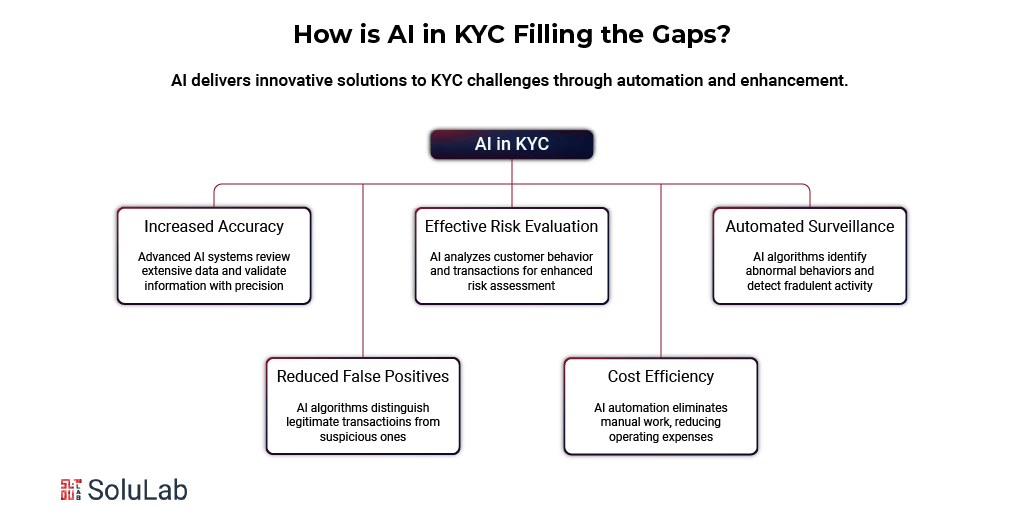
AI in banking offers a direct answer to the problems described above. Here are the five core areas where AI in KYC makes a practical difference for banking institutions.
1. Increased Accuracy for Identification
Advanced artificial intelligence systems process large data sets against complex algorithms and machine learning models to validate customer information with far greater precision than a manual check allows. The result: fake documents get caught more reliably, and the error rate on legitimate verifications drops significantly.
2. Effective Evaluation of Risks
AI for KYC processes pulls from customer behavior and transaction histories to run risk assessments that a human analyst working alone simply could not replicate at scale. Patterns that suggest money laundering, unusual transaction clusters, or links to high-risk individuals get surfaced in real time, giving institutions the ability to respond before the situation escalates.
3. Automated Surveillance and Notifications
Catching money laundering schemes requires continuous observation, not periodic reviews. AI algorithms watch financial activity across the full customer base simultaneously, flagging behavioral anomalies the moment they deviate from established patterns. This matters in practice: teams get an alert when something is off, not six weeks later during an audit.
4. Cutting Down on Faulty Positives
Traditional KYC systems generate a lot of false positives. Legitimate transactions flagged as suspicious, compliance teams buried in alerts that lead nowhere. AI cuts through that noise by getting better at distinguishing genuine risk from normal activity. Fewer false alarms means compliance staff spend their time on cases that actually warrant attention, and customers see less unnecessary friction.
5. Efficiency in Terms of Cost
Automating the repetitive, rules-based parts of KYC removes a large manual overhead. financial organizations that adopt AI-powered KYC technology cut operating costs by reducing headcount requirements for routine verification work, while freeing those same analysts for higher-judgment tasks.
Read Also: Generative AI in Payments
A Stronger Basis for AI in KYC
AI in finance opens the door to better customer experiences, sharper decision-making, and stronger operational results. But that potential only materializes when three things are in place: quality data, well-designed processes, and human oversight.
The Significance of Superior Data
AI is only as reliable as the data it works with. Incomplete or inaccurate inputs produce unreliable outputs, and that is a compliance risk in its own right. A well-architected data fabric, one that connects and standardizes data across the organization, gives AI systems what they actually need to function well. AI models that build on consistent, clean data pipelines see better fraud detection and stronger compliance monitoring as a direct consequence.
Robust Mechanisms for Mixed Autonomy
AI in KYC currently operates in a “mixed autonomy” model: machines handle the high-volume, rules-based work, while humans retain authority over complex calls. In practice, this works when the routing is deliberate. Tasks need to flow to the right decision-maker, whether that is an automated system or a senior analyst, with minimal friction. Getting that handoff right is where a lot of implementations stumble.
Involvement of People
AI handles pattern recognition at scale. It does not handle ethical judgment, regulatory interpretation, or the kind of context that comes from experience. Institutions that treat AI as a replacement for their analysts rather than a tool for them tend to create new risk while reducing old costs. Human expertise remains the check on AI outputs, not an optional layer.
Together, these three foundations, quality data, process architecture, and human judgment, determine whether an AI implementation actually performs or just looks good in a pitch deck. Institutions that get all three right are better positioned for regulatory change, operational efficiency, and genuine risk reduction.
Step-by-Step Process of AI-Powered KYC Verification
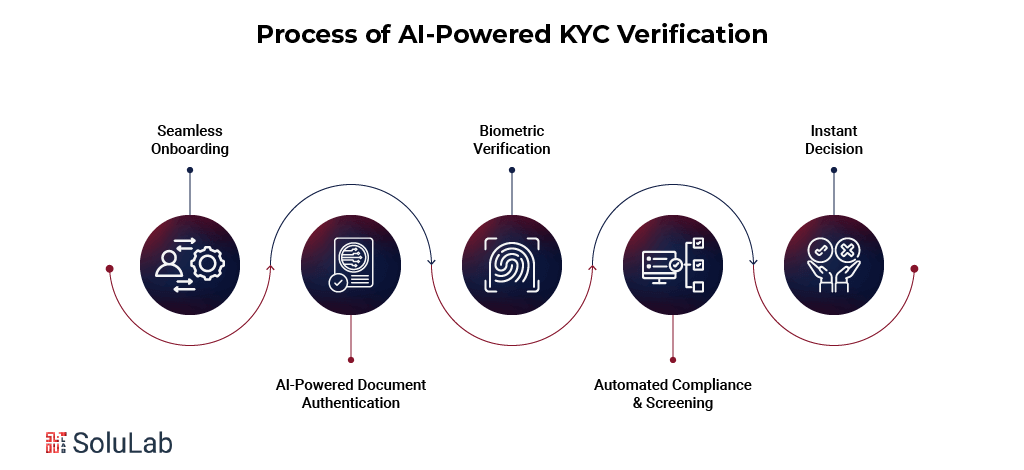
AI-powered KYC verification handles identity authentication faster and more accurately than manual processes. Here is how it actually works, step by step:
1. Seamless Onboarding
Users begin by submitting personal details and uploading government-issued identification through a secure digital interface. No branch visit, no paper forms.
2. AI-Powered Document Authentication
AI-Powered chatbots analyze each ID document for authenticity, checking security features like holograms, watermarks, and microtexts to catch any signs of forgery.
3. Biometric Verification
The user takes a real-time selfie or short video. AI-driven facial recognition matches it against the submitted ID, and liveness detection blocks spoofing attempts using deepfakes or static images.
4. Automated Compliance & Screening
AI tools cross-reference user data against global databases: government watchlists, AML lists, and fraud detection networks. Risk levels get assigned automatically, not manually.
5. Instant Decision
Low-risk users are onboarded immediately. High-risk cases go to manual review. And from that point forward, AI-powered monitoring keeps watching, so compliance does not end at onboarding.
The Search for Alternate Systems
Not every sector runs through the same KYC playbook. Some industries are actively looking for alternative verification approaches, driven by pressure to speed up onboarding and reduce friction without creating new compliance gaps.
Casinos Without Verification
No-verification casinos have emerged in online gaming as one response to this pressure. These platforms let users skip the standard KYC protocols that regulated online casinos follow, relying instead on cryptocurrency transactions to keep personal data collection to a minimum.
The appeal is speed and privacy. The challenge is regulatory: platforms that bypass traditional verification still need to show they are not facilitating money laundering or other financial crimes.
Peer-to-Peer Platforms
Online marketplaces and P2P systems often use lighter verification approaches, relying on social authentication or collecting limited identity data rather than running a full KYC check. This keeps onboarding fast and accessible.
In the gig economy especially, this model has found traction. Third-party identity checks keep the platform clean while avoiding the friction of a full compliance workflow. Done right, it builds trust without blocking users at the door.
Related: Best P2P Crypto Exchanges
Digital wallets and Currencies
Digital currencies and wallets backed by blockchain technology take a different approach to verification. On some platforms, wallet addresses serve as a user’s identifier, replacing traditional personal data collection.
That provides a degree of privacy and operational efficiency. But it does not eliminate KYC requirements for regulated organizations. In practice, smart contracts are frequently used by decentralized finance platforms to enforce compliance standards, with the technology itself often doing the work that document verification traditionally handled.

Future of AI in KYC
AI will not replace KYC analysts. It will change what those analysts spend their time on. As AI tools take over the repetitive, high-volume verification work, the analysts themselves shift toward higher-stakes decisions: edge cases, regulatory interpretation, situations where experience and judgment matter more than processing speed. Smart KYC platforms are already being built with this division of labor in mind, developing advanced AI tools that expand AI capabilities while keeping human analysts at the center of the decisions that count.
Where this is already playing out: GenAI-assisted profile monitoring, automated extraction of relevant data points from large document sets, and continuous compliance review that runs in the background without needing a human to trigger it. AI handles the administrative layer. The analyst handles the judgment call. That split is only going to sharpen as the tools mature.
The Final Word
AI is not a future consideration for KYC compliance. For institutions still running manual verification at scale, the cost gap between their approach and an AI-powered one is already significant, and the detection gap is worse. The question is not whether to integrate AI into KYC workflows, but how quickly you can do it without introducing new risk in the process.
AI in KYC delivers on three fronts simultaneously: lower operating costs through automation, better fraud detection through continuous monitoring, and faster onboarding through instant verification. Institutions that get this right also become easier to adapt when regulations shift, because the system learns and adjusts rather than requiring a manual overhaul. SoluLab has worked directly in this space, and recently delivered an AI in KYC solution for a client from Libya. It is an AI-powered banking application that handles KYC alongside a broader set of banking operations.
SoluLab has a proven track record as an AI Development Company, with a long list of AI integrations across regulated industries. If you are building toward that future and want to move faster with less guesswork, talk to the team.
FAQs
Shipra Garg is a tech-focused content strategist and copywriter specializing in Web3, blockchain, and artificial intelligence. She has worked with startups and enterprise teams to craft high-conversion content that bridges deep tech with business impact. Her work translates complex innovations into clear, credible, and engaging narratives that drive growth and build trust in emerging tech markets.