


.svg) 01
Maturity assessment (2 to 4 weeks)
Interviews, document review and a scored maturity level, using the governance and risk dimension of our readiness assessment.

SoluLab's AI governance consulting turns responsible AI from a policy document into working controls: risk classification, acceptable use policies, model monitoring, audit logs and human review, built into your AI systems and mapped to the EU AI Act, NIST AI RMF and ISO/IEC 42001. Start with a free AI readiness assessment.













AI governance is the set of policies, roles, processes, and technical controls that decide which AI systems an organization builds or buys, how their risks are assessed, and how they are monitored and corrected over time. Good governance makes AI safer, more compliant, and easier to scale, because every team follows the same rules.
Most companies already have a policy. What they lack is enforcement: a register of every AI system in use, a risk tier for each, named owners, and controls inside the software that stop a model from seeing data it shouldn't. For a step-by-step view, see our guide to enterprise AI security and governance, or start with our broader AI consulting services.
Data governance controls the data itself: quality, ownership, access, and retention. AI governance covers what's done with it: which models may use which data, how decisions are tested for accuracy and bias, who approves deployment, and how models are monitored. You need both, and AI governance pepends on data governance being in place.
SoluLab's AI governance consulting services cover strategy, policy, and engineering: governance framework and roadmap design, AI risk assessments, acceptable use policies, EU AI Act and ISO 42001 readiness, model risk management, generative AI and agent governance, AI audits and red teaming, and technical controls built into your AI stack.

We assess your maturity, set up an AI governance committee with clear roles, and deliver a phased roadmap tied to your AI portfolio. It starts with our free AI readiness assessment, which includes a governance and risk dimension.
We build a register of every AI system you build or buy, then classify each by risk using EU AI Act tiers and the NIST AI RMF, so effort goes where exposure is highest.
We write an AI governance policy and an employee acceptable use policy that people can follow: approved tools, banned data, review rules and escalation paths. The policy maps to the controls we build, so it's enforceable.

We map your systems to EU AI Act obligations by role (provider or deployer) and deadline, and structure your AI management system so it's ready for ISO/IEC 42001 certification audits.

Model cards, validation, bias and accuracy testing, approval gates and drift monitoring for every model in production, with documentation that stands up to AI risk management reviews in finance and insurance.
Guardrails, prompt-injection defenses, PII masking, tool permissions and human approval steps for LLM apps and agentic AI, where a model can take actions, not just give answers.
Independent review of existing AI systems against your policy and target frameworks, plus adversarial red-team testing for jailbreaks, data leakage and harmful outputs, with a prioritized fix list.
We implement the controls your policy promises: role-based access, audit logs, data residency, monitoring dashboards and incident response for AI, the same controls running in our One Wallet copilot.

Start the free 3-minute AI readiness assessment, which includes a governance and risk dimension.
Book NowSoluLab's AI governance framework has four layers that build on each other: oversight (committee, roles and policy), inventory and risk classification, controls built into data, models and applications, and continuous monitoring with audit evidence. Each layer maps to the EU AI Act, NIST AI RMF and ISO/IEC 42001, so one program serves all three.
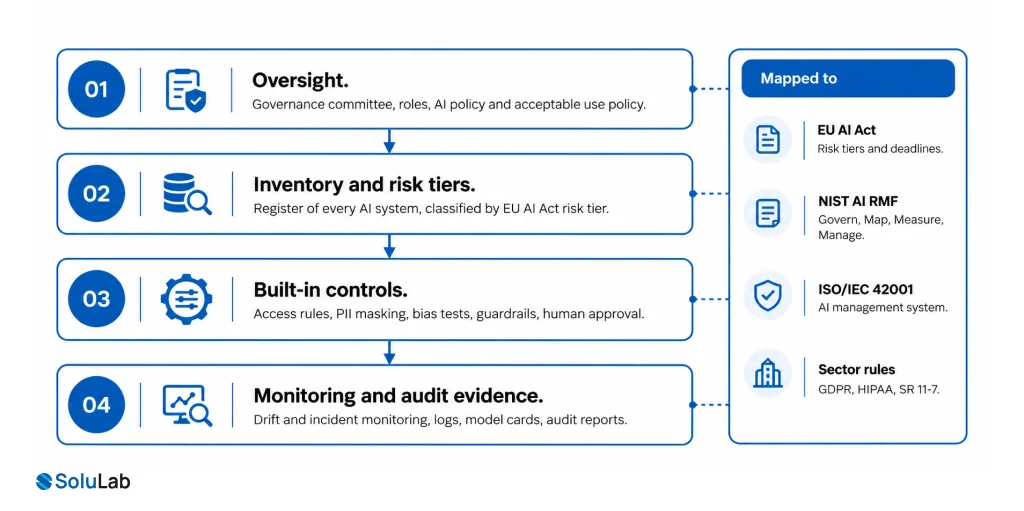
Layer 3 is where most programs stall: the policy says one thing, but nothing inside the AI system enforces it.
An AI governance maturity model shows how far your program has come, from ad hoc AI use with no inventory to governance that is automated and continuously improved. Only 27% of organizations call their AI governance fully mature, so most have work to do on controls and monitoring, not just policy.
 1. Ad hoc
 2. Defined
 3. Managed
 4. Enforced
 5. Optimized
Schellman's 2026 survey found 57% of organizations have a formal AI governance policy, but only 44% have AI-specific incident response procedures, which is the typical gap between levels 2 and 4.
Most organizations need to align with several AI frameworks at once. SoluLab maps one set of controls to the EU AI Act, the NIST AI Risk Management Framework, ISO/IEC 42001 and sector rules such as GDPR, HIPAA and SR 11-7 model risk guidance, so evidence is produced once and reused across audits.
 EU AI Act (Regulation (EU) 2024/1689, amended by 2026/1744)
 NIST AI RMF 1.0
 ISO/IEC 42001:2023
 GDPR, HIPAA, SOC 2
 SR 11-7 (US banking)
Fines for prohibited AI practices under the EU AI Act reach €35 million or 7% of worldwide annual turnover, whichever is higher. We provide technical and process guidance, not legal advice; your counsel confirms which obligations apply. Related: our explainer on AI TRiSM, Gartner's trust, risk and security management model.
A SoluLab AI governance engagement runs in five steps: maturity assessment, AI inventory and risk classification, policy and framework design, technical controls implementation, and monitoring with audit readiness. A typical first phase delivers a working framework and covers the highest-risk systems in 8 to 12 weeks.
01
Interviews, document review and a scored maturity level, using the governance and risk dimension of our readiness assessment.
 02
Every AI system you build or buy, registered and tiered.
 03
Governance policy, acceptable use policy, committee charter and AI governance roadmap.
 04
Access rules, logging, guardrails, bias tests and approval steps implemented in the highest-risk systems first.
 05
Dashboards, incident response, model documentation and an evidence pack mapped to your target frameworks.
AI governance consulting with SoluLab typically starts with a $5,000 to $20,000 readiness and maturity assessment over 2 to 4 weeks. Framework and policy design, risk classification, and technical controls are scoped from there, and ongoing monitoring and audit support can run as a monthly retainer.
| Engagement | What you get | Typical cost | Typical timeline |
|---|---|---|---|
| AI readiness check | Score across 8 dimensions, including governance and risk | Free | 3 minutes |
| Readiness and maturity assessment | Maturity level, AI inventory, gap report | $5,000 to $20,000 | 2 to 4 weeks |
| Discovery workshop | Governance roadmap with leadership | $10,000 to $25,000 | 1 day plus report |
| Framework, policy and risk classification | Policies, committee charter, risk register | $15,000 to $30,000 | 4 to 8 weeks |
| Technical controls implementation | Controls built into priority AI systems | $20,000+ | Scoped per system |
| Monitoring and audit support | Ongoing monitoring, reviews, evidence updates | $15,000+ | Ongoing |
Assessment and workshop prices match SoluLab's published AI consulting rates; governance-specific bands aren't published yet. Cost depends on the number of AI systems, how many are high-risk, the frameworks you report against and how much control work sits inside your applications.
Governance runs on tooling as well as policy. SoluLab implements controls with the platforms you already use, such as Azure AI Content Safety, AWS Bedrock Guardrails, MLflow model registries, LangSmith tracing and Datadog monitoring, and can integrate dedicated AI governance platforms when you need a central inventory and workflow.
 AWS Bedrock Guardrails
 Azure AI Content Safety
 Custom input and output filters
 Custom masking pipelines
 Role-based access
 SSO
 LangSmith
 Application audit logs
 MLflow
 Model cards
 Datadog
 Drift monitoring and Quality dashboards
 Dedicated AI governance platforms
 GRC tool register
AI governance matters most where AI decisions affect money, health or rights. SoluLab supports governance programs in banking and fintech, insurance, healthcare, HR and recruitment, public sector suppliers, and SaaS companies selling AI features to enterprise buyers who now ask for governance evidence in security reviews.
Each program is shaped by the sector's regulators and the decisions its AI makes.

Model risk management under SR 11-7, explainable credit and fraud decisions, and governed support copilots.


Fairness testing and documentation for underwriting and claims models.


HIPAA-aligned data controls and human review for clinical and patient-facing AI.


Bias audits and transparency for hiring tools, an EU AI Act high-risk category.


AI inventories, impact assessments and audit evidence for government buyers.

Governance evidence packs that answer enterprise security questionnaires about your AI features.
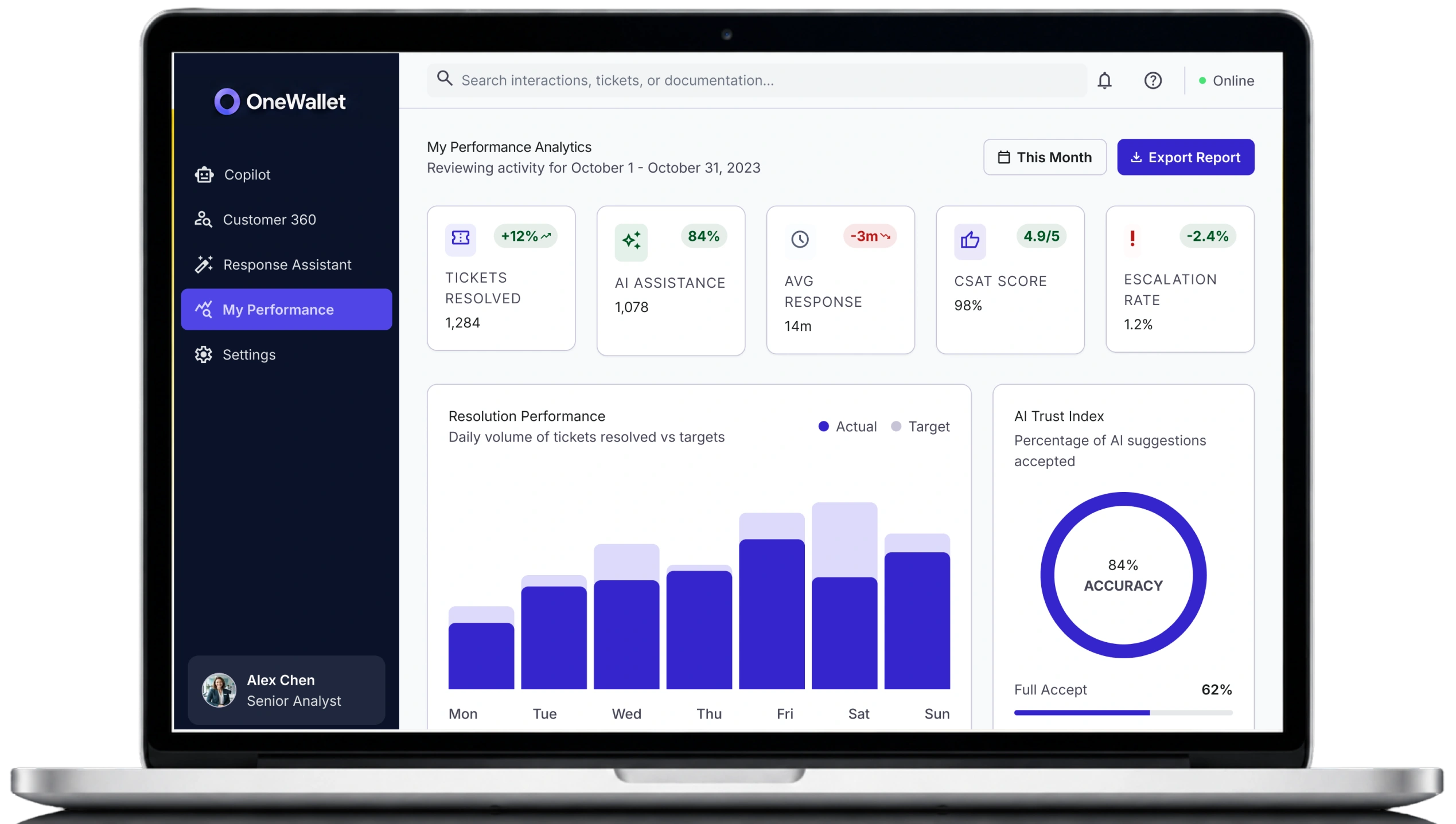
SoluLab's governance work runs inside production AI: a compliance-governed support copilot for One Wallet with PII masking, role-based access and full audit logs that cut ticket load by 72%, 14 autonomous agents for UpdateIA operating under human review, and AI-powered KYC onboarding for Amanbank in regulated banking.
 AI SUPPORT COPILOT
Compliance-Governed AI Support Copilot
One Wallet, a payments platform with 1.8M+ users, needed AI help for 60K+ monthly support requests without exposing customer financial data. SoluLab built governance into the copilot: a privacy pipeline that masks PII and validates data before it reaches the LLM, role-based access control, compliance-governed retrieval over 50K+ policy and support documents, and logging of every AI response, API call and retrieval source for audit.
 AGENT GOVERNANCE
Governed Autonomous AI Agents
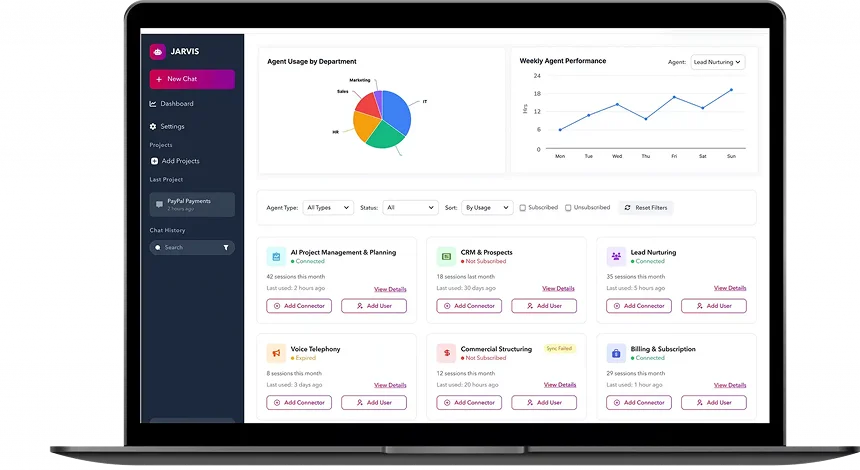
UpdateIA wanted repetitive enterprise workflows automated without losing control over how tasks were carried out. SoluLab scoped which workflows were safe to automate and deployed a coordinated system of autonomous AI agents, with people reviewing outcomes instead of doing each step, the core control pattern for agent governance.
 REGULATED BANKING
AI in a Regulated Banking Journey
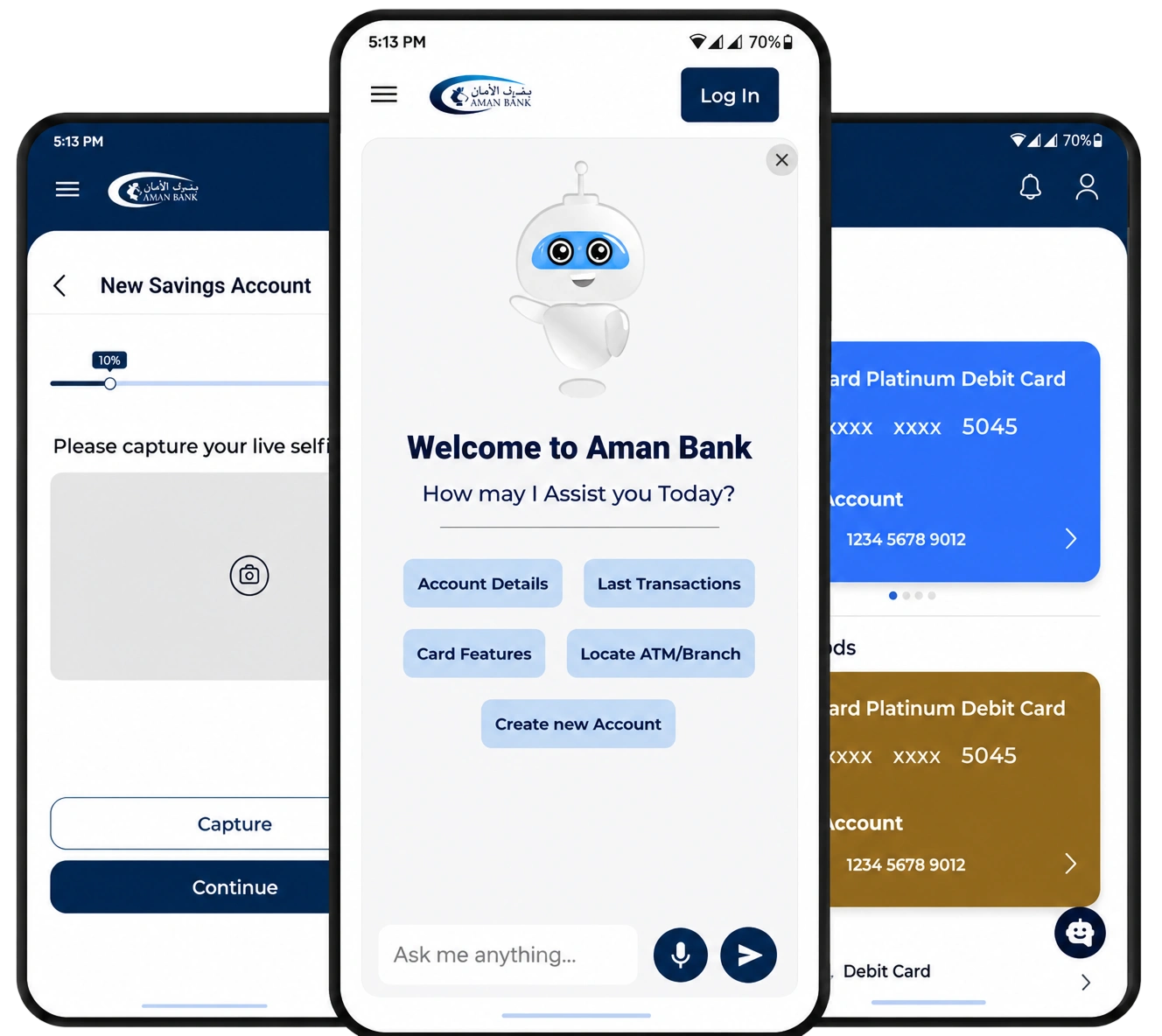
Amanbank, with about 750,000 customers, needed faster onboarding without weakening KYC. SoluLab delivered AI-powered onboarding with digital KYC, OCR document identification and digital signing, plus a generative AI chatbot and voice assistant inside the bank's mobile apps.

It tells every team which uses are safe to ship today, which need review, and which shouldn't happen at all. Let's find out where you stand.
Take the free AI readiness assessmentEnterprises choose SoluLab for AI governance consulting because we're engineers as well as advisers: we write the policy and then build the controls that enforce it inside your AI systems. You get one program mapped to the EU AI Act, NIST AI RMF and ISO/IEC 42001, published assessment pricing and a Clutch rating of 4.9.

The people who write your acceptable use policy also build the access rules, masking and logging that enforce it.
Our One Wallet copilot logs every AI response, API call and retrieval source, and masks PII before data reaches the model.

A single control set mapped to the EU AI Act, NIST AI RMF, ISO/IEC 42001, GDPR, HIPAA and SR 11-7.

Plans reflect Regulation (EU) 2026/1744, which moved high-risk deadlines to December 2027 and August 2028.

We've put 14 autonomous agents into production for UpdateIA with human review of outcomes.

Clear risk tiers and approval paths let low-risk use cases ship without waiting on a committee.

"Chintan spent about a decade at Goldman Sachs as a Vice President, working inside one of the most tightly regulated risk environments in finance, before co-founding SoluLab. He brings that model-risk discipline to every AI governance engagement, reviewing risk classifications, approval gates and audit evidence before they reach a client."
SoluLab helped us bring AI directly into the banking experience. From customer onboarding and account assistance to money transfers and card requests, the AI chatbot and voice agents gave customers a much faster way to complete everyday banking tasks. The solution helped us reduce onboarding time while taking significant pressure off our support teams.

CEO, Amanbank
SoluLab successfully delivered the AI automation system we needed for our FinTech platform. Their team understood how to translate complex business workflows into practical AI agents and worked closely with us throughout development. The result was a much more streamlined approach to automating tasks that previously required significant manual effort.

Co-Founder, FinTech Platform
SoluLab brought together document intelligence, predictive analytics, and a practical decision workflow. The solution gave our team a structured way to evaluate engine condition, value, and purchase risk.

Managing Partner, Aviation Gateway
AI governance is the set of policies, roles, processes and technical controls that decide which AI systems an organization uses, how their risks are assessed, and how they are monitored and corrected. It covers fairness, transparency, privacy, security and accountability, and it is how organizations meet rules such as the EU AI Act.
Data governance manages the data itself: quality, ownership, access and retention. AI governance manages what AI systems do with that data: which uses are allowed, how models are tested for accuracy and bias, who approves deployment and how outputs are monitored. AI governance depends on sound data governance underneath it.
An AI governance consultant assesses your current maturity, builds an inventory of AI systems, classifies their risk, writes governance and acceptable use policies, sets up a governance committee, and maps controls to regulations. Engineering-led consultants like SoluLab also implement the technical controls, monitoring, and audit evidence inside your AI systems.
Consulting firms turn ethical principles into operating rules: fairness and bias testing for models, transparency and explanation requirements, human review for high-impact decisions, and escalation paths when something goes wrong. They also align those rules with regulations and set up the committee, metrics and audits that keep the program running after the consultants leave.
AI governance consulting is offered by large consultancies and audit firms, specialist responsible-AI advisers, and engineering-led AI firms such as SoluLab. Large firms suit board-level programs across many countries; specialists suit policy and audit work; engineering-led firms suit companies that need the controls built into their AI systems, not only documented.
An AI governance framework is the structure an organization uses to govern AI: oversight roles and policies, an inventory and risk classification of AI systems, technical controls such as access rules and bias tests, and ongoing monitoring with audit evidence. Most frameworks map to the NIST AI RMF functions of Govern, Map, Measure and Manage.
An AI acceptable use policy should list approved AI tools, data that must never be entered into them, tasks that need human review, rules for disclosing AI-generated content, how to request a new tool, and who to contact when something goes wrong. Keep it short enough that employees actually read it, and enforce it with technical controls.
Under Regulation (EU) 2026/1744, which amended the EU AI Act in July 2026, obligations for stand-alone high-risk AI systems in Annex III, such as hiring, credit and education, apply from 2 December 2027. High-risk AI in regulated products under Annex I applies from 2 August 2028. Prohibited practices have applied since February 2025.
Not legally, but it's increasingly requested. ISO/IEC 42001, published in December 2023, is a certifiable standard for AI management systems. Enterprise customers and procurement teams use it as evidence of mature governance, and building to it helps with EU AI Act readiness. Many organizations build to the standard first and certify later.
With SoluLab, a readiness and maturity assessment typically costs $5,000 to $20,000 over 2 to 4 weeks, and a leadership discovery workshop $10,000 to $25,000. Framework design, risk classification and technical controls are then scoped by the number of AI systems, how many are high-risk and which frameworks you report against.
A maturity assessment takes 2 to 4 weeks. A first phase that delivers a working framework, policies, risk classification and controls on the highest-risk systems typically takes 8 to 12 weeks. Full coverage across a large AI portfolio, with monitoring and ISO/IEC 42001 readiness, usually runs several months longer.
Ask how they classify AI risk across use cases, which frameworks they map to, whether they implement technical controls or only write policy, what monitoring continues after deployment and how they handle regulatory changes. Ask for a governed AI system they built that's running in production, and check that their plans reflect the latest EU AI Act dates.