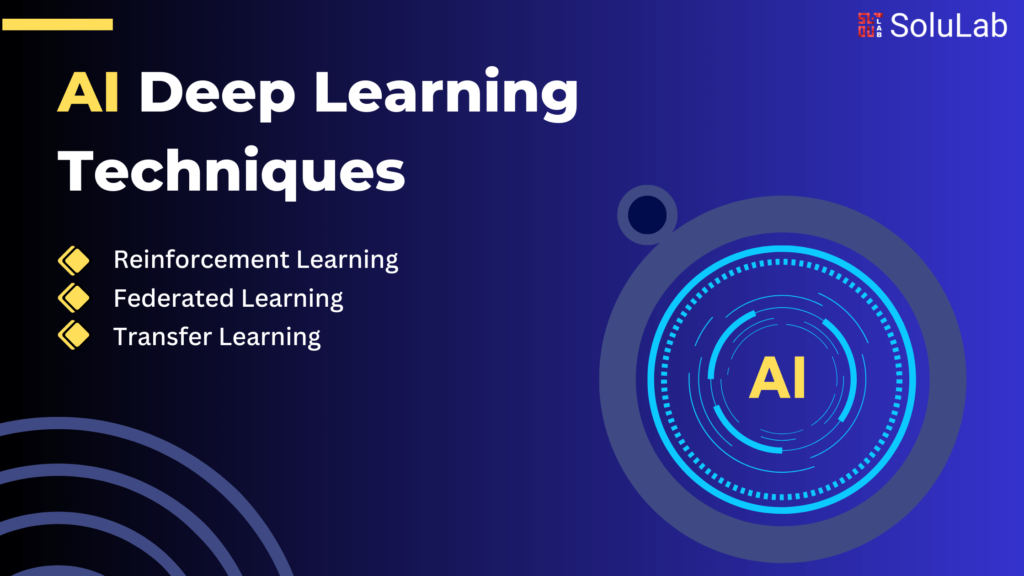
Deep learning is one slice of artificial intelligence (AI), and it has never sat still. It broke the older machine learning playbook, then kept rewriting itself every time the demands on it changed. Now it’s 2025. The trends worth your attention are the ones already changing how AI and machine learning get built, so those are the ones this piece deals with.
Start with federated learning. The idea is simple to state and hard to build: train the model without moving the data. Everything stays where it was generated, on local devices or on servers the owner controls. Organizations still get the benefit of what all that data collectively knows, without handing any of it over. Does that settle the privacy question completely? No. But it’s a serious dent in it, and it stretches what machine learning can be pointed at.
Why does this matter outside a research paper? Because deep learning keeps turning up where money and lives are on the line. Hospitals. Banks. Cars that drive themselves. The recommendation feed you scrolled through this morning. None of it is whiteboard theory anymore; teams ship it and businesses run on it.
Reinforcement learning earns its own mention here. Machines that learn by trying, failing, and adjusting.
What Key Advantages and Challenges Does Federated Learning Present in the Context of Deep Learning Trends?
Falling behind on deep learning trends costs more than bragging rights. Several cutting-edge techniques are converging right now, and that combination is what’s reshaping AI and machine learning work through 2025. Federated learning sits near the front of the group. Below: what it actually is, how it fits the wider trend picture, and why it keeps coming up the moment a company sits down to plan a machine learning project.
A. Concept and Basics
Federated learning is decentralized by design. Privacy and data security come first, and you still get the value of many datasets pooling what they know. The traditional setup ships everything to one central store and trains there. Federated learning flips that: models train locally, on the device or server where the data already lives, and the raw data never travels.
What travels instead is the learning. Those local models pass up what they’ve worked out, and the pieces get aggregated into one global model. It lines up neatly with where deep learning is heading: privacy first, security first, training spread out rather than piled into one place.
B. Applications in Real-World Scenarios
Federated learning shows up in a lot of different places, which tells you something about how adaptable it is. Take healthcare. Several hospitals can build a shared predictive model together, and no patient record ever leaves any of their systems.
It also sits behind personalized recommendations on platforms like social media. Your feed gets tuned to you; your data stays yours. Cases like these are why federated learning keeps getting named as one of the real advances in machine learning, the kind modern data-driven industries actually need.
C. Advantages and Challenges
The upside arrives in layers. Data privacy holds, which settles a chunk of the ethical questions hanging over AI in 2025. Models also update without hauling enormous datasets across the wire, so bandwidth and compute bills drop.
Then there’s the other side of the ledger. Keeping local models in sync is fiddly work. Non-IID data (non-Independently and Identically Distributed) piles on more difficulty. In practice, this is exactly where teams get stuck, and it’s why research and development on federated learning hasn’t slowed, and why it stays near the top of every machine learning trend list.
D. Federated Learning in Business Consultations
Sit in on a machine learning consultation now and federated learning comes up. Companies have worked out that they can build serious AI models and still keep the promises they made about privacy and security.
It matters most in two situations: models deployed across scattered geographies, and models trained on customer data nobody wants leaking. So when a business goes to hire AI developers for something built to fit, federated learning is one of the sharper tools they can ask for, and it matches where AI is going.
What Role Does Reinforcement Learning Play in the Broader Landscape of AI Trends in 2025?
AI moves quickly, and the people and organizations who keep pace get most of the upside. Reinforcement Learning, RL for short, has earned its place in that conversation. It’s flexible, it’s powerful, and it’s very much part of the 2025 deep learning story.
A. Understanding Reinforcement Learning
Definition and Fundamentals
RL drops an agent into an environment and asks it to rack up as much cumulative reward as it can. Every decision it makes counts toward that running total.
Trial and Error
It learns by trying things and getting them wrong. Same as you did.
Agent-Environment Interaction
The agent acts. The environment answers back with a reward or a penalty. The agent revises its strategy and goes again.
B. Reinforcement Learning in Deep Learning
Deep Reinforcement Learning
Deep RL bolts deep neural networks onto RL algorithms. That’s what lets these systems cope with messy, high-dimensional input instead of tidy little state tables.
Applications in Control
It does its best work where decisions stack up over time: control problems, sequential behavior, anything where step three depends on how step two went.
Real-World Examples
Robotics. Autonomous vehicles. Game AI. In each one, the machine adapts and sharpens its actions based on what the environment keeps telling it.

C. Real-World Applications and Success Stories
Healthcare OptimizationHospitals use RL to tune treatment plans, working toward the care strategy that actually does the patient the most good.
Financial Applications
Portfolio management and algorithmic trading both lean on RL algorithms, chasing returns while keeping the downside in check.
Historical Milestone
AlphaGo beating the world champion Go player was the moment a lot of people started paying attention. It proved RL could handle a task that deep.
D. Advancements in Reinforcement Learning in 2025
Continuous Evolution
Reinforcement Learning hasn’t plateaued. 2025 brought several genuine steps forward.
Algorithmic Improvements
Better algorithms, better results, less waste along the way.
Integration with Other Techniques
Pair RL with Transfer Learning and Generative AI and the range of problems it can touch widens considerably. Models start from knowledge they already hold, and the decisions that come out the other end are sharper for it.
E. Role in Federated Learning
RL matters inside Federated Learning too. Decentralized devices spread across the map train a shared model, data stays where it is, and RL is part of what makes that coordination hold together. That’s a big reason it keeps appearing on every list of new advances in machine learning.
Relevance for AI Development
Which explains the hiring pattern. Organizations bring in AI developers and book machine learning consultations specifically to get Reinforcement Learning working properly for them.
Transfer learning changed the default assumption of machine learning: you no longer start from nothing. That one shift pushed it into the front rank of the 2025 deep learning trends. The rest of this piece looks at where transfer learning gets used, which models lead the field right now, and why AI teams depend on it so heavily.
What are the Applications Across Various Domains?
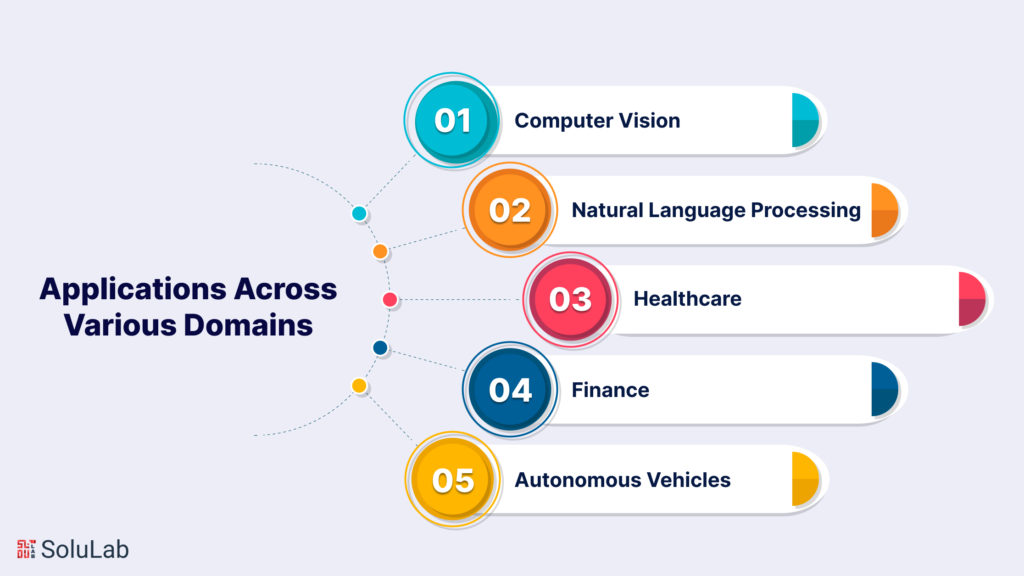
Transfer learning takes what a model learned in one domain or task and puts it to work in another. That single move has spread almost everywhere. Computer vision and natural language processing got there first, and it has gone well past both since.
Computer Vision
Object recognition, image segmentation, object detection: transfer learning reset all three. Pre-train on an extensive dataset, fine-tune for the specific task in front of you, and you no longer need a mountain of labeled examples to get somewhere useful.
Natural Language Processing
Sentiment analysis, text classification, language generation. Transformer-based models such as GPT-3 and BERT build on transfer learning, and they moved the bar for what counts as good language understanding and generation.
Healthcare
Disease diagnosis, medical image analysis, drug discovery. Starting from a pre-trained model saves clinical teams both time and money, and the diagnostic accuracy improves alongside.
Finance
Banks and funds put transfer learning to work on fraud detection, stock market prediction, and risk assessment. Taking a model that already works and bending it toward one specific financial question has turned out to be worth a great deal.
Autonomous Vehicles
Progress toward self-driving leans on it heavily. Train on vast datasets, then fine-tune for a particular road condition, a particular climate, a particular kind of terrain. That’s how the field keeps moving.
What are the State-of-the-Art Transfer Learning Models in 2025?
A handful of transfer learning models have taken most of the attention in 2025. These are the ones worth knowing by name.
GPT-4
GPT-4 follows GPT-3 and sits right at the edge of generative AI landscape. With 100 trillion parameters [SOURCE NEEDED], it’s transfer learning working at a scale that’s hard to picture. Call it a language model and you undersell it. It carries knowledge, and it multitasks across domains.
CLIP
CLIP (Contrastive Language-Image Pre-training) is another marker in the transfer learning story. It learns images and text jointly, in the same space, which is what cross-modal understanding actually means in practice. Image classification uses it. So does text-to-image generation, and plenty else besides.
ViT (Vision Transformer)
Vision Transformers now sit at the center of computer vision work. ViT pre-trains on vast image datasets and then performs, on image classification and object detection both. More evidence that transfer learning carries over cleanly to pixels.
What is the Role of Transfer Learning in AI Development?
Ask any working AI developer or machine learning practitioner what they reach for early. Transfer learning is on the list, every time. Here’s what it actually solves:
Efficiency
Your model starts with knowledge instead of noise. Less training on new data, and a much faster path to something you can actually put in front of people.
Resource Conservation
Pre-trained models mean you burn far less compute. If your hardware budget is modest, that’s the difference between shipping and not shipping.
Data Scarcity Mitigation
Short on data? Adapt a model from a related domain and the shortage stops being fatal.
Generalization
A model that performs in one domain can be fine-tuned for the next one. Solutions get reused instead of rebuilt from scratch.
How is the Synergy of Deep Learning and Generative AI Reshaping the Landscape of AI and Machine Learning?
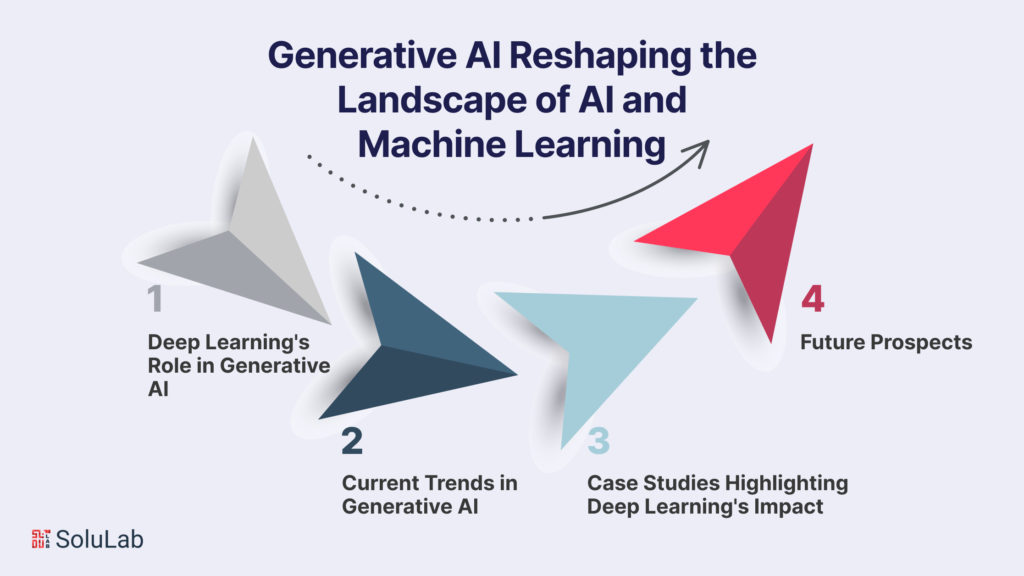
Deep learning and generative AI feed each other, and that pairing has pulled in more attention than almost anything else in machine learning. It stands to change how entire industries produce things. What follows: what deep learning contributes to generative AI, which trends are running now, a few cases that prove the point, and where it all goes next.
A. Deep Learning’s Role in Generative AI
Generative AI would not exist without deep learning underneath it. Generative AI models exist to produce content, images, text, whatever the format, close enough to human-made output to pass as it. The machinery doing that work is deep learning: deep neural networks, recurrent neural networks, and the model families built on top of them, GANs (Generative Adversarial Networks) and VAEs (Variational Autoencoders).
These models pull complex patterns and representations out of very large datasets, and that’s what gives generative systems both realism and range. Image synthesis needs it. So do natural language generation and data augmentation. The practical payoff is creative content produced at volume, richer back-and-forth between people and software, and tools a business can point straight at its content problem.
B. Current Trends in Generative AI
Generative AI had a loud year in 2025. A few threads stand out:
Enhanced Creativity
Music composition. Digital art. Deep learning models are now behind generative systems producing work you’d call creative without flinching.
Realistic Content Generation
Telling generated content apart from the human kind keeps getting harder. Media and entertainment noticed early and are already building on it.
Personalised Content
Generation tuned to one person’s preferences and needs. E-commerce and content recommendations are where most people run into it first.
Ethical Considerations
The better generative AI gets, the louder the questions get. Misuse. Bias baked into what comes out. No clean answers yet.
C. Case Studies Highlighting Deep Learning’s Impact
Abstract arguments only carry so far. Look instead at what deep learning has already produced inside generative AI:
Artistic Expression with DeepDream
Google’s DeepDream turns ordinary photographs into something hallucinatory. Strange to look at, and a useful demonstration: deep learning can make art, not just sort it.
ChatGPT and Natural Language Generation
OpenAI’s ChatGPT is the obvious case for natural language generation. It holds a text conversation that goes somewhere, and its deep learning architecture is the reason why.
Image Generation with StyleGAN
NVIDIA’s StyleGAN2 generates high-quality images and hands you fine-grained control over how they look. Creative production and visual effects work are both being rebuilt around that kind of control.
D. Future Prospects
So where does the deep learning and generative AI pairing go from here? A few developments look likely:
Improved Realism
Output keeps getting more convincing. Virtual reality, gaming, and design work will end up treating generative AI as standard equipment rather than an experiment.
Wider Adoption
More companies across more industries will put generative AI tools to work automating content production. Costs drop, output rises.
Ethical Advancements
Expect more weight on bias mitigation, responsible use, and being straight with people about what a machine wrote or drew.
Integration with Other Techniques
Federated learning, reinforcement learning, transfer learning: deep learning and generative AI will keep borrowing from all of them, and the systems that come out of those combinations will do more than any one technique could alone.
Conclusion
SoluLab builds with the 2025 toolkit: federated learning, reinforcement learning, transfer learning, generative models sitting on deep learning foundations. This blog walked through what each one changes and where the bar now sits in machine learning. That work is why companies come to us when they want to hire AI developers or need someone who has already made the mistakes worth avoiding.
Federated learning is doing the most to change how AI models get trained. No central data repository. Training runs on local devices, user privacy holds, and the model still improves. SoluLab moved on this early, because it matches how we already handle data: ethically, with privacy intact, and without asking clients to compromise on either.
On the reinforcement learning side, the interesting move has been combining it with a generative AI development company. That pairing produces AI that invents solutions to real problems rather than retrieving ones it has already seen. Healthcare is where it gets genuinely exciting: SoluLab’s models can surface treatment approaches nobody had mapped yet, and tighten up how patients get cared for.
FAQs
Shipra Garg is a tech-focused content strategist and copywriter specializing in Web3, blockchain, and artificial intelligence. She has worked with startups and enterprise teams to craft high-conversion content that bridges deep tech with business impact. Her work translates complex innovations into clear, credible, and engaging narratives that drive growth and build trust in emerging tech markets.