Key Takeaways
- AI consulting services are an ideal option for teams that require clarity on use cases, ROI, data readiness, feasibility, governance, or roadmap planning.
- AI development services come into the picture when the use case is validated, and the business needs a scalable AI product, workflow, platform, or integration.
- Go for both services for fewer handoff gaps, faster development, stronger adoption, and clearer ROI.
The AI market is expanding at a fast pace and is expected to reach up to 900M this year. While companies around the world are burning billions of dollars on AI, some still struggle to bring projects to execution. This scarcity raises a question around AI Consulting vs AI Development: which one is best for business?
While the answer to this question purely depends upon the needs of a business, the goal of these AI consulting services or AI Development services is to move projects faster towards execution.
This guide explores how mid-level organizations can choose between AI Consulting or AI Development for creating measurable business value.
AI Consulting and AI Development: Understanding The Difference
The difference between AI consulting and AI development may sound simple on paper, but expensive when misunderstood. AI consulting helps you decide what artificial intelligence can do for business, and AI development brings that idea to execution.
Here is a deeper view of AI Consulting vs AI Development to avoid the wrong investment.
| Business Question | AI Consulting | AI Development |
| Main purpose | Define the AI opportunity, business case, and roadmap | Build, integrate, deploy, and maintain the solution |
| Starting point | Business problem, data maturity, market pressure, and ROI target | Approved requirements, architecture, and delivery plan |
| Key output | AI strategy, feasibility report, cost estimate, governance plan | AI product, model, agent, automation system, or integration |
| Best for | Unclear use case, uncertain ROI, data gaps, and leadership alignment | Clear scope, validated data, and defined product requirements |
| Primary risk reduced | Wasted investment and poor prioritization | Poor execution, weak scalability, unreliable performance |
How Do Businesses Know If They Need AI Consulting or AI Development Services?
An AI consultant vs. an AI developer is purely based on the goal of the business. Choose a consultant for use case selection, such as AI roadmap design, data review, cost modeling, and risk planning. And go for a developer for architecture, coding, model deployment, and long-term support.
A business needs AI consulting services when:
They have ambition but not enough clarity. This usually happens when leadership says things like: We need AI in the product or our investors are asking about our AI strategy. This consulting phase helps to figure out the highest-value use case before money moves into engineering. It also protects the company from building AI around assumptions.
For funded startups, this can shape investor narrative. Here, the enterprise AI consulting framework can help companies move from vague AI intent to a clear execution plan.
The following are some important factors to consider when choosing AI Consulting Services:
- You Have Too Many AI Ideas
Your teams may want copilots, automation, chatbots, analytics, or generative AI features. AI consulting services help you rank those ideas by business impact, cost, risk, and implementation effort.
- Your Data Is Not Ready
The data sits across CRM, ERP, spreadsheets, product logs, support tools, or disconnected databases. Consulting helps assess readiness before engineering cost increases.
- Your Investors Expect a Clear AI Roadmap
Funded startups require a defensible roadmap that shows product value, market relevance, technical feasibility, and future scalability.
- Your Leadership Team Is Not Aligned
Consulting creates a decision framework around cost, risk, growth, delivery, and measurable outcomes.
A business needs AI development services when –
The AI use case is validated, the product requirement is ready, and requires execution. A SaaS startup may already know it needs an AI onboarding copilot, or an SMB may want to automate invoice processing with clear rules, review steps, and system integrations.
The following are some important factors to consider when choosing AI Consulting Services:
- You Already Know What to Build
Choose AI development services when your business has a confirmed use case. For example, AI copilots, recommendation engines, predictive analytics, workflow automation, intelligent search, document processing, or customer support automation.
- Your Product Needs AI Features
If AI must become part of your product experience, development should focus on usability, security, speed, and integration. SoluLab’s AI development solutions in the US support product teams building scalable AI systems.
- Your Internal Workflows Need Automation
You may need AI to reduce manual review, support tickets, reporting effort, onboarding delays, or operational bottlenecks. Development converts these workflows into AI-powered systems that improve speed and reduce repetitive effort.
- Your Current Tools Cannot Scale
Off-the-shelf AI tools often fail when workflows become complex. Custom development helps you build systems aligned with your data, users, security standards, and long-term growth.
Use Both When You Need Business-Led Execution
A consultant without developers may leave you with a roadmap. A developer without consulting may build the wrong solution. Combine both to connect the AI strategy with production outcomes.
How to Decide Between AI Consulting Services vs AI Development Services?
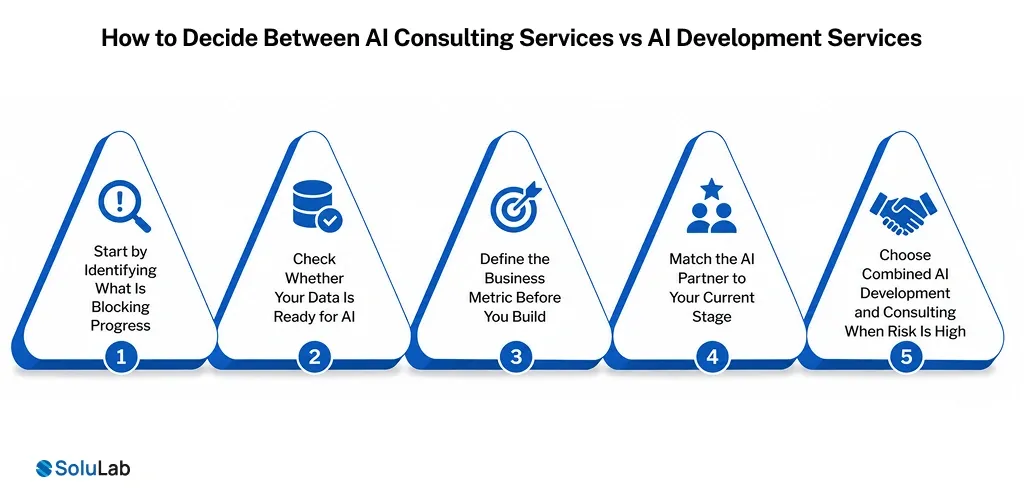
Here is how businesses can figure out which services go best with their current scenario:
- Start by Identifying What Is Blocking Progress
Choose AI consulting services if your team lacks clarity on use cases, ROI, data readiness, or implementation risk. Choose AI development services if your AI requirement is already validated and your business needs engineering execution, integration, and deployment.
- Check Whether Your Data Is Ready for AI
If your data is scattered, incomplete, duplicated, or ungoverned, start with the best AI consulting company. AI depends on reliable data. A readiness review helps prevent weak outputs, delayed delivery, and avoidable development costs before the project enters production.
- Define the Business Metric Before You Build
Every AI initiative needs a measurable target. Track onboarding time, support volume, conversion rate, processing cost, user adoption, error reduction, or revenue impact. Without a clear metric, it becomes difficult to prove whether the AI investment worked.
- Match the AI Partner to Your Current Stage
Early-stage AI needs a strategy. Validated AI needs development. Scaling AI needs monitoring, governance, optimization, and continuous improvement. The right partner should help your team move from decision-making to execution without losing business context.
- Choose Combined AI Development and Consulting When Risk Is High
Choose combined AI Development and Consulting when your business needs both direction and execution. This works well for funded startups, CTOs, innovation leaders, and SMBs that want faster delivery without building the wrong solution.
How AI Consulting Turns Into AI Development?
- Start With the Business Constraint
Start by identifying the constraint. Once the business issue is clear, the right AI approach becomes easier to define.
- Check Whether the Data Can Support the Idea
Before AI-led development, reviewing the data is required for idea execution. This step often decides whether the project moves fast or stalls.
- Turn the Roadmap Into a Buildable Plan
Build a practical delivery plan with features, integrations, data requirements, review points, and success metrics. This is where AI consulting and development begin to work as a single process.
- Build the AI System Around Real Users
It is the one your team or customers can actually use. That may be an AI copilot, a predictive dashboard, a workflow automation layer, a recommendation engine, or an intelligent document system.
- Connect AI With Existing Business Systems
If the solution sits outside your CRM, ERP, product platform, support desk, or analytics system, adoption becomes harder. Integration should be planned early, not added late.
- Improve the System After Launch
Monitor accuracy, speed, adoption, cost, feedback, and workflow impact. This is where early AI value turns into long-term business performance.
Why Consulting First Makes AI Development Smarter?
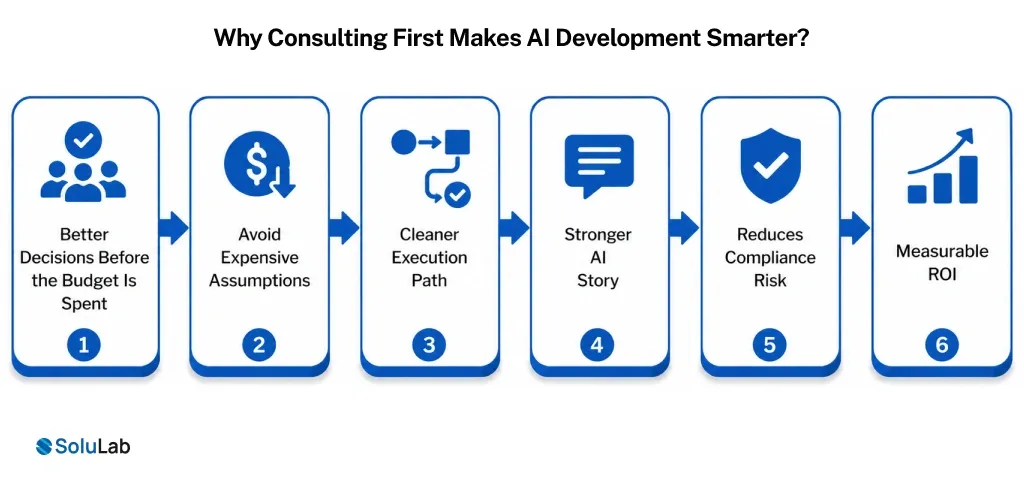
Consulting makes AI development faster because the team starts with a defined scope, cleaner data priorities, fewer approval gaps, and clearer success metrics. Here is how:
1. Better Decisions Before the Budget Is Spent
AI consulting services give leadership time to ask the hard questions before development begins.
What should be built? What should be avoided? Which use case has the strongest commercial value? These answers protect your budget from rushed execution.
2. Avoid Expensive Assumptions
Many AI builds start with confidence and end with rework. Consulting reduces that risk by testing assumptions around data, users, compliance, cost, and technical feasibility before engineering teams commit months of effort.
3. Cleaner Execution Path
A consulting-led approach defines architecture needs, integration points, security expectations, and ownership early. That makes AI development services easier to manage and easier to scale.
4. Stronger AI Story
Funded startups need a clear reason for AI to exist in the product. AI consulting helps connect AI features to retention, activation, conversion, defensibility, or investor confidence.
5. Reduces Compliance Risk
AI can touch sensitive customer, financial, operational, or product data. Consulting helps define governance, approval flows, human review, access control, and audit requirements before the solution reaches production.
6. Measurable ROI
A validated use case moves faster. When your team knows the goal, the data, the users, and the metric, development has fewer delays. That is how AI Consulting vs AI Development becomes an ROI decision.
What Happens When Businesses Skip AI Consulting?
Skipping AI consulting may feel faster at first, but it usually slows development later through unclear scope, data gaps, rework, and weak ROI tracking.
- Wrong AI Solution
This is more common than most teams admit. A company asks for an AI-powered chatbot, but the real issue is onboarding. Another wants a prediction, but the data cannot support forecasting. Without consulting, the build may look impressive and still miss the business problem.
2. The Scope Starts Moving Every Week
Weak planning creates shifting requirements. The product wants new features. Operations add exceptions. Compliance asks for controls. Finance questions the cost. Development slows because no one locked the business case early.
3. Data Problems Surface Too Late
Duplicate records, missing fields, unstructured files, disconnected systems, and unclear permissions can reshape the entire project. Consulting finds these gaps before they damage the delivery timeline.
4. Users Do Not Trust the System
Adoption of AI trends depends on trust. If the output feels unreliable, employees return to manual work. If the interface adds friction, customers ignore it. A solution must fit user behavior, not just technical requirements.
5. ROI Becomes Hard to Defend
Leadership will eventually ask what changed. Did onboarding get faster? Did the support cost drop? Did conversion improve? Without baseline metrics, your team may struggle to prove value even if the system works.
How to Align AI Strategy With AI Execution?
The following are the key points that can help you align the AI Strategy with execution:
Keep the Consulting Context Inside Development
Strategy should not disappear after discovery. The same business goals that shaped the roadmap should guide architecture, model choices, workflows, testing, and launch priorities. This keeps AI consulting and development aligned.
Translate Strategy Into Delivery Milestones
Break the work into milestones: data readiness, prototype, integration, testing, user review, launch, and optimization. Each stage should connect to a business metric.
Build for the Workflow
A polished prototype means little if it cannot handle messy data, real users, edge cases, or security controls. Production-ready AI must work where the business actually operates.
Keep Business Teams Close to the Build
Product, operations, compliance, finance, and customer-facing teams should stay involved. Their input helps prevent low adoption and keeps development tied to real business needs.
Measure What Leadership Cares About
Model accuracy matters, but it is not the whole story. Track time saved, manual effort reduced, conversion lift, support volume, onboarding speed, customer retention, and operating cost. These metrics make AI value visible.
Key Questions to Ask Before Choosing AI Consulting or AI Development
What Business Outcome Should AI Improve?
Start with the outcome. Your AI project should improve revenue, cost, speed, accuracy, retention, customer experience, or risk control. If the outcome is vague, start with AI consulting services.
Is the Use Case Already Validated?
If the use case is still unclear, consulting should come first. If your team has validated the workflow, data, users, and KPI, AI development services can begin with more confidence.
Is Your Data Ready for AI Development?
Check accuracy, structure, access, permissions, volume, and relevance. Weak data can turn a strong idea into an unreliable solution.
Who Will Actually Use the AI System?
The user changes the design. A sales team, customer support agent, product user, operations manager, and executive team all need different interfaces, outputs, controls, and success metrics.
What Risk Needs Human Oversight?
Review where human approval is needed, especially in finance, healthcare, legal, compliance, customer data, or high-impact business workflows.
Can This AI Solution Scale Beyond the First Use Case?
A narrow build may solve today’s problem and block tomorrow’s growth. Plan for future users, higher data volume, more integrations, model updates, monitoring, and new business use cases.
Industry Examples of AI Consulting and Development
- SaaS Product Teams- A SaaS company may use AI consulting services to identify where AI can improve activation, retention, or product stickiness. Development can then build an onboarding copilot, intelligent search, recommendation engine, or customer-facing AI assistant.
- Retail and eCommerce- AI for retail helps the team in personalization, demand forecasting, inventory planning, and customer segmentation. AI Consulting services can help prioritize the highest-value use case.
- Financial Services- Finance teams can use AI development services for risk scoring, fraud detection, document review, and compliance workflows.
- Healthcare and Wellness- Healthcare teams may use AI consulting services for documentation, triage, scheduling, patient engagement, or operational analytics. The AI development services can help with HIPAA-compliant solutions that support privacy controls and reliability checks.
- Logistics and Operations- Logistics companies use AI for route optimization, demand planning, fleet visibility, and delay prediction. AI Development services can contribute to operational data.
- Manufacturing- Manufacturers can use AI for predictive maintenance, defect detection, quality checks, and production planning. Consulting helps identify which workflow will deliver the fastest return before custom AI development begins.
Common Mistakes to Avoid When Choosing AI Consulting or AI Development
While choosing between AI Consulting vs AI Development services, focus on the following points:
Building AI Without a Clear Business Case
AI should not begin with a tool request. It should begin with a measurable business problem. Before AI development starts, define the process gap, revenue opportunity, cost pressure, customer pain point, or compliance risk the solution must address.
Skipping Data Readiness Before Development
Poor data creates unreliable AI outputs. Before choosing AI development services, check data quality, ownership, structure, access, security, and integration requirements. This protects your budget and improves the chances of building a usable AI solution companies.
Ignoring User Adoption During Planning
A technically strong AI system can still fail if teams do not trust it. Design around real workflows, user roles, review points, and decision habits. Adoption should be planned before launch, not treated as a post-deployment issue.
Underestimating Compliance and Governance Risk
AI systems can process sensitive business, customer, financial, or operational data. Security, audit trails, access controls, human review, and governance policies must be planned early, especially for regulated industries and enterprise-grade AI adoption.
Choosing Speed Over Scalable Architecture
Fast delivery matters, but weak architecture creates future cost. Your custom AI solution should support integrations, monitoring, model updates, user growth, security requirements, and performance needs. A rushed build may work in demo and fail in production.
Treating AI Consulting and AI Development as Separate Silos
Strategy and execution should stay connected. When consulting and development teams work separately, the business context often gets lost. A unified AI consulting and development approach keeps the roadmap, architecture, delivery, and ROI aligned.
Final Word
The right choice depends on where your business is in the AI journey. Choose AI consulting services when your team needs clarity on use cases, ROI, data readiness, feasibility, compliance risk, or roadmap planning. This is the right starting point when the business problem is clear, but the AI path is not.
Choose AI development services when your team already has a validated AI requirement and needs a scalable product, platform, workflow, or system integration built for real users.
Build the Right AI Path With SoluLab!
As an AI-native development partner, SoluLab helps funded startups, mid-level enterprises, and growing businesses move from early AI decisions to production-ready solutions. Our team provides custom AI development, AI product development, AI chatbot development, enterprise AI development, AI agents, machine learning models, and AI-powered business solutions. For teams still deciding where to begin, our experts offer AI consulting services that help cut through vague AI ambition and focus on the use case that can actually improve speed, cost, customer experience, or revenue.
If your team is comparing AI Consulting vs AI Development, the next step is not to choose the most advanced technology. It is to choose the right starting point. Partner with our experts and make your AI ambition measurable business impact through consulting, development, integration, and optimization.
FAQs
Shipra Garg is a tech-focused content strategist and copywriter specializing in Web3, blockchain, and artificial intelligence. She has worked with startups and enterprise teams to craft high-conversion content that bridges deep tech with business impact. Her work translates complex innovations into clear, credible, and engaging narratives that drive growth and build trust in emerging tech markets.