What if the characters in your favorite game could actually think? Not scripted responses, real adaptation, the kind that learns from how you play and reacts differently next time. That’s what AI agents are starting to do to games. NPCs act less like puppets and more like participants, and the worlds around them shift from one playthrough to the next.
Game studios aren’t just using AI for marketing copy, they’re building it into how games get made and played. And the money backs that up: the generative AI in gaming market sat around $992 million in 2022, and analysts expect it to reach $7.1 billion by 2032. That’s a CAGR of 23.3%, which is not a small number.
In this piece, we’ll walk through where AI agents show up in games, how developers actually build them in, and what you get out of it. Let’s get into how AI is reshaping the way we play.
Understanding of AI Agents in Gaming
Nim was the first AI game, built back in 1951. A year later, IBM built a checkers program designed to study every move it played and get a little better each time.
Games like Go and old Atari titles later became test beds for AI models. Researchers still use video games this way, as a proving ground for the reasoning skills of AI models, and as training material for whatever comes next.
But gaming is turning into one of the more interesting real-world applications for this technology. Generative AI agents can run complex physics simulations, control AI in-game surroundings and objects, shape procedural content, and adjust gameplay on the fly, all of which sharpens NPCs and lets them carry out other agentic tasks inside the game world.
Because these agents can act on their own toward a goal, follow detailed instructions, and read their surroundings, they don’t need to be locked into rigid scripts anymore. The payoff is real-time behavior instead of the same three canned reactions on a loop. That’s what starts to make an NPC feel less like a puzzle piece and more like a person.
Applications of AI Agents in Gaming
AI is reworking the gaming industry from two directions at once, gameplay and development. The application of AI touches nearly every part of a game’s production, giving algorithms room to build richer experiences. Smarter NPCs, procedural content, entire design pipelines, all of it is shifting.
1. NPC Behavior
NPCs used to just follow a script. Now AI agents give them actual responsiveness, and AI-powered NPCs can do things preset scripts never allowed, like:
- Adjust their behavior based on what the player actually does.
- Show more believable emotion and judgment.
- Learn from conversations to keep encounters varied.
Red Dead Redemption 2 is a good example. NPCs there remember what you did last time and react accordingly, which is a big part of why that world feels alive instead of static.
2. Procedural Content Generation
Generating huge volumes of content by algorithm is something AI agents are genuinely good at. Think:
- Terrain
- Missions and quests
- Treasure
- Character designs
No Man’s Sky is the poster child here: procedural generation building out entire universes, each planet with its own creatures and ecosystems, more territory than anyone could realistically explore.
3. Adaptive Difficulty
When AI agents tracks your performance in real time, the game can adjust its own difficulty around you. The goal is simple: hard enough to stay interesting, not so hard you rage quit. For example:
- The better you get, the tougher the opposition gets.
- Handing out power-ups or hints when you’re clearly struggling
- Doling out resources and obstacles based on skill level
Resident Evil 4 does this quietly, nudging item drops and enemy behavior based on how you’re actually performing, without ever announcing it.
4. Pathfinding and Navigation
Getting a character across a complicated map convincingly takes real algorithmic work. In strategy games especially, this is what makes both your units and enemy NPCs move like they know where they’re going, instead of bumping into walls.
5. Graphics Enhancement
Deep learning and other AI methods are being used to push graphics further, through things like:
- Upscaling textures and resolutions in real-time
- Generating lifelike animation and facial expression
- Rendering optimization to improve performance
6. Player Sentiment Analysis
AI in sentiment analysis systems dig into player feedback and behavior to gauge how engaged, or how frustrated, people actually are. Developers then use that data to shape design decisions and updates instead of guessing.
Expect the applications to get stranger and more inventive as the underlying tech matures, blurring the line between virtual and real a bit further and making experiences feel more personal.

Implementing AI Agents in Game Development
Actually building intelligent, responsive NPCs is one of the more interesting problems game creators face. It takes a mix of techniques to bring a virtual world to life, and honestly, it’s a balancing act between technical skill and artistic judgment. At its core, putting AI agents into a game usually comes down to three approaches.
1. Rule-Based Frameworks: The Basis of Games AI
Rule-based systems are still the foundation under a lot of game AI. An NPC gets a preset list of instructions for how to act in a given situation. Simple on paper. In practice, getting a rule-based AI to actually feel good requires real thought about player experience and how the mechanics interact.
Take a stealth game. An NPC there might, for example, follow rules like these:
“If you hear a noise, go check it out.” “If you spot the player, attack and sound the alarm.” The hard part is writing rules detailed enough to feel interesting without chewing through the computational budget.
2. Machine Learning: Developing Adaptability in NPCs
Machine learning takes this further: agents that learn from data and adjust their own behavior over time. The result is NPCs that are harder to predict, which is exactly what keeps a game replayable.
Supervised learning trained on expert gameplay data can teach NPCs a strong strategy directly. Or developers go the other way, unsupervised learning, letting the system spot patterns in how players behave and adjust NPC strategy from there.
And it’s not only about making enemies smarter. Machine learning can produce NPCs that surprise and delight players in ways nobody explicitly programmed for.
Another way to implement AI agents in games is through reinforcement learning (RL). NPCs learn through trial and error here, picking up rewards and penalties from whatever they do inside the game environment.
It’s not easy, but integrating reinforcement learning into a game pays off. Tools like Unity’s ML-Agents Toolkit have made it a lot more practical to train NPCs that adjust to player strategy almost instantly.
Here’s the catch: an NPC that keeps learning and improving is fun right up until it becomes unbeatable, or just annoying. Keeping that line intact means developers have to tune learning rates and reward structures with real care.
Benefits of AI Agents in Gaming
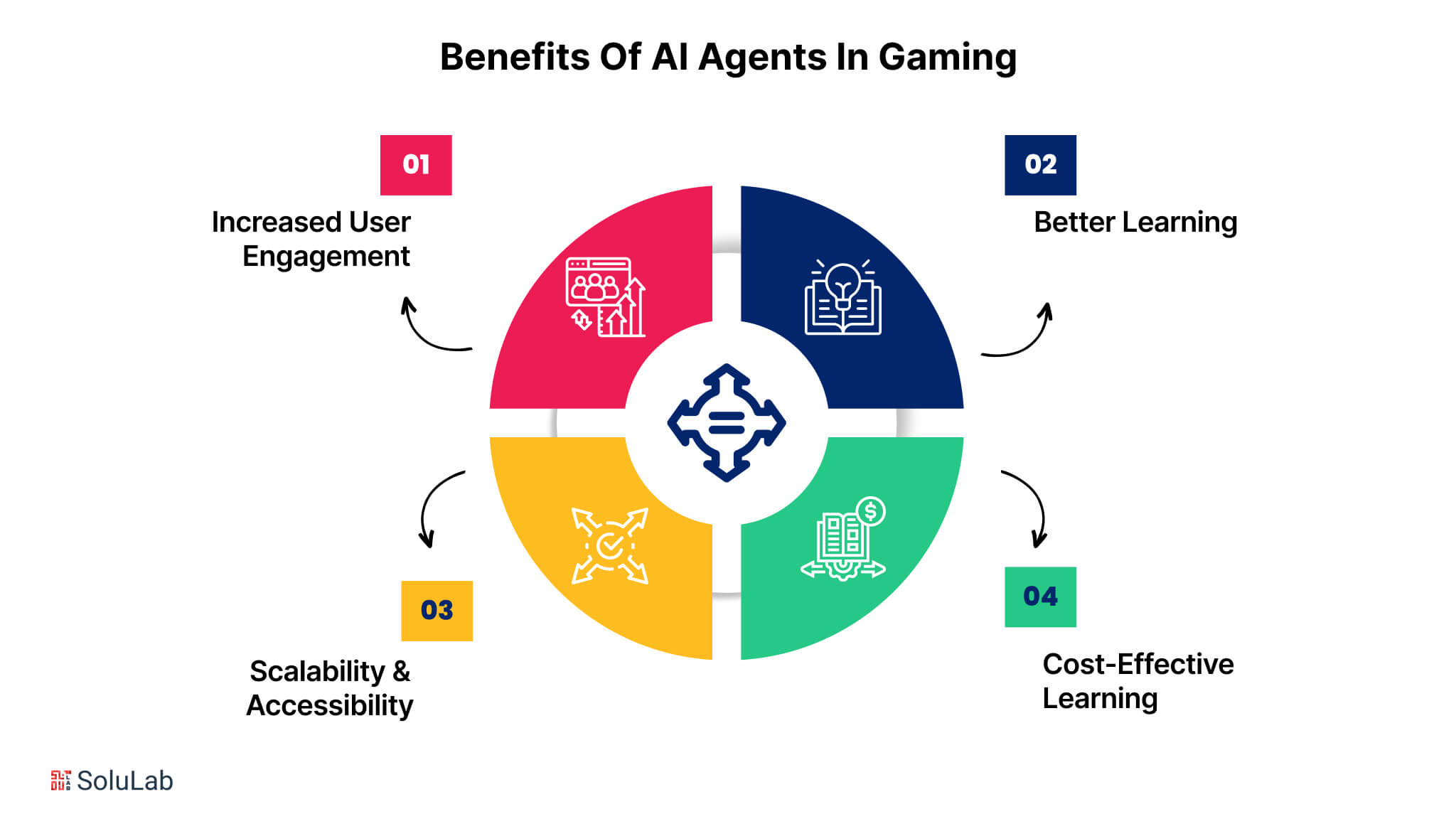
Gaming isn’t the only place this shows up either, e-learning has picked up the same benefits. Here’s a rundown:
1. Increased User Engagement
Content that adapts to what you’re actually doing keeps things from going stale, in games and in e-learning alike. Difficulty shifts to match your ability so the challenge stays fair. In e-learning specifically, that means interactive quizzes and simulations, plus gamification like rewards to keep motivation up. On top of that, AI-supported social features create a sense of community, which makes the whole thing feel less isolated.
2. Better Learning
AI-driven learning tools bring engaging, interactive experiences to fields like radiology and technology, where hands-on practice matters. Learning gets tailored to a student’s own pace and style, which is a big part of what makes it stick. Real-time feedback flags strengths and weaknesses as they happen, and the data behind it lets teachers adjust their approach. Shared online environments add peer-to-peer learning on top. Schools that lean into AI-powered education tend to see better retention and performance as a result.
3. Scalability & Accessibility
Online platforms erase geography as a barrier, which opens up access on its own. Flexible scheduling means students can learn whenever it actually fits their life. A mix of formats, videos, quizzes, and more, covers different learning styles. AI-based tools also help students with disabilities, which makes education more inclusive. And institutions get to scale without pouring money into physical buildings.
4. Cost-Effective Learning
Artificial Intelligence cuts overhead by needing less physical space and fewer physical resources. Online courses generally cost less too, no commute, lower tuition. Add in low-cost or free materials, and the savings stack up. Over time, that efficiency benefits institutions and learners both.
Future Trends of AI Agents in Gaming
AI agents are driving one of the bigger shifts happening in gaming right now. They’re changing how players interact with games, making the whole experience more flexible than it used to be. As we’ve seen throughout this piece, it’s less about programming fixed actions and more about building responsive environments that shift based on what each player actually decides.
According to the Netflix documentary, back in the 1980s, a group of college students hacked Atari’s Missile Command to make it harder to beat. Then they went further: booster kits for the arcade machine, and eventually a small black market arcade running out of their dorm room. When Atari settled with them legally, one of the terms was that the students had to come work for the company.
AI keeps pushing what’s feasible in game production, from procedurally generated content that guarantees no two playthroughs match to NPCs that genuinely learn and adapt. This isn’t just making gameplay better. It’s changing how games get imagined, built, and played in the first place. And the platforms behind all this are becoming real allies for developers and technical leaders looking to put these advances to use.
AI will keep narrowing the gap between virtual and real life. With advancements in predictive analytics, expect AI-generated narratives, hyper-personalized gameplay, and AI-driven Play-to-Earn models in Web3 gaming, all pushing toward richer, more adaptive experiences.
AI Implementations in Popular Games
AI has already left a real mark on the industry, more creative gameplay, better player experiences across the board. Here are a few well-known games that put it to good use.
1. Part II of The Last of Us: Enemies adapt to your tactics here, which keeps fights from feeling repeatable. And the NPCs behave realistically enough that even quiet moments carry some tension.
2. Shadow of Mordor: The Nemesis System builds player-enemy relationships that feel genuinely your own. Every enemy remembers your last fight, which opens the door to personal revenge plots nobody scripted.
3. F.E.A.R. (First Encounter Assault Recon): This game’s AI is still cited as a benchmark for tactical decision-making, and it’s a big reason the game plays as tough as it does. Enemies plan assaults, use cover well, and reposition based on what you’re doing.
4. Civilization VI: Civilization VI leans on AI to simulate the complex decision-making of rival civilizations. Each one has its own personality and approach, so no two games play out quite the same.
5. Halo Series: Halo’s AI is built to be difficult and unpredictable, and that’s most of why fights still hold up. Enemies flank, coordinate with each other, and change strategy based on how you’re moving. It keeps you honest.
6. StarCraft II: AI-powered bots here can go toe to toe with human pros. The game has become something of a benchmark for AI research, a real test case for how machine learning applies to real-time strategy.

Conclusion
AI is making game characters sharper and experiences more personal, full stop. From how NPCs behave to how the mechanics themselves work, it’s changing how players engage with virtual worlds.
As the technology keeps advancing, expect gameplay to get more interactive, less predictable, and harder to put down. Gaming’s future runs on AI, and it’s going to feel more real than anything that came before. Buckle up.
SoluLab helped Sight Machine, a leader in digital manufacturing, work around a resource crunch while building out a new tech product. Using its background in generative AI and machine learning, SoluLab built scalable architecture and combined advanced AI models to strengthen Sight Machine’s digital solutions, which let the company roll out new, data-driven manufacturing tools. SoluLab, an AI Agent development company, can do the same for your game: AI-driven NPCs, procedural generation, adaptive learning systems, whatever you need. Our team can help. Get in touch to talk through AI-powered gaming solutions.
FAQs
Shipra Garg is a tech-focused content strategist and copywriter specializing in Web3, blockchain, and artificial intelligence. She has worked with startups and enterprise teams to craft high-conversion content that bridges deep tech with business impact. Her work translates complex innovations into clear, credible, and engaging narratives that drive growth and build trust in emerging tech markets.