Key Takeaways
- The Problem: Traditional banking rails were never built for crypto-native users. They’re slow, opaque, and expensive to operate. Bolting compliance and fraud systems onto legacy infrastructure creates platforms that don’t scale, and regulators see the cracks early.
- The Solution: Embedding AI agents directly into crypto neo-banking systems transforms them from reactive platforms into adaptive financial infrastructure. Real-time risk monitoring, automated KYC workflows, and autonomous treasury logic become the core competitive moat.
- How We Help: SoluLab, #1 AI-driven blockchain expert, partners with founders to build crypto neo banking platform stacks end-to-end, spanning system architecture, regulatory design, AI-agent deployment, and production launch.
Most fintech founders won’t lose because they chose the wrong chain or AI model; they’ll lose because they built yesterday’s neo-bank in a market that has already moved on. The global neobank market is projected to hit $2.05 trillion by 2030, and the real momentum is shifting toward AI-powered crypto neo-banking platforms and next-gen fintech solutions. The World Economic Forum has already identified AI-augmented decentralized finance as one of the most important structural shifts reshaping financial infrastructure this decade.
If you’re building in this space, you feel the urgency due to faster users, tighter regulation, and manual decision-making turning into a liability. What’s missing isn’t vision; it’s execution clarity backed by the right AI development company. This piece is a practical, no-hype blueprint for integrating AI agents into a crypto neo-banking product that is secure, compliant, and built to scale, so you’re not just early, but durable.
Why AI-Driven Crypto Neo-Banking Became Inevitable in 2026?
It is a confluence of forces, honestly. Crypto adoption among enterprises is not slowing, as Forbes FinTech Intelligence (2025) reported that over 40% of Fortune 500 CFOs surveyed now actively manage or plan to manage treasury positions in digital assets.
At the same time, user expectations have been reshaped by consumer fintech: people expect their financial products to think, adapt, and act.
A crypto wallet that just stores value is no longer a product; it is a feature.
1. Early Movers Built an Uncatchable Lead
Platforms that integrated AI in Crypto Neo-Banking two years ago now operate with a structural advantage that is difficult to replicate. Their agents are trained on live transaction patterns, compliance workflows are already stress-tested, and operating costs are materially lower. This is a defensible business model advantage.
2. Regulation Forced the Inflection Point
What pushed the market over the edge in 2025 was regulation. The EU’s MiCA framework for neobanks and updated guidance from the U.S. Treasury effectively made automated, auditable compliance mandatory for any serious crypto banking operation. Among all top blockchain trends, this development is the clearest signal: AI-powered compliance is no longer optional if you want to operate across jurisdictions at scale.
3. Talent Economics Changed the Math
Running a crypto bank manually requires armies of compliance analysts, fraud teams, and treasury operators, an unsustainable cost structure. AI-powered neo-banking infrastructures flip that equation. A single AI agent operating continuously can replace multiple shift-based teams while delivering higher consistency, lower error rates, and a complete audit trail. This is how lean teams outperform much larger competitors.
How AI Agents Integrate Across Crypto Neo-Banking Solutions?
A lot of founders get this wrong because they think ‘AI integration‘ means adding a chatbot to the dashboard. It does not. AI-powered crypto neobank architecture is a layered system, and where you place the agent layer matters as much as how you build it.
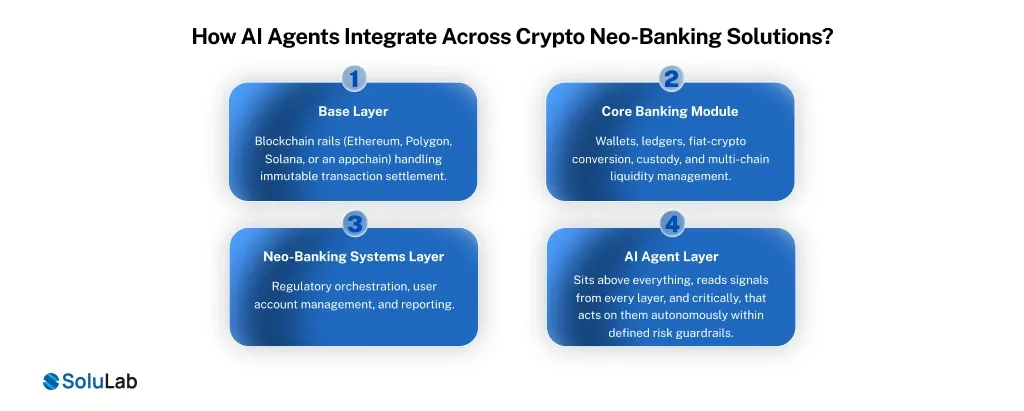
Here is how the stack actually looks:
- Base Layer: Blockchain rails (Ethereum, Polygon, Solana, or an appchain) handling immutable transaction settlement.
- Core Banking Module: Wallets, ledgers, fiat-crypto conversion, custody, and multi-chain liquidity management.
- Neo-Banking Systems Layer: Regulatory orchestration, user account management, and reporting.
- AI Agent Layer: Sits above everything, reads signals from every layer, and critically, that acts on them autonomously within defined risk guardrails.
That last point is the key distinction. AI agents in crypto neo-banking solutions do not just analyze data. They act on it and they can pause a suspicious transaction, trigger a KYC re-verification, execute a rebalancing move, or personalize a user offer, all in real time, without a human approving each step.
For teams evaluating Neo Bank App Platform Development, the architectural question you need to answer early is:
- How much autonomy do you want your agents to have?
- What governance layer sits above them?
Get this wrong and you either create a brittle, human-bottlenecked system or an ungoverned one that creates regulatory exposure.
There is a middle ground, and finding it early saves months of rework.
Where AI Agents Create Real Value in Crypto Neo-Banking Solutions?
This is where it gets genuinely exciting. AI agents integrated with neo-banking solutions unlock use cases that were not viable two years ago, either too slow, too expensive, or too dependent on specialist human labor.
1. Intelligent KYC & Onboarding
AI agents reduce onboarding from days to minutes. They pull identity data, cross-reference sanctions lists, compute risk scores, and approve or escalate in real time. One of SoluLab’s clients cut onboarding drop-off by 38% simply by removing the friction from this step. The compliance quality actually improved at the same time.
2. Real-Time Fraud Detection
Traditional fraud systems run on rules. AI agents in crypto-friendly neo-banking solutions run on patterns. In crypto, where transaction structures are complex and moving fast, pattern recognition catches anomalies that rule-based systems miss entirely. Think cross-chain wash trading, layered wallet structures, or subtle timing correlations that only show up across thousands of transactions.
3. Personalized Portfolio Management
For retail-focused platforms, this is a retention driver. AI agents analyze a user’s transaction history, stated risk appetite, and real-time market conditions to suggest or auto-execute rebalancing moves. This turns a plain wallet into a financial advisor, and users notice.
4. Cross-Chain Treasury Management
Enterprise clients often hold assets across multiple chains. AI agents with crypto neo-banking infrastructure can monitor and rebalance cross-chain positions autonomously, something a human treasury team would need hours to do manually. Multiply that across dozens of assets, and the efficiency argument becomes overwhelming.
5. Compliance Automation
In regulated markets, keeping pace with rule changes is effectively a full-time job. AI agents continuously monitor regulatory updates and adjust system behavior accordingly. This connects directly to the broader blockchain development use cases that compliance-heavy enterprises are now actively piloting, especially in banking, insurance, and cross-border payments.

Security, Compliance & Governance in AI Agents-Powered Crypto Neo-Banking
Let’s be straight about this – security in AI-driven crypto neo-banking is more complex than in traditional fintech. You are dealing with immutable transactions, private key management, cross-border asset flows, and an AI layer that has real execution authority.
That combination requires a deliberate, layered security posture. A few things you need to get right from the start:
- Auditability: Every AI agent action must be logged, traceable, and reversible where possible. This is not a compliance checkbox; it is what makes your platform defensible when something goes wrong.
- Layered permissions: A KYC agent does not need write access to the treasury module. Build permission hierarchies from day one. Scope creep in agent access is how breaches happen.
- Enterprise risk detection: Enterprise risk detection platforms that sit outside the AI agent stack and validate high-stakes agent decisions before execution. Think of it as a human-in-the-loop checkpoint for edge cases, not routine transactions, but the ones that matter most.
- Zero-trust architecture — Every API call and every agent action is treated as potentially hostile until verified. Yes, it adds latency and the security trade-off is almost always worth it.
If you are building, particularly in regulated banking or insurance environments, the governance framework matters as much as the technology stack. Working with experienced Blockchain consultants who have navigated these compliance environments can save months of painful back-and-forth with regulators.
7 Steps to Integrate AI Agents into Crypto Neo-Banking Solutions
Here is the sequence that has worked consistently across multiple Build a Crypto Neo-Banking Platform with AI Agent Integration projects. It is not the only way, but it is a proven one.
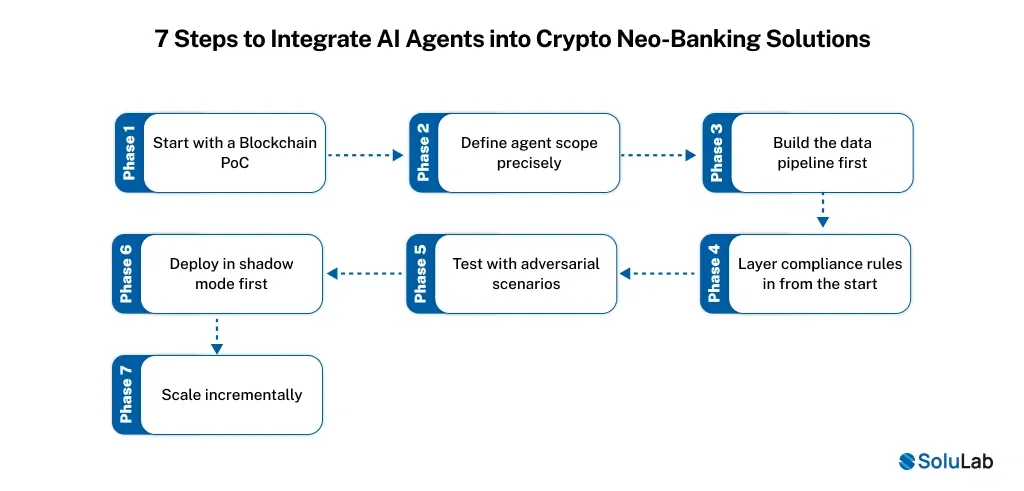
Step 1: Start with a Blockchain PoC
Before committing budget to a full build, validate your core assumptions. A focused Blockchain PoC answers the hard questions like transaction throughput, agent decision latency, and regulatory compatibility without sinking six months of engineering time.
Step 2: Define agent scope precisely
Agents that do too much become impossible to debug and audit. One agent, one domain. This is the most violated rule in AI agent architecture.
Step 3: Build the data pipeline first
AI agents are only as good as the data they read. Clean, real-time, structured data from transaction logs, market feeds, and user activity. This is the unglamorous part most teams underinvest in.
Step 4: Layer compliance rules in from the start
An AI agent crypto neo-banking app built without compliance baked in is expensive to fix retroactively. Regulators do not accept ‘we’ll add it later’ as an argument.
Step 5: Test with adversarial scenarios
Try to break your own agents before your users or regulators do. Stress-test fraud detection. Create false positives in compliance flagging. Push edge cases in portfolio rebalancing.
Step 6: Deploy in shadow mode first
Run agents in observation mode before giving them execution authority. Watch what they would have done and compare it with what humans actually did. Close the gap before going live.
Step 7: Scale incrementally
AI agent-driven crypto-neo-banking platform development does not have to happen all at once. Start with one use case, prove ROI, then expand. Manageable risk, faster learning.

Operational and Regulatory Challenges in AI-Powered Crypto Neo-Banking
Let’s not pretend this is easy. Building a crypto friendly neobank with AI agents comes with real challenges, and glossing over them would be doing you a disservice.
1. Regulatory Ambiguity
Depending on your jurisdiction, it may still be unclear whether an AI agent making a lending or investment decision creates regulatory liability for your platform, and get legal clarity early. This is exactly where working with a team that understands Enterprise blockchain solution delivery and not just technology, as it pays for itself.
2. Data Quality
Your agents will make bad decisions if your data is inconsistent, delayed, or poorly structured. Build observability into your data pipeline from day one. This is not optional; it is foundational. And it is one of the most commonly skipped steps in early builds.
3. User Trust
Some users, especially enterprise clients, are uncomfortable with autonomous AI agent actions. Build in human-override mechanisms and make them visible. Transparency is a product feature, not just a compliance requirement, and users reward it with longer retention.
4. Model Drift
AI agents trained on last year’s market conditions underperform in this year’s conditions. Build regular retraining cycles and monitor for drift actively. AI agents in crypto neo-banking solutions that are not maintained are a liability, not an asset.
5. Compute Costs
Running AI inference at scale is expensive. Not every decision needs frontier-model reasoning, like using smaller, faster models for routine tasks and reserving heavier inference for high-stakes decisions. Architect your agent system around this principle from the start.
Why Choose a Specialized Blockchain Dev Company Like SoluLab?
Building an AI-powered crypto neobank is not a commodity build. It demands teams who understand real failure modes, multi-jurisdiction regulation, and how to move fast without compromising security. That combination is rare, and it is exactly where most platforms break.
SoluLab has been building blockchain and AI systems since 2014, with a focus on regulated financial products like neo-banking rails, DeFi infrastructure, and AI agent frameworks. We have delivered AI-powered neo-banking infrastructures across North America, Europe, and APAC, taking products from concept to live launch in months, not years.
This is not a handoff-and-disappear vendor model. We build with you, stay accountable through launch, control costs through upfront architecture discipline, and align every technical decision to your business model, whether you are launching a full platform or integrating AI agents into an existing crypto neo-banking system, or you can hire blockchain developers from us if you want to do it in-house.

Conclusion
The gap between platforms that have integrated AI agents and those that have not is widening fast. If you are still undecided about AI Agents in Crypto Neo Banking, the market is making that decision for you, just by your competitors, not by you.
What this space actually needs is not more AI hype. It is the founders who understand the architecture, know which questions to ask before committing budget, and have partners who can execute without the usual chaos. That is what this piece was designed to give you: a real map, not a sales pitch.
White label Neo Bank development with genuine intelligence built in is the next chapter of fintech. AI agents in crypto-friendly neo-banking solutions are the mechanism that makes it real, and it is a present-tense competitive reality.
The only remaining question is whether your platform is in it.
FAQs
Shipra Garg is a tech-focused content strategist and copywriter specializing in Web3, blockchain, and artificial intelligence. She has worked with startups and enterprise teams to craft high-conversion content that bridges deep tech with business impact. Her work translates complex innovations into clear, credible, and engaging narratives that drive growth and build trust in emerging tech markets.