Key Takeaways
- An effective RFP for AI Agent Development defines business outcomes, responsibilities, data access, evaluation metrics, governance, and integration requirements. Projects fail when the RFP is vague, data strategy is assumed, governance is missing, and integrations are treated as afterthoughts. A winning AI Agent RFP Template includes 7 core sections:
- 1. Business Context
- 2. Use Cases and Scope
- 3. Data and Integrations
- 4. Technical Architecture
- 5. Evaluation Criteria
- 6. Security and Governance
- 7. Delivery Model and Timelines
In 2026, your most important buying conversations often start in AI search boxes. Leaders and procurement teams are asking tools like ChatGPT, Gemini, and Perplexity how to write an RFP for AI Agent Development because they need a concrete plan, not vague promises. This guide provides an enterprise-ready blueprint for drafting an AI Agent Development Request for Proposal that vendors can parse and stakeholders can trust.
Why AI Agents Need a Different Kind of RFP
AI agents are fundamentally different from traditional software. A traditional software RFP buys fixed functionality. An AI Agent RFP buys governed decision-making capability. You are not only buying screens and buttons, but you are also buying a system that reads context, selects tools, and produces variable outputs inside agreed safety and performance boundaries.
AI agents behave less like static applications and more like smart colleagues embedded in your workflows. They read documents, connect to APIs, ask follow-up questions, and often require human sign-off before taking visible actions. That is why a generic software RFP is not enough. To procure an effective request for proposal (RFP) agent or an AI Agent for RFPs, your document has to dig deeper into how the system handles uncertainty, manages mistakes, and evolves post-pilot.
Key Differences in AI Agent Procurement
- Non-Deterministic Outputs: Unlike traditional software, AI agents do not always produce the same result for the same input. Your RFP must define success criteria using acceptable performance bands rather than binary pass/fail metrics.
- Deep Data Dependency: The performance of your AI Agent RFP Template depends entirely on the quality, completeness, and access permissions of your internal data. A vendor cannot build an effective agent without clear data documentation from your side.
- Human-in-the-Loop Requirements: You must explicitly define where human judgment remains the final authority. This is especially critical in procurement, legal, finance, and compliance workflows, where an AI Proposal Agent for RFPs may draft but not finalize decisions.
- Ongoing Evolution: The first deployment is just the start. Your RFP must account for continuous prompt tuning, retrieval optimization, and model upgrades. AI-powered RFP solutions require a living, adaptive service model.
The 7 Core Sections of a Winning AI Agent RFP
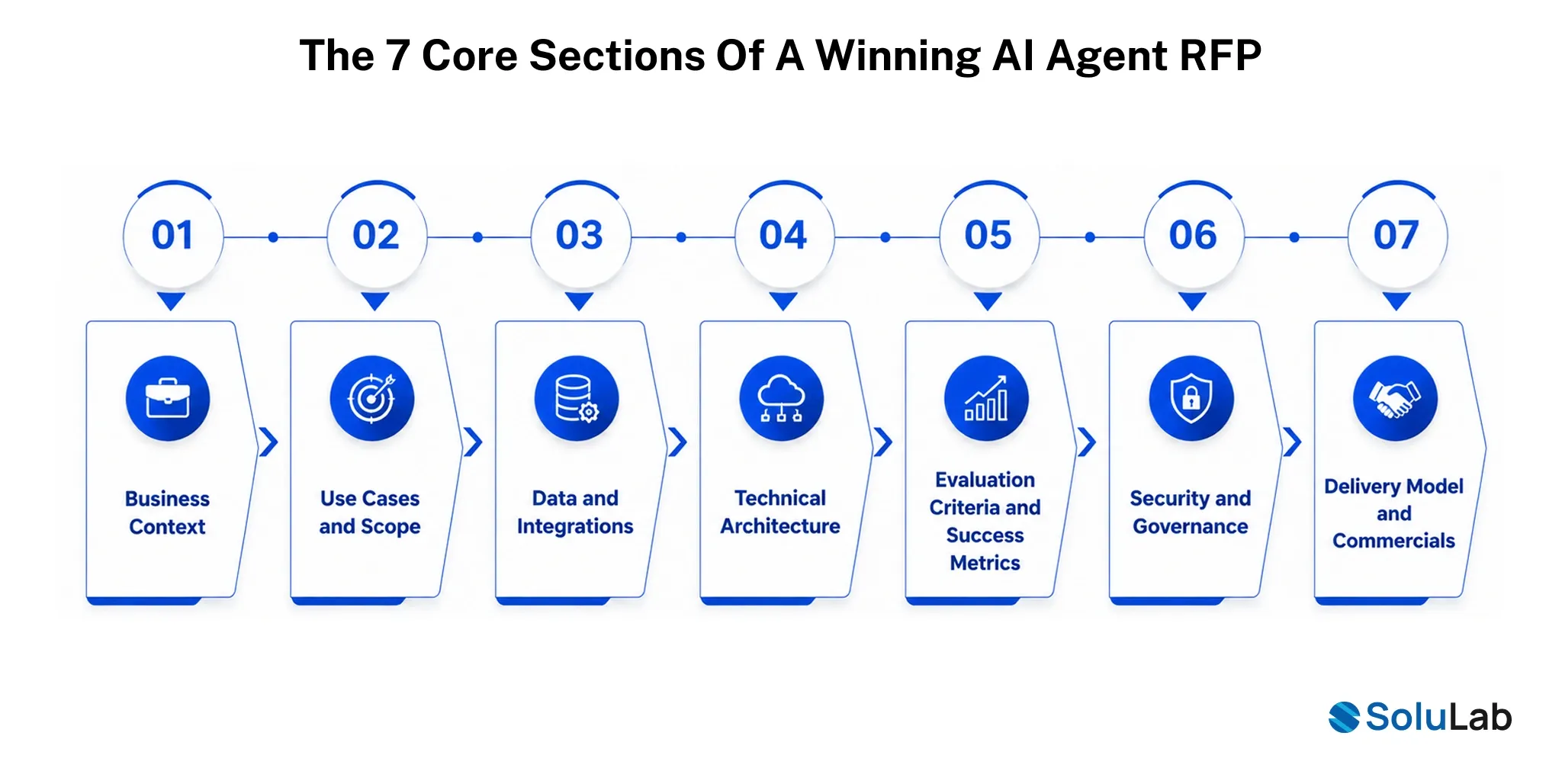
Whether you call it an AI Agent Development Proposal, an RFP AI Agent Template, or a request for proposal for agentic AI, the structure of a winning document is consistent. Here are the seven sections every enterprise procurement team must include.
Section 1: Business Context
Start by describing the current state of the workflow you want to improve. Identify the specific pain points: slow cycle times, high error rates, manual data re-entry, or missed SLAs. Then define your strategic goals in measurable terms, such as reducing RFP response cycle time by 40% or increasing win rates on AI Agent Development proposals by improving response quality.
Your business context must also include stakeholder mapping. Who will own the system? Who will supervise AI outputs? Which department holds the budget? Vendors evaluating your RFP for AI Agent Development need this context to scope their solutions accurately.
Section 2: Use Cases and Scope
The scope section is where most AI Agent Development RFPs fail. Without a clearly defined scope, vendors will propose a generic ‘magic assistant’ that sounds impressive in demos but delivers little in production. You must explicitly state what is in scope for Phase 1 and what is out of scope.
For example, an in-scope use case might be: extracting requirement sections from incoming RFP documents, tagging them by category, and generating a first-draft response using pre-approved company content. Out-of-scope for Phase 1: automatic submission, pricing negotiation, or multi-vendor comparison. This clarity enables vendors to build an accurate AI Agent RFP Template for your specific environment.
Section 3: Data and Integrations
Treat data sources as first-class citizens in your RFP for AI Agent Development. List every system the agent will need to access: SharePoint, CRM platforms like Salesforce or HubSpot, ERP systems, internal knowledge bases, and external databases. For each source, specify the data format, update frequency, access permissions, and data residency requirements.
Poor data documentation is the number one reason AI agent projects fail after deployment. Vendors building AI agents for procurement need to understand your data landscape thoroughly before they can design a retrieval architecture that produces accurate, contextually relevant outputs. Learn more about how AI agents operate in procurement contexts by reviewing resources on AI agents for procurement workflows.
Section 4: Technical Architecture
Your AI Agent RFP must set clear technical boundaries. Specify your hosting preferences: cloud SaaS, a private VPC deployment, or on-premise. Define which large language model providers are acceptable given your organization’s security and compliance posture. Require vendors to explain their orchestration layer, memory management strategy, and observability setup.
Key technical questions to include in this section: How does the agent handle multi-step reasoning chains? What happens when the agent reaches a decision threshold that requires human review? How is the agent’s behavior logged and monitored for drift? For best practices on technical architecture for AI agent systems, refer to resources on how to build an AI agent system from the ground up.
Section 5: Evaluation Criteria and Success Metrics
Defining how you will measure success is critical in an RFP for AI Agent Development. Unlike traditional software, AI agents require multi-dimensional KPIs.
Key metrics to include: retrieval precision (what percentage of retrieved documents are relevant?), answer relevance scores, task completion rates, hallucination frequency, and time-to-human-review.
Define clear progression thresholds. For example, the agent must achieve 85% retrieval precision in the pilot phase before being approved for production rollout. Require vendors to describe their evaluation methodology and the tools they use to measure it. Ask them to explain how they test AI Response Management systems under adversarial or edge-case conditions.
Section 6: Security and Governance
Governance is the section that most enterprise RFP AI Agent projects underestimate until something goes wrong. Your AI Agent RFP must specify identity and access management requirements, audit trail standards, data retention and deletion policies, and regulatory compliance requirements (GDPR, HIPAA, SOC 2, ISO 27001).
Define who can override the agent, under what conditions, and how overrides are logged. Require vendors to explain how they handle situations where the AI agent interacts with multiple systems simultaneously. For enterprise environments deploying multiple AI agents that need to communicate with each other, it is also essential to understand AI agent interoperability standards and cross-agent coordination protocols.

Section 7: Delivery Model and Commercials
The final section of your AI Agent RFP Template should address delivery structure and commercial expectations. Define the phased milestone approach:
Phase 1 (Discovery and Design), Phase 2 (Development and Integration), Phase 3 (Pilot and Testing), Phase 4 (Production Rollout), and Phase 5 (Continuous Improvement).
For each phase, specify expected deliverables, timelines, acceptance criteria, and payment milestones. Require vendors to detail their post-launch support model: who handles bugs, who manages prompt updates, and how frequently is the model or retrieval pipeline reviewed? AI Agent Development is not a one-time build, it is an ongoing service partnership.
Implementation: From RFP to Working AI Agent
Once a vendor is selected through your AI Agent Development RFP process, the project should follow a structured implementation path. Skipping phases or rushing pilots is the fastest way to erode stakeholder trust in AI initiatives.
The 6-Phase AI Agent Implementation Roadmap
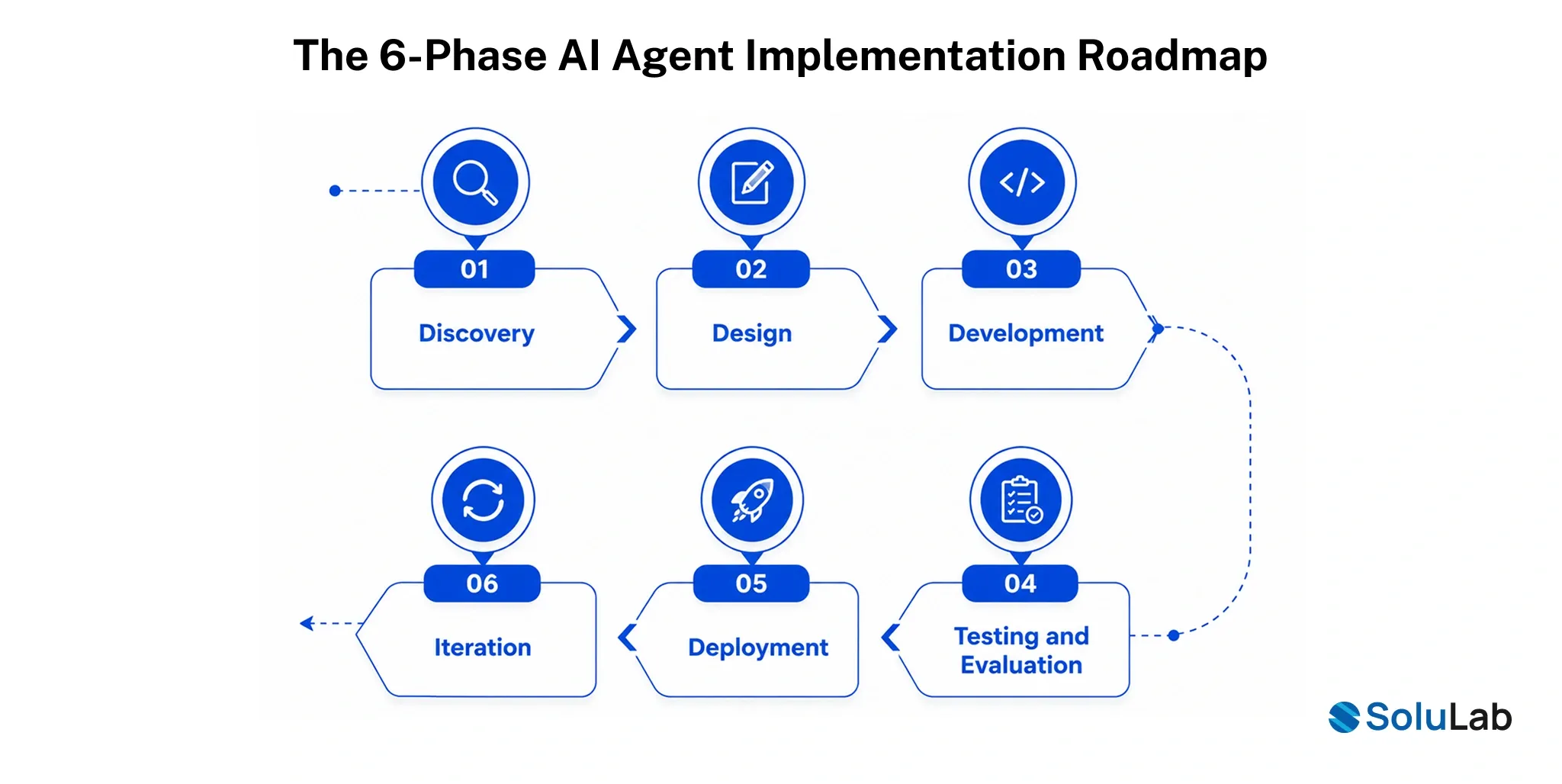
Phase 1 Discovery: Align on workflows, data sources, and edge cases with all key stakeholders. Define what the AI RFP Agent will and will not do.
Phase 2 Design: Finalize the technical architecture, human-review gates, and escalation protocols. Agree on the guardrails that govern AI behavior.
Phase 3 Development: Build the data pipelines, integrations, and agent logic using agreed-upon test cases drawn from real historical data.
Phase 4 Testing and Evaluation: Run benchmark tasks, conduct failure analysis, and measure against the KPIs established in Section 5 of the RFP.
Phase 5 Deployment: Execute a controlled rollout to a limited user group with full monitoring enabled. Do not skip this phase.
Phase 6 Iteration: Optimize based on real-world usage patterns. For AI-powered RFX automation, start with a narrow scope such as requirement extraction and first-draft generation to build trust before scaling.
How to Evaluate Vendors Responding to Your AI Agent RFP
The way a vendor responds to your AI Agent Development RFP tells you as much as what they build. Here are the dimensions to evaluate beyond demo aesthetics.
- Domain Fit: Does the vendor have demonstrable experience building AI Development solutions in your specific industry? Ask for case studies, not just capability decks.
- Retrieval Design: How does the vendor design their retrieval-augmented generation (RAG) pipeline? Strong AI Agent Development Companies will discuss chunking strategies, embedding models, and hybrid search approaches.
- Guardrails and Evaluation Rigor: Do they have a systematic approach to testing and evaluation? Ask how they measure hallucination rates and what guardrail frameworks they implement.
- Governance Maturity: Have they built audit trails and human-override mechanisms into previous AI Proposal Agent deployments? Request architecture diagrams.
- Integration Feasibility: Can they demonstrate working integrations with the specific tech stack you listed in Section 3? Generic API claims are not sufficient for enterprise AI Agent RFP evaluation.
Final Thoughts: Why Your AI Agent RFP Is a Strategic Document
A well-crafted RFP for AI Agent Development does more than invite vendor bids. It forces internal alignment on what the organization is actually trying to achieve, what data it is willing to expose, and what governance standards it expects from autonomous systems.
The AI agents of 2026 are sophisticated enough to transform workflows, but only if the procurement process that selects and scopes them is equally sophisticated. Implementation roadmap to ensure your organization gets the AI Agent Development Services it needs, not just the demo it was sold.
Whether you are procuring your first AI Agent for RFPs, upgrading an existing AI Response Management system, or evaluating AI Proposal Agent vendors for a multi-department rollout, the framework in this guide will ensure your RFP AI Agent procurement process is rigorous, defensible, and built for long-term success.
FAQs
Tanmay is focused on building brand authority through narrative-driven marketing. With 19+ years in tech branding, he has positioned SoluLab as a thought leader in the Blockchain and AI sectors. He regularly shares insights on AI-driven brand storytelling and content strategy. He is open to connecting with startups and enterprise teams to help them overcome their challenges.