Key Takeaways
- The problem: Manual accounting workflows slow reporting cycles, increase compliance risks, and limit scalability, making it harder for firms to deliver real-time insights and stay competitive.
- The solution: AI agents automate bookkeeping, auditing, and compliance while enabling real-time financial analysis, helping firms reduce errors, accelerate processes, and shift toward higher-value advisory services.
- How SoluLab helps: SoluLab is an AI-native company that uses AI across our workflows to build, deploy, and optimize AI agents faster, reducing development costs while delivering scalable, production-ready solutions.
You’re reviewing financial reports, switching between spreadsheets, and chasing deadlines that never seem to slow down. It works, but it’s exhausting, error-prone, and hard to scale when clients expect faster insights and real-time accuracy.
This is where most accounting firms feel stuck today. Traditional systems weren’t built for the speed and complexity modern finance demands. That’s exactly why AI for accounting firms is gaining attention.
With AI-powered accounting solutions, routine tasks become automated, insights become instant, and teams can focus on higher-value advisory work.
The global AI in accounting market is expected to reach USD 96,686.1 million by 2033, growing at a CAGR of 39.6% from 2025 to 2033. In this blog, we’ll break down real use cases, key benefits, and how firms can practically implement AI agents in 2026.
Why Accounting Firms Are Turning to AI Agents?
Accounting firms are adopting intelligent automation to handle growing complexity, reduce operational strain, and deliver faster, data-driven outcomes through AI agents for finance and reporting, and AI for Accounting & Finance solutions.
- Increasing compliance complexity: Frequent regulatory changes demand constant monitoring and accuracy. AI agents help firms automate compliance tracking, reduce human error, and ensure timely updates across evolving financial reporting standards.
- Manual workload and talent shortage: Repetitive tasks like data entry, reconciliation, and reporting consume valuable time. AI agents improve these processes, allowing accounting professionals to focus on strategic advisory and higher-value financial services.
- Need for real-time financial insights: Businesses require instant visibility into financial performance. AI agents enable real-time data processing, predictive analytics, and dynamic reporting to support faster and more informed decision-making.
- Client expectations for faster reporting: Clients now expect quick turnaround and transparency. AI-powered systems accelerate report generation, improve accuracy, and enhance client communication with automated insights and summaries.
Benefits of AI Agents for Accounting Firms
Agentic AI in accounting is enabling firms to shift toward autonomous financial workflows, while AI agents for finance and accounting are becoming essential for firms aiming to scale efficiently and stay competitive.
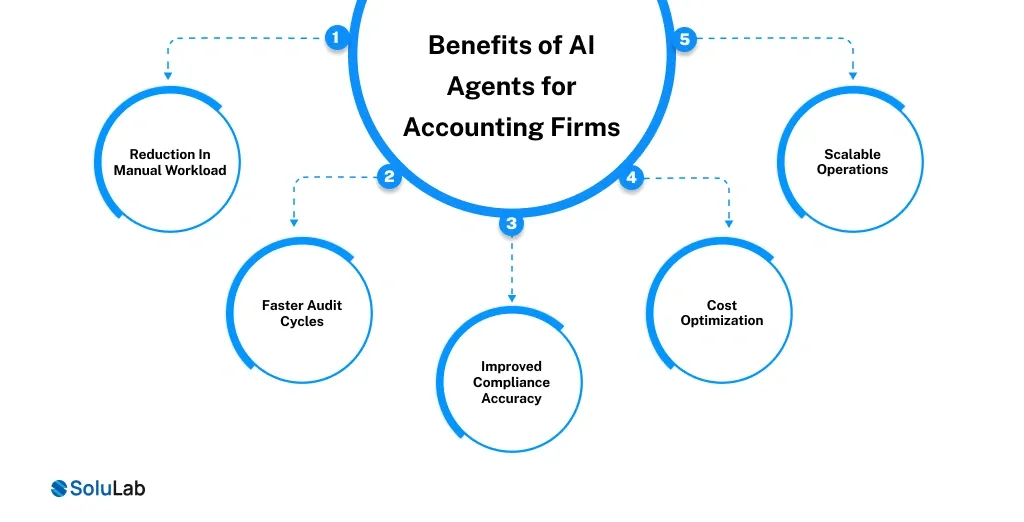
- Reduction in manual workload: AI agents automate data entry, reconciliation, and reporting tasks, reducing human effort by up to 60% and allowing accountants to focus on advisory and high-value financial analysis work.
- Faster audit cycles: With real-time data processing and anomaly detection, AI agents accelerate audit timelines, enabling continuous auditing and reducing turnaround time from weeks to days with improved accuracy.
- Improved compliance accuracy: According to ResearchGate, companies using AI for financial analytics report higher accuracy and faster decision-making, with some studies showing 78% improved operational efficiency.
- Cost optimization: By reducing dependency on manual processes and large operational teams, AI-driven systems lower overhead costs while improving productivity, making accounting firms more efficient and profit-oriented in competitive markets.
- Scalable operations: AI agents enable accounting firms to handle increasing client volumes without proportional hiring, ensuring seamless scalability while maintaining consistent performance, accuracy, and service quality across all financial operations.
How to Implement AI Agents in an Accounting Firm?
Here’s a complete step-by-step guide on how to implement AI in finance:
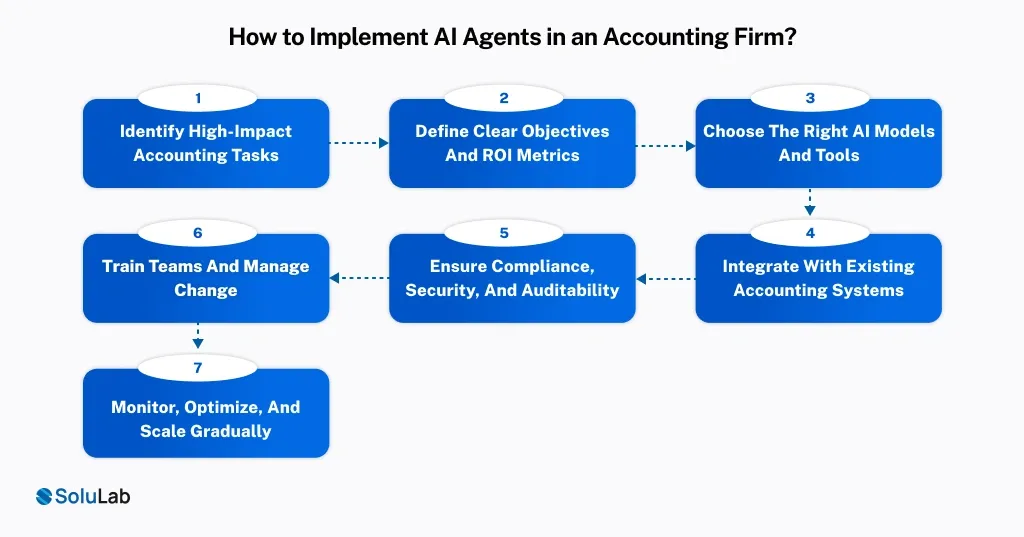
1. Identify High-Impact Accounting Tasks
Start by spotting where time actually leaks. Discuss with an expert AI consultant about repetitive bookkeeping, reconciliations, invoice processing, and compliance checks. These are predictable, rule-heavy workflows where AI agents can step in early, reduce manual effort, and deliver quick, visible wins.
2. Define Clear Objectives and ROI Metrics
Don’t implement AI just because everyone is talking about it. Decide what success looks like, whether it’s reducing audit time, improving reporting accuracy, or cutting operational costs. Clear KPIs help measure impact and justify further investment.
3. Choose the Right AI Models and Tools
Not every tool fits accounting workflows. You need AI agents trained for financial data, compliance sensitivity, and accuracy. Whether it’s NLP for document parsing or ML for anomaly detection, the tech should align with real accounting use cases.
4. Integrate with Existing Accounting Systems
AI agents shouldn’t sit in isolation. They need to plug into your ERP, CRM, and accounting software like QuickBooks or SAP. Smooth integration ensures real-time data flow, avoids duplication, and keeps workflows uninterrupted for your team.
5. Ensure Compliance, Security, and Auditability
Accounting isn’t forgiving when it comes to errors or data leaks. Build AI systems with strong data encryption, audit trails, and regulatory compliance in mind. Every action taken by an AI agent should be traceable and explainable.
6. Train Teams and Manage Change
Even the best AI fails if your team doesn’t trust it. Train accountants to work alongside AI agents, not against them. Focus on adoption, clarity, and showing how AI reduces workload instead of replacing roles.
7. Monitor, Optimize, and Scale Gradually
Start small, test performance, and improve continuously. Track accuracy, efficiency, and edge cases. Once confidence builds, expand AI agents into more complex areas like forecasting, advisory, or multi-entity financial management.

Challenges and Considerations
Accounting firms adopting AI agents development solutions must balance innovation with operational risks, ensuring secure data handling, seamless integration, and reliable outputs while managing internal change and maintaining compliance across financial workflows.
1. Data Privacy and Security
Handling sensitive financial data requires strict encryption, access controls, and regulatory compliance. AI systems must align with standards like GDPR and SOC 2 to prevent breaches and ensure client trust.
Solution: Implement end-to-end encryption, role-based access, and secure cloud infrastructure with continuous monitoring. Deploy compliance-ready architectures designed specifically for financial data protection within AI environments.
2. Integration with Legacy Accounting Systems
Many firms rely on outdated ERP and accounting tools. Integrating AI solutions into these systems demands API compatibility, data standardization, and minimal disruption to existing financial workflows.
Solution: Use middleware layers and API-driven architectures to bridge legacy systems with modern AI capabilities. Gradual integration ensures minimal disruption while enabling scalable automation across accounting operations.
3. Accuracy and Auditability Concerns
AI-generated outputs must be explainable and traceable. Accounting firms need transparent models that provide audit trails, ensuring financial decisions remain compliant, verifiable, and aligned with regulatory requirements.
Solution: Adopt explainable AI models with built-in audit logs and validation layers. This ensures every output is traceable, reviewable, and aligned with financial compliance standards and audit requirements.
4. Change Management Within Firms
Adopting AI requires cultural and operational shifts. Teams must be trained, workflows redesigned, and resistance addressed to ensure smooth adoption of enterprise AI solutions for finance and AI-driven financial assistants.
Solution: Introduce phased AI adoption with team training, pilot programs, and clear ROI communication. This helps reduce resistance while aligning employees with new AI-driven workflows and operational goals.
Build vs Buy: Should Accounting Firms Develop Custom AI Agents?
| Factor | Buy (Off-the-shelf Tools) | Build (Custom AI Agents) |
|---|---|---|
| Off-the-shelf tools limitations | Limited flexibility, generic workflows, and restricted integrations often fail to meet complex accounting needs or evolving client demands. | Fully tailored capabilities designed around firm-specific workflows, enabling deeper automation and better alignment with unique financial operations. |
| Need for domain-specific customization | Pre-built tools offer standard features but lack adaptability for niche accounting services like tax structuring, audit workflows, or regulatory nuances. | Custom solutions enable precise modeling of accounting logic, making them ideal for specialized use cases within AI for accounting firms. |
| Compliance-driven architecture | Compliance features are generalized and may not fully align with region-specific regulations or internal audit requirements. | Custom-built systems ensure compliance-first design, supporting secure, auditable, and scalable AI-powered accounting solutions and AI agents for finance and reporting. |
Future Trends: AI in Accounting Firms (2026 & Beyond)
Accounting firms are evolving with AI-driven capabilities, shifting from manual workflows to autonomous, insight-led operations that enhance efficiency, accuracy, and strategic financial decision-making across services.
- Autonomous accounting firms: AI agents will manage bookkeeping, reconciliation, and reporting tasks, reducing human intervention while enabling firms to operate continuously with higher accuracy, scalability, and operational efficiency.
- AI-driven CFO assistants: AI systems will act as virtual CFOs, providing real-time financial insights, forecasting, and strategic recommendations, helping firms and clients make faster, data-backed business decisions with minimal manual analysis.
- Real-time compliance engines: AI-powered compliance systems will continuously monitor regulatory changes, automate tax calculations, and ensure adherence to global standards, significantly reducing compliance risks and eliminating delays in regulatory reporting processes.
- Voice-enabled financial reporting: Voice-integrated AI tools will allow accountants and clients to generate reports, query financial data, and receive insights through natural language interactions, simplifying access to complex financial information and improving usability.
How SoluLab Can Help Accounting Firms?
Solulab follows an AI-native strategy to help businesses reduce manual work without adding headcount. The shift is already happening, and firms adopting AI early are quietly building a serious competitive edge.
- AI agent development for accounting workflows
- AI-powered bookkeeping and reconciliation solutions
- Intelligent audit and compliance automation systems
- Tax preparation and reporting AI tools
- Financial forecasting and predictive analytics solutions
- Custom AI integration with ERP and accounting platforms
For example, Rupiyah, a fintech app built by SoluLab, improved loan management through real-time credit tracking, automated KYC, and AI-driven processing. It reduced approval time, eliminated intermediaries, and enabled smarter financial decisions with features like EMI calculation, document upload, and instant loan status tracking.
Contact us today to get similar AI solutions for your business.

Conclusion
AI agents are no longer experimental in accounting. They are becoming core to how firms operate, deliver insights, and scale services.
From automating routine bookkeeping to enabling real-time forecasting and compliance, these systems are reshaping both efficiency and value creation. Firms that adopt early will gain a clear edge in accuracy, speed, and client satisfaction.
If you are planning to integrate AI into your accounting workflows, SoluLab, an AI development company, can help your business design, build, and deploy tailored AI solutions aligned with your goals.
FAQs
Neha is a curious content writer with a knack for breaking down complex technologies into meaningful, reader-friendly insights. With experience in blockchain, digital assets, and enterprise tech, she focuses on creating content that informs, connects, and supports strategic decision-making.