Key Takeaways
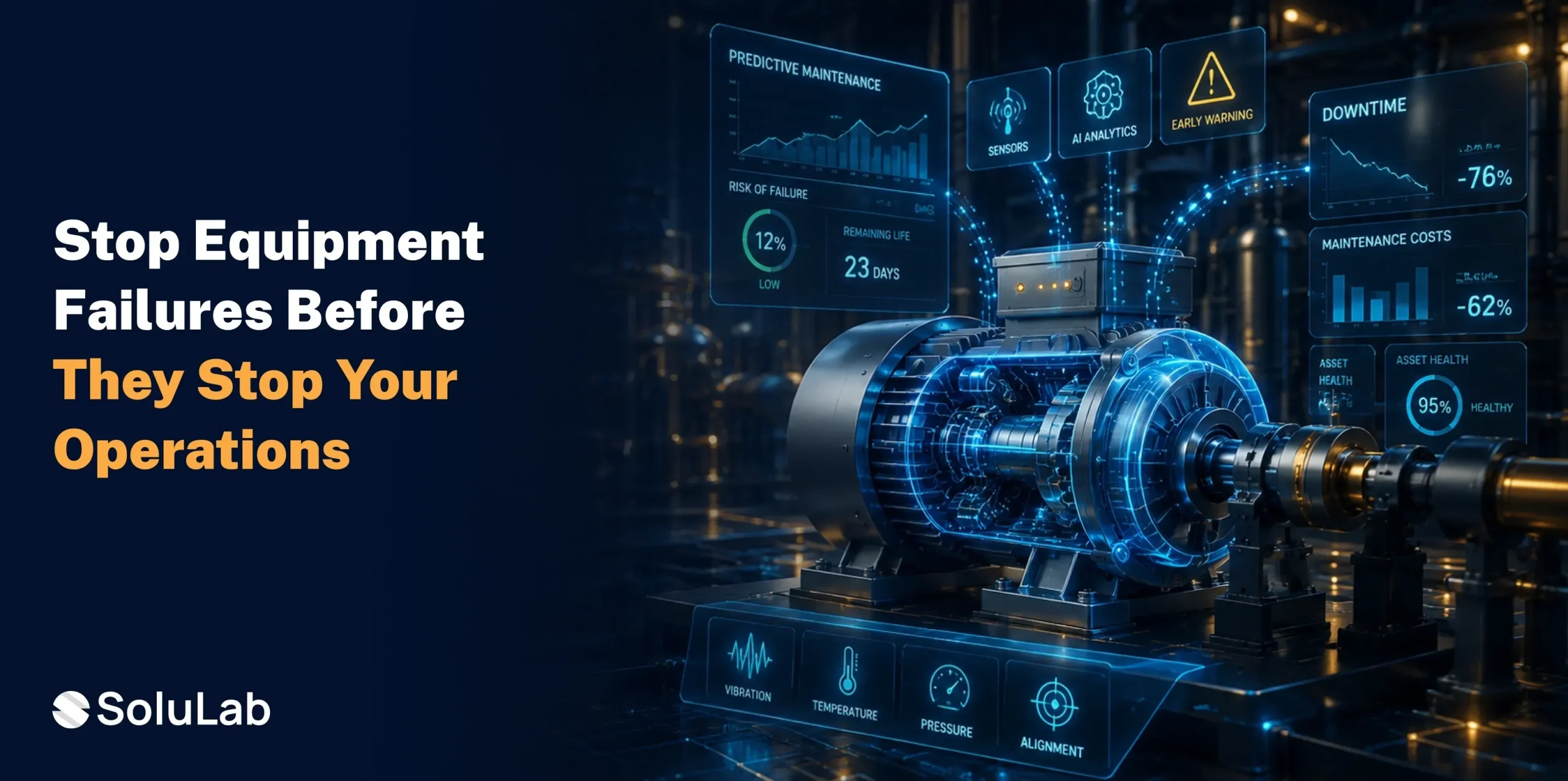
- AI for predictive maintenance uses sensor data and machine learning to catch equipment problems before they turn into a shutdown.
- Deloitte reports that predictive maintenance can raise uptime by 10% to 20% and cut overall maintenance costs by 5% to 10%.
- Deloitte pegs the cost of unplanned downtime at roughly $50 billion a year across manufacturers, which is why predictive maintenance strategy now gets real budget attention.
- You don’t need a full factory overhaul to get started. Pick one asset class, prove it works, then expand from there.
A single unplanned shutdown can wipe out a manufacturer’s margin for the month. Most plants deal with this in one of two ways: stick to a fixed maintenance calendar, or wait for something to break and scramble afterward. Both quietly waste money, one replaces parts too early, the other pays for the failure twice.
AI development solutions for predictive maintenance offer a third option. Sensors and machine learning models watch how equipment actually behaves and flag trouble weeks before a breakdown would happen. Gartner has noted that more than half of industrial companies already run AI-driven predictive maintenance in some form.
This guide covers what AI for predictive maintenance involves, why it’s worth the investment, and how it’s already being used across manufacturing, energy, transport, automotive, and oil and gas.
What is AI for Predictive Maintenance?
AI for predictive maintenance combines modern artificial intelligence with technologies ranging machine learning, sensor data, and analytics to predict when a piece of equipment is likely to fail, so the fix happens on your schedule instead of the machine’s. Instead of servicing something because a calendar says it’s time, teams act on what the machine is actually telling them through vibration, heat, or pressure readings.
McKinsey research on mature AI-driven predictive maintenance programs shows unplanned downtime dropping by up to 50%, with maintenance costs down 18% to 25%.
The real difference from older approaches is that the system learns. Every reading it collects sharpens the predictive models underneath it, so accuracy improves the longer the system runs. Give it a year of data, and it’s a different tool than it was on day one. That’s the core idea behind machine learning in predictive maintenance: the model gets smarter as your machines age, not the other way around.
Why Is Predictive Maintenance Important?
Unplanned downtime is one of the most expensive line items in industrial operations, and most of it is preventable.
- Deloitte puts the total cost at around $50 billion a year across manufacturers, and notes that poor maintenance strategy alone can shave 5% to 20% off a plant’s productive capacity.
- Predictive maintenance strategy matters because it protects uptime, budget, and safety all at once. A machine that fails without warning doesn’t just stop the line.
- It can damage the equipment around it, put a technician at risk, and force an emergency repair that costs several times what a planned one would have.
- A lot of businesses start by bringing in AI consulting services to figure out where their real downtime risk sits before they spend a dollar on new sensors or software.
How AI for Predictive Maintenance Reduces Downtime?
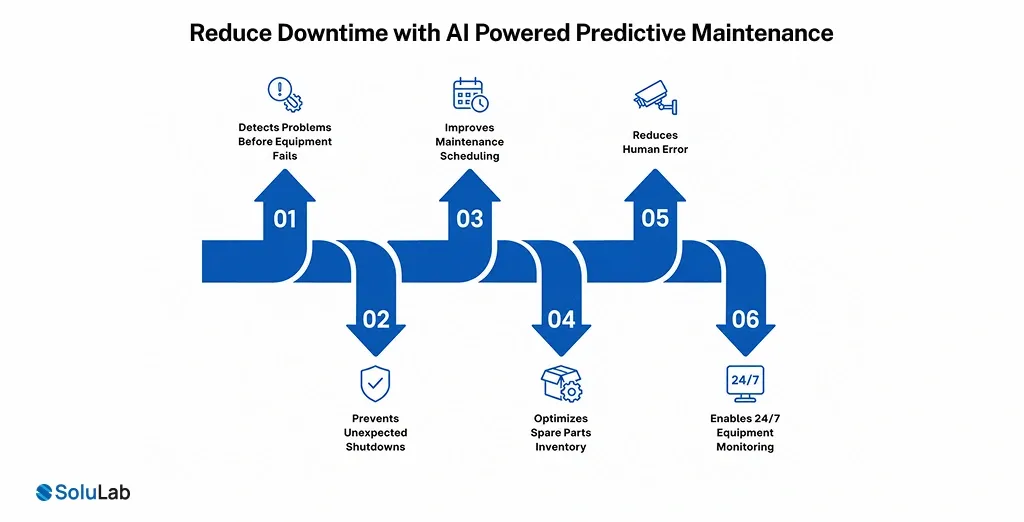
AI-driven predictive maintenance cuts downtime by catching problems earlier and more consistently than any manual inspection routine could. Here’s what that looks like in practice.
1. Detects Problems Before Equipment Fails
Sensors track vibration, temperature, and sound around the clock, and the model learns what “normal” looks like for each machine. When a reading drifts outside that range, it flags a fix before the part actually gives out.
2. Prevents Unexpected Shutdowns
Catching an issue early turns what would’ve been an emergency repair into a scheduled one, on your terms and your timeline. McKinsey’s research puts the downtime reduction from this shift at up to 50%.
3. Improves Maintenance Scheduling
Instead of working off a fixed calendar, AI ranks machines by real risk, so technicians spend their day on what actually needs attention rather than checking boxes on a list.
4. Optimizes Spare Parts Inventory
When you know roughly which part is likely to go next, you stop tying up cash in spares that sit on a shelf for years. Some teams take this further and build a predictive analytics model trained on their own parts and failure history.
5. Reduces Human Error
A tired technician on the third shift can miss a subtle sound or a slight vibration change. A sensor doesn’t get tired, and it applies the same threshold every single time.
6. Enables 24/7 Equipment Monitoring
Machines run through the night even when nobody’s watching them, and now the monitoring doesn’t stop either. AI agents for predictive maintenance can flag an anomaly at 3 a.m. and page a technician before it becomes a morning-shift emergency.

Preventive Maintenance vs. Predictive Maintenance
Both strategies exist to avoid breakdowns, but they start from different assumptions. Preventive maintenance assumes a part wears out on a predictable timeline. Predictive maintenance skips the assumption and just watches what’s actually happening.
| Factor | Preventive Maintenance | Predictive Maintenance |
| Trigger | Fixed time or usage interval | Real-time condition data |
| Risk of missed failures | Moderate, gaps between checks | Low, continuous monitoring |
| Parts usage | Often replaced too early | Replaced closer to actual need |
| Labor cost | Higher, more routine checks | Lower, focused on real risk |
| Data required | Minimal | Sensor and historical data |
| Best fit | Simple, low-cost equipment | Critical, high-value assets |
AI Technologies Behind Predictive Maintenance
Predictive maintenance using AI powered solutions isn’t one piece of software. It’s a stack of technologies working together, and each one earns its place.
1. Machine Learning
The model studies years of historical failure data and learns to recognize the early warning signs that show up before a breakdown, patterns a human reviewing spreadsheets would likely never spot.
2. Deep Learning
When the signal gets messy, layered vibration and thermal readings off a jet engine or turbine, deep learning picks up on the kind of nonlinear patterns a simpler model just can’t handle.
3. Computer Vision
A camera paired with computer vision can spot a hairline crack, corrosion, or a slow leak, especially on equipment that’s awkward or expensive to wire with physical sensors.
4. IoT Sensors
Sensors are the raw data source for everything else on this list, feeding vibration, temperature, and pressure readings back in real time.
5. Edge AI
Edge AI processes that data right on the machine instead of shipping it to the cloud first. The payoff is speed: an alert can fire in seconds rather than minutes.
How to Implement AI for Predictive Maintenance for Your Business?
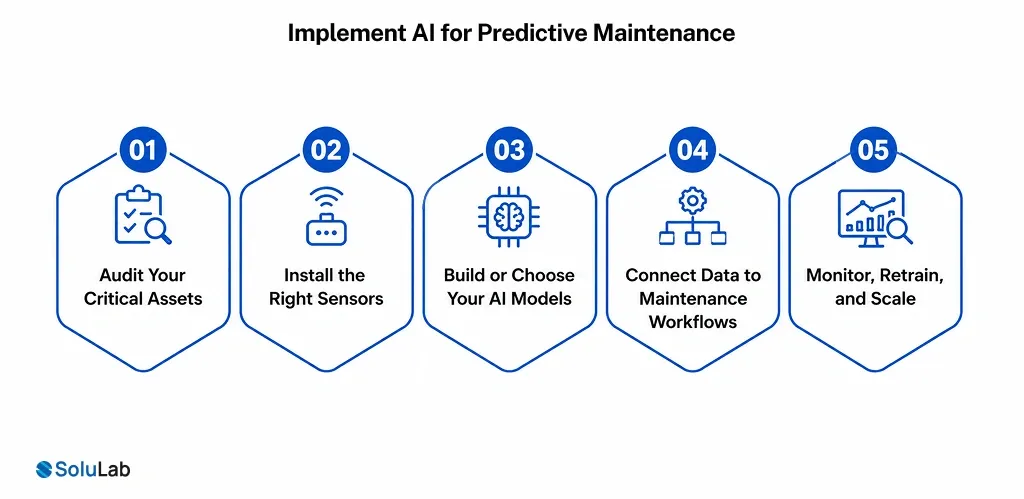
Rolling out AI-based predictive maintenance works better as a phased plan than a single big-bang launch. Here’s the path most businesses actually follow.
1. Audit Your Critical Assets
Not every machine deserves the same monitoring budget or attention.
- List assets by failure impact
- Rank machines by downtime cost
- Pick a pilot asset group first
2. Install the Right Sensors
Good predictions start with measuring the right thing on the right machine.
- Match sensors to failure type
- Cover vibration, heat, and pressure
- Confirm sensor placement accuracy
3. Build or Choose Your AI Models
This is where raw sensor readings turn into a prediction your team can actually use.
- Use proven AI models where possible
- Train on your own failure history
- Validate accuracy before full rollout
4. Connect Data to Maintenance Workflows
A prediction that never reaches a technician isn’t worth much.
- Link alerts to work order systems
- Set clear escalation thresholds
- Automate scheduling where you can
5. Monitor, Retrain, and Scale
Equipment ages and conditions shift, so the model needs upkeep, too.
- Track prediction accuracy monthly
- Retrain models on new failures
- Expand to more asset classes
Applications of AI in Predictive Maintenance
AI in predictive maintenance shows up differently depending on the industry, but the underlying goal never really changes: catch the problem early enough to do something about it.
1. Manufacturing Sector
On a production line, one stalled machine can bring everything downstream to a halt. Sensors on motors, conveyors, and robotics catch the early wear before it cascades into a full stoppage.
2. Energy Industry
Power plants and grid operators lean on enterprise predictive analytics to keep an eye on turbines, transformers, and substations, where a single failure can knock out power for thousands of people at once.
3. Transport & Logistics
Fleet operators watch engine health, brake wear, and tire pressure to head off a roadside breakdown, which usually means a missed delivery window and cargo sitting on a shoulder somewhere.
4. Automotive Industry
Automakers run predictive maintenance right on the assembly line itself, protecting the robotic arms and stamping presses that can’t afford to sit idle during a production run.
5. Oil & Gas Industry
On remote rigs and pipelines, predictive sensors catch corrosion, pressure swings, and fatigue early, in an environment where a failure is expensive to fix and genuinely dangerous to ignore.
Real-World Examples of AI Predictive Maintenance
1. Siemens
Siemens runs AI-powered predictive maintenance across its gas turbine fleet through its MindSphere IoT platform, using vibration and thermal data to flag bearing issues weeks before failure.
2. GE Aerospace
GE Aerospace applies predictive analytics to jet engine components, tracking performance data across flights so wear patterns show up long before a part reaches its actual failure point.
3. Bosch
Bosch uses predictive maintenance inside its own manufacturing plants, and it also sells the underlying sensor and analytics technology to other industrial manufacturers.
4. Caterpillar
Caterpillar builds condition-monitoring sensors directly into its heavy machinery, tracking engine health and hydraulic performance so fleet owners can plan a repair before a machine goes down in the field.
Future Trends of AI in Predictive Maintenance
Predictive maintenance with ai is heading toward more autonomous decision-making. Rather than just flagging an issue and waiting for a human to act, some systems are starting to recommend, or even trigger, the fix directly, which closes the gap between detection and action considerably.
Digital twins are worth watching, too. They simulate how a piece of equipment will respond to a change before anyone touches the real machine. Edge AI keeps expanding as well, pushing more of the prediction work onto the equipment itself instead of a cloud server somewhere.
A growing number of businesses are pairing AI-led development services with their own maintenance history to build models fitted to their specific machines, rather than buying a generic tool that was built for someone else’s factory.

Conclusion
AI for predictive maintenance isn’t an experimental upgrade anymore. It’s become a fairly standard part of running industrial operations well, and the numbers back that up. Deloitte shows real gains in uptime and cost.
The businesses seeing the biggest returns didn’t try to automate everything at once. They picked one critical asset, proved the model actually worked on real data, then scaled from there.
If you’re not sure where your own starting point should be, SoluLab, an AI development company in USA can walk through your equipment data and map out a predictive maintenance strategy built around your actual risk.
FAQs
Neha is a curious content writer with a knack for breaking down complex technologies into meaningful, reader-friendly insights. With experience in blockchain, digital assets, and enterprise tech, she focuses on creating content that informs, connects, and supports strategic decision-making.