Key Highlights
- Agent interoperability helps AI agents connect with external APIs, enterprise applications, data sources, and other agents. It is becoming important because most business work does not happen inside one tool.
- A single request may touch CRM, ERP, helpdesk, billing, compliance, or procurement systems. With proper AI agent API integration, agents can retrieve information, trigger workflows, update records, and coordinate tasks under defined governance.
- Standards like Agent-to-Agent Protocol (A2A) also support better agent-to-agent communication. For enterprises exploring custom AI agent development, interoperability is what turns isolated agents into useful workflow partners.
Enterprise AI is reaching an uncomfortable stage: many companies have agents that can reason, but not enough agents that can act. The gap is not intelligence; it is access. A support agent needs CRM context, a finance agent needs invoice data, and a compliance agent needs visibility before an action moves forward. Without agent interoperability, these agents stay useful but limited.
AI agent interoperability gives them a controlled way to communicate with external APIs, business systems, and other agents. For enterprises planning AI Agent development, this is what turns isolated AI assistants into connected workflow operators that can support decisions, automate handoffs, and still respect governance.
Why Agent Interoperability Is Now a Business Priority?
A lot of companies already have AI agents running. Some are useful. Some are interesting but not ready for serious work. The common problem is not always the agent’s reasoning ability. It is the lack of connection.
An AI chatbot that answers HR questions is helpful. But if it cannot check employee records, route a sensitive case, or create an approval task, the work still goes back to a human team. A sales agent may draft a follow-up email, but if it cannot read CRM data, check pricing rules, or request legal review, it remains limited.
That is why AI agent interoperability is becoming a serious topic for enterprise AI adoption.
It gives agents a way to communicate with the systems, APIs, and other agents needed to finish work. Without it, agents remain separate tools. With it, they become part of the operating workflow. This allows:
- Fewer manual handoffs
- Faster task completion
- Better system connectivity
- Lower integration friction
- Stronger control over agent actions
- More scalable automation across teams
The point is not to make agents “do everything.” That would create risk. The point is to help them do the right work, through the right system, with the right controls in place.
What does Agent Interoperability mean?
Agent interoperability means AI agents can exchange information, call tools, access APIs, and coordinate with other agents across different systems or platforms.
In simple terms, it lets agents work outside their own box.
A support agent may need to check the order history. A billing agent may need to verify payment status. A policy agent may need to confirm whether a refund is allowed. A supervisor agent may decide whether human approval is required.
If these agents cannot communicate, the workflow breaks. An AI agent interoperability framework gives structure to this communication. It defines how agents discover tools, pass context, request actions, and return results without every connection being custom-built from scratch.
There are two major parts:
a. Agent-to-system communication
This covers how agents connect with APIs, SaaS tools, databases, CRMs, ERPs, helpdesks, and internal platforms.
b. Agent-to-agent communication
This covers how one agent delegates work, asks for context, or coordinates with another specialized agent.
How AI Agents Talk to External APIs?
External APIs are usually the doorway into enterprise systems. If an agent needs to check an invoice, retrieve a customer profile, update a ticket, create a shipment request, or trigger an approval flow, it will likely use an API. This is where AI agent API integration becomes important.
A basic customer support example makes it clearer. A customer asks, “Where is my order?” A connected agent may need to identify the customer, call the order management API, check shipment details, retrieve delivery status, update the ticket, and respond with a useful answer. The agent needs:
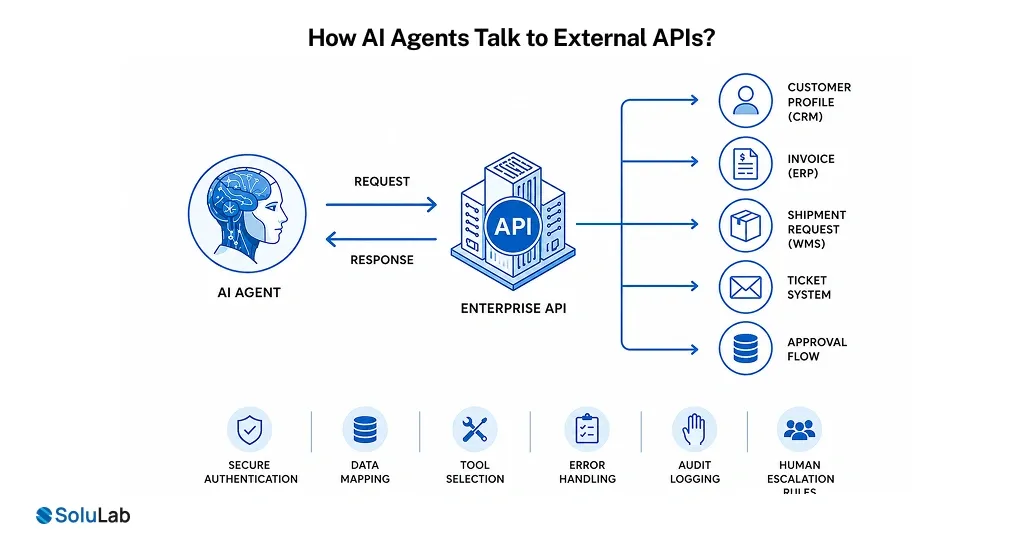
- API authentication
- Permission checks
- Data mapping
- Tool selection logic
- Error handling
- Safe response generation
- Audit logging
- Human escalation rules
A well-designed AI agent API connectivity should know what it can access, what it cannot touch, and when it needs approval before moving ahead.
Why APIs Matter in Agentic AI Workflows?
APIs are what move AI agents from advice to action. Without API access, an agent can only suggest the next step. With the right connectivity, it can help complete that step. This is especially useful in business workflows where employees lose time moving between systems.
For example:
- A support agent can create or update tickets.
- A sales agent can pull account history from CRM.
- A finance agent can compare invoices with purchase orders.
- A procurement agent can check vendor records.
- An HR agent can route employee requests.
- An IT agent can trigger a runbook or incident workflow.
Here, AI workflow automation solutions become more valuable. The agent is no longer a passive assistant. It becomes a controlled participant in the workflow.
Still, there is a line enterprises should not ignore. API access should not mean unlimited authority. Some actions are low risk, such as reading a product FAQ or checking order status. Others need tighter control, such as issuing refunds, changing employee records, approving payments, or updating compliance files.
Good interoperability respects that difference.
Agent Interoperability vs Traditional System Integration
Traditional integration predictably connects systems. System A sends data to System B. A middleware layer transforms it. A workflow runs when a condition is met.
That model still matters. Businesses will continue using APIs, middleware, event-driven architecture, and integration platforms.
Agent interoperability adds a different layer. An AI agent may decide which tool to call based on the user’s request. It may ask another agent for help. It may gather context from different systems before recommending an action. It may also stop and request human approval. The main differences are:
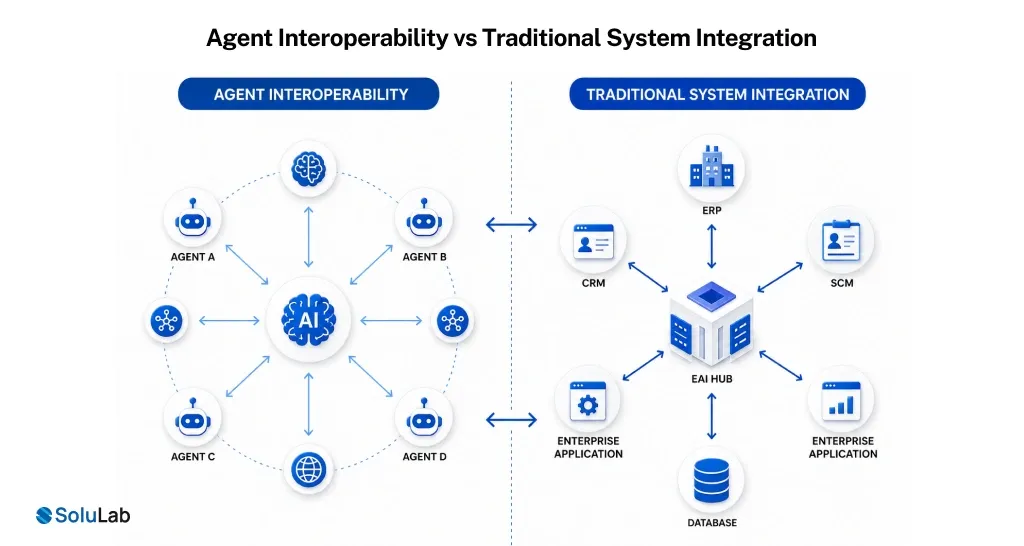
- Decision logic
Traditional workflows follow fixed rules. Agents may choose different paths depending on the request. - Context handling
Agents need to carry meaning across systems, not just pass fields. - Governance
Agent actions need identity, permissions, monitoring, and audit trails. - Flexibility
Agents can handle variations that rigid workflows may not cover.
This is why enterprises need more than basic API integration. They need an AI agent interoperability framework built for reasoning, action, oversight, and control.
What is Agent-to-Agent Protocol A2A?
The Agent-to-Agent Protocol (A2A) is designed to help AI agents communicate with each other across platforms, vendors, and frameworks. A finance agent may be built internally. A procurement agent may be vendor-specific. A compliance agent may sit inside another workflow system. Without a shared communication approach, each agent becomes another isolated tool.
An agent-to-agent interoperability protocol gives agents a structured way to discover capabilities, exchange tasks, share context, and return results. That does not mean every agent exposes its internal logic. It means agents can collaborate without needing to know everything about each other.
Think of a customer refund workflow.
The support agent understands the request. The order agent checks the delivery status. The policy agent reviews refund eligibility. The finance agent verifies payment constraints. If the refund is outside standard rules, a human manager reviews it. Specialized teams handle different parts of a task. Agent-to-Agent Protocol (A2A) brings a similar pattern into agent-based automation.
AI Agent Interoperability Standards
AI agent interoperability standards are becoming important because the agent market is getting crowded. Every platform wants to build agents. Every enterprise already has existing tools. Without standards, companies risk creating another fragmented technology layer. Standards help create a common way for agents to communicate, call tools, and exchange context. Two areas matter most:
Agent-to-agent standards
These help agents communicate across frameworks and vendors.
Agent-to-tool standards
These help agents connect with APIs, databases, applications, and knowledge sources in a consistent way.
Standards can reduce integration work, but they do not remove the need for architecture. A standard can help agents talk. It does not decide who should be allowed to act, what data can be accessed, or when approval is required.
- First, adopt protocols and open standards where they make sense.
- Second, build the governance layer around them.
Without governance, interoperability can become risky. With the right controls, it becomes a serious advantage.

Building Enterprise-Ready AI Agents With API Connectivity
An enterprise-ready agent needs more than a prompt and a model. It needs access, context, security, monitoring, and clear limits. This is where AI integration services become useful. An implementation should include:
1. API discovery: Teams need to identify which systems the agent should access and what each API should expose.
2. Permission design: Agents should work within defined roles and scopes. They should not inherit broad access by default.
3. Tool selection logic: The agent must know which API or system fits the task.
4. Error handling: If an API fails, returns incomplete data, or creates a conflict, the agent should respond safely.
5. Observability: Every agent action should be visible, logged, and traceable.
6. Human approval flows: High-risk actions should pause for review before execution.
7. Security controls: Agents need guardrails against prompt injection, data leakage, unsafe tool use, and unauthorized access.
This usually creates more risk than value. The better approach is to connect them carefully, starting with workflows where automation can create measurable improvement.
Multi-Agent Systems and Cross-Platform Communication
Most companies will eventually move from single-agent pilots to multi-agent systems. It will happen because one agent cannot handle every task well. A multi-agent setup may include:
- A planning agent
- A support agent
- A finance agent
- A compliance agent
- A research agent
- A workflow execution agent
- A human approval coordinator
Each agent has a job. The challenge is making them work together without confusion. Orchestration decides which agent owns the task, what context should be shared, which external API should be called, and when a human should step in.
Without orchestration, multi-agent systems can become messy. Two agents may duplicate work. One may act in an outdated context. Another may call the wrong system. A decision may move forward without approval. With proper orchestration, the system becomes more disciplined.
For example, in a procurement workflow, a request may begin with an employee. A procurement agent checks vendor options. A finance agent reviews budget availability. A compliance agent checks policy restrictions. A supervisor agent routes the approval if needed.
Common Enterprise Use Cases for Agent Interoperability
Agent interoperability becomes valuable wherever work crosses tools, teams, and approval layers. These are the areas where enterprises usually see practical results first.
1. Customer Support
Support work rarely lives in one system. Agents often need helpdesk data, CRM records, order status, billing details, and policy documents. An interoperable support agent can check customer history, retrieve shipment information, update the ticket, and escalate the case when needed. This reduces manual switching and helps support teams respond with better context.
2. Sales Operations
Sales teams use CRM platforms, proposal tools, pricing systems, email, contract workflows, and account research sources. A connected sales agent can prepare account summaries, update CRM fields, draft follow-ups, and ask a pricing or legal agent for input before a deal moves forward. This saves time without removing human judgment from important sales decisions.
3. Finance and Procurement
Finance and procurement workflows involve invoices, purchase orders, vendor records, payment systems, and approval chains. An interoperable agent can compare invoice details, check budget availability, flag mismatches, and route approvals through connected systems. This is a strong use case because the work is repetitive, document-heavy, and time-sensitive.
4. HR and Employee Support
HR teams deal with benefits, payroll, onboarding, policies, employee records, and internal requests. A connected HR agent can answer policy questions, create onboarding tasks, route sensitive cases, and retrieve approved information from internal systems. The privacy layer matters here. HR agents should be useful, but not over-permissioned.
5. IT Operations
IT teams rely on ticketing platforms, monitoring systems, cloud consoles, identity tools, and knowledge bases. An interoperable IT agent can summarize incidents, retrieve logs, create tickets, trigger approved runbooks, and escalate critical cases. This can reduce response time and help teams manage operational pressure.
6. Legal and Compliance
Legal and compliance teams work across contracts, policies, approval trails, regulatory records, and internal review systems. A connected agent can compare documents, flag risky clauses, summarize policy changes, and pass items to the right reviewer. For these teams, auditability is not optional. Every step must be traceable.
Risks Enterprises Should Manage
Agent interoperability creates value, but it also raises the stakes. Once agents can access APIs and coordinate with other systems, mistakes can move faster. The main risks include:
Unauthorized actions
An agent should not trigger sensitive workflows without proper permission.
Data leakage
Weak access rules may expose customer, employee, financial, or confidential business data.
Prompt injection
Malicious or careless inputs can push agents toward unsafe tool use.
Broken context
If one agent passes incomplete information to another, the final decision may be wrong.
Over-automation
Some decisions should stay with humans, especially in regulated or high-value workflows.
Poor monitoring
If teams cannot see what the agent did, they cannot audit or improve the system.
Vendor lock-in
Closed ecosystems can make future integration harder and more expensive.
AI agent interoperability is a safer approach to designing access, approvals, and logs before agents begin taking action. A connected agent should be treated like a software actor inside the enterprise. It needs identity, limits, records, and supervision.
What an AI Agent Interoperability Framework Should Include?
A strong AI agent interoperability framework should make agents useful without making them risky. At a minimum, enterprises should plan for these layers:
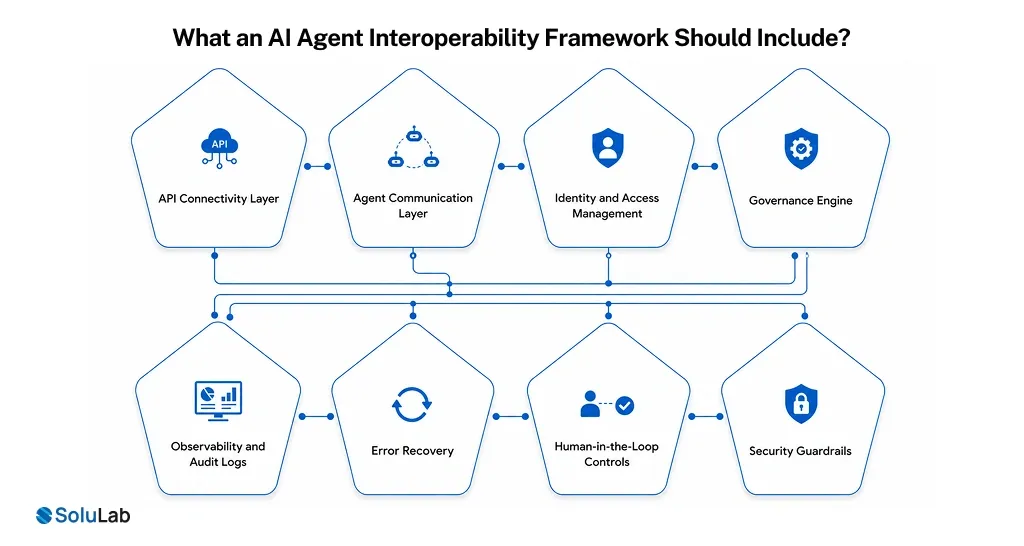
API connectivity layer
This connects agents with CRMs, ERPs, SaaS tools, databases, helpdesks, and internal applications.
Agent communication layer
This allows agents to exchange requests, status updates, task results, and shared context.
Identity and access management
Agents should operate with clear roles, permissions, and boundaries.
Governance engine
Business rules should define which actions are allowed, restricted, or approval-based.
Observability and audit logs
Teams should be able to track every important agent action.
Error recovery
The system should handle failed API calls, timeouts, incomplete responses, and conflicting outputs.
Human-in-the-loop controls
High-risk decisions should pause for review instead of moving automatically.
Security guardrails
The framework should protect against unsafe tool calls, prompt injection, and data exposure.
The framework does not need to be overbuilt on day one. But it should be designed with scale in mind. Retrofitting governance later is usually harder.
How SoluLab Helps Build Interoperable AI Agents?
SoluLab helps enterprises design, build, integrate, and scale AI agents that can work with real business systems. For companies exploring custom AI agent development, the challenge is rarely building one isolated agent. The harder part is making that agent useful across the systems where work happens. SoluLab’s AI agent development services can support:
- Agent strategy and use case planning
- API readiness assessment
- Multi-agent architecture design
- External API integration
- Agent orchestration setup
- Workflow automation planning
- Governance and security design
- CRM, ERP, SaaS, and database connectivity
- Human approval workflow design
- Testing, monitoring, and deployment
With AI agent integration services, businesses can connect agents with APIs, knowledge bases, internal tools, and third-party platforms while keeping control over data access and execution.

Conclusion
Agent interoperability is becoming a core requirement for enterprise AI. A standalone agent can help with narrow tasks, but connected agents are where serious business value begins. When agents can communicate with external APIs, business applications, data systems, and other agents, they can reduce manual handoffs and support workflows that used to require several teams.
Still, connection alone is not enough. Enterprises need governance, identity controls, monitoring, security, audit logs, and human approval points. The businesses that treat interoperability as architecture, not just integration, will be better prepared to scale agentic AI beyond isolated pilots.
Build Interoperable AI Agents With SoluLab!
AI agents cannot create real enterprise value if they stay trapped inside one tool. They need to connect with your APIs, systems, workflows, and business rules safely. From AI agent API integration to orchestration and governance, our experts design agents that can act safely across real business workflows. Explore custom AI agent development for your enterprise goals!
FAQs
Shipra Garg is a tech-focused content strategist and copywriter specializing in Web3, blockchain, and artificial intelligence. She has worked with startups and enterprise teams to craft high-conversion content that bridges deep tech with business impact. Her work translates complex innovations into clear, credible, and engaging narratives that drive growth and build trust in emerging tech markets.