It’s been 3 to 4 years since AI has come, and businesses are already using it in one of their workflows. Businesses now want to automate their processes, increase productivity, and improve ROI.
However, integrating generative AI in workflows is indeed important, but doing it without proper planning and identifying areas of automation may lead to wasted efforts. You’ll see productivity in workflows, automating repetitive tasks, but your ROI is not increasing.
| In fact, according to Gartner, 50% of generative AI projects failed due to poor data quality, inadequate risk controls, escalating costs, or unclear business value. |
And the reason is misaligned generative AI adoption. This blog post will guide you exact reasons why your generative AI implementation is failing, how to resolve it, and more. Let’s get started!
Key Takeaways
- The Problem: GenAI projects have a very high failure rate in terms of producing quantifiable ROI; research indicates that only about 95% of projects fail to reach full production or effect.
- The Solution: Effective adoption entails coordination: aligning AI to the business strategy, making it part of the business processes, governance, and cross-functional working. Target specific KPIs: improvements in productivity, cost reduction, revenue influence, and risk reduction.
- How SoluLab Can Help: SoluLab provides custom GenAI solutions that have an end-to-end orchestration that includes integration, governance, and workflow automation. We accelerate business ROI, mitigate risks, and grow AI adoption efficiently by ensuring strategy, technology, and talent alignment.
The Reality Check: Adoption ≠ Impact
A major MIT study found that 95% of enterprise generative AI pilots fail to produce measurable profit & loss impact, meaning only about 5% deliver real business value despite heavy investment.
Industry research suggests that 70–85% of AI (including GenAI) deployments fail to achieve the expected ROI, significantly higher than typical IT project failure rates.
An EY executive survey revealed that global companies experienced ~$4.4 billion in risk-related financial losses from AI adoption, mainly due to flawed outputs, compliance failures, and bias, before ROI could be realized.
Top 5 Reasons for Gen AI Adoption Failure in Businesses
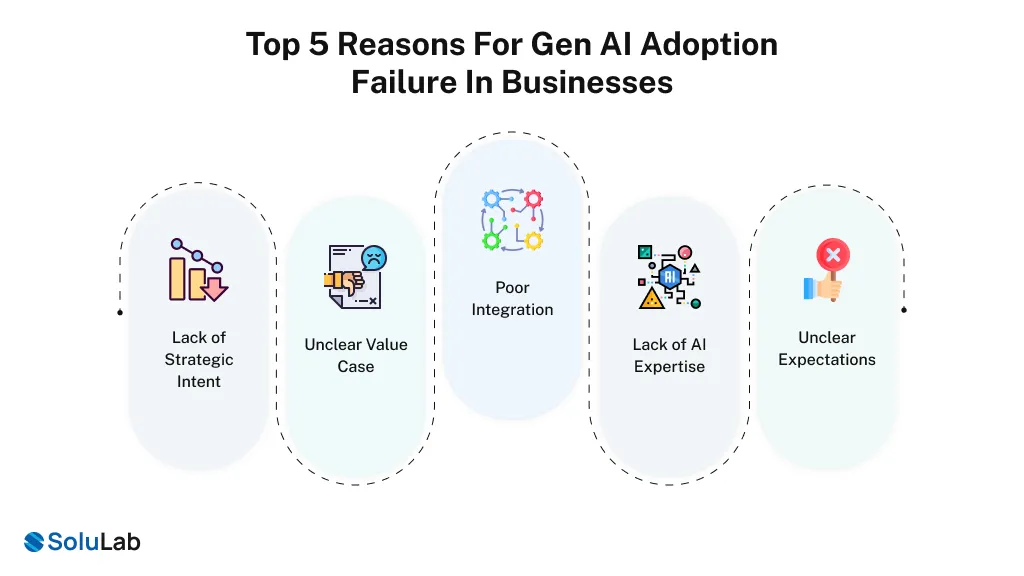
Generative AI has the potential to bring transformative business value, but not all organizations can realize tangible results. The failures of adoptions are usually caused by strategic, technical, and operational disparities that obstruct the ROI and scalability.
1. Lack of Strategic Intent: GenAI is embraced by many companies since it is a fad and does not correspond to a specific business objective. In the absence of a strategic plan, initiatives are not able to produce a tangible effect or contribute to the organizational goals.
2. Unclear Value Case: GenAI is frequently applied in a manner that is not explicitly defined by businesses on how it will generate tangible value. The lack of clarity in the expectations of ROI causes the inability to determine the success and invest in people, tools, and infrastructure.
3. Poor Integration: GenAI systems that are not integrated with main systems, such as CRM, ERP, or knowledge bases, do not produce actionable insights, and thus their usefulness is limited, as they cannot be easily integrated into the workflow.
4. Lack of AI Expertise: Lacking skilled AI specialists is a drawback to the development, deployment, and maintenance of GenAI systems. Organizations are not effective with fine-tuning their models, data preparation, and risk mitigation without the appropriate expertise.
5. Unclear Expectations: Hype is usually disillusioning. Companies that want immediate outcomes do not take into consideration learning curves, cumulative upgrades, and managing the change that will make GenAI successful.
Strategies to Avoid Gen AI Implementation Failures
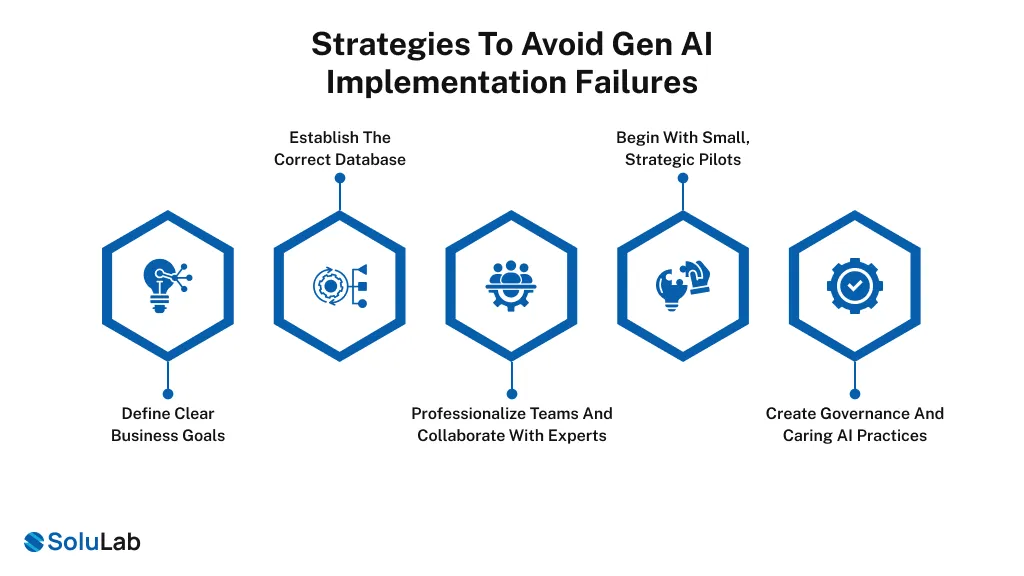
Generative AI consulting solutions produce a meaningful business impact rather than a silent failure; organizations should implement more organized approaches that can be aligned, data-ready, governed, talented, and run in cycles with real workflows and tangible results.
1. Define Clear Business Goals
Establish clear goals and KPIs before implementing GenAI, not merely because technology is an experiment on its own. Strict indicators related to income, productivity, or customer satisfaction drive decision-making and assess performance.
2. Establish the correct Database
Good quality, clean, and well-administered data is required. To remove bottlenecks, decrease biases, and enhance model performance, invest in strong data pipelines, storage, and governance.
3. Professionalize Teams and Collaborate with Experts.
Generative AI projects achieve success when internal teams are trained and guided by external AI professionals. Integrating business domain experience with technical skills will increase business implementation speed and knowledge degradation.
4. Begin with Small, Strategic Pilots.
Defined use case pilot projects are useful in testing hypotheses, demonstrating value early, and finding out what integration issues might be encountered at an enterprise-wide scale. This incremental strategy minimizes risk and confidence.
5. Create Governance and Caring AI Practices.
Install frameworks on ethics, security, privacy, and acceptable use. Governance ascertains compliance and instills trust in AI outputs, particularly when the level of usage across the functions rises.
Read More: Enterprise AI Security & Governance
How to Measure Generative AI ROI Effectively?
Calculating ROI in generative AI is essential to make a justified investment and be able to prove business value. It is not only located on the measure of adoption; it relates to productivity, expense reduction, revenue influence, and mitigation of risk.
1. Productivity Metrics: Track efficiency improvements across teams using GenAI tools, such as time saved on repetitive tasks, faster content creation, or accelerated decision-making. Productivity metrics show tangible operational benefits and highlight AI’s contribution to workflow optimization.
2. Cost Savings Metrics: Measure reductions in operational costs enabled by AI, including decreased labor hours, lower outsourcing expenses, or minimized resource wastage. Quantifying cost savings helps illustrate how AI delivers financial efficiency and supports sustainable scaling of business operations.
3. Revenue Impact Metrics: Assess how GenAI drives revenue growth through faster product launches, personalized marketing campaigns, or improved customer engagement. Revenue impact metrics link AI adoption directly to business outcomes, demonstrating its strategic value beyond operational improvements.
4. Risk Reduction Metrics: Evaluate how AI minimizes business risks, such as preventing errors, enhancing compliance, detecting fraud, or improving security. Risk reduction metrics quantify AI’s role in safeguarding assets, ensuring regulatory adherence, and building long-term organizational resilience.
Read More: Why 60% of US AI Projects Fail at Scaling (And How SoluLab Fixes It)?
Example of a Successful Generative AI Adoption
MedTech collaborated with SoluLab to develop a GenAI-driven Clinical Decision Support system that converts disjointed patient information into actionable data.
Our team designed a GenAI model with EHR/EMR systems, which allowed real-time diagnostics, generation of different diagnoses, and evidence-based treatment recommendations.
Clinical documentation was also automated by the solution, and patient-friendly discharge instructions were also generated. The platform was developed with a security level that is HIPAA compliant and an easy-to-use clinician dashboard, which led to better diagnostic accuracy, less delay, and workflow efficiency.
Consequently, the client enhanced its status as a reliable healthcare technological partner and improved the patient outcomes in various care contexts.
Conclusion
Even though generative AI has transformative capabilities, most businesses do not achieve their potential because of the misalignment of strategies, ineffective integration, incoherent data, skill shortages, and a lack of clarity.
Organizations that aim to achieve success should set clear goals, deploy orchestration theories, invest in information quality and talent, and effectively manage change.
When businesses avoid these pitfalls and work on quantifiable results, they can achieve the real potential of generative AI and become more innovative and efficient and grow sustainably.
SoluLab, a generative AI development company, can help you automate your business with proper planning. Book a free discovery call today!
FAQs
Neha is a curious content writer with a knack for breaking down complex technologies into meaningful, reader-friendly insights. With experience in blockchain, digital assets, and enterprise tech, she focuses on creating content that informs, connects, and supports strategic decision-making.