Key Takeaways
- White label banking allows businesses to offer banking or financial services under their own brand using infrastructure and services provided by a third-party financial institution or fintech provider.
- It can enable services such as digital accounts, payments, cards, lending, money transfers, and financial management tools without building the entire banking infrastructure from scratch.
- Businesses benefit from faster market entry, reduced infrastructure costs, and access to established financial technology and compliance capabilities.
- Common users include fintech startups, retailers, marketplaces, platforms, and non-banking businesses looking to embed financial services into their products.
- A white-label banking solution typically involves APIs, banking infrastructure, KYC/AML processes, payment systems, card issuing, security, and regulatory compliance.
White label banking is launching a banking product under your own brand using someone else’s platform and licence. You get the interface, the customer relationship and the pricing. The provider supplies the core banking software, the rails and usually the regulated permissions. Time to market is weeks to months rather than years.

What is a White Label Bank?
A white label bank is a banking product that carries your brand and runs on infrastructure you did not build. Customers see your name, your app and your terms. Behind it sit a core banking platform and a licensed institution.
Three layers are always present, and knowing which one a vendor sells you is the most important question in the procurement:
| Layer | What it provides | Who usually owns it |
| Brand and experience | App, web, support, pricing, marketing | You |
| Core banking software | Ledger, accounts, cards, payment processing | The white label platform |
| Licence and funds | Regulatory permissions, customer money | A licensed bank or e-money institution |
Some vendors supply the middle layer only, some bundle the licence through a partner, and some hold a licence themselves. The commercial and regulatory consequences of each are very different.
White label banking vs banking as a service
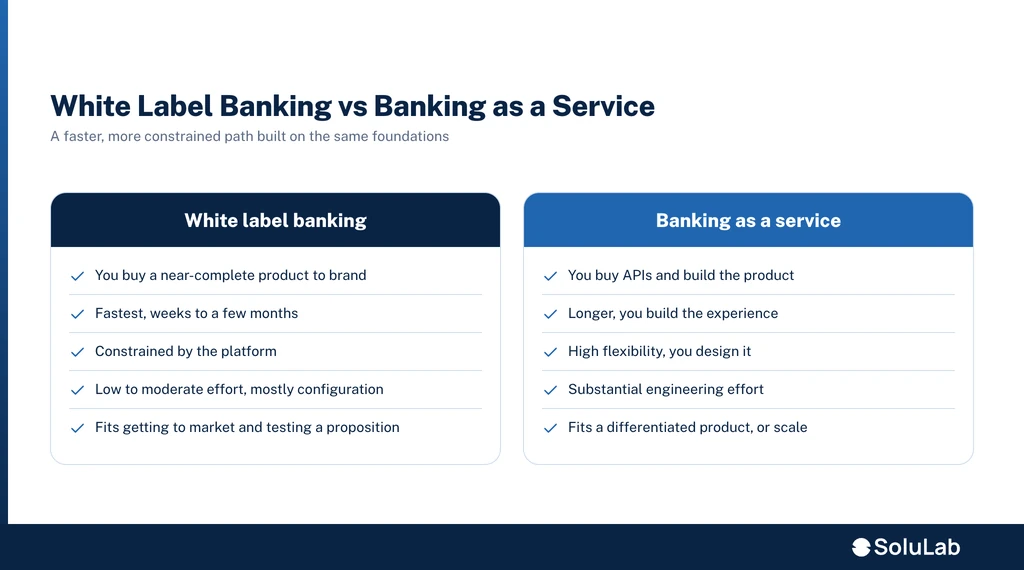
They overlap and are not the same thing.
| White label banking | Banking as a service | |
| What you buy | A near complete product to brand | APIs to build your own product |
| Time to market | Fastest, weeks to a few months | Longer, you build the experience |
| Flexibility | Constrained by the platform | High, you design it |
| Engineering effort | Low to moderate, mostly configuration | Substantial |
| Fits | Getting to market fast, testing a proposition | A differentiated product, or one at scale |
The practical relationship: white label is a faster, more constrained path built on the same foundations. Many companies start white label and move to a BaaS build once volume or differentiation justifies it, which is worth planning for at the start rather than discovering later.
Benefits of white label banking
- Faster time to market. Weeks to months, against years for a licence application.
- No licence required where the provider’s partner bank holds the permissions.
- Lower upfront cost, since core banking software is the provider’s capital expenditure rather than yours.
- New revenue streams from interchange, foreign exchange, subscriptions and lending margin.
- Improved customer retention. A financial product inside an existing relationship increases the cost of leaving.
- Customer experience control, at least at the interface layer.
- Access to embedded finance without becoming a financial institution.
What white label banking is genuinely good for
- A brand with an existing audience adding accounts or cards.
- A vertical software company embedding payments or lending for its customers.
- Testing a financial proposition before committing to a licence.
- A regional launch where local licensing would take years.
- A neobank proposition where the differentiator is the segment and the service, not the mechanics.
Where it is the wrong choice
- When the product is the differentiator. If your value is a mechanism the platform cannot support, you will hit its limits quickly.
- At high volume. Per account and per transaction pricing that is attractive at ten thousand customers can be punitive at a million.
- When you need unusual products. Anything outside the platform’s catalogue is a roadmap request, not a build.
- When data must stay under your control. The platform holds the ledger.
- When you cannot accept dependency. Your product’s pricing, features and risk appetite are partly someone else’s decisions.
What white label banking software must include
Check each of these explicitly rather than assuming:
| Capability | Why it matters |
| Core banking ledger | Double entry, reconciliation, statements. The foundation |
| Account issuance | Whether accounts are in the customer’s name or virtual |
| Card issuing and processing | Physical, virtual, and which schemes |
| Payment processing | Domestic and cross border rails, and their cut off times |
| Multi currency accounts | If you need them, confirm which currencies and at what spread |
| Onboarding, identity and screening | Who owns the policy and who can change thresholds |
| Open banking connectivity | Data access and payment initiation where regulation supports it |
| Operations console | What your support team can actually do without raising a ticket |
| Reporting and reconciliation | Daily reconciliation is a regulatory expectation, not a nicety |
| APIs and webhooks | How much you can customise, and the event model |
The operations console row is the one buyers under-examine and then regret. If your support team cannot investigate and correct a customer problem themselves, every incident becomes a vendor ticket.
How much does it cost to launch with white label banking?
| Cost | Basis |
| Setup and implementation | One off, charged by the platform |
| Monthly platform fee | Usually with a minimum, which dominates the economics early |
| Per account and per transaction | The part that scales, in both directions |
| Card issuance and processing | Per card and per transaction |
| Your build | Brand layer, integration, operations tooling |
| Compliance operations | Your own staff, frequently underestimated |
The figure that decides viability is the monthly minimum against your expected customer count in year one. A platform that is cheap per account and expensive per month is a poor fit for a slow launch, and the reverse is true at scale. Model both.
How to choose a white label banking platform
- Establish which layers they provide, especially whether the licence is theirs or a partner’s.
- Ask which regulated entity holds customer funds, and what deposit protection applies.
- Read the pricing at your year three volume, not your launch volume.
- Test the operations console with your actual support people.
- Ask what customisation is possible versus what needs their roadmap.
- Ask about exit. Can you migrate customers and balances, and at what cost?
- Ask about their concentration risk, meaning what happens if their partner bank exits.
- Check jurisdiction coverage against where you actually intend to operate.
We deliberately do not publish a ranked list of platforms. The market shifts quickly, and every published ranking is written by a vendor or an affiliate. The right choice depends on your products, jurisdictions and volume curve.
How to get started with white label banking
- Define the product and the segment. Accounts, cards, lending, and for whom.
- Jurisdictions and regulatory position. Which permissions your product needs, and who will hold them.
- Platform shortlist, scored on the eight questions above.
- Commercial modelling at launch, year one and year three volumes.
- Integration and brand build. Your experience layer, operations tooling and support workflows.
- Operational readiness. Complaints, disputes, fraud, reconciliation and reporting. This is what regulators and partner banks examine.
- Pilot launch to a small cohort, then scale.
Where SoluLab fits
We are not a bank or a platform. We build the layer you own: the branded experience, the integration to the platform, the operations console your team needs, and the reconciliation and reporting that keep a partner bank comfortable. We also help score platforms against the questions above, because the decision is hard to reverse.
Proof
- Generative AI mobile banking platform. A banking product with regulated workflows.
- Instant loans app for small business lending. Lending product delivery end to end.
- DLCC. Financial infrastructure work.
Architecture and compliance consult
Bring the product and the jurisdictions. You will get a platform shortlist scored against your volume curve, the questions to put to each provider, and an estimate for the layer you own.
FAQs
Shipra Garg is a tech-focused content strategist and copywriter specializing in Web3, blockchain, and artificial intelligence. She has worked with startups and enterprise teams to craft high-conversion content that bridges deep tech with business impact. Her work translates complex innovations into clear, credible, and engaging narratives that drive growth and build trust in emerging tech markets.