Rust developers build software that scales without turning brittle. A game engine. A web application. A custom operating system. The backend that keeps buckling every time your traffic doubles. All of that sits inside what a good Rust developer can actually deliver, and the work tends to hold up as your company grows into it.
Picking the right person matters more than most teams admit. Hire a backend developer who has never really written Rust, or who grates against the people already on your team, and you feel it in slipped deadlines and software releases that keep sliding a week to the right. With an 83% acceptance rating in 2024, Rust has taken off as the language developers most want to keep working in.
The right hire speeds your project up. The wrong one quietly wrecks it, usually because nobody checked the things that are easy to skip in an interview: skill alignment, domain knowledge, and what the whole arrangement actually costs. This blog walks through how to pick the Rust developer your team needs.
Why Is Rust Becoming the Go-To Choice for Blockchain Development Nowadays?
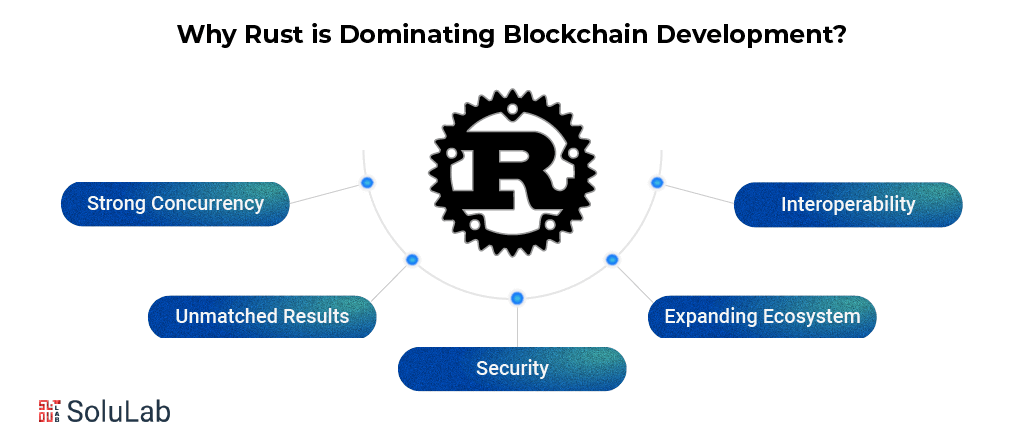
Plenty of languages have been used to write blockchains. Rust keeps winning the argument lately, and the reasons are fairly specific.
1. Security
Security token offerings in blockchain development, because a single defect here costs real money and a reputation you may not get back. Rust’s ownership model and borrow checker cut off whole categories of failure before the code ever runs: null pointer dereferences, buffer overflows, data races. That is not a stylistic preference. It is the difference between a bug report and an exploit, and it is a large part of why blockchain applications stay intact under pressure.
2. Unmatched Results
Blockchain systems chew through transaction volume, and they have to do it without stalling. Rust hands developers fine-grained control over system resources and performs in roughly the same class as C and C++. You see the payoff in three places: transactions clear faster, latency drops, and the network keeps scaling instead of hitting a ceiling.
3. Strong Concurrency
A chain that can only process one transaction at a time is not a chain anyone will use. Concurrency is the whole ballgame. Rust’s ownership system, plus what the community calls fearless concurrency, lets developers write parallel code that stays consistent and refuses to compile when two threads reach for the same data unsafely. If you plan to handle growing transaction volume rather than demo volume, you need this.
4. Expanding Ecosystem
The tooling has caught up. Libraries, frameworks, and toolchains aimed squarely at blockchain work are established and still multiplying, and the crates a developer reaches for on day one are already there. What sets Rust apart, though, is the community around it. People answer. People maintain things. That is the quiet reason Rust-based blockchain projects like blockchain solutions tend to still be alive three years later.
5. Interoperability
You rarely get to start clean. Rust drops into other languages, which means your team can keep the codebase it already has and build hybrid blockchain applications on top of it rather than around it. For a company that needs blockchain technology folded into infrastructure and processes that already run the business, this compatibility decides whether the project is feasible at all.

What Skills to Seek When Hiring Rust Developers?
Rust plays well with other languages. That trait is a good chunk of why it exploded in popularity, and it is also why you probably want a Rust programmer who is fluent somewhere else too.
Most Rust developers you meet will also know their way around JavaScript, MySQL, C++, and Node.js. A lot of current Rust work is rewriting: taking existing Java code and porting it over. Done well, that conversion has cut execution time by as much as 90%. So if that is the reason you are hiring, do not settle for a Rust specialist who has never touched Java.
A few more things worth weighing:
- Rust often shows up as the thing optimizing a JavaScript engine. Your Rust hire should be able to write solid JavaScript, not just read it.
- Clean, maintainable code is not a nice-to-have. The next person on the team has to read it, and six months from now the project may change hands entirely. Ask how they think about that.
- Rust engineers work alongside project managers and other developers every day. Whoever you pick should be comfortable in a team and able to say what they mean clearly.
- Deadlines mean juggling. Rust developers usually run several projects at once and have to decide what gets attention first. Look for people who organize themselves and keep project managers in the loop without being chased.
Read Blog: Top 10 Rust Development Companies of 2025
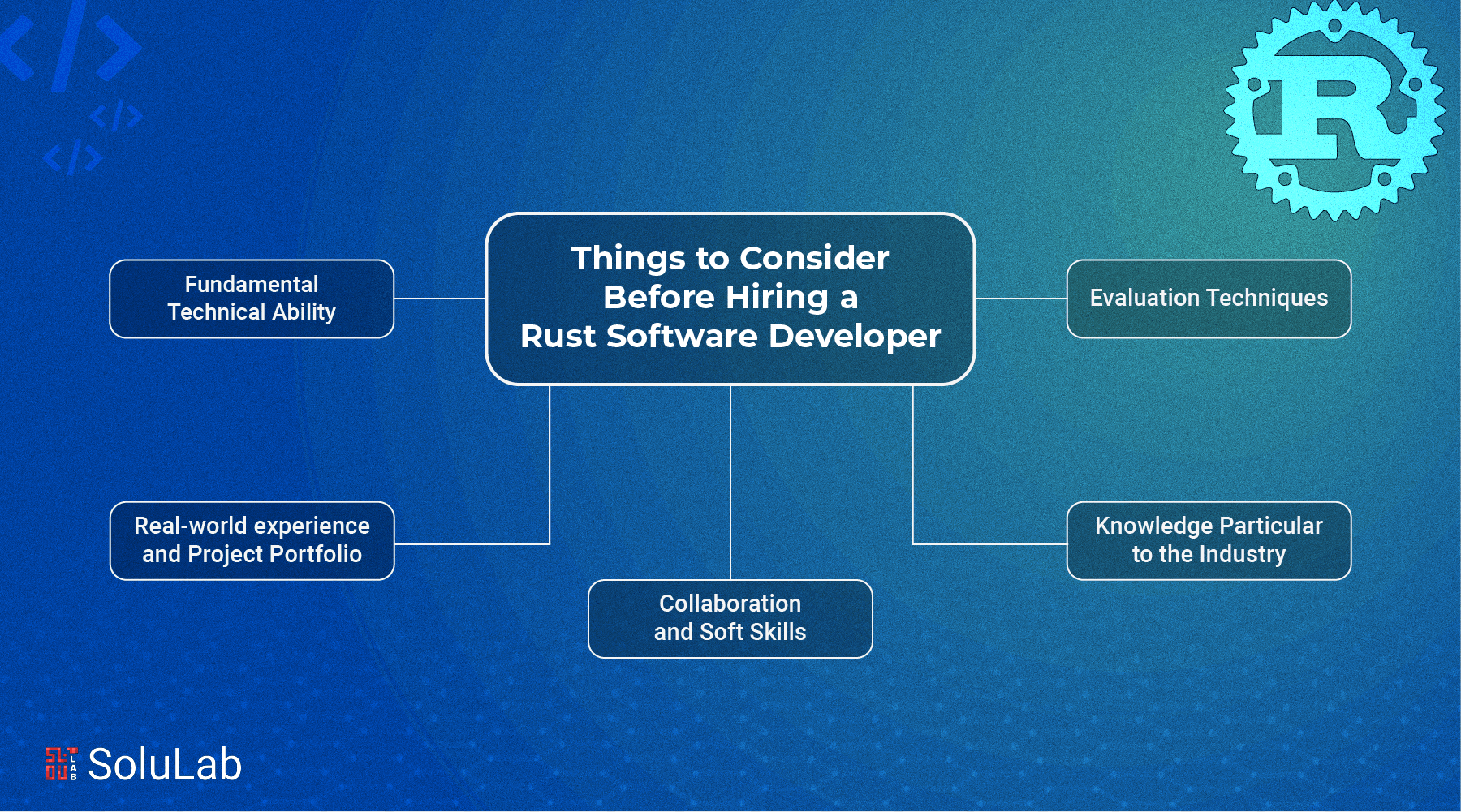
Things to Consider Before Hiring a Rust Software Developer
If you are assembling a team with real Rust depth, these are the factors that actually move the needle.
1. Fundamental Technical Ability
Start with the fundamentals, because everything else rests on them. A capable Rust blockchain developer should have a working command of data structures and algorithms, and should be able to tell you why they chose one structure over another for a specific workload rather than reciting Big O from memory. Then get to ownership and borrowing, which is where Rust’s memory safety actually lives. Ask them to walk you through lifetimes and the borrowing rules, and to explain how those rules stop data races and dangling pointers from happening in the first place. Push for code. An answer that stays abstract is usually an answer that has not been earned.
Concurrency is Rust’s strong suit, so test it. Threads, channels, mutexes, async/await, and the runtimes people actually use, meaning Tokio or Async-std. If they have shipped something with a parallel processing library like Rayon, that counts for a lot.
Error handling is the other tell. Rust gives you Result and Option, and a good developer reaches for explicit handling instead of sprinkling panics through the codebase. Ask about testing too: unit tests, integration tests, and whether they are comfortable in GDB or LLDB when something misbehaves at runtime. Code that nobody can debug is code you will eventually rewrite.
2. Real-world experience and Project Portfolio
Theory is fine. Shipped work is better. Open-source contributions are the easiest window into how someone really codes, so go read their GitHub: the commits, the review comments, the issues they picked up and finished. Personal projects count as well, especially the ones where Rust was used to solve an actual problem instead of to practice the syntax.
Go through their employment history with the same attention, particularly any embedded work. And check that they know Cargo properly, since dependency management is where most day-to-day friction shows up.
3. Collaboration and Soft Skills
Technical skill is one piece of the puzzle. Communication is the other, and teams underweight it constantly. Can the candidate explain a technical decision to someone who did not make it? Can they say what they were thinking and why, without burying it in jargon? That is the skill your whole development team depends on.
Rust work runs into hard problems on a regular basis, so watch how they approach one: how they define the issue, break it into pieces small enough to reason about, and land on something workable. Look at how they behave in code review too. Do they give criticism that helps, and take it without flinching? Rust itself keeps moving, so the last thing to check is appetite. The Rust blockchain engineers worth hiring are the ones still learning.
4. Knowledge Particular to the Industry
Match the specialization to the work in front of you. Building embedded systems? Then microcontrollers, real-time operating systems, and bare-metal programming are what you screen for when hiring Rust blockchain developers, not generic backend experience.
For web projects, familiarity with Actix Web, Rocket, or Warp saves you weeks. For blockchain, you want someone who has written smart contracts and worked with chain-specific libraries before, not someone who is about to learn on your budget.
5. Evaluation Techniques
One interview will not tell you enough. Use several angles. Run a real technical conversation around core Rust concepts, how they attack problems, and coding situations that resemble the ones your team hits on a Tuesday. Then watch them write code in a controlled setting, whether that means an online coding platform or a test you build yourself.
Where you can, hand them existing Rust code and ask them to review it, or ask for a sample of their own. Then read the portfolio slowly. Design patterns, the shape of their problem-solving, the general quality of the code: that is where the answer usually is.
Read Also: Dedicated Team vs Freelance Developer
How Much Does a Rust Developer Cost?
Numbers first. O’Reilly’s 2021 survey of US and UK developers put full-time Rust salaries between $100,000 and $150,000. ZipRecruiter reports an average of around $124,000 a year for remote Rust engineers, which lands just under $60 an hour.
Rust coders sit near the top of the pay scale, and the reason is simple supply and demand: the language got popular faster than the talent pool grew. Here is the part that catches finance teams off guard. If your last few hires were PHP, Ruby, or Python developers, budget at least 20% above what you paid them.
How To Hire Rust Developers?
Once you have a shortlist, move fast and assess properly. Pre-employment testing platforms are the most reliable way to do both, since their tests are built to measure the hard and soft skills of Rust developers rather than how well someone interviews.
Hiring remotely opens up the global talent pool, which you will need. Three arrangements are on the table:
- Full-Time: You get a developer’s undivided attention. In exchange you owe them a competitive salary and a benefits package good enough to keep them, because strong Rust engineers get recruited constantly. Expect your company to handle income tax withholding as well.
- Part-Time: If programming help is something you need occasionally and often on short notice, a part-time consultant is the economical answer. Write a clear non-compete clause into the contract. That detail matters more here than it does anywhere else.
- freelancing: Need flexibility above all? Go freelance. The pool runs from computer science students to systems engineers with decades behind them, scattered across the world and nowhere near Silicon Valley. Freelancers generally sort out their own income tax and health insurance, which takes that off your plate.
Consultants and freelancers usually quote an hourly rate, but read that rate for what it is: an estimate of the time a programming milestone will take, where the milestone is a defined piece of the application. You and the remote Rust developer hammer out those milestones together, and the back-and-forth is how interim fees for the life of the project get set.
Common Mistakes When Hiring a Rust Developer
Two errors account for most bad Rust hires. Both are avoidable.
1. Soft Skills: It does not matter how good someone is at writing Rust if they cannot prioritize their own work, cooperate with other developers, or hold a straight conversation with a project manager. Those skills shape every single working day. They also get waved through in interviews more often than any technical gap would be.
2. Overlooking the Cultural Fit: Fit carries the same weight as skill. Some developers do their sharpest work under pressure with a fast clock running. Others need quiet and room, and they write worse code when you take it away. Neither type is wrong. Be honest about which one your development team actually is, then hire people who want that.

Conclusion
The backend systems your company grows on are the ones a Rust developer builds. Choosing well is the whole thing. Scale comes from it, and so does the ability to fix software problems the week they appear instead of the quarter after.
If the task in front of you is specific and well defined, hire one remote developer and stop there. It costs less and it gets you to the goal sooner. Hire the wrong person, though, and your codebase slowly turns into something nobody wants to open.
Work backwards from your needs: define them, write the job description, then go find candidates. SoluLab, a software development companyhas a team of experts to solve your business problems and grow your business. Follow the steps and considerations above, and you are good to hire Rust developers now.
FAQs
Shipra Garg is a tech-focused content strategist and copywriter specializing in Web3, blockchain, and artificial intelligence. She has worked with startups and enterprise teams to craft high-conversion content that bridges deep tech with business impact. Her work translates complex innovations into clear, credible, and engaging narratives that drive growth and build trust in emerging tech markets.