The custom software market keeps getting bigger, and companies that want to keep pace are paying attention. Statista expects revenues to reach USD 179.90 billion in 2024 with a projected annual growth rate (CAGR 2024-2028) of 6.87%, which would put the market at USD 234.70 billion by 2028. Why the pull? Custom apps bend. When client needs shift or the tech underneath changes, a company that owns its software can adjust instead of waiting on someone else’s roadmap, and it gets far more out of the digital systems it already runs.
Building custom software means planning, designing, developing, and deploying something shaped around one specific set of activities, users, and organizations. Every one of those steps matters. Done well, it improves the customer experience, tightens up internal processes, and gives a business an edge over rivals, and that holds even outside narrow industry-specific tools. The real payoff is in spotting what clients struggle with today, fixing it, and guessing correctly at what they will ask for next. That is how a business stays ahead in its sector.
So here is what this piece covers: why custom software product development has become such a central part of how modern businesses operate, what it actually gives you, and how the custom software development business is changing companies across a long list of industries.
What is Custom Software Development?
Custom software is an application or program built for the exact needs and specs of one company or user. Nobody else. It gets made from start to finish around a particular set of problems, either by an in-house team or by an outside vendor. Commercial off-the-shelf software (COTS) works differently: it targets the common issues across an industry and is sold to a broad audience. Custom software goes the other way. Every feature is lined up with the goals, workflows, and preferences of the business that commissioned it. And that is where the advantage comes from, because a company with custom applications can change course when the market does, without asking permission.
What Does it Mean to Design Customized Software?
It is a process with several moving parts. You start by pinning down a specific business need. Then you design and build a technical solution for it, and finally you fit that solution into the way the company already operates, without breaking what works. But launch day is not the finish line. The software keeps getting developed and improved as the business sets new goals, and the whole point, over the long run, is to generate revenue and grow it.
Customization sits at the core of all this. In custom business software development, the product is carefully shaped to fit one company’s audience, its internal dynamics, and what it is trying to achieve.
Custom software development services are built around the needs of the business and the market it sells to. That could mean a mobile app that talks directly to users, or a backend system the marketing and sales team uses every day. Either way, the goal is software that slots into the company’s existing procedures without friction and also makes the company better and faster at hitting its strategic targets.
Difference Between Custom Software and Off-the-Shelf Software
Build or buy? Businesses still argue about it. Off-the-shelf software works the moment you install it on a computer or device. Custom software is made to fit a particular set of needs. They are not the same thing, and the gaps show up in functionality, usability, and performance. Here is how shelf vs custom software compares on the points that matter most:
1. Goal and Personalization
Custom software starts from one company’s needs. What you get is a solution that fits its own goals and its own way of doing things.
Off-the-shelf software is aimed at a much bigger crowd. It offers a general answer, and that general answer may leave gaps for any single company with unusual requirements.
2. Compatibility and Integration
A custom build can be designed from day one to plug into an organization’s existing systems and procedures, so operations run smoothly and data moves where it should. Off-the-shelf tools are another story. Getting them to cooperate with your other systems can cost extra time and money, and in practice the integration is often where teams get stuck.
3. Flexibility and Scalability
You can plan for scale while the custom software is being written. That makes it easy to extend and rework as the company grows and its demands change. Packaged software tends to be less flexible here, and bending it to fit new business needs can be a real struggle.
4. Investment and Cost
Yes, the cost to develop a software product built to order is usually higher. Still, because it fits so well and adapts so easily, it can work out cheaper over the long haul.
Off-the-shelf software often wins on upfront price. The catch is what comes later: upgrades, customization work, and licensing fees that keep adding to the bill.
5. Developing and Deploying Time
Custom software takes longer. You are building something from scratch around specific needs, and both development and deployment reflect that.
Software already on the market can be used almost immediately. All it needs is a bit of time for installation and setup.
6. Reliance on the Software Vendor
Custom software development businesses lean far less on a vendor. They decide how development goes and what the next revision looks like.
Buy off the shelf, and you may find yourself waiting on the vendor for upgrades, support, and any new feature you want.
Read Also: Custom AI Development Services
Types of Custom Software Solutions
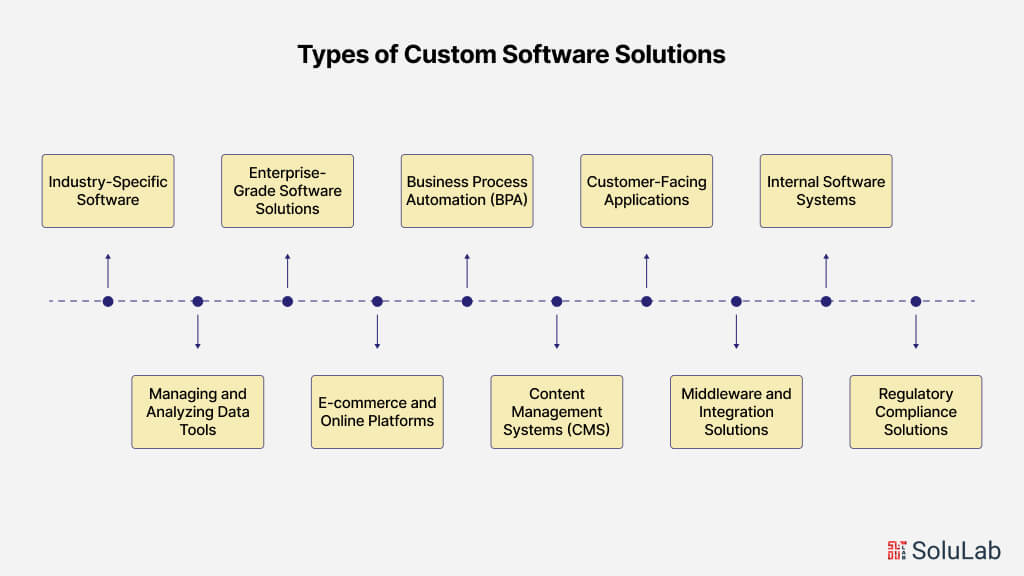
Organizations use custom software to stay ahead and to cope with the messy details of their own sectors. Broadly, custom software development consulting work falls into three buckets: industry-specific solutions, mobile apps, and enterprise applications. Each does a different job. Each brings its own kind of benefit. In more detail, the common types look like this:
- Industry-Specific Software: This is software shaped around the particular needs of one sector, whether that is healthcare, education, finance, manufacturing, or retail. It usually bakes in the compliance rules and features that only that sector cares about.
- Enterprise-Grade Software Solutions: Think large, full-scope systems: supply chain management (SCM), customer relationship management (CRM), enterprise resource planning (ERP), and business intelligence (BI). These are built to support the core operations of big enterprises.
- Business Process Automation (BPA): Software built to automate specific business processes, so people do less repetitive manual work and output goes up. Project management software, document management systems, and process automation tools all belong here.
- Customer-Facing Applications: Programs meant to improve how users experience and engage with a business. Examples include personalized mobile apps, online portals, self-service platforms, and online booking systems.
- Internal Software Systems: Tools that tune a company’s internal processes and workflows. Collaboration tools, staff scheduling software, inventory management software, and HR management systems are typical.
- Managing and Analyzing Data Tools: Software that collects, examines, and presents data so people can see what is going on and make better decisions. Data warehousing, bespoke reporting systems, business intelligence (BI), and analytics tools all fit in this group.
- E-commerce and Online Platforms: Online businesses can run their e-commerce operations on custom software covering order fulfillment, inventory management, storefronts, payment processing, and Customer Relationship Management (CRM) platforms.
- Content Management Systems (CMS): A CMS is a software platform businesses use to build, manage, and publish websites, blogs, and online stores. With a custom CMS, the features for producing, publishing, and distributing content can be shaped however the business needs.
- Middleware and Integration Solutions: Custom software that makes it easier to connect the different databases, apps, and systems inside a company. It lets data move between them, automates processes, and keeps the systems compatible with each other.
- Regulatory Compliance Solutions: Software designed to help companies stick to industry norms, laws, and regulations. Regulatory reporting platforms, audit monitoring tools, and compliance management systems are common examples.
Custom Software Development Applications in Various Industries
The applications of custom development software below show just how far custom software product development stretches across sectors. In each case it helps companies try new things, cut wasted steps out of their processes, and give clients real value.
Healthcare
In healthcare, custom software shows up as Electronic Health Records (EHR) systems for managing patient data, telemedicine apps for remote consultations, analytics tools that support data-driven decisions, and patient engagement apps that encourage health awareness and help people stick to treatment plans. The results? Stronger data security. Faster admin work. Better patient care, and easier communication between patients and their doctors.
Related: AI Agents in Healthcare
Finance
Finance has its own long list: risk management tools, banking apps built around specific client needs, financial planning platforms for personalized investment plans, automated trading systems, and more. For financial institutions, these apps help manage investments and cut risk. They also make personalized banking possible and give clients what they need to make sound decisions about their money.
Retail
Retail is a natural fit. Software custom development here can mean point-of-sale (POS) systems that make checkout simple, inventory management systems that keep stock under control, CRM tools that build engagement and loyalty, and e-commerce platforms with personalized buying journeys. With these in place, retailers can grow sales, have better conversations with customers, run leaner operations, and make the whole shopping experience better.
Check Blog Post: AI Agents in Retail and E-Commerce
Manufacturing
On the factory side, custom software powers supply chain management systems, quality control apps, production scheduling and planning tools, and predictive maintenance programs that catch equipment failures before they happen. Done right, these solutions can bring down custom software development costs and lift productivity. How? By tightening production procedures, making it easier to work with suppliers and partners, protecting product quality, and keeping downtime to a minimum.
Education
Schools and education providers use Learning Management Systems (LMS) to deliver lessons online, student information systems to keep administration efficient, interactive learning apps, and learning analytics platforms that track student performance and outcomes. Put together, these tools support data-driven decisions in education. They make remote learning possible, take friction out of running a school, and give students learning experiences that are engaging and personal.
Real Estate
Real estate custom software covers property management systems that keep property processes running efficiently, CRM tools for client relationships, virtual tour platforms for showing listings, and analytics solutions for reading the market and choosing investments, among others. For agents, the gains are practical: more contact with customers, simpler processes, better property promotion, and smarter investment calls.
Logistics
Logistics companies rely on custom software development for supply chain management with end-to-end visibility, fleet systems that track vehicles and optimize routes, warehouse management for inventory control, and analytics that surface operational insights and improve performance. The payoff is lower costs and happier customers. Operations get simpler, too, and decisions start coming from data instead of gut feel.
Tourism and Travel
Travel and tourism businesses use booking and reservation apps that make trip planning easy, itinerary tools for organizing personalized trips, feedback platforms that help raise service quality, and travel analytics systems for market insight and trend spotting. That is only a sample. These solutions improve the traveler’s experience, make life simpler for travel agencies, surface useful information for improving services, and help the industry base its decisions on data.
E-Commerce
For e-commerce, custom software can include order management and fulfillment systems that process orders efficiently, marketplace platforms with personalized shopping experiences, and analytics tools that show how consumers behave and what they prefer. With those in hand, an online store can sell more, engage shoppers better, run a tighter operation, and make decisions grounded in real data.
Benefits of Custom Software Development
Custom business software development gives you answers to your specific problems, which is exactly why it matters so much for improving how a business runs. Whether the goal is a better customer experience or simpler internal procedures, custom software delivers a level of flexibility and effectiveness that generic tools struggle to match. How much the custom software development business matters is tied closely to how the bespoke software itself gets built. Research from several well-known organizations backs this up. A few findings stand out:
- According to a Software Advice poll, 86% of corporate decision-makers say building custom software is essential to their organization’s success.
- According to a Gartner analysis, the average return on investment (ROI) for custom software development may run 15 times higher, compared with just 3 times for off-the-shelf software.
- According to IBM research, custom software may cut operating expenses by 30%, lift revenue by 20%, and raise customer satisfaction by 40%.
- According to SOLTECH, custom software development can give companies a competitive edge through differentiation, creativity, and efficiency gains.
Customized software does more than cover the basics. It hands an organization a complete solution cut to its own demands and objectives. Here are the advantages of custom application development software that tend to matter most:
- Meets Particular Commercial Requirements: Customized software development services are made for the specific needs and headaches of one organization. Unlike off-the-shelf tools, they can be shaped to the company’s workflow, preferences, and goals, so the fit is right on day one and stays right as the company grows.
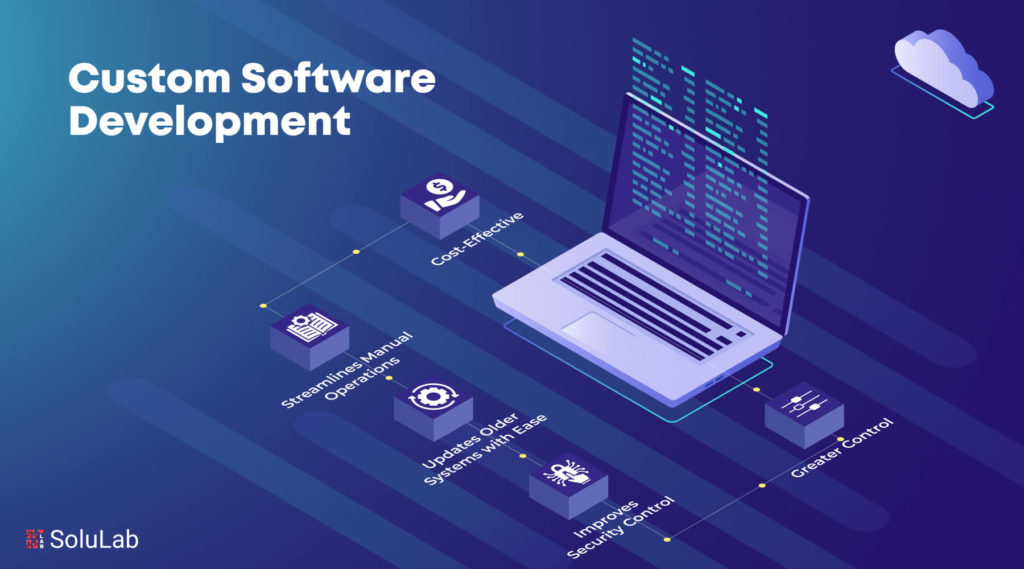
- Streamlines Manual Operations: Automating and tuning manual procedures slashes the time and effort that routine tasks eat up. And once that work is off their plates, staff can spend their hours on the parts of the business that need people, like strategic planning and new ideas.
- Cost-Effective: The first cheque is bigger. Over time, though, custom software usually proves the thriftier choice. Companies stop paying, again and again, to buy, license, and maintain packaged products that were never quite right for them. And because scale can be planned in from the start, there is no need to stitch together several unrelated systems.
- Improves Security Control: Custom software comes with security features built for the company’s own requirements. Its one-of-a-kind design takes more effort to break into than widely used off-the-shelf software, so attackers are less likely to go after it. Firms can also add advanced protections, such as access limits and encryption, to keep their data safer.
- Updates Older Systems with Ease: Bespoke software lets a business modernize outdated systems and keep up with technology. As things shift quickly, custom development makes it possible to fold new features and technologies into existing systems cleanly, so those systems stay useful and relevant.
- Greater Control: The company controls everything: design, development, and maintenance. That level of control keeps the software in step with the company’s changing demands and goals, which is something off-the-shelf software simply cannot promise.
Add it up and custom software development brings a wide set of advantages that can seriously improve a company’s security, competitiveness, and day-to-day operations. When businesses invest in custom solutions, their custom software development consulting can be matched precisely to their goals, and they get a solid base to grow from in a digital-first market.
Examples of Custom Software Development
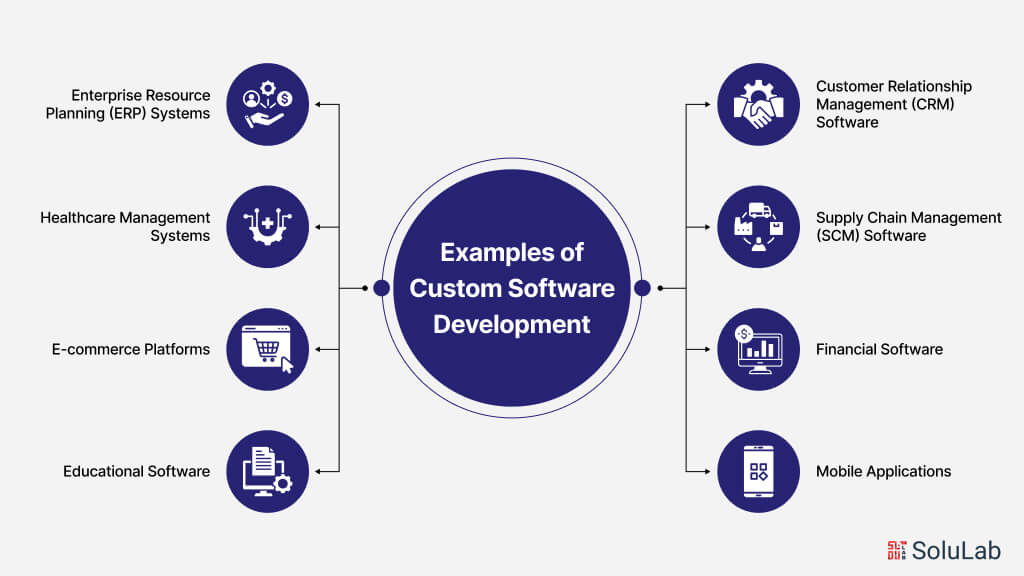
Custom software development covers a lot of ground, all of it shaped around specific business needs. Here are some well-known examples of how top custom software development companies deliver bespoke solutions:
1. Enterprise Resource Planning (ERP) Systems: A custom ERP pulls finance, HR, supply chain, and inventory management into one place, which simplifies how the business runs. Top custom software development companies build ERP solutions around each business’s own requirements, so efficiency goes up and decisions get sharper.
2. Customer Relationship Management (CRM) Software: A custom CRM helps a business manage how it deals with current and potential customers. Off-the-shelf CRMs give you what they give you. A custom one can be designed with exactly the features you want, such as advanced analytics, personalized marketing, and clean integration with your other business systems.
3. E-commerce Platforms: Leading custom software development firms build e-commerce platforms with features you will not find in a template: custom payment gateways, advanced product search, personalized user experiences, and third-party integrations. They are designed for the specific needs of online retailers, and the aim is more engaged customers and more sales.
4. Healthcare Management Systems: In healthcare, custom software includes patient management systems, electronic health records (EHR), and telemedicine platforms. They are shaped to meet industry regulations and to follow the real workflows of healthcare providers, which improves patient care and makes operations more efficient.
5. Financial Software: Custom financial software spans trading platforms, banking apps, and financial analytics tools. Top custom software development companies make sure these meet strict security requirements and include features like real-time data processing, risk management, and compliance with financial regulations.
6. Educational Software: Custom educational software includes learning management systems (LMS), e-learning platforms, and virtual classrooms. These are built with features like interactive content, personalized learning paths, and links to other educational tools, all of which make learning better for students and teachers alike.
7. Supply Chain Management (SCM) Software: Custom SCM solutions help businesses run and improve their supply chains. Top custom software development companies build SCM systems with real-time inventory tracking, demand forecasting, and supplier management, each tuned to what that particular business needs.
8. Mobile Applications: Custom mobile apps deliver features and a personal feel that generic apps cannot. They range from enterprise mobility tools to consumer apps, and they are designed around the exact requirements of their target audience while making use of the latest mobile technology.
These examples of custom software development make operations more efficient, and they give companies a real edge over competitors.
Best Practices to Implement in Custom Software Development
You need a plan. Custom software only earns its keep when it actually solves the business problem it was built for, and that takes strategy. These practices make the difference:
- Conduct a Cost-Benefit Analysis: Check whether the numbers work by weighing the expected benefits against the estimated cost of the custom software.
- Assess Existing Solutions: Before you commit to a custom build, look hard at whether any commercial off-the-shelf product already does what you need.
- Define Clear Requirements: Know from the start which problem the software will tackle and how it will solve your business challenges in a way nothing else does.
- Select the Right Development Partner: Pick your custom software development partner with care. Read their testimonials, study their case studies, and test their expertise.
- Choose an Appropriate Outsourcing Model: Work out which outsourcing model suits the project best: nearshoring, onshoring, offshoring, insourcing, or homeshoring.
- Consider Staff Augmentation: Already have a team but need extra hands for a while? Staff augmentation can be the practical answer.
- Decide Early on Hosting: Settle early where the software will live, on-premise or on a public cloud like Amazon AWS, Azure, or GCP.
- Maintain Thorough Documentation: Document everything as you go. Future maintenance and updates depend on it.
- Address Training Requirements: Make sure every user gets enough training to use the software properly.
- Use the Latest Technology Stack: Choose a technology stack that keeps your custom software sustainable and able to scale.
- Implement a Proof of Concept (PoC): If the idea is new and untested, build a PoC first to prove it works before you go into full-scale development.
- Build a Minimum Viable Product (MVP): Think about shipping an MVP ahead of the full product so you can collect user feedback and make the changes it points to.
- Develop a Mobile App: Where it makes sense, build a mobile version of your custom software so mobile users are covered and access gets easier.
Stick to these best software development custom practices and your custom software development projects are far more likely to be well planned, cost-effective, and in line with where the business is heading.
Conclusion
For a business that wants software shaped to its own needs, and an edge because of it, custom development is the route. Off-the-shelf tools make you adapt to them. Custom solutions flip that around, letting a company build exactly the features and functions its operations call for. Efficiency and productivity go up. More importantly, the software can keep changing alongside the business as it grows and its needs move.
It is not all upside. Custom software development comes with real challenges: high initial costs, longer build times, and the ongoing need for maintenance and updates. SoluLab, a leading custom software development company, is set up to handle exactly those challenges. Our experts use the latest technologies and proven methods to deliver custom software that is cost-effective, scalable, and dependable. We care about quality and about our clients being happy with the result, and SoluLab works to make sure your software meets your expectations and goes beyond them. Ready to change how your business runs with custom software? Contact Us today to talk through your project and find out how we can help you reach your goals.
FAQs
Shipra Garg is a tech-focused content strategist and copywriter specializing in Web3, blockchain, and artificial intelligence. She has worked with startups and enterprise teams to craft high-conversion content that bridges deep tech with business impact. Her work translates complex innovations into clear, credible, and engaging narratives that drive growth and build trust in emerging tech markets.