Give a large language model a seat next to your team and you get an AI copilot. It’s a virtual assistant that talks back like a person, and it has quietly become one of the biggest productivity shifts across a lot of industries. It researches. It drafts. It chews through data, and the better ones flag problems before anyone asks. Generative AI adoption jumped in 2024, with 67% of organizations planning to spend more on AI over the next three years, mostly to get more done with less effort and to automate workflows that used to eat whole afternoons. That tells you something. Businesses now see copilots as a way to change how the work gets done and how revenue comes in, and marketing and supply chain teams are feeling it first.
Chat-style AI broke records the moment ChatGPT landed. Copilots rode that wave straight into digital transformation plans. According to the recent report, companies aren’t stopping at routine automation anymore; they’re wiring AI into specialised jobs like real-time analysis of industrial data or customer conversations shaped to each person.
So what actually is an AI copilot, and what makes one worth having? That’s what this piece walks through. Let’s get into it.
Understanding AI Copilot
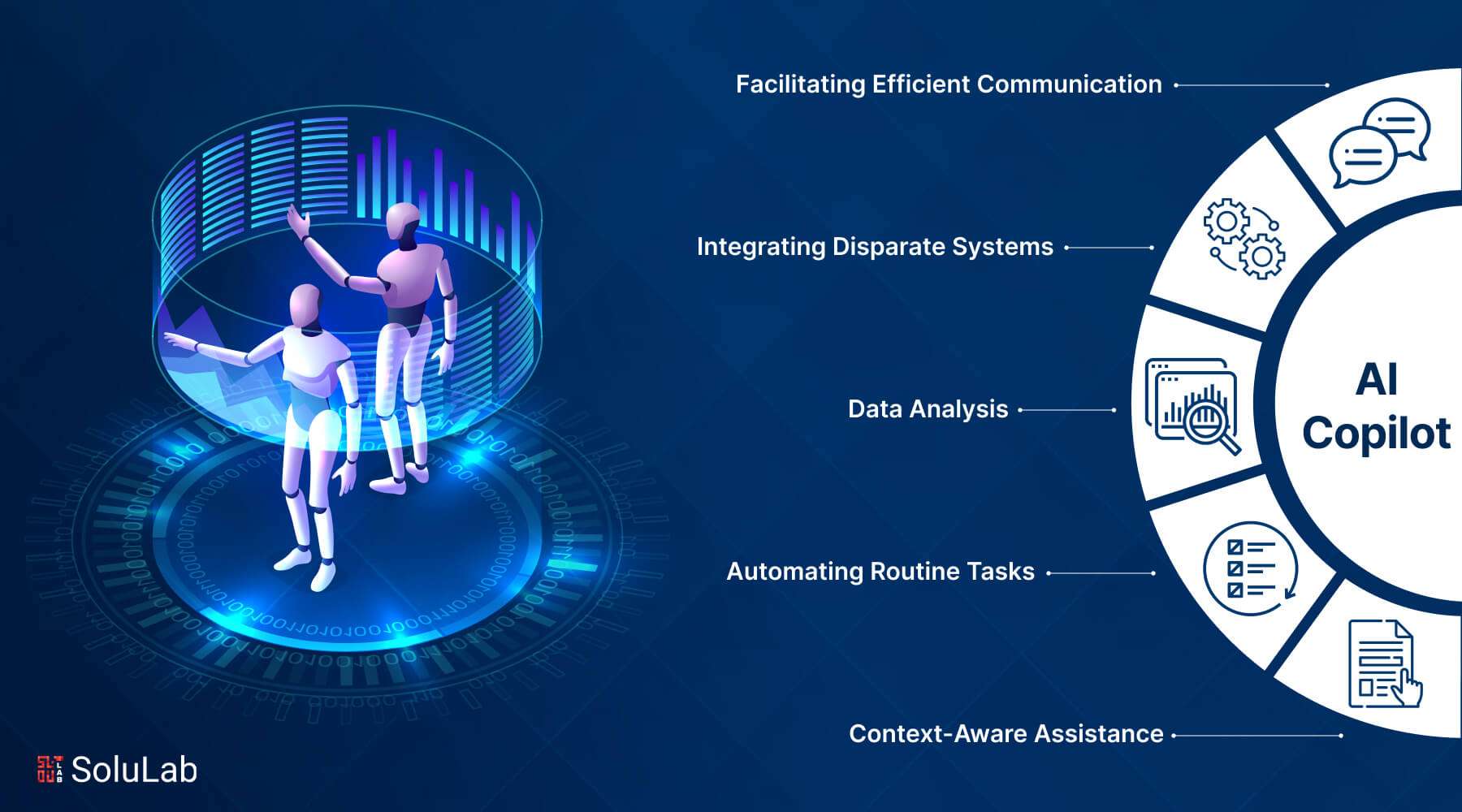
Here’s the short answer to “what is an AI copilot?” It’s a tool that makes people faster at their jobs by doing five things well:
- Context-Aware Assistance: A copilot reads the situation, guesses what you’ll need next, and responds, so the help shows up on time and on topic when a big decision is on the table.
- Automating Routine Tasks: It takes the slow, repetitive chores off your plate. That leaves people free for the strategic and creative work, and overall output climbs noticeably.
- Data Analysis: Huge piles of data? A copilot gets through them quickly and picks out the trends and patterns.
- Facilitating Efficient Communication: Whether you’re talking to staff, clients, or suppliers, a copilot makes the back-and-forth simpler, with fewer misunderstandings and fewer delays.
- Integrating Disparate Systems: Think of it as glue. A copilot can pull your separate software, platforms, and tools under one roof, which keeps data interoperable, reachable, and intact across the whole company.
Put together, that makes messy work simpler and gives people useful direction when they need it, which is how organisations hit their goals faster. And copilots are still getting better. As their capabilities grow and they plug deeper into company systems, they could change how businesses run, and how they compete, over the next few years.
What is an Enterprise AI Copilot and Why is it Necessary?
An enterprise AI copilot is a conversational layer that sits between your people and every system your company runs. Under the hood it draws on hundreds of machine-learning models tuned to your business’s own data. It works on every platform. It speaks more than 100 languages. For your staff, that means getting things done is simpler than it has ever been.
The problem it solves is familiar. As a company grows more sophisticated and piles on more technology, employees end up juggling a small army of systems. Traditional point solutions, each living in its own silo, rarely fix the gaps between those systems, and productivity leaks out through the cracks. A corporate AI copilot is how you plug them.
Once every system answers to one conversational interface, employees can find information and finish jobs without hopping between tabs. Teamwork gets smoother. People do better in their roles, and total output goes up by a wide margin.

How Does AI Copilot Work?
Two things hold every AI copilot up: the artificial intelligence itself, and the system integrations around it.
Artificial intelligence (AI) techniques from machine learning, context awareness, and natural language processing let a copilot work out what you’re after and suggest something sensible. The integrations do the other half. They connect the copilot to a wide spread of devices and apps, so you end up with one networked place to manage jobs and talk to people.
If you want to weigh the upsides and the trade-offs properly, it helps to know the four-tier framework people use to describe copilot strategy.
- Tier-one: These copilots are built on plain API calls to an LLM. Getting started is cheap and easy, which is the appeal. You get lots of general knowledge, but with no domain expertise behind it, the model can hallucinate.
- Tier-two: Here you fine-tune an LLM on your organisation’s data and deploy it as your own. It costs a bit more. In return, security and privacy improve and the answers fit the company better. The catch? Everything hinges on one LLM’s output, so performance tops out early and you’re limited to single-step use cases.
- Tier-three: Tier-three copilots chain several LLMs together into pipelines built for multi-step work, using what each model is best at. That lets them take on harder domains, cover far more use cases, and push productivity further.
- Tier-four: This is where copilots start making decisions on their own and backing up staff at scale. Tier-four copilots run on advanced LLM development systems designed for rollout across an entire enterprise. On top of custom connections built for a big company’s specific needs, they bring premium features: analytics, security, privacy, and a reasoning engine.
Benefits of AI Copilot for Businesses
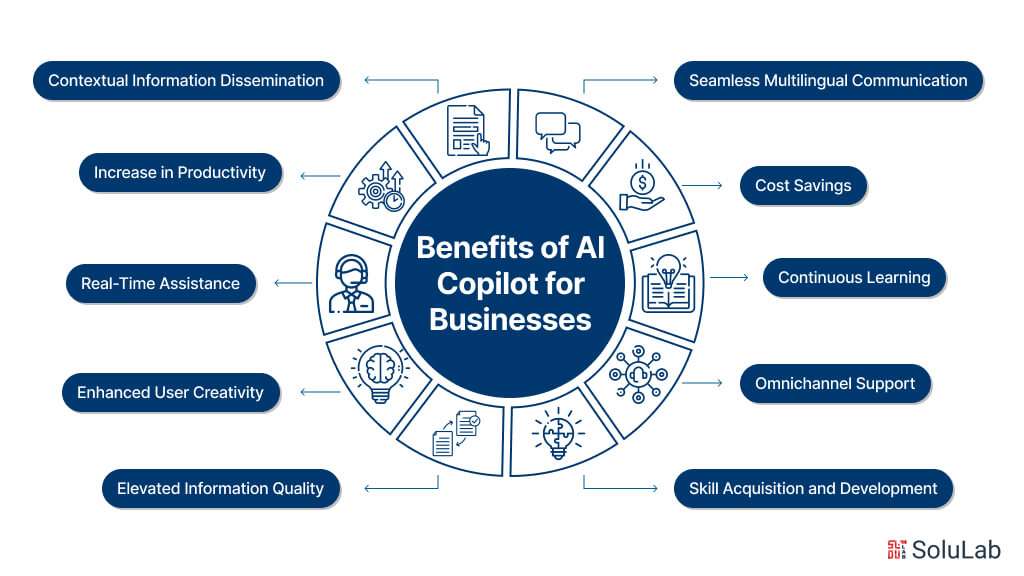
By combining AI with tight integrations, copilots can predict what a user needs and offer a timely, relevant nudge before they ask. That changes a lot of business functions at once, from customer service to e-commerce to lead generation. Here’s where the value actually shows up:
1. Increase in Productivity: Copilots see what’s coming and suggest the next move, which shortens workflows. Hook them into the enterprise apps your team already uses and they’ll take over the dull tasks, so people can spend their hours on work that matters more.
2. Cost Savings: Automate the repetitive stuff and operating costs drop. That money can go into new projects that make the business more efficient and harder to beat.
3. Contextual Information Dissemination: Built on AI and machine learning, copilots hand out suggestions and fixes that fit your enterprise specifically. Less time digging through research. More accurate answers.
4. Continuous Learning: A copilot keeps learning as your needs shift. It gets better with time, at the tasks and at supporting decisions.
5. Real-Time Assistance: Help arrives the moment it’s needed, and it understands the context. Employees get more done, operations run tighter, and some issues get resolved automatically without a human stepping in.
6. Omnichannel Support: The same conversational interface follows people across channels. Customers and employees can switch platforms without the conversation breaking.
7. Seamless Multilingual Communication: Multilingual support comes built in. So a business can give users all over the world genuinely good help, and both customers and staff notice the difference.
8. Enhanced User Creativity: When you can solve a task, troubleshoot a problem, or talk something through in a conversation that feels human, you tend to try more ideas. The work gets richer for it.
9. Elevated Information Quality: Because a copilot understands context and can reach your enterprise-specific data, its answers are more accurate and more relevant. Users simply get better information.
10. Skill Acquisition and Development: Working alongside AI teaches people things. Copilots help users level up, do their current jobs better, and branch out into new areas of learning.
Best Practices for Selecting AI Copilots
Picking a copilot is where a lot of projects go right or wrong. If you want a clean rollout and strong performance afterwards, check these four things first:
1. Enterprise Context: Can it read and use your company’s own data? If not, its answers won’t be accurate or relevant to how your organisation actually works.
2. Data Security and Compliance: Go for platforms with strict security, compliance, and privacy standards, ones that protect sensitive data at the individual, group, and tenant level.
3. Scalability and Integrations: Look for an AI copilot that connects to plenty of applications and scales as you do. You want something flexible and sturdy enough to grow with the organisation, not something you outgrow in a year.
4. Learning Capability: Pick one that keeps learning and adjusts its skills as your organisation and industry change. That’s what keeps it relevant and useful over the long haul.
AI Copilot Use Cases
Copilots are very good at two things: getting more out of people and cracking problems. Jobs that would normally burn serious time and money get instant help. Think solving a knotty problem by looking at past data, backing up account reps on routine questions while the customer is still on the line, or firing off quick answers to the questions everyone asks.
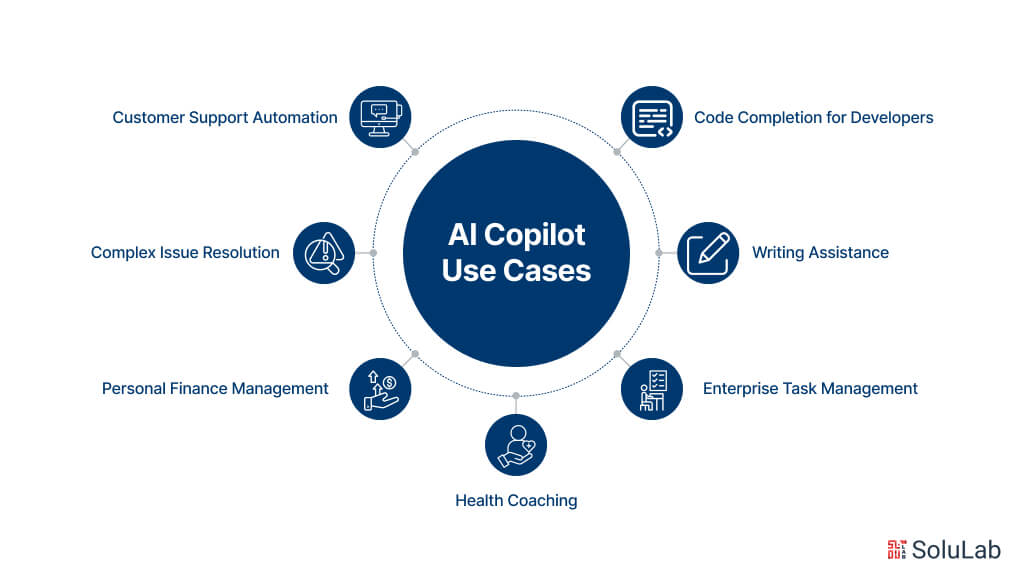
The efficiency and cost gains are close to endless across retail and e-commerce, insurance, healthcare, telecom & utilities, hotel & travel, and banking & finance. A few of the use cases:
- Customer Support Automation: Copilots can answer the frequently asked questions automatically. Support reps get a lighter load, and customers wait less.
- Complex Issue Resolution: With historical data and machine learning algorithms behind them, copilots can work through complex issues quickly, borrowing lessons from past cases to land on the best fix.
- Code Completion for Developers: For software developers, AI predicts the next snippet of code from the surrounding context. Fewer errors, more shipped.
- Writing Assistance: Tools like Jasper, Writer, and OpenAI’s ChatGPT help in real time with grammar, punctuation, style, and clarity, so the writing is better and comes together faster.
- Personal Finance Management: Budget insights, expense tracking, investment suggestions, advice fitted to your situation: copilots help individuals keep their money in order.
- Health Coaching: AI health coaches help people tune their fitness, training, and nutrition plans and reach their health goals with less guesswork.
- Enterprise Task Management: Enterprise copilots from Salesforce, Microsoft, and ServiceNow help employees collaborate, manage tasks, and get more done across a messy mix of systems and processes.
Understanding the Differences: AI Copilots vs. AI Chatbots vs. Virtual Agents
People mix these three up constantly. You shouldn’t, because each one earns its keep differently. Yes, all three run on artificial intelligence. But what they do, how capable they are, and how they deal with users are very different things.
AI Copilots
Copilots are the sophisticated end of the scale. They stay with the user the whole way, giving personal guidance across all sorts of tasks, and they adjust to how that person works so the suggestions fit each step of a complicated job. Code completion tools, virtual writing assistants, and enterprise system integrations are all examples.
AI Chatbots
AI chatbots hold text or voice conversations with users, powered by natural language processing and machine learning algorithms. They’re simpler than copilots. Still, they cope with a wide range of customer requests, mostly keeping conversations moving, answering FAQs, and giving support in places like customer service and e-commerce. Some are scripted for specific scenarios and barely learn at all.
Virtual Agents
Virtual agents run on programmed rules and conversational AI to deliver basic services or help. The term is broad. It covers chatbots, voice bots, and interactive voice response systems. A chatbot is one specific kind of virtual assistant, built for text. Virtual agents, on the other hand, can talk through several mediums, including voice over the phone. You’ll find them in customer support, sales, and technical help across lots of fields.
AI copilots, AI chatbots, and virtual agents get used as if they mean the same thing. They don’t. Each sits at a different level of functionality and sophistication. To pick the right one, look at what your operations need, how much hand-holding your users want, and how well the tool can learn your organisation’s context.
The Future Outlook for AI Copilots
Copilots keep maturing, and as they do, the partnership between humans and machines gets stronger. Expect more productivity and sharper problem-solving.
They slot into all kinds of enterprise systems and give help that fits the moment. In a business world that changes this quickly, that’s worth a lot.
Before you roll one out, though, do your homework. Know what makes a copilot different, work out how it will change your operations, and be clear on how it differs from chatbots and virtual agents.
Success comes down to the platform. It has to fit your organisation’s specific needs and put strong security, scalability, and continuous learning first.
Get that choice right and a copilot helps you grow, run leaner, and make work better for employees and customers alike.

The Bottom Line
Copilots are a real step forward for productivity and problem-solving, in pretty much every industry that’s tried them. They plug into the systems you already have and give each person help that fits, which closes a lot of the distance between people and machines. Operations get smoother. Decisions get better. For companies dealing with how complicated modern business has become, adopting a copilot is one of the more direct routes to new efficiency and fresh ideas, and to growth that lasts. The hard part isn’t deciding whether to use one. It’s picking a tier that matches the problems you actually have.
Thinking about putting AI copilots to work in your organisation? SoluLab can help, as a leading AI copilot development company. We know AI technology and we build custom solutions, and we use both to help businesses get everything they can out of copilots: smoother operations, more productive teams, and customer experiences that stand out. Contact us today to talk through how we can shape an AI copilot around your needs and move your business forward.
FAQs
Shipra Garg is a tech-focused content strategist and copywriter specializing in Web3, blockchain, and artificial intelligence. She has worked with startups and enterprise teams to craft high-conversion content that bridges deep tech with business impact. Her work translates complex innovations into clear, credible, and engaging narratives that drive growth and build trust in emerging tech markets.
![10+ AI Copilot Use Cases to Drive Business Growth [2026]](https://www.solulab.com/wp-content/uploads/2025/01/AI-Copilot-Use-Cases-300x149.png)