


Social networking is getting rebuilt from the ground up, and Web3 is doing the rebuilding. It brings decentralization, puts users back in charge, and adds ideas the old platforms never had, like token-based incentives and community governance. A centralized social network runs on one company’s servers. A Web3 network runs on distributed infrastructure, so you keep far more control over your data, your privacy, and what you post. Spread the system out and the risks of data breaches, censorship, and surveillance shrink with it. There’s a money angle too. Web3 lets financial transactions live inside the social platform itself, so users can take part in DeFi in the Web3 era and trade NFTs without leaving the app. This guide looks at what Web3 is actually changing about social media, and why it could reshape how people interact online and how much say they have in it.
Understanding Web3 in Social Networking
Web3 breaks with the centralized model. Completely. The two big wins from decentralization are transparency and security. But it goes further than that: it can change who you socialize with, letting you find people anywhere in the world who share your interests, which makes for a wider and more inclusive mix of voices. Put simply, Web3 beats the traditional centralized networks by being more open, more secure, and more in the hands of its users, and that’s the kind of setting where real, honest social interaction has room to happen.
The Impact of Web3 on Social Platforms
Bring Web3 principles into a social platform and a lot shifts at once. This section looks at how deep that shift goes: how decentralization changes the day-to-day user experience, what it does to privacy, and how it rearranges the way online communities work.
Decentralization in Social Media
Who holds the keys? On a traditional platform, one company does. Decentralized social platforms flip that by spreading control out and handing it to users. You become the custodian of your own data, which gives you independence and privacy that a single corporate owner won’t. Mastodon and Diaspora already run this way, on decentralized networks that form many separate but connected social communities. The upside is real: resistance to censorship, transparency, and more room for new ideas in social media. These platforms could also make online life fairer and more centered on the user, and help cut down the spread of misinformation and hate speech. If they keep gaining ground, how we behave online could look quite different: more open, more inclusive, and with users holding more of the power.
Tokenization and Incentive Mechanisms
Tokens are at the heart of it. Web3, the next version of the internet, is building a new kind of digital interaction around tokenization, where digital assets become working parts of how people engage socially. Look at how traditional platforms make money: advertising, mostly. Web3 does something else entirely. It rewards engagement with cryptocurrency. That gives users a reason to actively help the platforms they use grow and succeed, and it builds a real feeling of community and shared ownership along the way.
Key elements of Web3 tokenization include:
- Decentralization: Web3 runs on decentralized networks such as blockchains. Control and decisions are spread among the participants instead of sitting with some central authority.
- Transparency: Blockchain is open by design. Every transaction and interaction goes onto a public ledger, and that visibility is what builds trust and holds people accountable.
- Interoperability: Web3 platforms are built to work together, so you can move your digital assets and data from one platform or app to another without friction.
- Cryptoeconomics: Cryptocurrencies and blockchain reward systems give people a reason to contribute to the network, vote on governance, and do all sorts of things that make the whole network better.
Benefits of Web3 in Social Networking
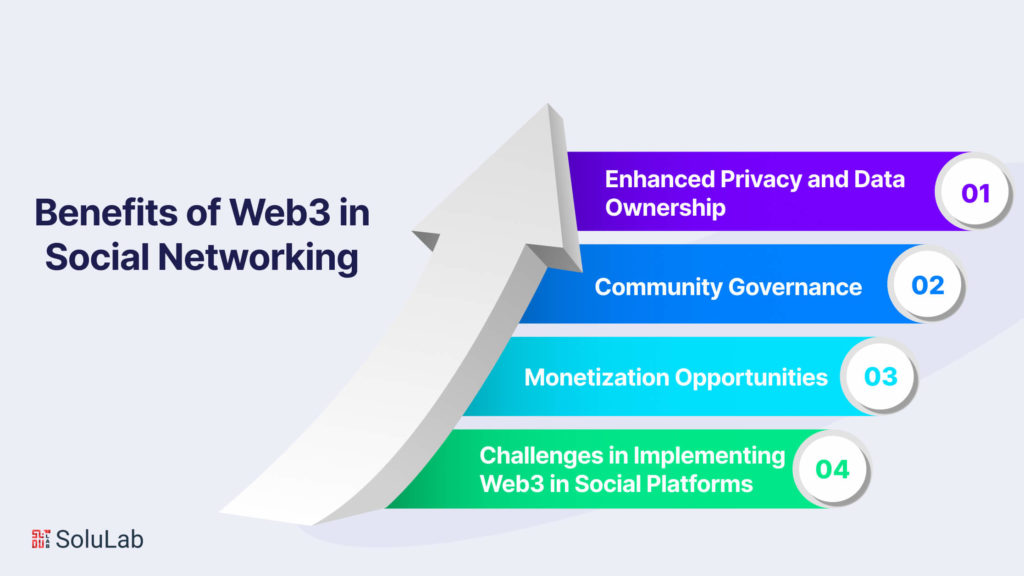
So what’s in it for the people using it? Quite a lot. From stronger privacy to governance run by the community, here are the concrete benefits of social media built on Web3.
Enhanced Privacy and Data Ownership
Privacy comes first in Web3. That’s a design choice, not an afterthought. With traditional web apps, a central company usually collects and stores your data. Web3 apps are built to give you control over your personal information instead. They use blockchain technology and decentralized finance protocols to make the experience more secure and more private. You own your data and you control it, which lowers the risk of a big centralized breach or someone getting in without permission. A few features make this work:
- Decentralized Identity (DID) systems: DID systems swap the old username and password login for something safer that also protects your privacy. A DID is a self-sovereign digital identity. You own it, you control it. It lets you prove who you are without giving away personal details, and that cuts the risk of identity theft and phishing considerably.
- Data encryption: Web3 apps typically use strong encryption to protect data while it moves and while it sits in storage. If an attacker grabs it in transit, what they get is unreadable and useless.
- Transparent and auditable transactions: Every blockchain transaction lands on a public ledger, which keeps things transparent and accountable. Bad actors have a much harder time manipulating records or hiding what they’re up to.
- Reduced reliance on third parties: In Web3 you deal directly with apps and services. No middlemen, no trusted third parties in between. Every extra party that touches your personal information is another chance for a leak or compromise, so fewer parties means less risk.
Because it puts privacy first and hands people real control over their personal data, Web3 security lets users guard their sensitive information and go about their online lives with more confidence and trust.
Community Governance
Here’s where it gets interesting. With decentralized governance, users help make the decisions on a social platform, and that gives them a real stake and a reason to show up. It tackles the usual complaints about transparency, accountability, and responsiveness by spreading decision-making power across the user base, through mechanisms like these:
- Voting: Users vote on proposed changes to the platform’s policies, rules, and features. Decisions get made fairly and democratically, and they reflect what the community as a whole wants.
- Delegated decision-making: Don’t have time to weigh in on everything? You can hand your vote to people or organizations you trust who share your values and interests. Decisions get made faster and by people who know the topic, and the community stays involved.
- Open governance: Every governance decision and discussion is out in the open for the whole community to see. People can watch how decisions get made and who makes them, and that builds trust and accountability.
When users take part in running a platform, they care more about it, and they get to shape where it goes next. Spreading power across the community also lowers the risk of censorship and data breaches. It builds a sense of shared ownership and keeps the platform transparent, accountable, and responsive. For online communities that want to grow, stay inclusive, and last, this governance model matters a great deal.
Monetization Opportunities
For creators, this might be the biggest change of all. Web3 has overhauled how content makes money. Token-based models bring in microtransactions and cut out the traditional gatekeepers. Creators aren’t stuck with ad revenue or whatever a platform decides to offer anymore. They have other ways to earn. Blockchain lets them create and trade digital tokens or cryptocurrencies that stand for exclusive content, special perks, or ownership rights via NFT use cases. Because it’s all transparent and secure, it builds trust and a sense of authenticity, and that strengthens the community and its loyalty. With decentralized models, there are no middlemen and less dependence on any one platform, so creators control their content, how it’s distributed, and the revenue it brings in. And the options are wide open. Creators can design monetization that fits their audience, which gives them more creative freedom and more room to experiment. In the end, Web3 and token-based models change the relationship between creators and their audiences: decentralized, collaborative, sustainable, with creators getting direct support for the work they put out.
Challenges in Implementing Web3 in Social Platforms:
None of this is easy. Bringing Web3 into social platforms could change how people interact online and what digital ownership and privacy mean. But several real obstacles stand in the way of wide adoption.
- Scalability: Web3 has built-in limits on transaction speed and scale, and it may buckle under the sheer volume of a large user base. Getting scaling right is non-negotiable.
- Adoption Barriers: Jargon and specialized tools scare off people who aren’t technical. The experience has to get simpler, and people need learning material that actually helps.
- User Education: Users need to understand self-custody of assets, gas fees, and how smart contract interactions work. Without that, they can’t take part safely or with confidence. In practice, this is where most newcomers get stuck.
- Regulation and Legal Uncertainties: The rules are still being written, and that leaves a lot of uncertainty and few clear guidelines. Innovation and growth need regulation that is clear and consistent.
- Interoperability: Different blockchains have to work together smoothly. If they don’t, things fragment, and you never get a lively decentralized Web3 ecosystem.
Can these problems be solved? Yes, if the many parties involved work on them together. That’s what clears the path for Web3 to settle into social platforms properly and deliver the change it promises.
Real-world Examples
Enough theory. Here are real cases where Web3 principles have changed social networking, from decentralized identity systems to fresh ways of making money. They give a clear look at what Web3 does once it’s out in the wild.
Existing Web3 Social Platforms
Steem and Hive are two working examples of how Web3 use case can change social networking. Both give users token-based systems and decentralized content curation, and that alters how people engage at a basic level. On Steem and Hive, users don’t just consume. They create, curate, and validate content themselves, which gives them more control over their data and real ownership of it. Tokens reward people for posting valuable work. The decentralized setup, meanwhile, leaves room for independence and free expression. Both platforms lean on blockchain to keep things fair and transparent, protecting the integrity of the system and the authenticity of what gets posted. They point toward a fairer, more user-centered internet, and they show how Web3 could change both online interaction and the way value gets created.
User Experiences
Ask people who use decentralized social platforms what they like, and the same benefits keep coming up:
- Enhanced Data Control: Users get control of their personal data back, so the worry about privacy breaches and misuse goes away. They decide how their information gets shared, stored, and used. That builds trust, and it gives people a real sense of control.
- Flourishing Diverse Communities: These platforms grow communities that are varied and active. With no central algorithm and no central censor, people can connect honestly, trade ideas, and have real discussions without fear of discrimination or bias. All those different voices make the whole experience richer.
- Innovative Monetization Models: Decentralized social platforms bring new ways to earn that reward users directly for what they contribute. Advertising isn’t the only engine anymore. Users can earn through content creation, curation, and taking part in governance, among other things. The result is a fairer and more sustainable model for everyone involved.
- Transparent and Ethical Operations: The big traditional social networks keep their workings behind closed doors. Decentralized platforms don’t. Open-source code and community-run governance keep the decision-making visible and accountable. Ethics get real weight here: user data is protected and responsible social media practice is the norm.
- Resistance to Censorship and Manipulation: Decentralized platforms resist censorship and manipulation by their very structure. Because they’re distributed, no single party can control or change the content. That sturdiness means people can say what they think without worrying about unfair censorship or an algorithm quietly burying them.
Social platforms that go decentralized are changing how we connect and engage online. What they offer is social media that puts the user at the center, shows its workings, and gives people real power. It’s a new chapter for digital communication and for how communities get built.
Future Trends in Web3 Social Networking
Where is all this heading? The future of Web3 in social networking is wide open, pushed along by several advanced technologies coming together. These are the trends shaping it right now:
- Virtual Reality (VR) Integration: VR could change how we interact on social platforms entirely. Expect immersive experiences that go well past what a flat screen can do. Picture going to virtual events, wandering shared virtual spaces, and hanging out with people in a way that feels more real and more engaging.
- Artificial Intelligence (AI) for Personalization: AI algorithms keep getting smarter. Social networks can use them to tailor content, recommendations, and the whole user experience far more closely than before. Interactions become more personal and more relevant, and the experience gets better overall. AI-powered chatbots and virtual assistants can also step in with better customer support and help.
- Interoperable Decentralized Protocols: A lot of the future of Web3 in social networking rides on interoperable decentralized protocols. With them, users can carry their data, identities, and social connections from one platform to another without getting locked into any single one. Social media becomes more open and inclusive, and users get more control over their digital assets.
- Emphasis on Data Privacy and Ownership: Web3 hands control of personal data back to the user. Social networks built on Web3 principles will put privacy and security first, and show users clearly how their information gets used, with the power to change it. That move toward user-owned data will change how social platforms operate.
- Decentralized Governance: Traditional social media platforms take a lot of heat for making decisions behind closed doors. Web3 brings decentralized governance, where users get a say in how the platforms they use develop and where they go. The result is social media that’s more democratic and more transparent.
- Rise of Social Tokens and Creator Economies: Social tokens are digital assets that carry the value and reputation of a person or a community on a social network. People use them for patronage, for governance, and for building community. As social tokens and creator economies grow, creators can earn directly from their audience, which makes the whole model more sustainable and puts artists at the center.
Put these trends side by side and a picture forms. The future of Web3 in social networking looks more immersive, more personal, more decentralized, and built around the user. As the technology matures, the way we connect, talk, and interact online is likely to change a lot.
Conclusion
Web3 principles are already changing social networking in big ways. Bringing Web3 in social platforms puts users at the center, with stronger privacy and governance shared by the community. SoluLab, a leading Web3 Development Company, helps companies make this shift with practical solutions and a serious commitment to quality work. The skilled Web3 Developers at SoluLab are the people actually building it. They take decentralized ideas and turn them into social platforms that put user control, privacy, and community engagement first. Their experience covers the full range of Web3 Services, which opens up a lot of possibilities. The point of it all is simple: users get to shape their own digital experience and become active contributors to a secure, community-run network.
SoluLab’s full set of services fits this vision closely, with modern solutions that change how social interaction works. Web3 in social networking reaches well past the usual models. It turns users from passive participants into contributors with real power. As a Web3 Development Company, SoluLab works at the leading edge of this shift, helping bring Web3 principles into social platforms where users get privacy, ownership, and connections that matter. Put Web3 principles and social networking together, with SoluLab doing the build, and you get new room to design around the user. If you’re planning a platform like this, SoluLab can help you rethink what digital interaction looks like. Our focus stays on user control, security, and belonging, so every user’s Web3 experience is a genuinely good one. Together, we can build social networking that embraces Web3 development trends, and make every user’s digital experience worth coming back to.
FAQs
Bhavya is driving growth through data-backed demand generation for AI and Web3 solutions. With 9+ years in digital marketing, he has spearheaded initiatives that led to a 40% increase in qualified inbound leads. Bhavya shares insights on marketing ROI and scaling a digital presence via AI workflows. He is open to connecting with startups and enterprise teams to help them overcome their challenges.

![How to Build a Web3 DAO Platform for Decentralized Governance? [2026 Guide]](https://www.solulab.com/wp-content/uploads/2026/06/Develop-a-Secure-DAO-Platform-for-Web3-Communities.webp)