Key Takeaways
- Social engagement drives retention—leaderboards, followers, comments, sharing, and copy betting turn individual betting into a community experience.
- Recurring events create repeat usage—sports, crypto, entertainment, and other continuously changing markets give users frequent reasons to return.
- Reputation creates long-term value—Prediction history, accuracy, ROI, badges, and rankings help users build a recognizable forecasting identity.
- Rewards and gamification encourage participation—points, quests, streaks, challenges, and loyalty incentives can increase engagement when they reinforce genuine product usage.
- Liquidity and simple UX are critical—deep markets, competitive execution, fast settlement, and low-friction Web3 onboarding can significantly influence whether users return.
Web3 social betting platforms keep players through three retention mechanics: a play-and-own model that givesusers real ownership of what they earn, token reward loops that pay for repeat participation, and a social layer that turns a solo bet into a shared activity. Together these lift return rate and cut churn far better than a one-off payout ever does.
SoluLab builds these systems end to end. Our team designs the reward loop, the token economy, and the social features that turn first-time bettors into daily players. If you are planning a betting or prediction-market product, our Web3 development company team can architect the retention layer with you from day one.
What is a web3 social betting platform?
A web3 social betting platform is an on-chain betting or prediction-market app where users own the tokens and assets they earn, and where social features (leaderboards, friend challenges, shared pools) sit at the center of the experience. It differs from a traditional betting app in three ways: settlement runs on smart contracts instead of a house ledger, rewards are transferable tokens the user actually holds, and outcomes are often community-driven rather than set by a single operator.
Think of it as three layers stacked together:
- A betting or prediction engine. Users stake on sports, events, esports, or open-ended questions. Prediction markets like Polymarket are the clearest public example of on-chain event betting at scale (CoinMarketCap).
- A token and ownership layer. Wins, streaks, and participation pay out in tokens or NFTs the player can hold, trade, or stake.
- A social layer. Public leaderboards, friend groups, and shared pools make betting a group habit instead of a private transaction.
That third layer is what earns the “social” label, and it is the part most traditional operators skip.
Why is retention the hard problem for web3 betting?
Retention is hard because token incentives make acquisition cheap and churn easy. A signup bonus or airdrop pulls users in fast, but the same users leave the moment rewards thin out. This is the extractive pattern that sank the first generation of play-to-earn games: players farmed the token, sold it, and left, which pushed the price down and drove the next cohort out too.
Axie Infinity is the textbook case. Its earning token SLP fell from over $0.40 in mid-2021 to a fraction of a cent as farming outpaced real demand, and daily users collapsed with it (CoinMarketCap Academy). The lesson for betting platforms is direct: a reward that only pays out and never gets spent or held builds a crowd that dumps and disappears. The loop design, not the payout size, decides whether anyone stays.
What retention mechanics actually keep players coming back?
The mechanics that hold players share one trait: they reward the next session, not just the last one. Four loops do most of the work.
- Play-and-own rewards. Users keep real ownership of tokens, NFTs, or positions. Ownership creates a reason to return that a cash payout does not.
- Token rewards with sinks. Players earn tokens for participation, then spend them on entries, cosmetics, boosts, or governance. Earning without spending inflates the supply and kills the loop.
- Streaks and daily loops. Daily-bet streaks, login rewards, and time-boxed pools give a concrete reason to open the app tomorrow.
- Social challenges. Friend bets, group pools, and leaderboard seasons make quitting feel like leaving a group, not closing an app.
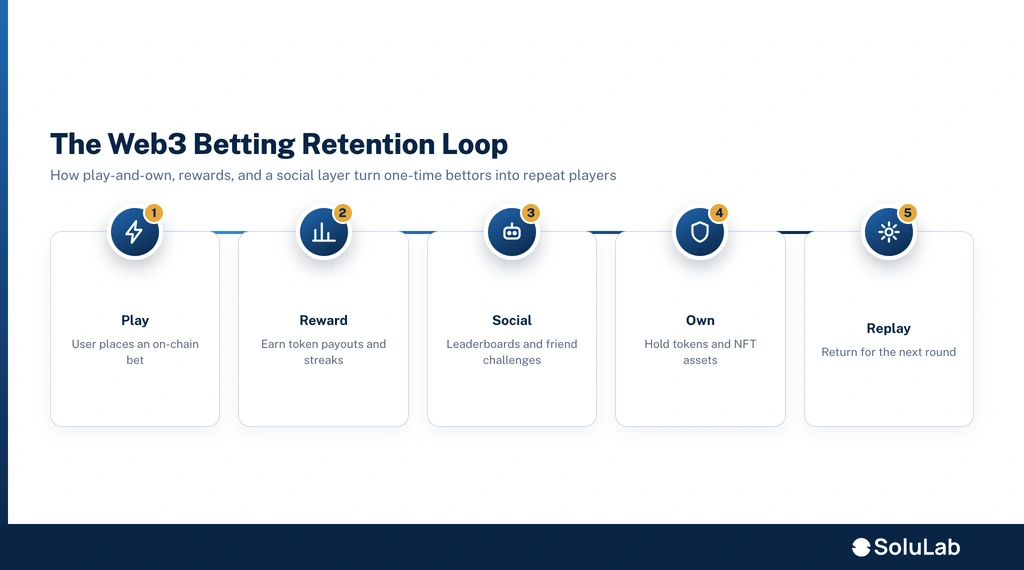
Each loop feeds the next. A player bets (engine), earns a token (reward), spends it on a group challenge (social), and holds an asset that grows in value if the platform grows (ownership), which pulls them back to bet again. That circular path, play to reward to social to own to replay, is the retention loop worth designing around.
How does the play-and-own model drive retention versus play-to-earn?
Play-and-own keeps players because ownership rewards staying, while play-to-earn rewards leaving. The distinction is simple but decisive.
| Dimension | Play-to-earn | Play-and-own |
| Core motive | Extract income, then exit | Own and grow an asset |
| Reward behavior | Sell tokens fast, cash out | Hold, stake, or use in-app |
| Effect on token supply | Constant sell pressure | Demand and sinks absorb supply |
| Player type attracted | Yield farmers, mercenaries | Fans, competitors, collectors |
| Retention outcome | Churn spikes when yield drops | Return tied to platform growth |
Under play-to-earn, the rational move is to farm and dump, which is exactly what broke Axie’s economy (Medium, ironSource LevelUp). Under play-and-own, the assets a player holds (a rare bet NFT, a governance stake, a seasonal rank) are worth more if the platform thrives, so the incentive flips from exit to stay. For a betting platform, that means designing rewards people want to keep and use, not just sell.
How does the social layer increase retention?
The social layer increases retention by adding a reason to return that has nothing to do with money: other people. When betting is a shared activity, quitting has a social cost, and that cost is stickier than any single payout.
Four social mechanics do the heavy lifting:
- Leaderboards and seasons. Public ranking with a reset each season gives players a fresh reason to climb, and status they do not want to lose.
- Friend challenges. Head-to-head bets between friends turn a private wager into an ongoing rivalry.
- Shared pools and syndicates. Groups pool stakes on an event, which spreads risk and creates a group chat’s worth of reasons to stay.
- Status and identity. Badges, tiers, and displayed win records give players a persona they build over time and want to protect.
Community, not the payout, is often what keeps attention in web3. As one practitioner put it, attention “stays where narratives and communities are actively cultivated,” not where it was bought for a day (LinkedIn, industry post). A betting platform that treats social features as core, not decoration, converts one-time bettors into a returning group.
What do real platforms teach us? Case-study patterns
Public examples across betting, prediction markets, and web3 gaming point to a consistent rule: platforms that pair a clear core loop with a real retention lever hold users, and those that lean only on payouts do not. The table maps the pattern. Any named metric is tagged for verification, because case-study numbers should never be invented.
| Platform pattern | Core loop | Retention lever | Reported outcome |
| On-chain prediction market (e.g. Polymarket) | Stake on real-world event outcomes | Liquidity, fresh event feeds, and public odds | Sector volume hit roughly $111B in Q2 2026, a record quarter [VERIFY exact figure and source] |
| Web3 iGaming / crypto casino | Bet, earn, stake winnings | DeFi-style staking of NFTs and tokens for yield | Staking mechanics used to drive retention [VERIFY platform-specific retention numbers] |
| Play-and-own game economy | Play, own assets, trade | Ownership tied to platform growth | Ownership loop reduces dump-and-leave churn [VERIFY specific D30 lift] |
| Early play-to-earn (e.g. Axie Infinity) | Farm token, sell | None beyond yield | Token SLP crashed and daily users collapsed after mid-2021 [VERIFY exact price and user figures] |
Read across the rows and the takeaway is consistent. Where a retention lever exists (liquidity, staking, ownership, or a fresh feed), the platform sustains activity. Where the only lever is a payout, the crowd farms and leaves. Prediction-market volume reaching record levels in 2026 shows the demand is real when the loop holds (CoinMarketCap). SoluLab has shipped web3 gaming, DeFi, and NFT game builds; a named, anonymized retention case from one of those is worth adding here once approved [VERIFY: which shipped project, with metrics, sales can release].
How do you design token economics that retain rather than inflate?
You retain players by balancing what enters the economy (faucets) against what leaves it (sinks), so the reward token holds value instead of bleeding out. Sink-and-faucet design is the core discipline: faucets mint tokens through rewards, and sinks remove them through spending, keeping supply and demand in rough balance (Chainscore Labs). When faucets outrun sinks, inflation sets in and the token loses the value that made it worth earning (Medium, game economy design).
A retention-first token model for a betting platform usually includes:
| Faucets (tokens in) | Sinks (tokens out) |
| Bet participation rewards | Entry fees for premium pools |
| Win and streak bonuses | Cosmetic and status upgrades |
| Referral and social bonuses | Staking lockups for yield or tiers |
| Seasonal leaderboard prizes | Governance stake and burn on actions |
Two more design choices matter. First, separate the volatile reward token from any stable in-app currency so speculation does not wreck the betting experience; listing both an in-game and a governance token without discipline is part of what collapsed early economies (CoinMarketCap Academy). Second, route real decisions (fee rates, reward schedules, treasury use) through on-chain governance so players who hold and stake have a say. That governance layer is where a DAO fits, giving committed players ownership over the rules, which is itself a retention lever.
Where does AI fit in a web3 betting platform?
AI fits at three points where it directly protects retention: personalization, matchmaking, and fraud or collusion detection. This is the combined web3-plus-AI angle SoluLab builds into, and most betting-content competitors skip it entirely.
- Personalization. AI models rank events, markets, and challenges for each user so the feed stays relevant, which keeps sessions frequent. Relevant live feeds are already cited as essential to betting retention (gr8.tech).
- Matchmaking. For head-to-head and pooled bets, AI pairs players of similar skill and stake so games feel fair, which keeps casual users from quitting after a lopsided loss.
- Fraud and collusion detection. On-chain betting is a target for wash trading, bot farms, and collusion in pooled markets. AI anomaly detection flags coordinated accounts and abnormal betting patterns before they poison the economy and drive honest players away.
Retention and integrity are linked. A platform that lets bots farm rewards or collude in pools loses the real users who fund it, so AI-driven anti-fraud is a retention investment, not just a compliance one. SoluLab’s practice sits at the web3-and-AI intersection, which is why we treat these as one build, not two.
How do you measure retention, and what is good?
You measure retention with cohort return rates at fixed intervals, D1, D7, and D30, plus churn and lifetime value (LTV). D1 is the share of new users who return the next day, D7 the following week, D30 after a month; churn is the inverse, and LTV is the total value a player generates before leaving.
Public mobile-game benchmarks give a rough goalpost, though betting and prediction apps behave differently and deserve their own baselines. GameAnalytics’ 2026 report put median mobile D1 retention around 22%, D7 just under 4%, and D30 near 0.7 to 0.8%, while the top games hold far higher (GameAnalytics). Other cross-genre data lands D1 in the 25 to 33% range and D7 around 6 to 14% (Segwise). Treat these as directional; a web3 betting platform should set targets against its own early cohorts, not a generic game curve [VERIFY: SoluLab’s own benchmarked targets for betting builds].
A simple measurement stack for a betting platform:
- D1 / D7 / D30 return rate by acquisition cohort, to see whether onboarding, week-one habit, and month-one loyalty each hold.
- Churn rate per cohort, watched for spikes after reward changes.
- LTV against acquisition cost, so token incentives stay profitable.
- On-chain retention signals such as repeat-bet wallets and staking duration, which web2 dashboards miss.

How does SoluLab build web3 social betting platforms?
SoluLab builds web3 social betting platforms as one integrated system: the betting engine, the token economy, the social layer, and the AI safeguards, designed together so retention is engineered in rather than bolted on. We start from the retention loop (play to reward to social to own to replay) and work outward to the smart contracts, wallet flows, and governance that support it.
Our approach covers smart-contract development and audit-ready settlement, sink-and-faucet token modeling, leaderboard and social features, and AI for personalization and fraud detection. Because betting products carry real regulatory and token-classification questions by jurisdiction, we route those to specialists and design around the answers rather than assuming them [VERIFY: SoluLab’s specific compliance and audit scope for betting builds].
If you are building a betting or prediction-market product, talk to our Web3 development company team, and pair it with our DeFi development work when your reward layer needs staking, liquidity, or on-chain yield.
Frequently asked questions
Chintan leads SoluLab's highest-level AI consulting conversations, assessing whether a client's business problem actually justifies an AI investment before any solutioning begins.