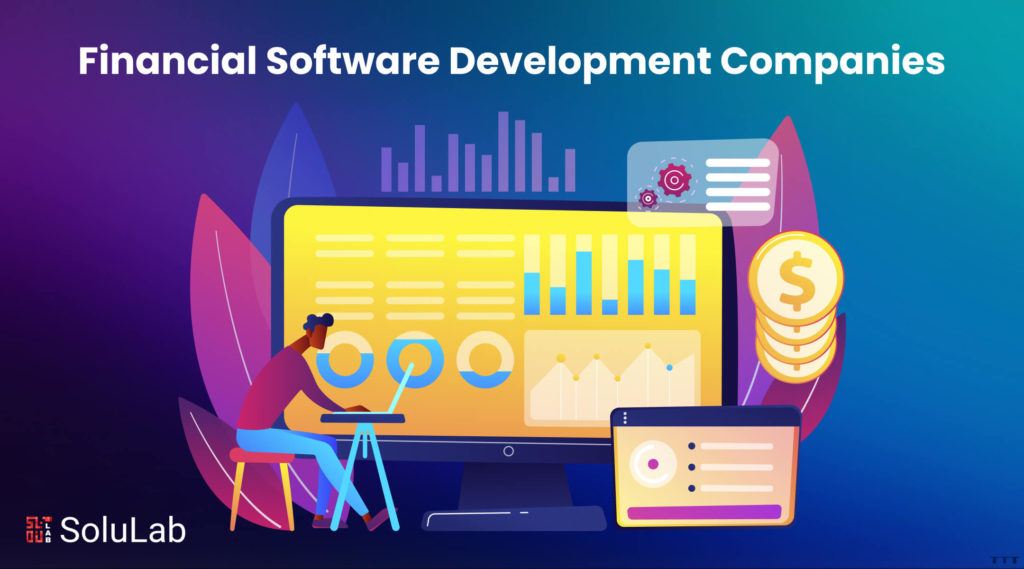
The global financial software market was projected to grow at a CAGR of 7.2% from 2018 to 2023, according to Market Research Future. What’s driving that? A combination of things: rising demand for advanced analytics, broader adoption of cloud-based solutions, and the growing pressure on finance teams to do more with less manual overhead.
This article covers financial technology software and some of the best financial software companies to know in 2026.
Understanding Financial Software Development
Financial software development is about building programs designed specifically for financial institutions, businesses, and individuals to handle and automate their financial operations. Accounting, budgeting, financial analysis, risk management, investment management, and more can all be done faster and more accurately when the software is built with finance in mind.
Companies that specialize in this space do more than write code. They understand how banks, insurance companies, asset managers, brokerage firms, and accounting practices actually work, and they build to those requirements. The result is software that fits the problem rather than forcing the client to fit the software.
In practice, that means teams of software developers, financial domain specialists, and data scientists working together to design, build, test, and ship solutions that hold up under strict security requirements and regulatory scrutiny.
Read Our Blog: Top 10 Software Development Companies in USA 2026
The Top Financial Software Development Services Include the Following:
- Custom Software Development: Good financial software starts with understanding the client’s actual workflows, not generic templates. That means a thorough analysis before a single line of code gets written. Many companies look offshore to nearshoring in Eastern Europe, Latin America, Southeast Asia, and India, where technical depth, time zone coverage, and cost structure often combine in ways that work well for development teams.
- Integration Services: A financial software development company also connects its solutions to whatever’s already running, whether that’s accounting software for nonprofits, enterprise resource planning (ERP) systems, or customer relationship management (CRM) software. When data moves cleanly across systems, operations stop being a bottleneck.
- Maintenance and Support: Shipping software is not the finish line. These companies stay involved with bug fixes, updates, and technical support so that what went live stays working.
- Security and Compliance: Financial data is sensitive. Full stop. That’s why development teams in this space build security in from the start, not as an afterthought, and they work to meet standards like PCI DSS and GDPR as a baseline, not a stretch goal.
Criteria for evaluation
When you’re sizing up financial software development companies, here’s what actually matters:
- Expertise and technical skills: Look at how deep their knowledge goes. Do they understand financial software frameworks, protocols, and platforms? Can they talk fluently about data analytics, cloud integration, security, and compliance, or do they go vague when you push?
- Experience and track record: Past projects tell you a lot. How complex were the builds? Did they scale? Did clients stay happy? A company with real longevity in this space has usually earned it by delivering consistently, not by landing one big name early.
- Innovation and R&D efforts: Finance moves fast. A company that’s not investing in emerging technologies now will hand you a solution that’s outdated before it’s even fully deployed. Check for patents, community contributions, and a track record of staying ahead rather than catching up.
- Range of services and solutions: Can they cover the whole lifecycle, strategy, architecture, development, integration, and post-launch maintenance? Or do they hit a wall partway through and hand you off to someone else?
- Client reviews and testimonials: Read the case studies. Look at who’s talking, what they built, and whether the outcomes were real. It’s easy to collect a good quote. Actual results are harder to fake.
Here is a List of the Top Financial Software Development Companies in 2026

1. SoluLab
SoluLab is a recognized financial software development company, known for building stable, high-quality solutions that help organizations clean up their operations and improve their bottom line. The team brings together technical depth and real financial domain knowledge, which shows in how they approach things like fraud detection systems, mobile banking apps, and financial management platforms.
Whether you’re starting from scratch or replacing a system that’s held your team back for years, SoluLab brings the combination of financial domain knowledge and engineering discipline that the work requires. They serve banks, asset managers, insurance companies, and other financial institutions with a full range of software products and services.
2. Fiserv
 $115
$115
 23,000
 1984
1984
 Wisconsin, USA
 Centra Credit Union, Zelle LLP
Fiserv is a major force in financial software, serving banks, credit unions, investment firms, and a broad range of other financial organizations. Their product catalog covers core banking systems, payment processing platforms, risk management tools, and digital banking solutions. What sets them apart is industry knowledge that goes deep enough to actually shape product decisions, not just inform them. The result is software that helps financial institutions ship real digital experiences, cut operational drag, and run leaner.

3. Temenos
$110
4,000
1993
Geneva, Switzerland
Atlantic Union Bank, Bank Leumi, Baxter Credit Union
Temenos builds banking software for institutions of all sizes, from small community banks to large multinationals. Their product line includes core banking systems, digital banking solutions, payments software, and analytics tools. The software is built to scale and flex as a bank’s needs change. That’s not a small thing in a market where a rigid platform can quietly become a growth ceiling. Temenos has built a name on shipping technology that keeps banks ahead rather than playing catch-up.

4. SAP
$120
100,000
1972
Walldorf, Germany
Ford Motors, Coca Cola, DHL
SAP is an enterprise software company that has been building financial management systems since 1972. Their financial software covers accounting, treasury management, financial planning, and analytics, and it connects directly into other parts of the business, like supply chain and HR, so finance teams get a real picture of what’s happening across the organization. The integration is the point. When finance, operations, and HR are all pulling from the same data, decisions get faster and the audit trail gets cleaner.
5. Oracle
$115
12,000
1984
Texas, USA
eBay, Airbnb
Oracle Financial Services covers a wide terrain: core banking, risk and compliance, financial crime prevention, and customer analytics. Their depth in complex financial operations is one of the things they’re known for. Where many platforms struggle when the use case gets complicated, Oracle tends to hold up. Financial institutions that need to manage risk at scale while keeping customer engagement sharp tend to find a lot to work with here.

6. SS&C Technologies
$125
22,000
1986
Connecticut, USA
Banks, hedge funds, asset managers, insurance companies
SS&C Technologies is a global provider of investment and financial software, focused mainly on asset managers, wealth managers, insurance companies, and related institutions. Their product stack touches investment management, trading and order management, portfolio accounting, and risk management. The combination of technical depth and domain expertise here is real, and it shows in the kind of clients they attract. Financial professionals worldwide rely on SS&C’s platforms to handle high-stakes decisions with less friction.

7. SimCorp
$110
1,700
1979
Copenhagen, Denmark
Norges Bank, Zurich Insurance Group
SimCorp focuses squarely on investment management software for asset managers, fund managers, and institutional investors. Their platform covers the full front-to-back office, portfolio management, order management, risk and compliance, and performance measurement all in one place. That integrated view matters. In practice, this is where many investment teams get stuck: data living in separate systems, reconciliation eating hours, risk reports arriving too late to be useful. SimCorp built specifically for that problem.

8. Calypso Technology
$120
1,200
1990
London, UK
Banks, asset managers, and insurance companies
Calypso Technology specializes in cross-asset trading and risk management software for financial institutions. Trading, risk analytics, collateral management, treasury operations: all covered. The platform scales and adapts as market requirements shift, which matters in a space where the rules can change faster than development cycles. Clients turn to Calypso when they need trading operations that run cleanly and risk exposure that’s actually visible in real time.

9. Bloomberg L.P.
$130
19,000
1981
New York City, NY
Bank of America, Citi group, Goldman Sachs
Bloomberg is one of the most recognized names in financial software and data. Their suite covers trading platforms, risk management tools, investment analytics, and market data at a scale few others match. Financial professionals use Bloomberg not just for execution but for the analytical layer underneath every decision: what’s moving, what’s at risk, what the data actually says before you commit. That real-time data coverage and analytical depth is what keeps it a default tool across the industry.

10. Broadridge
$115
15,000
1981
New York City, NY
BlackRock, State Street, Morgan Stanley
Broadridge delivers technology solutions across the financial industry, covering investor communications, securities processing, data and analytics, and wealth management technology. The clients on their roster, BlackRock, State Street, Morgan Stanley, give you a sense of the scale they operate at. What Broadridge is particularly good at is the infrastructure layer: the parts of financial operations that have to work every time, at volume, without exception. Banks, broker-dealers, and asset managers all rely on that reliability.
Final Words
Financial software development is a discipline that only gets more demanding as the industry evolves. The companies that do it well are the ones that understand finance as deeply as they understand technology, where regulatory requirements, data security, and operational complexity are features of the problem, not obstacles around it. The list above covers organizations that have earned real credibility across those dimensions.
If you’re building or upgrading financial software, the right partner depends on your specific needs. SoluLab offers financial software development services across banking, insurance, investing, and a range of other sectors, with a focus on building financial software that handles compliance, security, and operational efficiency without making your team chase the gaps.
FAQs
Shipra Garg is a tech-focused content strategist and copywriter specializing in Web3, blockchain, and artificial intelligence. She has worked with startups and enterprise teams to craft high-conversion content that bridges deep tech with business impact. Her work translates complex innovations into clear, credible, and engaging narratives that drive growth and build trust in emerging tech markets.