Key Takeaways
- A monolith scales as one block. You cannot give the catalogue more capacity without scaling the whole application, so peak traffic either costs a fortune or takes the site down.
- Speed is a revenue problem, not a cosmetic one. Conversion drops by an average of 4.42% for each additional second of load time between zero and five seconds.
- Data silos show up as cancelled orders. A product reads in stock, then cancels after purchase because inventory never synced.
- Technical debt is a tax on every future change. It lands in maintenance hours, security exposure, hiring difficulty and missed opportunity.
- AI needs an event stream and clean APIs. A coupled platform with fragmented customer data has no clean surface to plug a model into.
- Strangler fig beats a big-bang rewrite for most estates. You never flip a single switch, so there is no single point of catastrophic failure.
- SEO needs a named plan from day one. A redirect map and rank monitoring belong in the migration plan, not in the post-launch retrospective.
Legacy ecommerce modernization addresses the performance, integration and scaling limits that come from running a store on aging, tightly coupled software. The common symptoms are slow pages, data trapped in silos, fragile custom code, and an inability to add AI or new channels. Therefore fixing them means modernising the architecture rather than patching around it.
SoluLab plans and runs these programmes for retail and B2B commerce teams through our enterprise software development services, pairing commerce architects with a de-risked migration path so revenue keeps flowing while the platform changes underneath it.
On this page: what these challenges are, why monoliths slow you down, how data silos damage experience, the real cost of technical debt, why legacy tech blocks AI, three modernisation options compared, a safe migration sequence, and how to choose a partner.

What Are Legacy eCommerce Modernization Challenges?
Legacy ecommerce modernization challenges are the recurring problems a business hits when its commerce platform was built for an earlier era of the web. The platform still processes orders. However, it resists change: new features take months, integrations break, and every peak sale becomes a stability risk.
Most of these platforms share a shape. A monolith welds the storefront, catalogue, cart, checkout and admin together in one codebase. Consequently one change ripples into unrelated areas, and one slow query drags the whole site down. Around 93% of organisations say their existing technology limits ecommerce success, with outdated systems causing integration failures and missed opportunities, according to Netguru.
Legacy ecommerce modernization challenges cluster into five areas.
Performance. Slow pages and checkout under load.
Scalability. The platform buckles at traffic peaks instead of scaling.
Data silos. Customer, order and inventory data live in disconnected systems.
Technical debt. Brittle custom code that few people understand.
Innovation drag. No clean way to add AI, personalisation or new channels.
Why Do Legacy Commerce Platforms Slow You Down?
Legacy platforms slow you down because a monolith scales as one block. You cannot give the catalogue more capacity without scaling the entire application, so peak traffic either costs a fortune or takes the site down. Page rendering is often server-side and heavy, and years of plugins pile onto every request.
Speed is not a cosmetic problem. Conversion rates drop by an average of 4.42% for each additional second of load time between zero and five seconds, based on Portent’s site-speed research. A store loading in five seconds instead of two therefore leaves measurable revenue on the table daily.
There is a second cost. Because the code is coupled, engineers move carefully. A small change to the product page can break checkout, so releases get batched into rare, risky deployments. As a result, that slowness compounds.
How Do Data Silos Hurt the Customer Experience?
Data silos hurt experience because the pieces of a shopper’s journey stop talking to each other. Inventory sits in one system, the CRM in another, order history in a third, and the storefront in a fourth. Consequently no single view of the customer or the stock exists.
| Siloed system | What breaks | Business impact |
| Inventory not synced to storefront | Overselling, false stock counts | Cancellations, refunds, lost trust |
| CRM disconnected from storefront | No personalisation or recognition | Lower repeat purchase rate |
| Order data isolated from support | Agents cannot see live status | Slow, frustrating service |
| Marketing data separate from behaviour | Untargeted campaigns | Wasted spend, weak ROI |
The visible failures are familiar. For example, a product shows in stock, then cancels after purchase because inventory never synced. Meanwhile a returning customer gets treated like a stranger because their history is stranded elsewhere.
Modern commerce architectures fix this with an API-first design, where each system exposes its data through APIs and a shared data layer keeps everyone consistent.
What Is the Real Cost of Technical Debt?
The real cost of technical debt is the compounding tax you pay on every future change. Debt shows up as outdated frameworks, undocumented custom code and dependencies nobody wants to touch. As the burden grows, it hinders a retailer’s ability to meet modern customer expectations, as Codurance notes.
That tax lands in four places.
Maintenance. A large share of engineering time goes to keeping the old system alive instead of building new value.
Security. Unpatched, end-of-life components widen the attack surface and raise compliance risk.
Talent. Few engineers want to work on obsolete stacks, so hiring and retention get harder.
Opportunity. Every feature the platform cannot support is revenue a competitor captures instead.
Quantifying technical debt before legacy ecommerce modernization takes real numbers: hours spent on maintenance versus new features, incident frequency and delayed launches. Build that model with your own engineering-time and downtime figures rather than a published benchmark.
How Does Legacy Tech Block AI and Personalisation?
Legacy tech blocks AI because both AI and personalisation need clean, real-time access to data, and a monolith with data silos cannot provide it. Personalisation engines, recommendation models and agentic shopping assistants all read live behavioural and catalogue data through APIs.
The practical blockers are concrete. First, there is no event stream to feed a recommendation model in real time. Second, customer data is fragmented, so any model trains on partial signals. Finally, the platform cannot expose the APIs an AI service needs.
This is where modernisation pays a compounding dividend. Once the architecture is API-first and event-driven, adding AI becomes a matter of connecting a service rather than rebuilding the platform. SoluLab often sequences an AI roadmap alongside the migration, drawing on our AI development capabilities.

What Are Your eCommerce Modernization Options?
There are three main paths off a legacy commerce platform: replatform to a modern packaged solution, re-architect to composable or MACH commerce, or modernise incrementally with the strangler fig pattern. The right choice depends on risk tolerance, budget and how custom your requirements are.
Composable commerce means assembling best-of-breed services instead of buying one suite. MACH architecture is the technical foundation, standing for Microservices-based, API-first, Cloud-native and Headless, per Sitecore.
| Option | What it is | Best for | Trade-offs |
| Replatform | Move to a modern packaged platform | Standard needs, speed to value | Less control, possible feature gaps |
| Re-architect (composable / MACH) | Assemble best-of-breed microservices, API-first, headless | Complex, differentiated commerce | Higher upfront cost and integration work |
| Incremental (strangler fig) | Replace the monolith piece by piece while it runs | Risk-averse teams, large custom estates | Longer timeline, needs discipline |
For most mid-to-large retailers, legacy ecommerce modernization works best as a strangler fig approach toward a composable target gives the best balance of risk and reward. In short, you get modern architecture without a big-bang cutover.
How Do You Migrate Off Legacy Safely?
You migrate safely by replacing the legacy platform incrementally, keeping old and new running in parallel, and shifting traffic piece by piece behind a routing layer. The strangler fig pattern exists precisely to avoid the big-bang rewrite, as set out on martinfowler.com.
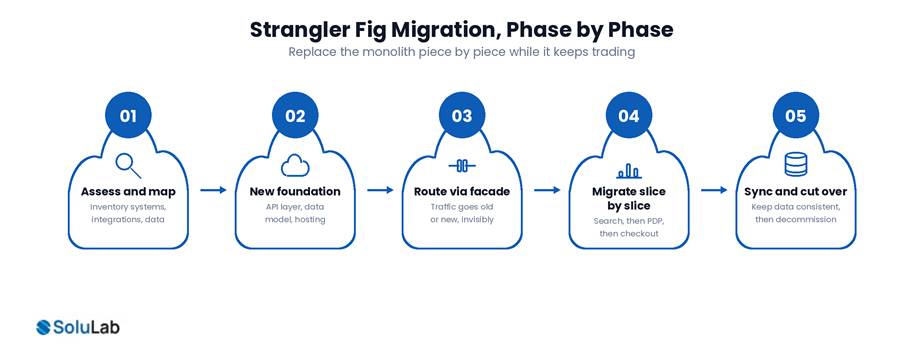
1. Assess and map. Inventory the current system, its integrations and its data. Then rank components by business value and migration difficulty.
2. Stand up the new foundation. Build the API layer, data model and hosting for the target architecture.
3. Route through a facade. Put a routing layer in front, so requests reach either system without the shopper noticing.
4. Migrate slice by slice. Move one capability at a time, validating each before the next.
5. Sync and cut over data. Keep data consistent across both systems, then decommission the legacy parts.
Two risks deserve named plans. SEO and traffic can drop if URLs, redirects and metadata are not preserved, so a redirect map and rank monitoring belong in the plan from day one. Meanwhile uptime is protected by the parallel-run design itself. SoluLab runs this playbook with DevOps and deployment automation.
How Do You Choose a Modernization Partner?
You choose a legacy ecommerce modernization partner by testing for three things: commerce architecture depth, a de-risking method, and honesty about trade-offs. The strongest signal is a partner who leads with an incremental plan and a rollback story rather than a rip-and-replace pitch.
Architecture fit. Do they work in composable, headless and event-driven patterns, not just one packaged platform?
Migration method. Can they explain a strangler fig or phased approach in concrete terms for your estate?
Data and integration. How do they handle sync, silos and a shared data layer?
AI readiness. Will the target architecture support personalisation without another rebuild?
Delivery discipline. What do their testing, CI/CD and rollback practices look like?
Proof. Can they show relevant commerce or modernisation work you can verify?
Where Does SoluLab Fit?
SoluLab delivers legacy ecommerce modernization through combined commerce, cloud and AI teams. You can scope a programme with us through our cloud application development and SaaS product development practices, which handle the hosting, scaling and product engineering a modern commerce stack depends on.
Frequently Asked Questions
Shipra Garg is a tech-focused content strategist and copywriter specializing in Web3, blockchain, and artificial intelligence. She has worked with startups and enterprise teams to craft high-conversion content that bridges deep tech with business impact. Her work translates complex innovations into clear, credible, and engaging narratives that drive growth and build trust in emerging tech markets.