Key Takeaways
- Text-based AI tutors use natural language processing to hold ongoing, personalized conversations with students, not just answer one-off questions.
- Adoption in K-12 settings has moved fast. Survey data now shows a majority of teens already use AI chatbots for schoolwork.
- The strongest use cases are homework support, concept reinforcement, and writing feedback. Not replacing teacher-led instruction.
- Data privacy, accuracy checks, and human oversight are the biggest implementation risks for districts and edtech vendors alike.
- Schools and companies building their own tutor need a deliberate build-vs-buy decision. Off-the-shelf tools rarely fit curriculum standards exactly.
A student stuck on a fraction problem at 9 p.m. used to have two options: wait until class the next day, or give up for the night. That gap is closing.
Conversational AI for education now lets a student type a question and get a step-by-step explanation within seconds, at any hour, in language they actually understand. This isn’t a niche experiment anymore.
The global AI in K-12 education market size is projected to grow from USD 901.3 million in 2026 to USD 7,949.9 million by 2033,
So what changed? This piece breaks down what text-based AI tutors actually do, where they genuinely help, where they still fall short, and what a school or edtech team needs to think through before adopting one.
What Is a Text-Based AI Tutor, Exactly?
A text-based AI tutor is software that holds a written, back-and-forth conversation with a student to explain a concept, check understanding, or walk through a problem. Unlike a search engine, it remembers what was said earlier in the session. Ask it to clarify one step, and it adjusts the explanation instead of repeating itself word for word.
Most systems on the market today fall into one of two camps.
- Rule-based tutoring chatbots that follow scripted decision trees for a narrow subject, like a fixed set of algebra problem types.
- LLM-powered tutoring assistants that generate responses dynamically, adapt to how a student phrases a question, and can handle open-ended subjects like essay feedback or science reasoning.
Most of the new investment right now is going toward the second category. That’s also why an “AI tutor” in 2026 looks and behaves very differently from the scripted chatbots schools were piloting five years ago.
How This Differs From a Basic Chatbot
A basic FAQ chatbot answers a fixed list of questions and stops there. An AI chatbot for tutoring built for education gets judged on something harder: can it figure out where a student’s understanding actually breaks down, and correct course mid-conversation? That diagnostic loop, not the chat window itself, is what moves the needle on learning outcomes.
Why K-12 Schools Are Adopting AI Tutoring Chatbots Now
Three things are converging at once. Teacher shortages. Wider access to devices in classrooms and at home. And language models that have finally gotten accurate enough for academic use. None of these three existed together even three years ago.
- The adoption numbers back this up. As of April 2024, 63% of U.S. teenagers said they’d used AI chatbots or text generators for school assignments, according to Statista.
- A separate 2025 RAND survey found 54% of middle and high school students reported using AI for schoolwork, and 53% of English, math, and science teachers said the same for instructional tasks.
- Gartner’s 2025 Hype Cycle for K-12 Education places AI-driven tools among the innovations K-12 CIOs are actively evaluating to address learning gaps and staffing pressure. Not as a future bet, but as something districts are weighing right now.
- None of this means schools are handing instruction over to software. Teachers still set the curriculum and make the judgment calls. What’s changed is that a text-based learning assistant can now absorb the repetitive, one-on-one explanation work that used to require a human tutor sitting on standby.
How Text-Based AI Tutors Actually Work
Underneath the chat window sits a language model trained, or fine-tuned, to reason through academic content and explain it at a reading level that fits the student. The core technology doing the heavy lifting is natural language processing (NLP), the branch of AI that lets software interpret and generate human language instead of just matching keywords.
The Basic Pipeline
- The student types a question or a response in plain language.
- The system parses intent: is this a request for a definition, a worked example, or feedback on the student’s own attempt?
- A response gets generated, usually grounded in curriculum-aligned content rather than the model’s general training data, to keep answers accurate and age-appropriate.
- The system holds onto conversation history so a follow-up question builds on what was already explained, instead of starting cold.
- In more advanced setups, the tutor logs where a student got stuck and passes that back to teachers as a simple progress signal.
NLP for education has matured to the point where these systems handle messy, real-world phrasing without falling apart the way older keyword-matching bots did. Misspellings. Half-formed questions. Slang. That reliability jump is a big part of why adoption accelerated so quickly between 2023 and 2025.
Top AI Use Cases in K-12 Education
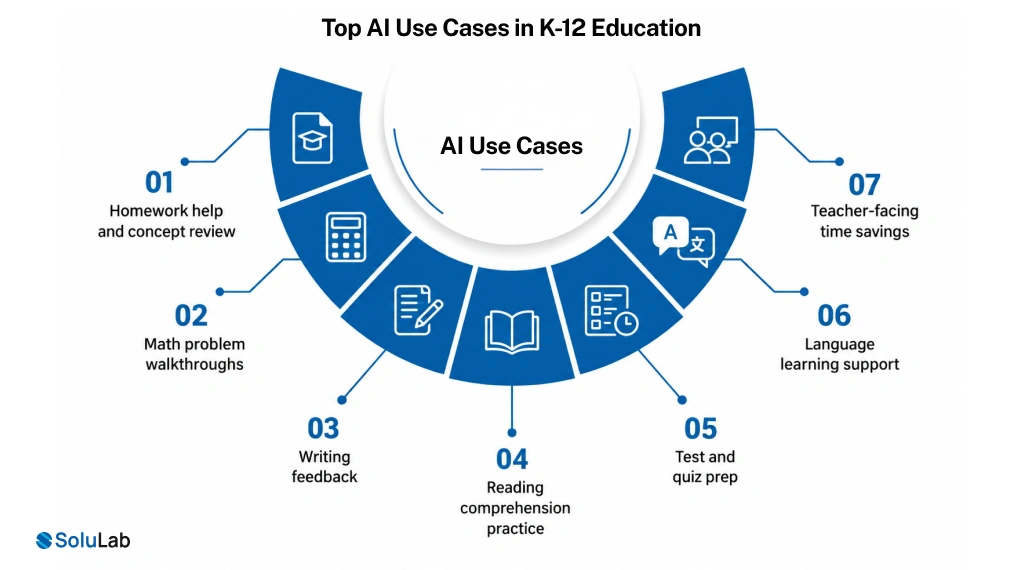
Not every subject benefits equally from AI tutoring, and it’s worth being honest about that up front. Some applications already have solid evidence behind them. Others are still experimental. Here’s where the data and classroom reports currently point.
- Homework help and concept review. The most common use case by a wide margin. Students ask a conversational AI tutor to re-explain a lesson in different words when the original explanation didn’t land.
- Math problem walkthroughs. Step-by-step reasoning is where text-based tutors perform best, since math has clear right and wrong answers the system can check against.
- Writing feedback. AI tutors flag structural issues, weak topic sentences, or unclear arguments before a student hands a draft to a teacher.
- Reading comprehension practice. Chatbots generate comprehension questions pitched at a student’s specific reading level and adjust difficulty as they go.
- Test and quiz prep. Tutors generate practice questions on demand, which turns out to be especially useful for standardized test review.
- Language learning support. Conversational practice in a second language, available outside class hours, without needing a native-speaking partner on call.
- Teacher-facing time savings. Instead of tutoring students directly, some tools draft first-pass feedback or build differentiated practice sets that teachers then review and approve.
The Real Benefits for Students and Teachers
The appeal here isn’t novelty for its own sake. There’s a measurable case for why districts keep expanding small pilots into full rollouts.
For Students
Immediate feedback matters more in learning than most people give it credit for. A student who waits two days to learn they misunderstood a concept has usually already built on top of that misunderstanding by the time it gets corrected. Fixing it in the same session avoids that compounding problem entirely. Availability outside school hours also helps students who don’t have access to after-school tutoring, which has historically tracked closely with household income.
For Teachers and Schools
Teachers who use AI tools weekly report saving close to six hours a week on average, mostly from reduced grading and lesson-prep time. That time goes back into small-group instruction, exactly the kind of work a human is genuinely irreplaceable at. It’s also why workforce researchers, Deloitte included in its enterprise AI research, keep listing broad AI fluency as a top organizational priority. The same logic extends to schools: students entering a workforce where working alongside AI tools is routine need practice with that now, not after graduation.
Where AI Tutors Fall Short (and Why That Matters)
No vendor pitch mentions this part enough, so it’s worth saying plainly.
- Accuracy isn’t guaranteed. Language models can produce confident, wrong answers, especially on ambiguous or multi-step problems. Any deployment needs a way to check content against a trusted curriculum source.
- They can’t replace relationship-based teaching. A teacher who knows a student is anxious before a test, or that a dropping grade might trace back to something happening at home, brings context no chatbot has access to.
- Equity gaps can widen instead of shrink. A student with unreliable internet or an older device gets a worse version of the same tool, which can deepen existing achievement gaps rather than close them.
- Data privacy is non-negotiable. Any system handling student data has to meet FERPA and COPPA requirements, with clear rules on what gets logged and who can see it.
- Over-reliance risks critical thinking. Some teachers report a real concern: always-available answers lower a student’s tolerance for productive struggle, which is actually a core part of learning.
A well-designed rollout treats these as design constraints from day one. Not problems to patch after launch.
A Step-by-Step Personalized AI Tutor Development Process
Building a tutor that actually improves outcomes takes more than plugging a curriculum into an LLM; it means working through curriculum mapping, model selection, safety testing, and teacher feedback loops in a deliberate sequence.
Step 1: Define Learning Objectives and Curriculum Scope
- Pin down which grade levels, subjects, and standards the tutor needs to support before touching any technology decisions.
- Decide upfront whether the tutor will handle open-ended reasoning (essays, science explanations) or narrower, checkable problems (math, vocabulary).
- Loop in curriculum specialists and teachers early. A technically sound tutor that ignores how a subject is actually taught rarely gets adopted.
Step 2: Choose the Right AI Model and NLP Approach
- Weigh a general-purpose LLM (faster to deploy, broader knowledge) against a fine-tuned or retrieval-grounded model (slower to build, more accurate for a specific curriculum).
- Decide how much of the response will come from the model’s own generation versus content retrieved from vetted curriculum material.
- Test candidate models against real classroom questions, not generic benchmarks, before committing to one.
Step 3: Build Guardrails Against Inaccurate or Unsafe Responses
- Set up content filters and age-appropriate response boundaries specific to K-12 audiences.
- Add a verification layer that checks generated answers against curriculum sources before they reach a student.
- Build an escalation path so ambiguous or sensitive questions get flagged for a human, rather than answered by the model regardless.
Step 4: Design the Conversation and Feedback Loop
- Map out how the tutor responds to a wrong answer: does it give hints, ask guiding questions, or explain directly? This decision shapes learning outcomes more than most technical choices.
- Build in a way for the tutor to track what a student has already been told, so it doesn’t repeat the same explanation on a follow-up question.
- Decide what gets surfaced to teachers, and in what format, so the data is actually usable rather than just another dashboard nobody opens.
Step 5: Pilot With a Small Group Before District-Wide Rollout
- Run a limited pilot with a handful of classrooms across different subjects and student ability levels.
- Collect both usage data and direct teacher feedback; the second one catches problems the metrics won’t show.
- Adjust the guardrails and conversation design based on real pilot behavior before scaling further.
Step 6: Integrate With Existing School Systems
- Connect the tutor to the school’s LMS, gradebook, or single sign-on system so it fits into a teacher’s existing workflow instead of becoming one more login.
- Confirm data-sharing agreements meet FERPA and COPPA requirements before any student data flows between systems.
- Set up monitoring so IT teams can spot outages or degraded performance before students do.
Step 7: Monitor, Retrain, and Expand
- Track accuracy and student outcomes over time, not just usage numbers, since high engagement doesn’t automatically mean better learning.
- Retrain or fine-tune the model periodically as curriculum standards shift or as new question patterns show up in usage logs.
- Expand to additional subjects or grade levels only after the initial rollout hits its accuracy and adoption targets.
Building vs. Buying: How Schools and Edtech Companies Approach AI Tutors
Once a district or edtech company decides to move forward, the next question is whether to license an existing platform or invest in custom AI chatbot development built around a specific curriculum, subject, or student population.
When an Off-the-Shelf Tool Makes Sense
Off-the-shelf platforms work well when the need is general: homework help across common subjects, standard test prep, or writing feedback that doesn’t need to match a proprietary curriculum. Deployment is faster, and the cost is predictable from day one.
When Custom Development Is Worth It
A custom build tends to make more sense when:
- The curriculum is proprietary or heavily customized, and generic tutors can’t align with it out of the box.
- Student data needs to stay within a specific compliance boundary or infrastructure setup.
- The product needs to plug into an existing LMS, gradebook, or analytics dashboard.
- Differentiation matters commercially, meaning an edtech company doesn’t want a tutor that behaves identically to five competitors’ tools.
This is usually the point where districts and edtech founders bring in outside expertise. AI consulting for edtech helps map the actual pedagogical requirements to a technical architecture before a single line of code gets written, which avoids a common and expensive mistake: building a technically impressive chatbot that doesn’t actually teach well.
Firms with hands-on experience in LLM-powered tutoring assistants also bring pattern recognition from prior builds, like which guardrails actually prevent hallucinated answers, how to structure feedback loops with teachers, and how to keep response latency low enough that a student doesn’t just give up and close the tab.
Personalized AI Tutors: Top Five Examples
Five products already show what personalized text-based tutoring looks like in real classrooms, from open-response grading to full adaptive learning paths built on millions of student interactions.
1. Khan Academy’s Khanmigo
Built on OpenAI’s GPT-4 and launched in 2023, Khanmigo works inside Khan Academy’s existing video and practice library rather than as a standalone app.
- Answers student questions through a Socratic-style approach, offering hints and guiding questions instead of just handing over the answer.
- Covers math, science, coding, and writing, and lets students “converse” with historical or literary figures within a guided script.
- Gives teachers a parallel AI assistant for lesson planning and progress tracking through the Parent and Teacher dashboards.
2. Cognii Virtual Learning Assistant
Cognii built its whole product around a problem multiple-choice testing can’t solve: grading open-ended, written answers at scale.
- Uses NLP to analyze syntax, semantics, and concept structure in a student’s own words, not just keyword matches.
- Provides instant, qualitative feedback on short-essay responses and coaches students through revisions until they reach conceptual mastery.
- Reports assessment accuracy close to human-grader levels in controlled studies, which is a meaningful claim for anyone worried about AI grading quality.
3. Century Tech
Century Tech, founded in the UK in 2013, leans hard on the “adaptive pathway” model rather than open-ended conversation.
- Tracks every click, score, and interaction to map a student’s knowledge gaps and adjust their learning path automatically.
- Automates routine assessment and progress reporting, which the company says saves teachers up to six hours a week on admin work.
- Serves over 1,000 UK schools, plus a growing international footprint through groups like Nord Anglia and Cognita.
4. Squirrel AI
Squirrel AI, out of Shanghai, takes personalization to an extreme by breaking subjects into thousands of “knowledge points” rather than broad topics.
- Splits middle school math alone into more than 10,000 fine-grained knowledge points, each linked into a larger knowledge graph.
- Runs a diagnostic test first, then decides the sequence of topics itself rather than letting the student pick.
- Has enrolled tens of millions of students in China and has publicly reported faster knowledge-point mastery than comparable human-led instruction in head-to-head trials.
5. Duolingo Max
Duolingo’s premium tier, powered by GPT-4, applies conversational tutoring specifically to language acquisition rather than core academic subjects.
- “Explain My Answer” lets a learner ask why a response was right or wrong and request further examples, right inside the lesson flow.
- “Roleplay” drops learners into unscripted conversations, like ordering coffee in Paris, and scores them on accuracy and complexity afterward.
- Keeps a human-written scenario framework underneath the AI, so the model improvises within guardrails rather than generating open-ended dialogue from scratch.

What’s Next for Text-Based AI Tutors in K-12
The next two to three years will likely bring three shifts. First, tutors will get better at showing their reasoning the way a teacher would on a whiteboard, instead of just spitting out a final answer.
Second, integration with existing school systems will deepen, so a tutor’s insights feed straight into a teacher’s dashboard instead of sitting in a separate app nobody checks. Third, regulatory scrutiny around student data and AI accuracy will tighten, which will favor vendors who built compliance in from the start over those trying to retrofit it later.
None of this points toward AI tutors replacing teachers. It points toward classrooms where routine explanation and practice get handled by software, freeing teachers to spend more time on judgment calls, motivation, and the relationship-building no model can replicate.
Conclusion
Text-based AI tutors have moved past the pilot-program phase and become a real part of how K-12 students get academic support. The adoption numbers, the time savings, and the classroom data all point in the same direction.
The schools and edtech companies getting the most out of it are the ones treating it as a serious build, with real attention to accuracy, privacy, and pedagogy, rather than a quick chatbot bolted onto an existing app.
If you’re evaluating whether to build a tutoring assistant for your school system or edtech product, SoluLab, an AI development company with hands-on experience building LLM-powered applications, can help you scope the right approach. From a lightweight pilot to a fully custom platform, before you commit engineering budget to it.
FAQs
Neha is a curious content writer with a knack for breaking down complex technologies into meaningful, reader-friendly insights. With experience in blockchain, digital assets, and enterprise tech, she focuses on creating content that informs, connects, and supports strategic decision-making.