Key Takeaways
- Property deals can now close in hours, not weeks. Atomic execution and on-chain escrow do the heavy lifting, and they work across regulated markets worldwide.
- Rules matter here. The GENIUS Act and MiCA give stablecoin property payments a compliant footing, with reserves you can verify in real time and trust layers built for institutions.
- Pair tokenization with stablecoins and fractional ownership stops being a pitch deck idea. Liquidity opens up. So does access to real estate deals you could never touch before.
Buying and selling property is getting faster. It is also getting more structured, and more open to buyers on the other side of the planet, as the digital plumbing underneath it matures. Stablecoins sit right in the middle of that change now, working as a dependable settlement layer for real deals. What is different about 2026 is that the guardrails already exist. Regulation, big institutional players, compliance standards, all of it landed before most people expected it to.
- Global real estate tokenization hit $4.7 billion in 2026. Long-range forecasts stretch toward $24 billion by 2035.
- That is a 21% CAGR. Aggressive by any measure.
- And the bigger story: stablecoins are moving real money in high-value property deals. Not a lab experiment anymore.
A few things pushed this forward at once. Regulation lined up. Security got better. Institutions started working together instead of circling each other. Put those together and you get the way stablecoin property transactions actually run today.

Stablecoin Development: Powering the 2026 Real Estate Economy
By March 2026, tokenized real estate and regulated stablecoins had stopped being pilot projects. They became the backbone that global institutions build on.
Total value locked in tokenized Real-World Assets (RWAs) passed $26.4 billion early in the year. And stablecoins? They are the settlement layer property deals default to now.
1. Key Market Indicators (Q1 2026)
- $24 Billion+ TVL: Money locked into tokenized real-world assets.
- 65% Adoption Rate: Share of RWA platforms running the ERC-3643 (T-REX) standard for automated compliance.
- < 24 Hour Closings: In compliant jurisdictions, settlement dropped from 30 to 60 days down to under a single day.
This year, the industry stopped treating digital liquidity as a novelty. The conversation around stablecoin development moved past raw speed. Now people ask harder questions. Is the transaction clean? Can you audit it later?
What Defines This 2026 Infrastructure?
- Primary Settlement Layers: For cross-border real estate tokenization, stablecoins are the default. They skip the 3 to 5 day wait on bank wires.
- 24/7 Market Operations: Banks close. Stablecoins do not. Property deposits and rental payouts settle around the clock, holidays included.
- Fee Compression: Settle on-chain and costs drop below 1%. Compare that to the 3 to 6% you often eat on a traditional international property purchase.
- Legal Parity: Federal frameworks like the GENIUS Act put stablecoin settlements on the same legal footing as a wire transfer.
2. Solving Traditional Pain Points with Stablecoin Innovation
Ask anyone who has closed a property deal what slows it down. Three culprits usually: delay, cost, and opacity. Stablecoin solutions go after all three by swapping manual verification for code that runs itself.
3. Eliminating Counterparty Risk via Atomic Settlement
Here is the old way. You send the money. Then you wait, and you hope the deed shows up a few days later. Atomic settlement kills that gap. The digital deed and the stablecoin payment change hands in the same instant. If any piece of the deal breaks, the whole thing unwinds, and nobody walks away holding nothing.
4. Automated Compliance and Global Accessibility
For a long time, one problem stalled real estate tokenization: how do you make sure an investor abroad actually clears local KYC and AML checks? By March 2026, platforms had a cleaner answer. They baked compliance straight into the token.
- ERC-3643 (T-REX) Standard: The token itself refuses to move to a wallet no recognized identity provider has verified. It just will not transfer.
- Fractional Liquidity: An investor in London can grab a $500 slice of a Tokyo office building on the spot, and collect dividends every day in a USD-pegged token.
5. The Trump Organization and Global Political Shifts Shaping Stablecoin Real Estate Transactions
The Maldives Tokenization Project (February 2026): WLFI, co-founded by the Trump family, teamed up with Securitize, which BlackRock backs. The goal? Tokenize the Trump International Hotel & Resort in the Maldives.
The Saudi project, built with Saudi Arabia’s Dar Global, lets accredited investors buy tokens tied to loan revenue interests. That is a real departure from old-school private equity. Now global capital can pour into luxury hospitality builds straight through the blockchain.
U.S. “Crypto Capital” Policy: Since January 2025, the administration has been pushing an executive order to turn the U.S. into the “crypto capital of the world.” Out of that came the SEC’s “Project Crypto” initiative, which trades an enforcement-first posture for a clear taxonomy covering digital assets.
Benefits of Stablecoin Development Solutions in Real Estate Financial Transaction
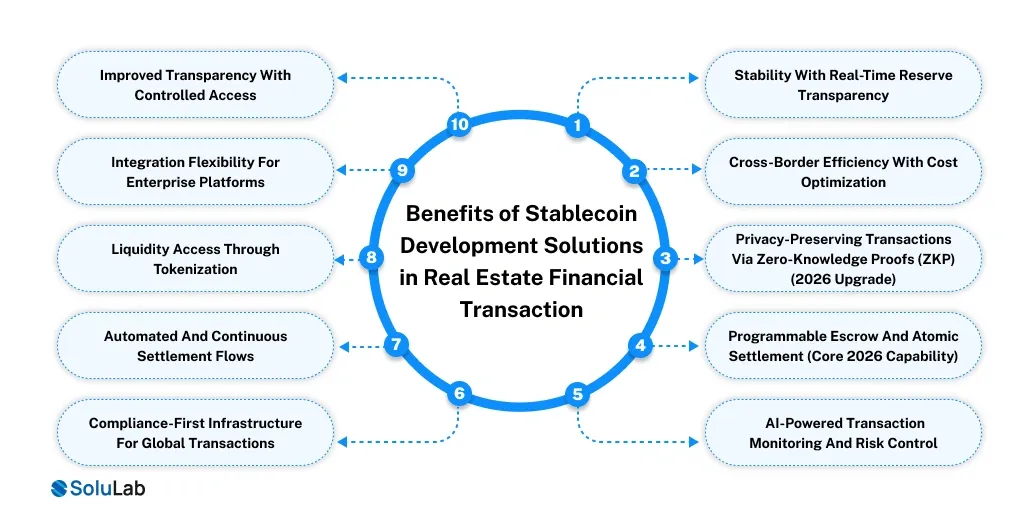
Faster payments were the opening act. In 2026, stablecoin real estate transactions do a lot more than that. They sit inside a structured system that ties compliance, automation, and smart execution together.
Today’s stablecoin development solutions fold in privacy layers, programmable settlement logic, and AI-driven validation. That combination makes blockchain real estate transactions more dependable for enterprises and the institutions writing big checks.
1. Stability with Real-Time Reserve Transparency
Price predictability still counts for everything in stablecoin property transactions. What shifted in 2026 was proof. How do you actually confirm the stability is real?
- Reserves are provable in real time now, not through a report that lands once a quarter
- For large property deals, enterprises lean toward fully backed, regulated tokens
- Both sides can lock a deal value and stop worrying about a swing in price
Where it matters:
- High-value residential deals
- Commercial property acquisitions
- Cross-border real estate payments using stablecoins
Deals that drag on for months get a lot steadier because of it.
2. Cross-Border Efficiency with Cost Optimization
Send money across borders the old way and you pick up middlemen, delays, and fat fees at every stop.
Pay for property on-chain instead and the picture changes:
- Transactions settle within minutes or hours
- Fees usually land below 1%
- No dependency on SWIFT or banking windows
Typical cost comparison:
- Traditional cross-border transfer: 3% to 6%
- Stablecoin real estate payments: ~0.2% to 1%
On a global deal, that gap goes straight to the bottom line for developers and investors.
3. Privacy-Preserving Transactions via Zero-Knowledge Proofs (ZKP) (2026 Upgrade)
One of the sharper upgrades to stablecoins in real estate is the use of Zero-Knowledge Proofs (ZKP).
- A buyer can prove they hold the funds required (say, $2M USDC)
- No need to expose full wallet history
- Sensitive financial and identity data stays protected
Enterprise relevance:
- High-net-worth individuals
- Institutional investors
- Cross-border regulatory environments
You get transparency and privacy at the same time. That balance used to be the wall everyone hit.
4. Programmable Escrow and Atomic Settlement (Core 2026 Capability)
Atomic settlement is one of the biggest reasons smart contracts in real estate works the way it does.
How it works:
- Ownership transfer and payment fire at the same moment
- One condition fails, the whole transaction reverses
On-chain escrow for real estate:
- Funds sit locked inside smart contracts
- They release only when:
- Title verification is complete
- Legal checks are approved
- Conditions are digitally validated
Institutional usage:
Securitize, for one, runs settlements this way, fully automated.
Cost insight:
- Traditional escrow services: $2,000 to $10,000 per deal
- On-chain escrow: a lot less, mostly whatever the network fees run
Fewer intermediaries in the loop. More trust in the way stablecoin property transactions settle.
5. AI-Powered Transaction Monitoring and Risk Control
The stablecoin development solutions people ship today come with AI layers baked in, and they make transactions more reliable.
Key capabilities:
- Fraud detection using behavioral analysis
- Real-time anomaly detection in payments
- Automated compliance checks (KYC/AML validation)
- Smart contract risk scoring before execution
Use cases in real estate payments using stablecoins:
- Identifying suspicious wallet activity
- Preventing unauthorized token transfers
- Monitoring large-value transactions
Bring AI into the loop and blockchain-based property payments hold up even as volume climbs.
6. Compliance-First Infrastructure for Global Transactions
Compliance is not bolted on anymore. In property transactions, it lives inside the system.
What has changed:
- Wallet-level KYC enforcement
- Region-based transaction restrictions
- Integration with standards like ERC-3643 (T-REX)
Benefits:
- Prevents transfers to unverified participants
- Keeps legal ownership tracked
- Simplifies cross-border regulatory compliance
That is what makes stablecoin real estate transactions workable in tightly regulated markets like the US and EU.
7. Automated and Continuous Settlement Flows
With stablecoin development, real estate money never really stops moving.
Examples:
- Instant property settlement after verification
- Automated rental income distribution
- Scheduled mortgage payments using stablecoins
Smart contract escrow gives you:
- No delays
- No manual approvals
- Transparent execution
The day-to-day of running a blockchain-powered real estate operation just gets smoother.
8. Liquidity Access through Tokenization
Stablecoins are a big part of what makes fractional real estate investment.
How it works:
- Properties are split into smaller tokenized units
- Investors buy shares with stablecoins
- Returns land automatically
Benefits:
- Unlocks liquidity in traditionally illiquid assets
- Allows smaller investors to participate
- Enables faster capital rotation for developers
Real-world asset transactions get stronger, and more people get a seat at the table.
9. Integration Flexibility for Enterprise Platforms
These stablecoin development solutions are built to plug into what you already run.
Key integrations:
- Payment gateways
- Property management systems
- Legal and compliance platforms
- Banking and custody solutions
Estimated implementation cost range:
- Basic integration: $20,000 to $30,000
- Enterprise-grade platform: $30,000 to $50,000+
So a business can adopt blockchain infrastructure without tearing down everything it already has.
10. Improved Transparency with Controlled Access
Transparency is still the headline advantage. In 2026, though, it comes with a dial you can turn.
- Transaction records are immutable
- Access is permissioned based on roles
- Regulators and stakeholders can verify data when needed
Trust goes up, and privacy in stablecoin real estate payments stays intact.
How Does Stablecoin Development Help Safeguard Real Estate Investments Against Inflation?
When prices start climbing, real estate investors need a place to park value without losing control of it. Stablecoins do that job, and they keep your options open.
- Hedging Against Inflation: A stablecoin pegged to a steady asset holds its value while inflation eats away at everything else. Convert your property profits into one and you shield those returns from local currency slides, yet you can still redeploy the moment a deal appears.
- Preserving Value: These digital assets keep the purchasing power of your real estate holdings intact. Fiat currencies bleed value over the years. A properly backed stablecoin does not, which makes it a solid place to store what your property is worth.
- Facilitating Quick Transactions: Markets turn fast. Stablecoins let you turn with them, whether you are chasing a fresh opportunity or pulling back to protect assets in a downturn. That speed hands investors agility they simply did not have before.
- Integration with Tokenized Real Estate: Put stablecoins next to tokenized real estate and diversification gets easier. You rebalance holdings without friction and keep the exposure you want across different property types and markets.
Top-Performing Stablecoin Tokens in the 2026 Market
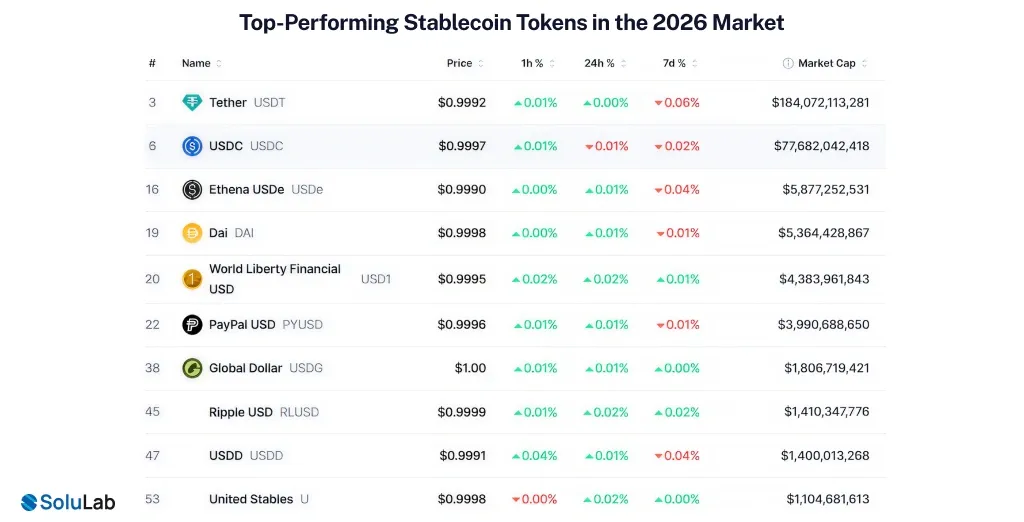
The property market has settled on a handful of stablecoins it trusts. Each one brings something a little different to transactions and to managing an investment.
- USDT (Tether): Tether is the one most people reach for. Deep liquidity, accepted almost everywhere, and its wide range of trading pairs makes it handy for international real estate deals, though it pays to keep an eye on the reserves behind it. The rising interest in cryptocurrency coin options like Tether is quietly reshaping how cross-border payments happen.
- USDC (USD Coin): USDC earns trust the boring way, through regulatory compliance and backing you can actually see. Regular audits and institutional support behind it make it the go-to for big property transactions.
- DAI (Dai): DAI takes a different route. It is decentralized and crypto-collateralized, and that structure gives it an edge for smart contract-based real estate deals.
- BSC-USD (Binance Peg): Running on the Binance Smart Chain, this one keeps fees low and settlement quick, which is why it shows up in smaller real estate deals and rental payments.y
- USDE (Ethena): USDE is the newcomer. People are watching it for its stability mechanism and its lean toward institutional real estate use.
Conclusion
Stablecoins have earned a real place in property deals. They chip away at the old friction points and open doors for how people invest and manage what they own. The tech keeps getting better by the day, and stablecoins look set to become a fixture of real estate finance rather than a side experiment.
More professionals in the field are seeing the efficiency and the security for themselves. Plenty of hurdles are still standing, regulation and standardization chief among them, but the upside for stablecoins in real estate is too big to wave off.
Take Crypto Mining, an e-commerce platform for mining hardware. They wanted to make global transactions simpler and easier to reach, so SoluLab, a Stablecoin development company built them a blockchain-based marketplace running on smart contracts, so every transaction stayed secure, transparent, and quick. We automated the busywork, cut out intermediaries, and shipped a platform that connects miners worldwide with strong security and costs kept low.
FAQs
Shipra Garg is a tech-focused content strategist and copywriter specializing in Web3, blockchain, and artificial intelligence. She has worked with startups and enterprise teams to craft high-conversion content that bridges deep tech with business impact. Her work translates complex innovations into clear, credible, and engaging narratives that drive growth and build trust in emerging tech markets.