
Key Takeaways
- Data residency for AI is narrower than sovereign AI as a national strategy. It’s about where a specific model processes a specific dataset, and whether that’s legally permitted.
- GDPR and comparable laws don’t ban AI outright. They govern how personal data can leave a jurisdiction and under what safeguards.
- Most compliance failures happen at the inference layer, not training. A vendor SaaS API silently routing prompts through a foreign region is the most common gap.
- An approved model catalog turns a one-time legal review into a reusable decision your engineers can self-serve against.
- On-premises LLM deployment and private cloud AI aren’t the only paths to compliance. Regional cloud availability zones with contractual data-processing addenda often clear the bar at a fraction of the cost.
AI data residency compliance starts with a question most teams skip: not “which model performs best,” but “which models are we legally allowed to send this data to?”
If a prompt containing customer records, health data, or financial details crosses into a jurisdiction your legal team hasn’t cleared, the model’s accuracy stops mattering. Gartner has estimated that more than 40% of cross-border AI data incidents through 2027 will trace back to improper generative AI use, often because a model was integrated into an existing product without anyone flagging where it actually processes data.
This guide walks through how to evaluate models against data residency rules, where GDPR and similar laws actually bite, and how to build an approved model governance catalog your engineering team can use without asking legal every time.

What “Data Residency” Actually Means for AI Workloads?
Data residency is the requirement that certain data be stored, and often processed, within a specific geographic or legal boundary. For AI, that boundary question gets complicated fast, because a single prompt can touch three different places: where it’s sent from, where the model runs inference, and where logs or cached outputs end up stored.
This is a narrower, more operational cousin of sovereign AI, which is the broader national or organizational strategy of controlling AI infrastructure, models, and governance end to end. If you want the full picture of why nations and enterprises are pursuing that strategy, our earlier piece covers it in depth. This article picks up where that conversation gets practical: given a specific dataset and a specific regulation, which models can your team actually use?
Why This Question Got Harder in 2026
Three years ago, most enterprise AI use was internal chatbots and low-stakes automation. Today it’s underwriting decisions, clinical documentation, and contract review, exactly the workloads regulators care most about.
Gartner projects that platform lock-in driven by regional AI rules will jump from 5% to 35% of countries by 2027, meaning the “just use whichever model is best” approach is closing off as a default option for a growing share of the world.
Why the Model You Pick Is a Compliance Decision, Not Just a Technical One?
Procurement teams still tend to shortlist models on benchmark scores and price per token. That’s backwards for any workload touching regulated data. The compliance question has to be answered before the technical bake-off, because a model that fails residency review is disqualified regardless of how well it performs.
Gartner research on AI sovereignty notes that regulatory compliance under these emerging rules leads directly to higher operational costs and new interoperability challenges for organizations that haven’t planned around it. Separately.
That’s not a training-time problem. It’s a “nobody checked the inference region” problem, and it’s entirely avoidable with a documented review step.
The Three Places Data Actually Moves
- Ingestion. Where the prompt is sent from, and whether it passes through a third-party gateway or proxy first.
- Inference. Where the model physically runs the computation, often a different region than the one advertised on the vendor’s marketing page.
- Retention. Where logs, embeddings, fine-tuning data, and cached responses are stored after the request completes, sometimes indefinitely.
Most cross-border AI data transfer violations happen at step 3, not step 1. A vendor can process inference in-region and still replicate logs to a US-based analytics pipeline by default.
Where Does GDPR Actually Apply to AI Data?
GDPR applies to AI the same way it applies to any other processing activity: if personal data of an EU resident is being processed, GDPR’s rules on lawful basis, data minimization, and cross-border transfer apply, regardless of whether the tool doing the processing is a spreadsheet or a large language model.
GDPR AI data processing obligations kick in the moment a prompt contains personal data and gets sent to any system, including a third-party model API. A few things follow from that in practice:
- You need a documented lawful basis (consent, contract necessity, or legitimate interest) for sending personal data to a model, not just for collecting it originally.
- If the model provider is outside the EU/EEA, you need a valid transfer mechanism, typically Standard Contractual Clauses (SCCs) or an adequacy decision, before that data can legally leave.
- Data subject rights (access, deletion, rectification) still apply. If a customer requests deletion and their data lives inside a vendor’s fine-tuning set, you have a problem you can’t easily fix after the fact.
According to Statista’s aggregation of UNCTAD data, roughly 71% of countries worldwide now have active data privacy legislation, up sharply over the past decade. That means “just deploy the model that scores highest” is a shrinking option globally, not a regional edge case limited to the EU.
On-Premise, Private Cloud, or Regional Cloud: Comparing Your Options
Once you know what a workload requires, the deployment model follows. Here’s how the three common paths stack up.
| Deployment path | Data leaves your control? | Typical cost | Best fit |
| On-premise LLM deployment | No, everything runs on owned or colocated hardware | Highest upfront, lowest marginal cost at scale | Highly regulated data (health records, government, defense) with steady, predictable load |
| Private cloud AI | No, dedicated infrastructure in a controlled environment | High, but scales with usage | Enterprises needing sovereignty guarantees without owning hardware |
| Regional cloud with DPA | Yes, but contractually bound to a named region | Lowest, pay-as-you-go | Most commercial workloads where a signed Data Processing Addendum and in-region SLA satisfy the regulator |
A mistake we see often: teams jump straight to on premise LLM deployment because it sounds like the “safest” answer, without checking whether their actual regulatory obligation requires it.
Full sovereignty over hardware and governance is genuinely necessary for some workloads, defense, critical infrastructure, certain health data classes, but for most commercial use cases, a regional cloud deployment with the right contractual terms clears the same bar for a fraction of the infrastructure cost and timeline.
When Private Cloud AI Is Worth It
Private cloud makes sense when you need dedicated, isolated infrastructure but don’t want the capital cost of owning data centers.
It’s the middle path: your workloads aren’t sharing compute with anyone else, you control network egress rules, and you can still scale elastically instead of provisioning for peak load year-round.
Building an Approved Model Catalog: A Practical Framework
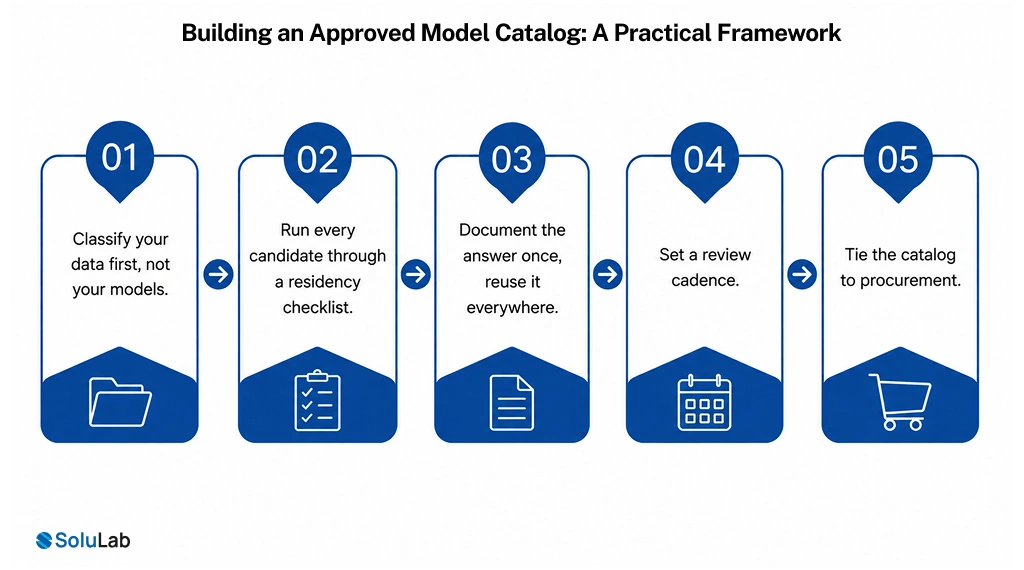
The single highest-leverage thing a compliance-conscious AI team can build isn’t a policy document. It’s a living approved model catalog, a short list of pre-vetted models mapped to data classes and regions, so engineers stop re-litigating the same legal question for every new project.
Here’s how to build one in practice:
- Classify your data first, not your models. Sort workloads into tiers: public, internal, confidential, regulated- before you touch a vendor list. The catalog entry depends on the data tier, not the other way around.
- Run every candidate through a residency checklist. Where is it hosted, where does inference run, does the vendor retain prompts, is there a valid transfer mechanism. The decision flow above is a starting template.
- Document the answer once, reuse it everywhere. Legal answers “can we use Model X for Tier 3 data in the EU” one time. Engineering references that answer for every project after.
- Set a review cadence. Vendors change infrastructure, add regions, and update retention policies without much fanfare. A quarterly re-check keeps the catalog honest.
- Tie the catalog to procurement. If a team can spin up an API key without checking the catalog, the catalog doesn’t actually govern anything.
Deloitte’s 2026 State of AI in the Enterprise survey of over 3,200 business and technology leaders found that sanctioned AI tool access expanded from under 40% to around 60% of the workforce in a single year. That kind of scale-up is exactly why a documented catalog beats case-by-case review: nobody can manually clear every request once adoption reaches that level.
Common Compliance Pitfalls Enterprises Hit With AI Model Selection
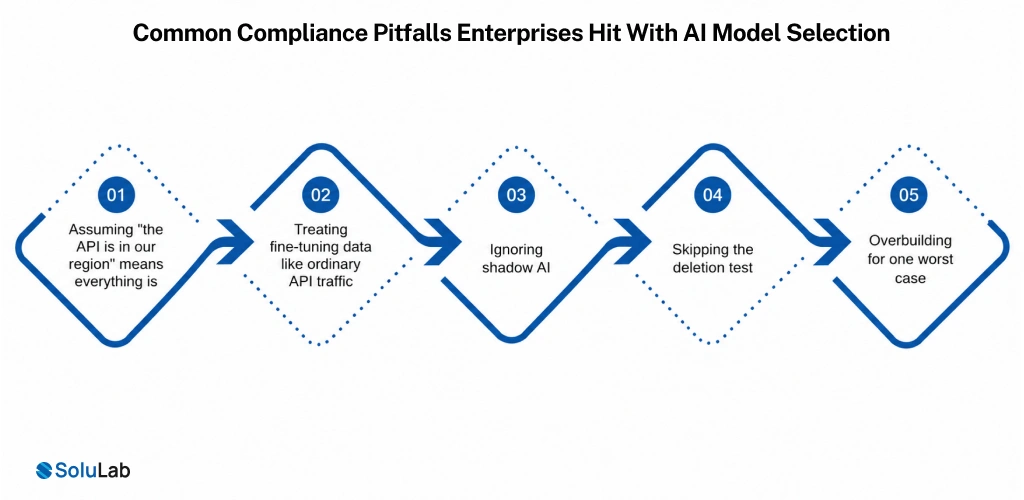
Even teams that take residency seriously tend to trip on a handful of recurring mistakes.
- Assuming “the API is in our region” means everything is. Front-end endpoints are often regional; back-end inference and logging frequently are not. Ask for architecture documentation, not marketing copy.
- Treating fine-tuning data like ordinary API traffic. If you fine-tune a hosted model on customer data, that dataset’s residency and retention terms may differ entirely from standard inference calls. Read the fine-tuning-specific terms separately.
- Ignoring shadow AI. Employees adopting consumer AI tools for work tasks routes sensitive data outside any vetted catalog entirely. This is a governance gap, not a technical one, and it needs a policy plus detection, not just a better model list.
- Skipping the deletion test. Send a test data-subject deletion request through your actual pipeline before go-live. If it can’t be honored cleanly, that’s a defect to fix now, not a risk to accept later.
- Overbuilding for one worst case. Not every workload needs air-gapped, on-premise infrastructure. Matching the deployment tier to the actual data classification, rather than defaulting to maximum sovereignty everywhere, keeps both cost and delivery timelines sane.
On the trend side, adoption isn’t slowing down to give teams breathing room. Statista’s aggregated data on global privacy legislation shows the regulatory floor rising steadily as more countries adopt formal data protection laws, which means the residency conversation is only going to apply to more of your vendor list over time, not less.
How SoluLab Helps Enterprises Deploy Compliant AI Models
This is exactly the kind of decision SoluLab works through with clients before a single line of model-integration code gets written: classify the data, map it against jurisdiction requirements, and choose between enterprise AI development on a regional cloud, a dedicated private cloud build, or a fully on-premise deployment based on what the workload actually requires rather than what sounds safest.
We’ve applied a similar disciplined, compliance-first build approach outside pure AI residency work too. In our DLCC digital lending case study, the priority was building trading and lending infrastructure where data handling, access controls, and audit trails had to hold up to regulatory scrutiny from day one, not be retrofitted after launch. The same discipline applies whether you’re deploying a compliant LLM or a regulated financial platform: get the data architecture right before you optimize anything else.
Depending on where your team lands on the deployment spectrum, our related work covers AI deployment services for production rollouts, and for teams exploring infrastructure models beyond centralized cloud vendors entirely, our piece on decentralized AI explains how distributed compute changes the residency calculus again.
Ready to find out which models you’re actually allowed to use? Book a free discovery workshop and we’ll map your data classes against a working approved model catalog in one session.

Conclusion
Choosing an AI model used to be a technical decision. For any workload touching regulated data, it’s now a legal one first and a technical one second. The organizations handling this well aren’t the ones with the most restrictive policies; they’re the ones with a documented, reusable framework: classify the data, check the residency chain from ingestion through retention, and maintain a living catalog so the same question doesn’t get re-argued every quarter.
Whether that lands you on on-premise infrastructure, a private cloud build, or a well-documented regional cloud deployment depends entirely on what your data actually requires, not on which option sounds the most cautious. Get that mapping right once, and every AI project after it moves faster because the compliance question is already answered.
SoluLab, an AI development company, can help your business build that framework, evaluate your current model stack against data residency requirements, and design a deployment architecture that satisfies legal, security, and engineering all at once.
Neha is a curious content writer with a knack for breaking down complex technologies into meaningful, reader-friendly insights. With experience in blockchain, digital assets, and enterprise tech, she focuses on creating content that informs, connects, and supports strategic decision-making.