
Key Takeaways
- AI inference cost optimization isn’t about switching to a cheaper model and hoping. It’s a mix of routing, caching, and monitoring that most teams never fully set up.
- Token prices have dropped sharply since 2023, yet AI bills at most companies keep climbing. Usage growth is outrunning the price cuts.
- Model routing strategy sends easy queries to cheap models and hard ones to expensive models, instead of running everything through your priciest option by default.
- Prompt caching can cut repeat-context costs by 50 to 90%, but only if your prompts are actually structured to hit the cache.
- Comparing AI API pricing across providers means looking past the headline number, since output tokens, caching discounts, and context length all move the real cost.
- An AI FinOps habit- ownership, dashboards, and forecasting- turns inference spend from a surprise line item into something you can actually plan around.
Here’s the strange part nobody warns you about: token prices have been falling for three years straight, and most companies’ AI bills are still going up. Not down. Up.
That’s not a contradiction once you look closer. Usage is growing faster than prices are dropping. A feature that made ten API calls a day in 2024 might make ten thousand today, across more users, longer context windows, and chattier agent loops that call the model five times to answer one question. AI inference cost optimization is the practice of getting ahead of that curve instead of discovering it in next month’s invoice.
For businesses scaling AI applications, this is also where AI consulting becomes valuable, helping teams evaluate model choices, optimize infrastructure, control inference costs, and build an AI strategy that remains sustainable as usage grows.
This piece walks through why bills climb even as per-token prices fall, what actually moves the needle on cost (routing, caching, provider comparison), and how to build the kind of ongoing discipline that keeps inference spend predictable instead of alarming.

What’s Actually Driving Up Your AI Inference Bill?
If you’re staring at a bill that’s higher than last quarter and wondering how that’s possible given how cheap tokens have gotten, you’re not imagining things. A few forces are working against the price cuts at the same time.
- Usage is compounding faster than prices are falling. More features call the model. More users hit those features. Agentic workflows, in particular, chain together multiple calls to complete one task, and each hop adds tokens nobody budgeted for individually.
- Context windows keep growing, and so does the temptation to fill them. A 128K-token context window is genuinely useful, but it’s also easy to stuff with more retrieved documents, more chat history, more “just in case” content than the task actually needs. Every extra token in the prompt gets billed, whether the model uses it meaningfully or not.
- Output tokens cost more than input tokens, often three to five times more, and reasoning models widen that gap further. A model that “thinks” before answering generates internal tokens you’re billed for, even though you never see them in the response.
- Nobody owns the number. This is the quiet one. Engineering owns the feature. Finance owns the budget. Almost nobody owns the actual token spend day-to-day, which means it drifts until someone notices the invoice.
Gartner’s research on the AI models and platforms market notes that enterprise AI budgets are coming under sharper scrutiny, with buyers increasingly prioritizing usage efficiency and demonstrable cost control rather than raw model capability alone. That shift in buyer behavior is itself a signal: cost visibility has become a competitive factor, not an afterthought.
How Much Does LLM Inference Really Cost?
The honest answer is “it depends,” but that’s not a very useful one, so let’s break down what actually determines the number on your invoice.
Providers charge per token, split into input tokens (what you send) and output tokens (what the model generates). Output is almost always more expensive. That asymmetry matters more than most pricing conversations give it credit for, because a chatty system prompt or a verbose response format quietly inflates the expensive half of the bill.
A few things worth checking against your own usage:
- Your input-to-output ratio. Retrieval-heavy applications lean input-heavy; conversational agents skew output-heavy, and the pricing math is different for each.
- Whether you’re paying for tokens you don’t need. Bloated system prompts, redundant retrieved chunks, and chat history that never gets trimmed all add up.
- Whether reasoning or “thinking” tokens are in play, these get billed as output even when you never see them, and they can dwarf the visible response.
- Cache hit rate. Repeated context, a system prompt, a knowledge base chunk, a few-shot example set, costs far less on a cache hit than a fresh call.
Deloitte’s 2026 State of AI in the Enterprise survey, which polled 3,235 business and IT leaders across 24 countries, found that worker access to AI rose 50% in 2025, with the number of companies running a significant share of AI projects in production expected to double within six months.
Spend follows usage almost by definition, so that kind of adoption curve is exactly what turns a manageable pilot budget into a line item that gets someone’s attention at the next board meeting.
What Is Model Routing, and How Does It Cut Your Bill?
Most teams pick one model and send every request through it. A password-reset FAQ answer and a multi-step legal analysis both get the same expensive model, because building anything smarter felt like extra work nobody had time for.
A model routing strategy breaks that habit. Instead of one model handling everything, a lightweight classifier or rules layer decides which model a given request actually needs, then routes accordingly.
- Simple, well-defined queries (FAQ lookups, basic classification, short summarization) go to a small, cheap model that handles them just as well as a flagship one would.
- Complex reasoning, long-context synthesis, or high-stakes outputs get routed to the larger, pricier model where the quality difference actually shows up.
- A fallback path catches cases where the cheap model’s confidence is low, escalating to the stronger model rather than shipping a weak answer.
The upside isn’t small. Teams running proper routing regularly report cutting inference costs by 40% or more, without any noticeable quality drop on the bulk of their traffic, simply because most requests never needed the expensive model in the first place.
The catch is that routing needs real testing against your actual query mix. A routing layer built on guesses about which queries are “easy” tends to misroute the exact requests where quality matters most.
Does Prompt Caching Actually Reduce LLM Costs?
Yes, and often by more than teams expect, but only when prompts are structured to take advantage of it.
Prompt caching lets a provider reuse the processing work done on a repeated chunk of context instead of recomputing it from scratch on every call. Major providers now offer meaningful discounts, frequently in the 50 to 90% range, on cached portions of a prompt.
Here’s where it tends to work well:
- A stable system prompt that doesn’t change between calls
- A knowledge base or document chunk reused across many queries
- Few-shot examples that stay identical request to request
- Long conversation history where only the newest message is new
And here’s where teams accidentally break it without realizing:
- Inserting a timestamp or session ID early in the prompt, which invalidates the cache on every call
- Reordering context between requests, even when the content is identical
- Mixing static and dynamic content in a way that puts variable data ahead of the cacheable block
The fix is almost always structural: put stable content first, variable content last, and keep the stable portion byte-for-byte identical across calls. It sounds like a small detail. In practice, it’s often the single highest-leverage change a team can make to their token bill, because it costs nothing to implement and directly targets the most repeated, most expensive part of many prompts.
How Do You Compare AI API Pricing Across Providers?
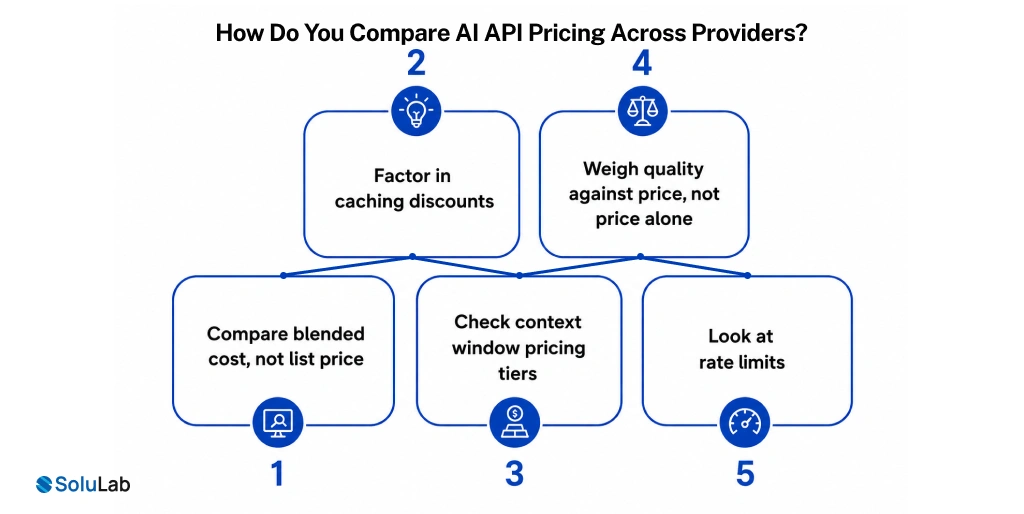
Sticker price per million tokens is the number everyone quotes, and it’s also the number that misleads people the most. A real AI API pricing comparison has to look past that headline figure.
- Compare blended cost, not list price. Model your actual input-to-output ratio against each provider’s rates, since a “cheaper” model with expensive output pricing can lose to a pricier one with a lighter output rate.
- Factor in caching discounts. A provider offering a 90% cache discount can beat a nominally cheaper competitor once your real hit rate is accounted for.
- Check context window pricing tiers. Some providers charge more once you cross a context-length threshold, which can quietly double the cost of long-document workloads.
- Weigh quality against price, not price alone. A model that’s 30% cheaper but needs a retry loop to hit acceptable quality can end up costing more per successful response.
- Look at rate limits: A cheaper model with tight rate limits can force parallel calls or added infrastructure that erases the savings.
None of this means constantly chasing the lowest sticker price across providers. It means running the comparison on your actual workload, on a schedule, since the “best” provider for your use case shifts as pricing and model quality both move. And it’s not just a model-pricing exercise, either. The compute sitting underneath your inference layer- GPUs, vector stores, caching infrastructure- has its own cost curve, which is why some teams loop in cloud computing consulting alongside the model comparison instead of treating the two as separate line items. Honestly, they rarely are separate in practice.
How Do You Build an AI FinOps Practice to Forecast Inference Spend?
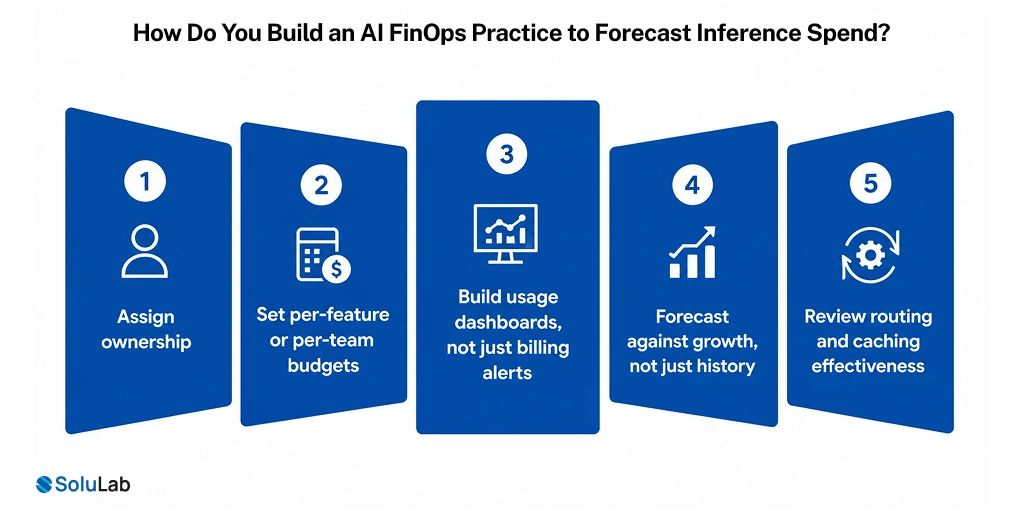
The teams that don’t get blindsided by their AI bill aren’t the ones using the cheapest models. They’re the ones who treat inference spend the way they’d treat any other significant infrastructure cost: tracked, owned, and forecasted, not discovered after the fact.
That’s the core of AI FinOps as it applies to inference specifically, and it comes down to a short list of habits.
- Assign ownership. Someone needs to watch token spend the way an SRE watches uptime, not as a side task nobody has time for.
- Set per-feature or per-team budgets. Attributing spend to the feature or team generating it turns a vague total into something people can actually act on.
- Build usage dashboards, not just billing alerts. By the time a billing alert fires, the overspend already happened. Real-time usage visibility catches drift earlier.
- Forecast against growth, not just history. A feature growing 20% month over month needs a forecast that accounts for that trajectory, not a flat projection based on last month’s number.
- Review routing and caching effectiveness. Both degrade quietly as prompts evolve and new features get bolted on, so a quarterly check catches drift before it compounds.
Statista’s data on AI adoption barriers found that in 2025, high costs of AI products and services were cited by 29% of businesses as a top obstacle to adoption, right behind a lack of internal skills and a lack of leadership vision.
That’s a meaningful chunk of organizations where cost, not capability, is the thing standing between a pilot and a production rollout. A working FinOps habit is often the difference between staying in that 29% and getting past it, though most in-house teams don’t have the bandwidth to build one from scratch while also shipping features, which is usually when AI integration services end up in the conversation.
SoluLab has seen this play out directly with real clients. The Locus GenAI supply chain platform needed inference costs that scaled predictably with usage, not unpredictably against it, given how much reasoning-heavy work the platform runs per shipment decision. Getting that predictability right wasn’t a one-off tweak. It took routing, caching, and a genuine FinOps habit working together.
What’s the Best Process to Cut Your Token Bill Without Losing Quality?
Cost cuts that also tank quality aren’t really cost cuts. They just move the cost somewhere else, retries, customer complaints, lost trust in the feature. A structured process avoids that trade-off, and it’s roughly the same process SoluLab’s AI deployment services team runs when a client’s inference bill has quietly gotten out of hand.
1. Audit Current Token Usage
Start by seeing where the money actually goes before changing anything.
- Break spend down by feature
- Identify highest-volume prompt patterns
- Flag any unexpectedly expensive calls
2. Identify Routing Opportunities
Find the requests that don’t need your most expensive model.
- Classify queries by complexity
- Test a cheaper model on simple cases
- Measure quality delta honestly
3. Restructure Prompts for Caching
Rework prompt order so the stable content actually gets reused.
- Move static content to the front
- Keep it byte-for-byte identical
- Push variable data to the end
4. Trim Unnecessary Context
Cut whatever isn’t earning its place in the prompt.
- Remove redundant retrieved chunks
- Shorten verbose system prompts
- Cap chat history sensibly
5. Re-Test Quality Against Baseline
Confirm none of the above quietly broke output quality.
- Compare outputs to pre-change baseline
- Run on real, not synthetic, queries
- Check edge cases specifically
6. Roll Out Gradually
Ship changes to a slice of traffic first, not all of it at once.
- Start with a small traffic percentage
- Watch quality and cost together
- Expand once both look stable
7. Monitor and Iterate
Treat this as ongoing work, not a one-time project.
- Track cost per successful outcome
- Revisit routing rules quarterly
- Adjust as usage patterns shift
Conclusion
Cutting an AI bill without wrecking the product isn’t about finding one clever trick. It’s routing the easy requests to cheap models, structuring prompts so caching actually kicks in, comparing providers on real workload math instead of sticker price, and building the kind of FinOps habit that catches drift before it becomes a surprise invoice.
None of it is complicated on its own. Getting all of it working together, and keeping it working as usage grows, is where most teams run out of runway.
SoluLab, an AI development company, helps businesses build exactly that: routing layers, caching architecture, and ongoing cost monitoring that scale with usage instead of against it. If you’re still at the stage of figuring out what a build should even cost before committing budget.
Get a free AI cost audit from SoluLab!
FAQs
Neha is a curious content writer with a knack for breaking down complex technologies into meaningful, reader-friendly insights. With experience in blockchain, digital assets, and enterprise tech, she focuses on creating content that informs, connects, and supports strategic decision-making.