Storing and managing health data has always been slow, messy work. Smart contracts and blockchain are starting to change that, making it quicker and a lot less painful. And the tools keep improving, so the list of ways healthcare can use them keeps getting longer.
Here’s the number that should make anyone sit up. According to Johns Hopkins Medicine, roughly 10% of deaths in the U.S. come down to medical mistakes. Now picture smart contracts keeping patient records accurate, moving medicines through the supply chain faster, and helping doctors actually coordinate. Improvements like that could save tens of thousands of lives a year. They’d also kill off a lot of manual busywork along the way.
Yes, good engineers who know AI and blockchain platforms don’t come cheap. But skimping here is a false economy. Stablecoin development is genuinely complicated, and a team that has done it before is what gets you to a good result instead of an expensive lesson.
What is a Smart Contract?
Think of a smart contract as a small program living on a blockchain that runs by itself. When the conditions written into it are met, it executes the deal. Nobody has to push a button. That saves money, and it also closes off a lot of room for tampering. Once deployed, a smart contract is permanent: you can’t quietly edit it after the fact. Most are written in languages such as Solidity.
Smart contracts platforms show up everywhere now, from hospitals to corporate finance. Work moves faster because there’s no middleman to wait on, and every step is out in the open. For plenty of industries, that opens doors that simply weren’t there before.
Underneath sits the blockchain itself, a decentralized record nobody can rewrite. Because of that, every party involved can check transactions and data transfers for themselves, safely and without much fuss.
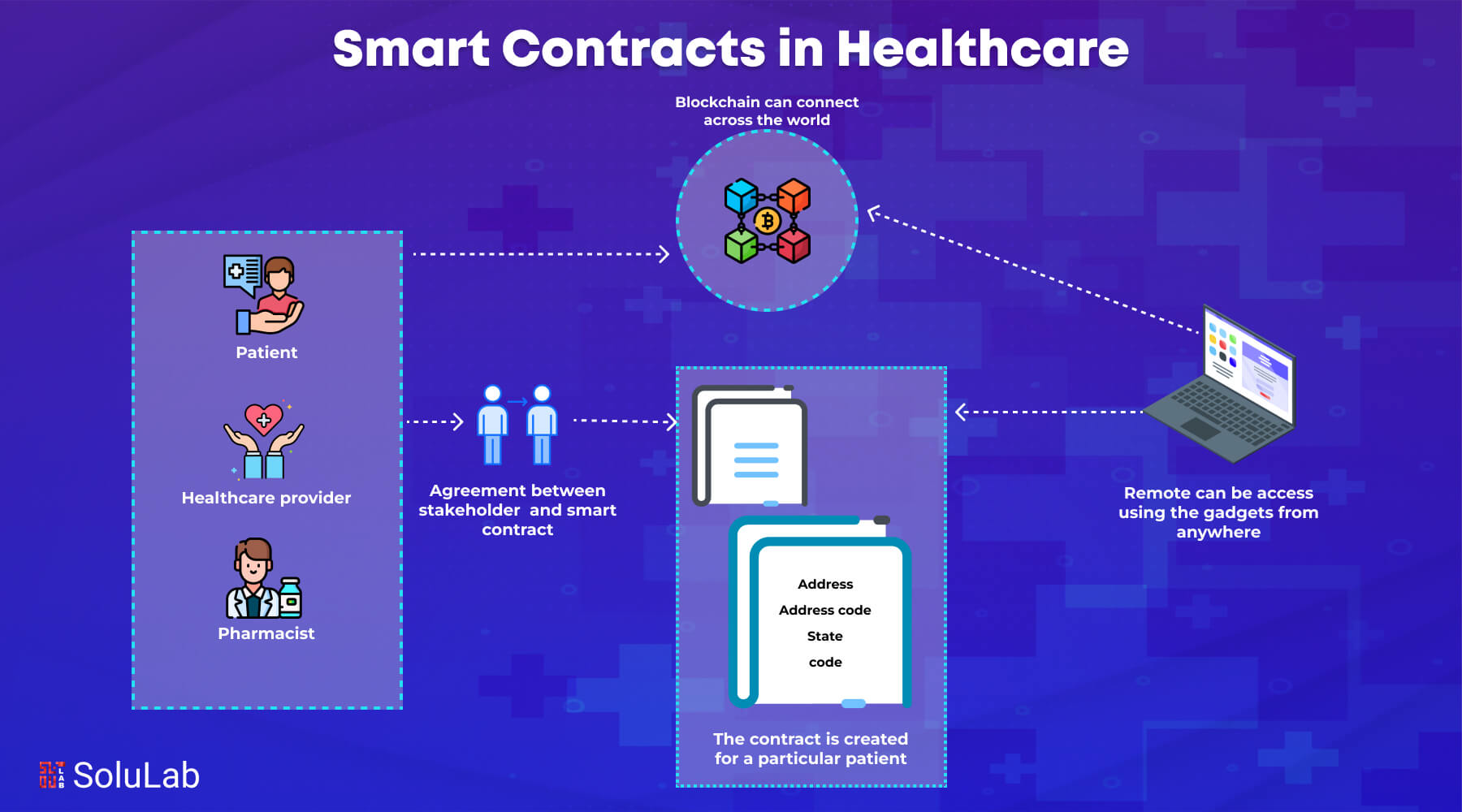
Healthcare has carried some of the same problems for decades. Smart contracts offer a fresh way at them. They can take over complicated, multi-step tasks and enforce specific conditions automatically: confirm a patient has insurance before a treatment goes ahead, say, or release medical data only to people who have the right to see it.
How Can Smart Contracts Be Used in the Healthcare Industry?
So where do they actually fit? Quite a few places, and in each one the goal is the same: faster, safer processes.
- Automated Payment Processing: Payments run on autopilot, so clinicians and staff get paid the right amount, on time, without someone chasing invoices.
- Patient Information Management: Records stay locked down on the blockchain, and only authorized medical professionals can open or update them when there’s a real need.
- Insurance Claims and Billing: A smart contract can flag overdue medical bills to insurers and push the claim forward itself, sending along exactly the patient data needed to get it paid.
- Treatment History and Safety: With patient profiles on the blockchain, doctors can see the full medical history. That means better decisions, safer patients, and less exposure to malpractice.
How to Implement Smart Contracts in Healthcare?
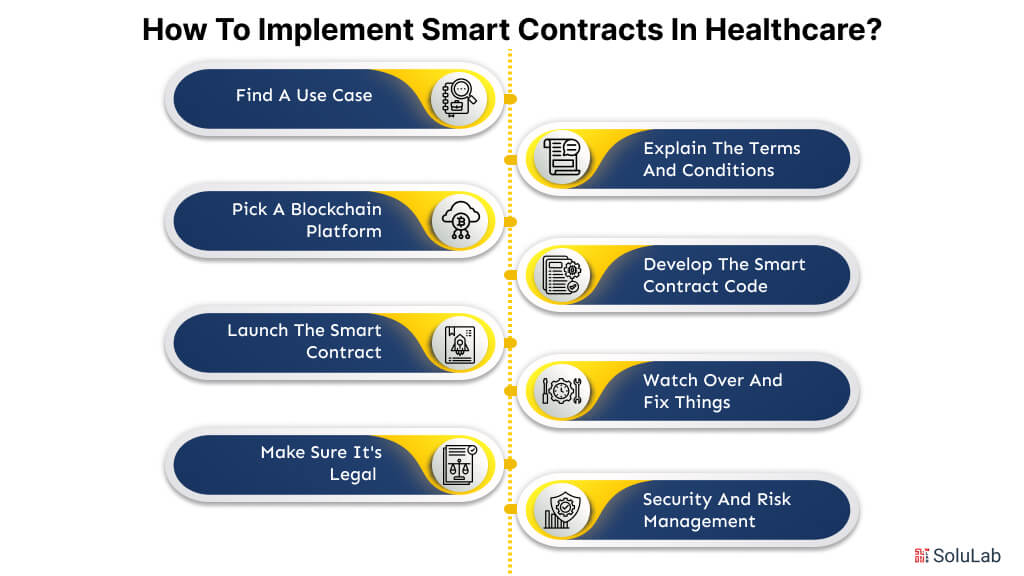
Ready to build one? Here’s the sequence we’d follow:
Find a Use Case
Start with the problem, not the technology. Smart contracts shine where the rules are clear-cut and can be followed without judgment calls. Business agreements, supply chains, property deals, even voting systems all fit that description. You’re looking for something that gets simpler once it’s automated. Many of the strongest blockchain use cases sit in exactly these areas, where automation saves time, cuts human error, and makes the whole thing more transparent.
Explain the Terms and Conditions of the Contract
With the use case settled, pin down the details. What triggers the contract? How should it behave once triggered? Who’s involved? Spell all of it out. Ambiguity is the enemy here, because the contract will do exactly what you tell it, not what you meant.
Pick a Blockchain Platform
This choice matters more than people expect. Weigh cost, how well the platform scales, its security record, and how active its community is. Ethereum, Binance Smart Chain, or another option entirely could be the right answer. Each one handles smart contract programming a little differently.
Develop the Smart Contract Code
Now the real work. You’ll usually write the contract in a blockchain-friendly language like Solidity or Vyper (for Ethereum). Not a coder? Hire smart contract developers instead. Either way, test relentlessly. Bugs and weak spots are far cheaper to find now than after launch.
Launch the Smart Contract
Once testing checks out, deploy the contract to your chosen blockchain. The code gets sent to the network and pinned to its ledger. One thing people forget: deployment usually costs money, so budget for it.
Watch Over and Fix Things
A live contract enforces its rules without you. That doesn’t mean you walk away. Check in regularly to confirm it’s behaving the way you intended, and expect to review or adjust things when circumstances shift.
Make Sure It’s Legal
The rules depend on where you operate and what the contract covers. Smart contracts can be legally binding, but “can be” isn’t “definitely is.” Get a lawyer to confirm everything holds up in your jurisdiction.
Security and Risk Management
Security isn’t optional. Blockchain transactions can’t be reversed, full stop. Run regular code audits and security tests, guard your keys carefully, and build in fail-safes for the day something goes wrong. Because eventually, something will.
Benefits of Smart Contracts in Healthcare
Public blockchains and distributed ledgers give healthcare providers new ways to run medical research and look after patient records. And because blockchain smart contracts are immutable and encrypted, they can tighten patient privacy while keeping providers within the law.
- Stability: A lot of the distributed ledger technology used in healthcare is owned by major industry players, which makes it steadier and more dependable than traditional health records. Since blockchain data can be verified and never altered, health information is there the moment you need it, and you can trust it.
- Speed: When medical knowledge moves slowly, patients pay for it. Smart contracts get data where it needs to go faster. Platforms like SAFE rely on unique health identifiers, so patient privacy is protected and the data stays valid. Providers can log information in real time, giving other providers, employers, and regulators easy access. With proof-of-stake and DAG-based ledgers, patient data updates and becomes available within seconds, and DAG lets several nodes update at once.

- Privacy: Patient confidentiality is non-negotiable. Encrypted smart contracts let providers stay compliant without slowing down. Digital signatures and decentralized identities keep private data private. Permissioned blockchains add another layer, since viewing data requires a third party’s approval. After approval, organizations can access and update patient information on these private chains fairly easily, though private blockchains do run slower than public ones.
- Timestamps: In healthcare, getting the time right really matters. Consensus timestamps from smart contracts and distributed ledgers record exactly when each event happened. Take vaccinations: an IoT-connected device can log the moment a patient gets a shot, and that entry lands on the blockchain with its timestamp, permanent and easy to look up.
- Immutable: Nobody can alter medical data held by a smart contract, and it’s simple to find, which shuts the door on a lot of fraud. Every record traces back to whoever created it, so healthcare workers can trust what they’re reading. And since changes are permanent, audits get easier, and compliance and openness hold up over time.
Future Trends and Developments in Smart Contracts
There’s a lot of headroom left, driven by advances in blockchain in healthcare. Healthcare, finance, and supply chains are all getting better because of it. A few developments we expect to see:
- Better Measures for Security and Privacy: Patient data is about as sensitive as data gets, so a great deal of effort is going into stronger security and privacy. Expect smart contracts to build in more advanced protections that keep patient information safe and keep providers in line with healthcare regulations.
- Interoperability and Integration with Healthcare Systems: A smart contract that can’t talk to existing hospital systems isn’t much use. Getting that connection right is the whole ballgame, because it’s what lets clinicians use smart contracts in their daily routine without friction.
- Integration of IoT Devices for Real-Time Data: More IoT devices means more live health data, and smart contracts will start taking it in directly. That’s a big deal for remote patient monitoring, for making sure people take their medication as prescribed, and for managing overall health.
- Personalized Healthcare Solutions: Patients will get more say over their own health data, choosing which providers can see it. From there, it gets much easier to build treatment plans around each individual and what they actually need.
- Frameworks For Rules and Following them: Regulation will have to catch up as blockchain and smart contracts spread. Healthcare-specific rules will probably evolve so that smart contract use stays orderly and fully within the law.
- Telemedicine and Remote Care: Automated billing and payments will make telemedicine run more smoothly. The result: more people able to use remote healthcare.
Who Benefits From Smart Contracts in Healthcare?
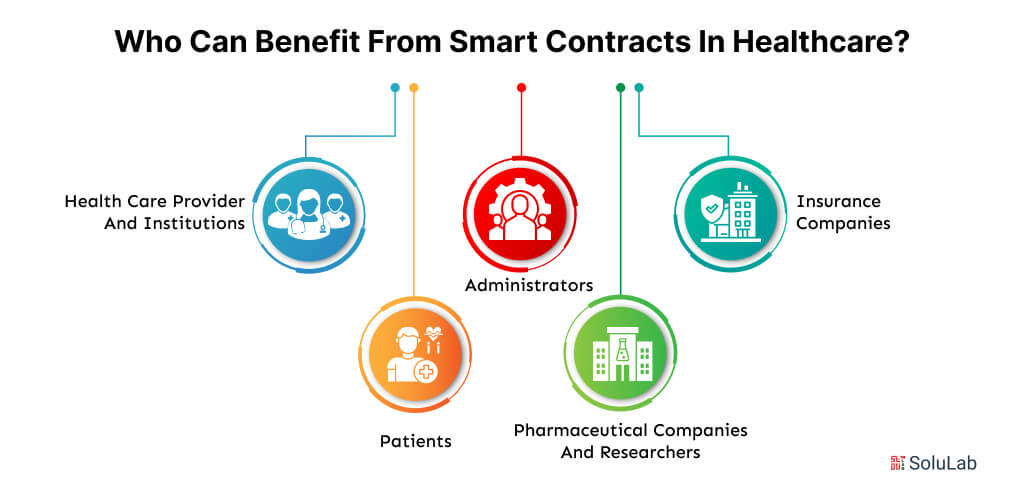
Smart contracts development is reshaping healthcare: simpler operations, more transparency, better outcomes. And the gains aren’t limited to one group. Hospitals feel it, patients feel it, insurers feel it, each in different ways. Here’s how it breaks down for the main players.
1. Healthcare Providers and Institutions
For hospitals, clinics, and the people working in them, the upside looks like this:
- Efficient Resource Allocation: Routine tasks run themselves, so staff and budget go toward patient care.
- Streamlined Insurance Processing: Claims move faster, with far less paperwork.
- Error Reduction: Patient data is handled precisely, every time.
2. Patients
Patients get smoother care and a real grip on their own health information:
- Controlled Data Sharing: Share medical details securely, only when you choose to.
- Efficient Procedures: Quicker processes mean treatment arrives when it should.
- Personalized Care: A complete history lets doctors fit the treatment plan to the person.
3. Pharmaceutical Companies and Researchers
In pharma research, smart contracts support both new work and the integrity of the data behind it:
- Accelerated Clinical Trials: Consent and data-sharing are automated, which saves weeks of admin.
- Reliable Data: Research runs on data that’s accurate and hasn’t been tampered with.
4. Insurance Companies
Insurers get more efficiency, and more trust, out of the deal:
- Fraud Prevention: Automated checks mean fewer fraudulent claims slip through.
- Faster Claims: Simpler workflows, happier customers.
5. Administrators
Admin teams spend less time on grunt work and make better calls:
- Reduced Workload: Repetitive tasks get automated, lifting a real weight off the team.
- Time Savings: Faster, accurate processes free up attention for bigger-picture goals.
Add it up and smart contracts make healthcare more efficient, more transparent, and better for patients, pointing toward a system that’s more secure and built around the people it treats.
What are the Challenges of Using Smart Contracts in Healthcare?
None of this is plug-and-play. Bringing smart contracts into healthcare runs into real obstacles, some technical, some regulatory. Solve them and you get the full benefit. Ignore them and you put patient safety, data security, and legal compliance at risk. The same concerns come up with systems like dispatch software for NEMT, where regulatory compliance, data security, and real-time coordination matter just as much for delivering safe, reliable patient services.
1. Data Privacy and Security Concerns: Health data is deeply personal, and strict regulations govern it. Smart contracts run on distributed ledgers and blockchains, which means strong encryption and tight access controls aren’t negotiable. New approaches are needed to keep patient data confidential, out of the wrong hands, and compliant with rules like HIPAA.
2. Interoperability Issues: Walk into most health systems and you’ll find a patchwork: old legacy platforms, different electronic health records (EHRs), data in a dozen formats. Getting all of that to talk is hard. Standard protocols for exchanging and interpreting data consistently are what let smart contracts work properly without corrupting accuracy along the way.
3. Legal and Regulatory Compliance: Fitting smart contracts into healthcare’s legal frameworks is tricky. An automated agreement has to deal with patient consent, data sharing, and treatment decisions, all while staying inside existing law. In practice, this is where lawyers and engineers have to sit in the same room, so contracts can keep pace with changing regulations, protect patient rights, and meet consent management standards.
4. Technological Complexity: Blockchains still wrestle with scalability, energy use, and transaction speed. Healthcare, meanwhile, needs data in real time and execution without delay. That mismatch makes integration hard. Getting past it means tuning the blockchain infrastructure and shaping smart contracts around healthcare’s time-critical demands.
5. Ethical and Moral Implications: Plenty of healthcare decisions depend on human judgment, empathy, and ethics. Automate too much with smart contracts and those things can get pushed aside. So the infrastructure and the contracts themselves have to be designed with care, fitted to healthcare’s time-sensitive needs without cutting human judgment out of the decisions that need it.
The Real-World Examples of Smart Contracts in Healthcare
The healthcare blockchain companies field is shifting, and smart contracts are helping crack some of its toughest problems while keeping things moving. Theory is one thing. Here’s what it looks like on the ground:
1. Better Access in Developing Countries: Where healthcare facilities are thin on the ground, smart contracts give secure access to patient records. Doctors, hospitals, and clinics work from current information, and the risk of records going missing drops. Care improves as a result.
2. Better Control for Patients Over their Medical Data: Platforms such as Medicalchain use smart contracts to put patients in charge of their medical data. The patient decides who sees it, and for how long. Privacy gets stronger, and control sits where it arguably always belonged.
3. Verification of prescribed Drugs: Counterfeit prescription drugs are a real threat, and smart contracts are one of the tools being used against them. They confirm a prescription is genuine and that the right drug goes out at the right dose. Fewer patients end up with the wrong medication, or a fake one.
4. Streamlined Claims Handling: Health insurers are putting smart contracts to work on claims. Once the set conditions are met, the contract kicks off the claim on its own. Less paperwork. Faster reimbursement, for customers and providers alike.
5. Controlling Patient Consent for Clinical Studies: Here, smart contracts record patient consent for clinical studies on a blockchain. Building one of these systems? Working with clinical trials lawyers helps teams turn protocol requirements into smart-contract logic that can actually be enforced, check that consent capture and withdrawal work properly, and stay HIPAA/GDPR compliant while managing IRB/ethics submissions across jurisdictions.
6. Drug Traceability: Smart contracts follow drugs through the entire supply chain, from the factory to the pharmacy counter. That’s how you know a pharmaceutical product is the real thing. Real-time tracking keeps patients safer and makes it much harder for counterfeits to get through.
7. Telemedicine Billing and Payments: For telemedicine, smart contracts handle billing and payment automatically, so providers are paid correctly and promptly. Remote care works better, and it’s easier for people far from a clinic to get seen.

Conclusion
As healthcare keeps changing, smart contracts matter more each year. They adapt well, and as security and regulation mature around them, they should make care more efficient and better for patients. Safer, faster, more centered on the person being treated: that’s the direction. Think personalized treatment, leaner clinical trials, pharmaceutical supply chains you can trust, and telemedicine that’s simple to use.
One example from our own work: SoluLab helped The Internet of Things (IoT) to build a smart continuous glucose monitoring (CGM) system for people with diabetes. The IoT-based solution streams real-time blood glucose readings to phones, tablets, and smartwatches. Getting devices to connect and transfer data reliably was the hard part. We solved it, and the app now lets caregivers monitor remotely, which gives families both convenience and control.
At SoluLab, a Smart Contract Development Company, our experts can build bots like these, put the right strategies in place, and help you get clear on your crypto trading goals. Want to work together? Get in touch today.
FAQs
Shipra Garg is a tech-focused content strategist and copywriter specializing in Web3, blockchain, and artificial intelligence. She has worked with startups and enterprise teams to craft high-conversion content that bridges deep tech with business impact. Her work translates complex innovations into clear, credible, and engaging narratives that drive growth and build trust in emerging tech markets.