



Step One
Scope and estimate in 48 hours.
Features, tenancy model, integrations, timeline, and a fixed price, in writing.

SaaS web development is building a browser-based application that many customers subscribe to, each in a separate, secure account. A SaaS web app needs four things an ordinary website doesn't: multi-tenant data separation, subscription billing, role-based access with single sign-on, and releases that ship without downtime. SoluLab builds all four into the first release.












SaaS web development is building a web application that runs on the provider's servers and is sold as a subscription, where every customer signs in through a browser and sees only their own data.
A SaaS web app differs from an ordinary website or a single-company tool in three ways. It serves many customers from one codebase, so tenant data must stay separated. It charges on a recurring basis, so plans, trials, and upgrades are part of the product. And it changes constantly, so releases have to ship without downtime for every account at once.
For the business side of SaaS, including consulting, migration, and budget ranges, see our SaaS development company page.
Our SaaS web development services cover the parts of a web application that decide whether it can grow: tenancy, billing, access, and the screens customers use every day.
We take a SaaS idea from scope to a launched web app, usually starting with an MVP. Our MVP development for startups page explains how we scope the first release.

We design how customer data is separated, whether by a tenant ID on shared tables, a schema per customer, or a database per customer for regulated buyers. The choice affects cost, security reviews, and how easily you can sell to enterprises.
Trials, tiers, seat-based or usage-based pricing, invoices, and upgrades, built on billing platforms such as Stripe, Chargebee, or Paddle rather than custom code.
Email and social sign-in for small customers, SAML and OpenID Connect single sign-on for enterprise accounts, and role-based permissions inside each workspace.
Customer dashboards, an internal admin console for your support team, and product analytics that show which features accounts actually use.

We rebuild older on-premise or desktop software as a browser-based SaaS product, moving customers across in stages so nobody is left on a broken version.
A SaaS web application has four layers: the customer's browser, the web app, an API that checks which customer every request belongs to, and the database. Billing, sign-in, and analytics run as shared services beside them. The API is where tenant separation is enforced, so one customer can never reach another's data.
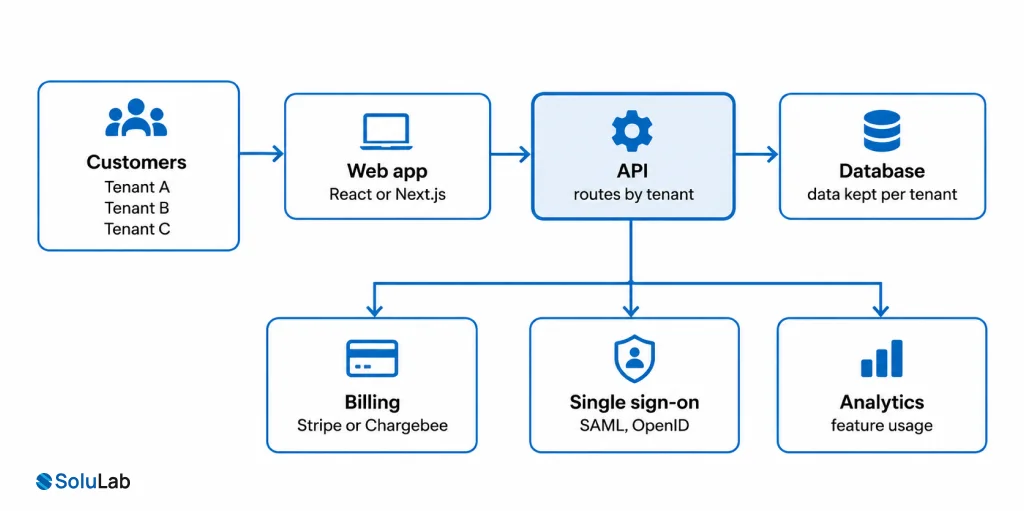
The API checks which customer each request belongs to before it touches data, billing, or sign-in
SaaS web application development at SoluLab runs in five steps, with the price fixed after the first.
Features, tenancy model, integrations, timeline, and a fixed price, in writing.

User roles, plans and pricing logic, data model, and the decision on how tenants are separated.

A clickable prototype of the core workflow, the billing flow, and the admin console.

Each sprint ends with a demo on a staging link you can open.

Releases that don't take accounts offline, with monitoring and error alerts from day one.

Get a written scope and a fixed price within 48 hours.
SoluLab builds SaaS web applications on widely supported technology: React or Next.js for the front end, p Node.js, Python, .NET, or Java for the backend, PostgreSQL for data, and AWS, Azure, or Google Cloud for hosting. Billing, sign-in, and monitoring use proven platforms rather phan custom code.
 React
 Next.js
 Angular
 Vue.js
 Node.js
 Python (Django, FastAPI)
 .NET
 Java (Spring Boot)
 PostgreSQL
 MySQL
 MongoDB
 Redis
 AWS
 Microsoft Azure
 Google Cloud
 Stripe
 Chargebee
 Paddle
 Datadog
 Grafana
 Prometheus
 Sentry
 Docker
 Kubernetes
 Terraform
 GitHub Actions
 GitLab CI
 OAuth 2.0
 OpenID Connect
 SAML single sign-on
 Auth0
 AWS Cognito
 Keycloak
SoluLab builds SaaS web applications for fintech, healthcare, insurance, education, logistics, marketing technology, HR, and real estate. These industries share three needs that SaaS architecture answers: subscriptions instead of licences, many users per customer account, and strict data separation that customers and regulators can check before they buy.


Lending, payments, and wealth platforms with audit trails, KYC integrations, and role-based approvals, like the lending platform shown below.


Patient portals and care management SaaS with access logs, consent controls, and hosting set up for health data rules.


Policy, claims, and broker portals with multi-level approvals and secure document handling.


Learning and school management platforms for teachers, parents, and administrators, like SchoolUp.

Shipment tracking, documentation, and customs workflows connected to ERP and warehouse systems, like Morpheus.Network.


Campaign, analytics, and reporting platforms connected to Google Ads and Meta Ads, like CyberHulk.

Hiring, onboarding, and payroll SaaS with a separate workspace for every client company and enterprise sign-on.


Property management and listing platforms with separate portals for owners, tenants, and agents.
SoluLab has built SaaS platforms that handle the hardest parts of the model. Some major ones are:
 01
Supply Chain
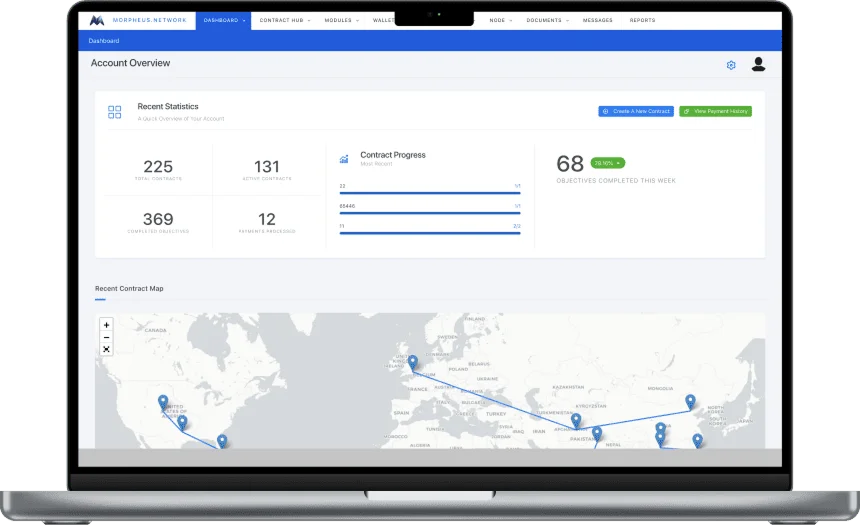
Morpheus.Network is a blockchain-powered SaaS platform for logistics businesses. We built smart contracts that automate payments, customs compliance, and document checks, with integrations to ERP, warehouse, and RFID systems, and payment settlement through the SWIFT network.
 02
Fintech
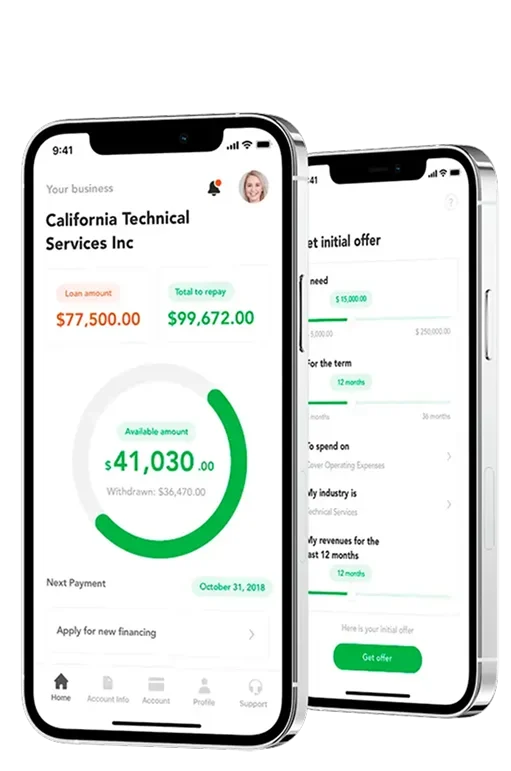
A fintech startup replaced manual small-business lending with a digital platform. Alongside the customer app, we built the web admin module and back office that run the loan portfolio, scoring settings, and reporting.
 03
Education
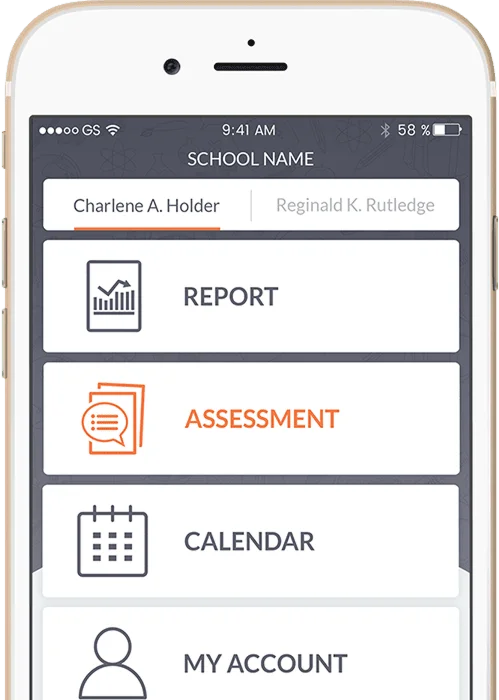
SchoolUp connects schools, teachers, and parents. Parents track progress and school bus locations and pay fees online, while teachers share lessons, assignments, and report cards.
SaaS web development at SoluLab costs from $10,000 for a micro SaaS to $500,000 or more for an enterprise platform. A micro SaaS takes 4 to 8 weeks, a SaaS MVP 8 to 16 weeks, and a mid-complexity product 4 to 6 months. Your exact price comes from the 48-hour scope.
Need extra hands on an existing product instead? Engineers join your team from $25 to $49 an hour.
The number of integrations, the tenancy model, compliance needs such as HIPAA or SOC 2, and how many user roles the product supports.

for your product instead of a range? Get a written scope and a fixed-price estimate within 48 hours.
Companies choose SoluLab for SaaS web development because the price is fixed before the build, tenancy, billing, and single sign-on are designed into the first release, and the same team can add AI features or on-chain records later.

A written scope, timeline, and one price before you commit, so the budget is settled before the build starts.

Multi-tenancy, subscription billing, single sign-on, and audit logs are designed in, so security reviews from larger buyers don't stall your sales.
We pick shared tables, schema per customer, or database per customer in discovery, which avoids a costly migration of every account later.
Each sprint ends with a demo on a staging link you can open, so progress is visible, not reported.

Older on-premise or desktop products move to SaaS in stages, with existing customers kept on a working version throughout.
When your SaaS needs AI features or on-chain records, no second vendor is needed.

"Chintan leads SoluLab's product engineering teams across AI, blockchain, IoT, and enterprise software, after about a decade at Goldman Sachs, where he was a Vice President."
SoluLab helped us turn our vision for secure, file-less document management into a practical platform. Their understanding of blockchain technology and focus on building a reliable, user-friendly solution made the development process much easier. We now have a stronger foundation for issuing and verifying documents while reducing the risks associated with traditional files.

Working with the SoluLab team completely changed how we handle marketing. CyberHulk turned from a simple idea into a powerful AI-driven marketing platform that runs our entire process. Everything works smoothly, and it feels like having a 24/7 AI marketing team that constantly drives growth, improves conversions, and saves time.

SoluLab didn't approach AI as a feature; it became part of the product experience. Their team helped translate our vision into an AI-powered platform that feels intelligent while remaining intuitive for users. The combination of technical execution and genuine understanding of wellness made a meaningful difference.

In web development, SaaS means a web application sold as a subscription rather than installed by each customer. It runs on the provider's servers, customers sign in through a browser, and each customer's data is kept separate. Gmail, Slack, and Salesforce are familiar examples.
A website mainly presents information. A SaaS web application lets many paying customers do work inside their own secure accounts. That adds requirements a website doesn't have: tenant data separation, subscription billing, user roles, single sign-on, and releases that reach every account without downtime.
SoluLab publishes ranges of $10,000 to $25,000 for a micro SaaS, $25,000 to $50,000 for a SaaS MVP, and $50,000 to $150,000 for a mid-complexity product. Your exact price comes from the 48-hour scope. Our guide to the cost to build a SaaS product explains the drivers.
A micro SaaS takes about 4 to 8 weeks, a SaaS MVP about 8 to 16 weeks, and a mid-complexity product about 4 to 6 months, based on SoluLab's published ranges. Integrations, compliance needs, and how quickly decisions are made on your side affect where you land.
We typically use React or Next.js for the web front end, Node.js or Python for the backend, and PostgreSQL for data, hosted on AWS, Azure, or Google Cloud. Billing runs on Stripe, Chargebee, or Paddle. The final choice depends on your integrations and future team.
Multi-tenant architecture lets one application serve many customers while keeping each customer's data separate. Data can be split by a tenant ID in shared tables, a schema per customer, or a database per customer. Stricter separation costs more but makes enterprise and regulated sales easier.
Yes. We rebuild the product as a browser-based application, design the tenancy and billing model, and move customers across in stages. Most teams keep the old version running for existing customers until the SaaS version covers the features they rely on.
Security starts with tenant isolation in the data model, then adds encrypted connections and storage, role-based access, single sign-on for enterprise accounts, audit logs, and automated security testing in every release. Hosting and compliance settings are chosen to match the industries you sell to.
You should own the code, designs, and cloud accounts, and the contract should say so. Ask for repository access from the first sprint so you are never dependent on the vendor to see your own product.
Yes. Common additions are AI assistants inside the app, document processing, smart search, and usage-based recommendations. CyberHulk, a SaaS platform we built, uses AI for campaign suggestions and reporting. Our AI development team handles the model side.