Talk to an Expert
Get in Touch

Top Custom Software Development Companies in 2026

Companies are no longer looking for one-size-fits-all solutions; they need software built around their processes, customers, and long-term growth goals. From AI-powered platforms and cloud-native applications to secure enterprise systems, the demand for reliable custom software partners is higher than ever.

In fact, the global custom software development market is expected to reach USD 386,012 million by 2034, expanding at a CAGR of 23.03%. So, choosing the right development company can directly impact project success, scalability, and return on investment. 

In this blog, we’ve curated a list of the top custom software development companies in 2026 based on key business and technical criteria.

How Did We Compile the List of Top Custom Software Development Companies?

To ensure accuracy and business relevance, we followed a structured evaluation process combining market research, technical expertise, and client-focused performance metrics to shortlist top custom software development service providers.

1. Technical Expertise: We assessed companies based on their technology stack, engineering capabilities, and ability to deliver scalable, secure, and future-ready custom software solutions for diverse business needs.

2. Industry Experience: Firms with proven experience across multiple industries were prioritized, ensuring they understand complex business workflows, compliance requirements, and domain-specific challenges.

3. Client Reviews and Testimonials: We analyzed verified client feedback to measure satisfaction levels, communication quality, delivery timelines, and long-term partnership reliability.

4. Project Portfolio: A strong portfolio showcasing real-world projects, measurable outcomes, and innovative problem-solving approaches helped identify companies with consistent delivery excellence.

5. Business Scalability and Support: We evaluated each company’s ability to scale teams, provide post-launch support, and maintain software performance as business requirements evolve.

Top Custom Software Development Companies in 2026

The comparison table below highlights the key differences between leading custom software development companies in 2026, enabling businesses to quickly evaluate expertise, scale, and suitability for their specific project needs.

CompanyHQ / Primary PresenceKey Services FocusTypical Client TypeNotable Strengths (positioning idea)
SoluLabGlobal, strong India/USCustom software, blockchain, Web3, AI, mobile & web apps ​Startups, SMEs, enterprises, Fortune 500 ​Deep expertise in emerging tech (Web3, AI) and product ideation support ​
LuxoftGlobal (origin: Switzerland)Enterprise custom software, digital engineering, automotive, finance solutions ​Large enterprises, regulated industriesStrong domain know‑how and large engineering teams for complex systems ​
AvengaEurope‑led, globalEnd‑to‑end custom software, CX platforms, cloud & data solutions ​Mid‑market and enterprisesBlends consulting and engineering; good fit for digital transformation programs ​
ChetuUS‑based, global deliveryCustom software, staff augmentation, industry‑specific solutions ​SMEs and large enterprisesVery broad tech stack coverage and scalable dedicated teams ​
VentionNorth America & EuropeCustom product development, dedicated engineering teams, SaaS builds ​Startups and high‑growth scaleupsStrong for long‑term, embedded product teams and startup‑style velocity ​
RadixwebIndia‑centric, globalCustom software, legacy modernization, cloud, DevOps ​SMEs, ISVs, mid‑marketCost‑effective delivery with focus on reliability and long‑term support ​
ScienceSoftEastern Europe/US presenceCustom software, data & analytics, cybersecurity, QA ​SMBs to enterprisesMature processes and broad tech portfolio across industries ​
Q3 TechnologiesIndia/USCustom software, enterprise apps, product engineering ​Mid‑market enterprisesStrong record in full‑cycle development and global delivery centers ​
SimformUS & IndiaCustom software, cloud‑native apps, AI/ML, DevOps, data engineering ​Digital‑first SMEs and enterprisesRecognized in rankings and strong at modern cloud and AI projects ​
TuvocIndia‑led (boutique)Custom web & mobile apps, product engineering, staff augmentation ​Startups and SMBsFlexible engagement models and focus on rapid, cost‑efficient delivery

Use this comparison as a starting point to shortlist partners that align with your technical requirements, industry focus, and long-term growth goals before making a final custom software development decision.

SoluLab

1. SoluLab

$25 – $49 / hr

200 – 249

2014

Los Angeles, CA, USA

Disney, Mercedes Benz, Goldman Sachs

SoluLab is the top Web3 development company that helps entrepreneurs and established businesses build effective solutions. The company has 10 years of industrial experience across AI, blockchain, gaming, and many more sectors.

Their focus extends to decentralized applications, platforms, NFTs, multi-chain solutions, and wallet creation. If you are looking for a reliable partner for Web3 development, SoluLab is one of the top options.

2. Luxoft

$100 – $149 / hr

1000+

2000

Switzerland

Luxoft is a global custom software development company known for delivering complex, enterprise-grade digital solutions. Luxoft offers end-to-end custom software services, including consulting, development, integration, and modernization.

Its delivery model is flexible, supporting agile, dedicated teams and long-term partnerships. With strong enterprise trust, Luxoft follows strict compliance standards, including ISO certifications, GDPR, and SOC 2.

3. Avenga

$50 – $99 / hr

1000+

2019

Germany

Avenga is a custom software development firm delivering scalable, enterprise-grade solutions using modern technologies and frameworks. The company offers end-to-end custom software services, following agile delivery and flexible engagement models.

Avenga serves industries like fintech, healthcare, and manufacturing, with a strong focus on security, compliance, and quality. Backed by trusted partnerships and certifications such as ISO and GDPR, Avenga is a reliable choice for long-term digital transformation initiatives.

Chetu

4. Chetu

$25 – $49 / hr

2000+

2000

USA

Chetu is a custom software development service provider known for delivering tailored, scalable solutions across complex business environments. The company works with modern technologies and frameworks to build enterprise-grade applications aligned with client requirements.

Chetu offers end-to-end custom software services, following flexible engagement models that support long-term partnerships. With strong industry coverage, certified processes, and compliance with global standards.

Vention

5. Vention

$50 – $99 / hr

1,000 – 9,999

2002

NY, USA

DirectID, guide:human

Vention is a custom software development company known for building scalable, high-performance solutions using modern technologies and proven frameworks. The company offers custom software services, from product engineering to ongoing support.

Vention follows flexible engagement models, including dedicated teams and agile delivery, ensuring smooth collaboration. With compliance standards like ISO and GDPR, Vention serves industries such as fintech, healthcare, SaaS, and eCommerce.

6. Radixweb

$25 – $50 / hr

600+

2000

India

Radixweb is a custom software development firm known for delivering scalable, secure, and business-driven digital solutions. The company works across modern technologies and frameworks.

Radixweb offers end-to-end custom software services, following flexible engagement models and agile delivery practices. With strong industry experience, global client trust. Radixweb serves businesses across multiple industries with reliability and consistency.

ScienceSoft

7. ScienceSoft

$50 – $99 / hr

700+

1989

McKinney, Texas, United States

ScienceSoft is a custom software development company known for delivering scalable, secure, and business-centric digital solutions. The company works with modern technologies and frameworks. It offers end-to-end custom software services, including development, modernization, and integration.

ScienceSoft serves industries like healthcare, finance, retail, and manufacturing, with strong trust and credibility backed by long-term client partnerships. Its commitment to quality and security is reinforced through certifications and compliance with standards like ISO, GDPR, and SOC 2.

Q3 Technologies

8. Q3 Technologies

$20 – $49 / hr

500+

1996

USA

Q3 Technologies is a custom software development service provider delivering scalable, high-performance digital solutions for modern enterprises. The company specializes in advanced technologies and frameworks to build secure, business-ready applications tailored to specific needs.

Q3 Technologies offers end-to-end custom software services using flexible engagement models. Trusted by enterprises across industries, the firm maintains strong credibility through global certifications and compliance standards, including ISO and GDPR.

Simform

9. Simform

$25 – $49 / hr

200 – 999

2010

FL, USA

Tudu, Equilo

Simform is a custom software development company known for building scalable, high-performance digital products for global enterprises. The company leverages modern technologies and proven frameworks to deliver tailored software solutions.

Simform provides custom software services, following agile and flexible engagement models to ensure faster delivery and transparency. Trusted by startups and large organizations alike, Simform serves multiple industries while adhering to global certifications and compliance standards such as ISO, GDPR, and SOC 2.

10. Tuvoc

$30 – $49 / hr

200+

2018

India

Simform is a custom software development company known for building scalable, high-performance digital products for global enterprises. The company leverages modern technologies and proven frameworks to deliver tailored software solutions.

Simform provides custom software services, following agile and flexible engagement models to ensure faster delivery and transparency. Trusted by startups and large organizations alike, Simform serves multiple industries while adhering to global certifications and compliance standards such as ISO, GDPR, and SOC 2.

Conclusion

Choosing the right custom software development partner in 2026 is a strategic decision that directly impacts business growth, scalability, and digital resilience. Whether you’re modernizing legacy systems, building enterprise-grade platforms, or scaling digital products, the right partner can increase outcomes while reducing risk. 

SoluLab, a custom software development company, helps businesses design, build, and scale tailored solutions that align with your goals. We recently delivered a software for a promising US healthcare company that provides staff with a unified system for making, accessing, and managing patients’ health status reports.

If you also wish to have software for your business operations, book a free discovery call today!

FAQs

1. What industries benefit most from custom software development?

Industries like healthcare, fintech, logistics, retail, manufacturing, education, and SaaS gain the most value from tailored software solutions.

2. How much does custom software development cost in 2026?

Costs vary based on project complexity, features, team size, and technology stack, typically ranging from hourly pricing to fixed-cost project models.

3. How long does it take to build custom software?

Development timelines can range from a few months to over a year, depending on project scope, integrations, and testing requirements.

4. What technologies do top custom software development companies use?

Leading firms work with modern technologies like cloud computing, AI, blockchain, IoT, web and mobile frameworks, and scalable backend architectures.

5. Can custom software integrate with existing business systems?

Most custom software solutions are designed to integrate seamlessly with CRMs, ERPs, payment systems, and other third-party tools.

How Generative AI is Shaping the Future of AR and VR Experiences?

How Generative AI is Shaping the Future of AR and VR Experiences?

Augmented Reality (AR) and Virtual Reality (VR) have witnessed significant advancements over the years, transforming how we interact with digital content and the physical world. These immersive technologies have applications in various fields, from gaming and entertainment to healthcare and education. However, the true potential of AR and VR lies in their ability to deliver lifelike, engaging experiences, and this is where Generative AI comes into play.

Generative AI, a subset of Artificial Intelligence, has been instrumental in pushing the boundaries of AR and VR by enabling the creation of highly realistic, interactive, and adaptive digital content. In this blog, we’ll explore how Generative AI is shaping the future of AR and VR experiences and its exciting possibilities.

The Role of Generative AI in Augmented Reality (AR) and Virtual Reality (VR) Learning

The Role of Generative AI in Augmented Reality (AR) and Virtual Reality (VR) Learning

Before delving into the exciting possibilities of augmented reality (AR) and virtual reality (VR) in education, it’s essential to recognize the pivotal role that Generative Artificial Intelligence (AI) plays in shaping the future of learning within these immersive realms.

At its core, Generative AI harnesses advanced neural networks to create dynamic content tailored to the individual needs and preferences of students. In the context of AR and VR, this technology acts as a virtual tutor, available 24/7, capable of adapting to each student’s unique learning journey within these interactive environments.

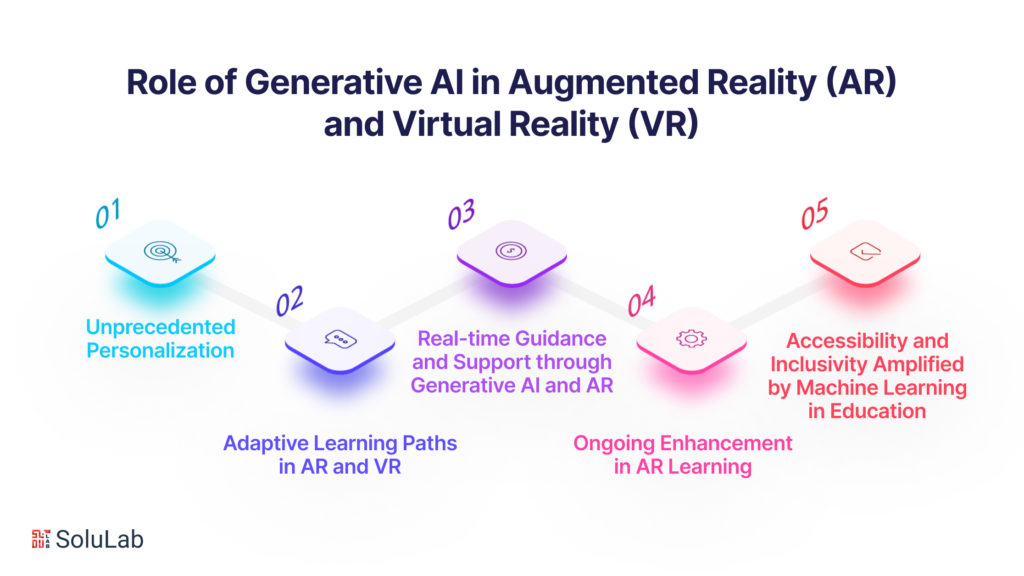
  • Unprecedented Personalization

Generative AI trends take personalized learning to new heights, surpassing the limitations of traditional teaching methods. The one-size-fits-all approach of textbooks and standardized curricula falls short of meeting the diverse learning needs of students.

In AR and VR, Generative AI ensures that learning materials are dynamically customized in real time. This means that students receive content aligned with their current knowledge levels and learning preferences, promoting more effective and engaging learning experiences.

Imagine a student immersed in an AR mathematics lesson. Generative AI, driven by machine learning algorithms, continuously evaluates the student’s progress within the virtual environment. If the AI detects areas of struggle, it generates additional practice problems or offers alternative explanations until the student comprehends the concept. Conversely, if the student is advancing rapidly, the AI can introduce more advanced topics or challenges to maintain their engagement and motivation.

  • Adaptive Learning Paths in AR and VR

Generative AI empowers educators to implement adaptive learning paths within AR and VR experiences. It can analyze students’ responses to AR/VR quizzes, assignments, and interactions with virtual learning materials to create personalized educational journeys. This approach ensures that students receive the appropriate level of challenge and support, thereby preventing boredom or frustration within these immersive environments.

For instance, consider an AR or VR language learning application enriched by Generative AI. The system can assess a student’s vocabulary and grammar proficiency within the virtual space. If a student excels in vocabulary but struggles with grammar, the AI may recommend tailored exercises and resources to address the grammar deficiency. As the student progresses, the AI dynamically adjusts the difficulty level, ensuring a learning experience that remains engaging and beneficial.

  • Real-time Guidance and Support through Generative AI and AR

Generative AI not only delivers tailor-made content but also provides immediate feedback and assistance within augmented reality (AR) environments. This means that students no longer have to wait for a teacher’s response or corrections; they receive real-time guidance. This feature not only accelerates the learning process but also bolsters students’ confidence as they can promptly correct errors and reinforce their understanding.

In a science class, for example, a student might be conducting a virtual experiment in an AR setting. Generative AI closely observes the student’s actions, identifying any misconceptions or errors in the experiment. Almost instantly, the AI offers feedback and suggests necessary adjustments. This iterative process ensures that students learn through their mistakes, a potent educational tool made possible by Generative AI and AR.

  • Ongoing Enhancement in AR Learning

Generative AI and Augmented Reality don’t limit themselves to customizing content; they also actively improve the teaching materials themselves. Over time, as it gathers data on how students interact with various learning resources in AR, it can optimize those resources for maximum educational effectiveness.

Imagine an online history course enriched by Generative AI within an AR framework. As students engage with the course materials, which might include textbooks, videos, and interactive timelines, the AI continuously monitors their preferences. If students exhibit a preference for video content to learn about historical events, the AI could generate more video-based modules. Similarly, if students respond positively to interactive timelines, the AI can create additional interactive content to reinforce their understanding. This dynamic optimization of AR learning materials by Generative AI ensures that the educational experience remains engaging and effective.

  • Accessibility and Inclusivity Amplified by Machine Learning in Education

One of the most promising facets of Machine Learning in education is its capacity to render learning more accessible and inclusive. This technology, driven by Machine Learning algorithms, proves to be a game-changer for students with varying learning needs, including those with disabilities, by accommodating their requirements. In effect, this fosters an all-encompassing learning environment where every student can not only participate but also excel.

Consider, for instance, a visually impaired student engaged in the study of literature. Thanks to Machine Learning, educational materials can be transformed to meet the specific needs of this student. Machine Learning algorithms can convert text into audio, providing the student with the option to listen to literary works. Moreover, the technology can offer detailed audio descriptions of visual elements within these literary works, enriching the student’s understanding of the content.

In tandem, Machine Learning can adjust the reading pace to align with the student’s preferences, ensuring comprehension without any undue haste. Essentially, Machine Learning is revolutionizing the entire educational landscape, transforming learning into a highly adaptive, personalized, and inclusive experience. This empowerment extends to both students and educators, enabling them to embark on educational journeys that are uniquely tailored to individual needs and aspirations. In doing so, Machine Learning paves the way for a more equitable and effective education system that caters to the diverse needs of every learner.

Related: Role AI in Transforming Education Industry

Defining Augmented Reality and Virtual Reality

Virtual Reality (VR) refers to a computer-generated, three-dimensional environment that a person can explore and interact with. When engaged in VR, an individual becomes an integral part of this virtual world, fully immersed in the computer-generated environment. Within this space, the person can manipulate objects and execute actions that influence the happenings within the virtual environment. VR technology primarily relies on devices such as headsets or goggles to create this immersive experience.

Conversely, Augmented Reality (AR) is an enhanced version of reality where a person’s direct or indirect view of the real physical world is enriched by the addition of computer-generated images. These digital elements are superimposed over the user’s perception of the real world, effectively enhancing their current reality. In simpler terms, AR users observe digital layers of information overlaid on real-world images, enhancing their overall perception of reality.

CTA1

AR technology comes in various forms:

  • Location-based AR: This system delivers supplementary information to users based on their geographic location, which holds immense potential, particularly in industries such as automotive and transportation.
  • Projection-based AR: In this instance, AR software projects light onto a physical object, creating an interactive interface within the real-time environment.
  • Superimposition-based AR: This form of AR permits users to either entirely or partially replace the actual image with new elements, thus augmenting their perspective. Superimposition-based AR is well-suited for applications in the fashion industry, architecture, and design.

Real-life Generative AI Use Cases in Enhancing Learning Experiences

Real-life Generative AI Use Cases in Enhancing Learning Experiences

The value of Generative AI in enhancing the learning experience becomes clearer when illustrated through concrete examples. These real-life Generative AI use cases provide insights into how these new technologies can aid educators in delivering knowledge more effectively and engagingly.

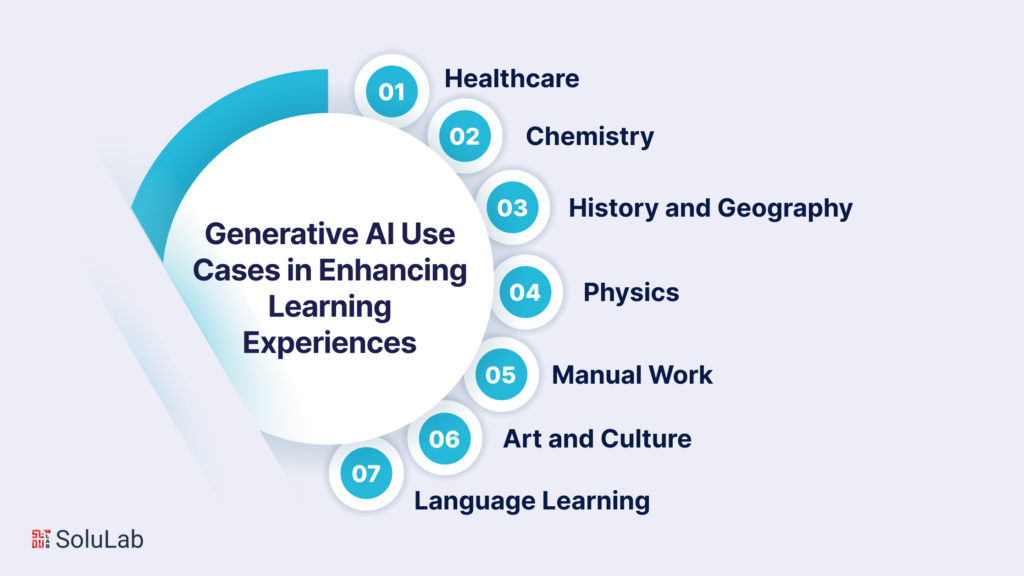
1. Healthcare: Traditionally, learning about healthcare necessitated real-life apprenticeships in hospitals. However, with the advent of Generative AI in healthcare education, students can engage in virtual surgeries and medical procedures, gaining valuable experience without any risk to patients. This makes healthcare learning safer and more efficient.

2. Chemistry: Teaching complex concepts in chemistry can be challenging. Generative AI introduces a new approach where students can perform experiments, mix substances, and gain a hands-on understanding of chemistry. This not only enhances safety but also reduces costs as schools no longer need to purchase various chemical substances for laboratory experiments.

3. History and Geography: The rich narratives of ancient civilizations can be daunting to students. Generative AI can bring history and geography to life through augmented and virtual reality. Virtual field trips transport students to distant lands and historical eras in a matter of minutes, making learning engaging and cost-effective.

4. Physics: Teaching classical mechanics and scientific theories can be dry and theoretical. With Generative AI, students can immerse themselves in virtual environments where they can put theory into practice. Whether it’s exploring the cosmos or experiencing interstellar journeys, Generative AI makes complex subjects more accessible.

5. Manual Work: Many vocational fields involve heavy machinery and tools, making hands-on training challenging in a traditional classroom. Generative AI, particularly in VR, enables students to safely engage in activities like driving trucks, conducting construction tasks, or simulating high-risk professions such as firefighting and coast guard operations.

6. Art and Culture: Generative AI, specifically superimposition-based AR, can be used to create engaging art and culture learning experiences. With AR, students can interact with famous artists’ styles and learn about artistic history. AI and VR allows them to attend cultural events and even travel back in time to witness historical performances.

Related: Generative AI Art

7. Language Learning: The best way to learn a new language is through immersion, often requiring travel. Generative AI can change this by offering virtual trips to foreign countries, enabling language learners to practice with native speakers and explore local cultures.

It’s important to note that the applications of Generative AI in education extend far beyond these seven examples. Furthermore, the potential for creating virtual classrooms where students from around the world can access top-tier educators remains an exciting prospect, although it is still evolving. These use cases illustrate the transformative potential of leveraging Generative AI in making learning more immersive, engaging, and accessible across various fields of study.

How Generative AI Enhances Realism in AR and VR Environments?

Generative Artificial Intelligence (AI) is revolutionizing Augmented Reality (AR) and Virtual Reality (VR) by significantly enhancing the realism of the environments experienced within these immersive technologies. Through the clever use of Generative AI, AR and VR experiences have become more convincing, engaging, and lifelike than ever before.

Generative AI, particularly through Generative Adversarial Networks (GANs), plays a pivotal role in creating hyper-realistic surroundings. GANs consist of two neural networks – a generator and a discriminator – that work in tandem to produce lifelike content. The generator creates synthetic data, such as images or 3D models, while the discriminator evaluates this content for authenticity. Through repeated iterations and fine-tuning, GANs can generate images and environments that are almost indistinguishable from reality.

In AR, this technology ensures that digital elements seamlessly blend with the physical world. For example, AR apps can superimpose virtual furniture into your living room, appearing so realistic that you might forget it’s not actually there.

In VR, Generative AI facilitates the creation of immersive, lifelike worlds. Whether exploring a historical era, visiting a far-off planet, or undergoing surgical training, AI and VR environments feel incredibly real, thanks to AI’s ability to generate detailed textures, landscapes, and interactive elements.

Ultimately, Generative AI is the magic wand that transforms AI and VR from mere technological novelties into powerful tools that offer users experiences that feel, look, and interact with the world just like reality. This not only enriches entertainment and gaming but also holds significant promise in domains such as education, training, and design.

The Role of AR and VR in Training and Simulation

The Role of AR and VR in Training and Simulation 

Augmented Reality (AR) and Virtual Reality (VR) have emerged as transformative tools in the realm of training and simulation. These immersive technologies offer a unique and highly effective way to prepare individuals for various real-world scenarios, both in professional and educational contexts.

In training and simulation, AR and VR excel in several key ways:

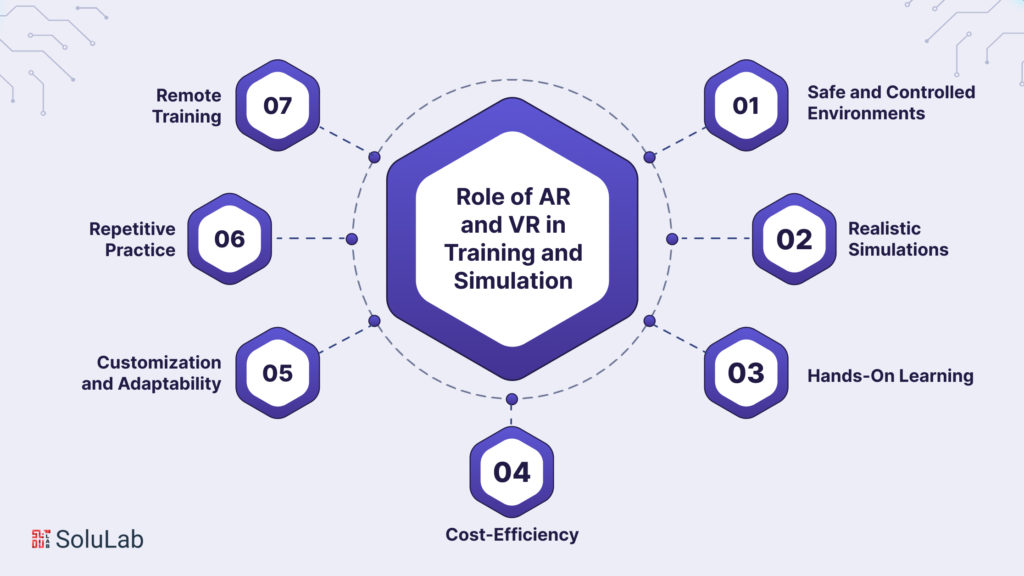
  • Safe and Controlled Environments: AR and VR provide controlled, safe, and repeatable environments for training. Professionals in fields like medicine, aviation, and the military can rehearse complex procedures and emergency scenarios without real-world risks.
  • Realistic Simulations: VR, in particular, offers incredibly realistic simulations. Trainees can immerse themselves in highly detailed virtual environments that mimic real-world settings, complete with interactive elements. This level of realism enhances muscle memory and helps individuals develop practical skills.
  • Hands-On Learning: Both AR and VR enable hands-on learning. Trainees can manipulate virtual objects, perform tasks, and interact with simulated elements, making the learning experience more engaging and effective.
  • Cost-Efficiency: AR and VR reduce the need for physical resources, equipment, and facilities, saving costs associated with real-world training. This is especially valuable in industries with expensive or limited resources.

Related: How Generative AI is Revolutionizing Art?

  • Customization and Adaptability: AR and VR simulations can be customized to suit specific training needs. Training programs can be adapted to various skill levels and learning speeds, allowing for a more personalized training experience.
  • Repetitive Practice: Trainees can practice procedures as many times as needed until they achieve proficiency, which is particularly valuable in industries where repetition is critical, such as surgery or military exercises.
  • Remote Training: AR and VR technologies enable remote training and collaboration, breaking down geographical barriers. Experts from around the world can guide and assess trainees, making it easier to access specialized knowledge and instruction.

In brief, AR and VR have revolutionized training and simulation by offering highly realistic, safe, and cost-effective learning environments. These immersive technologies not only accelerate skill acquisition but also provide a flexible and adaptable platform for individuals to become experts in their respective fields.

CTA2

Concluding Remarks

The integration of generative AI in virtual reality and augmented reality is propelling these immersive technologies into the forefront of the digital era. The dynamic capabilities of Generative AI have ushered in a new era of hyper-realism, personalization, and interactivity within AR and VR experiences. It has rendered what was once considered the stuff of science fiction into a tangible, transformative force for a multitude of industries.

As we look to the future, the horizon for AR and VR powered by Generative AI is brimming with possibilities. These technologies are poised to redefine education, enabling personalized and engaging learning journeys, while also revolutionizing training and simulation by providing realistic, cost-effective, and risk-free environments for skill development. Furthermore, the potential applications span far beyond education, from healthcare to gaming, industry, and beyond. 

SoluLab worked on OmniSoft is a pre-made solution that may be customized for you. We have developed a solution that satisfies every requirement of our customers, you can host conferences, seminars, and other events in addition to business meetings in a metaverse. Our tools and infrastructures are designed to manage big teams so you can keep doing what you need to. With this, we can assist you in transferring your physical board rooms, conference rooms, and offices to the online space. We also provide avatars of your favorite characters to add to the excitement. 

FAQs

1. How does AI function in AR and VR?

Tracking and recognition are two of the most basic applications of AI in VR and AR. Behind the scenes, AI algorithms are actively working on tasks like object tracking, gesture detection, and facial recognition. 

2. Is AR a form of AI?

No AI and AR are not the same thing. Through the realistic augmented reality activity that air technology offers, consumers can see products in their environment and make better selections.

3. Which technology powers AR and VR?

Rendering and 3D modeling are used in AR to produce virtual imagery. They may be superimposed on the actual environment. Both the geometry and appearance of the virtual objects define them.

4. Which algorithm does virtual reality use?

POV-Ray is a freeware, standalone, outstanding renderer that uses a text file describing the scene in a scripting language called POV-Ray scene description language (SDL) as input to produce three-dimensional photo-realistic graphics. 

5. How does SoluLab’s expertise contribute to the development of Generative AI solutions for AR and VR applications? 

SoluLab offers experienced Generative AI developers who can integrate advanced AI models and algorithms to maximize the potential of Generative AI. This collaboration leads to groundbreaking advancements in education, training, and entertainment, shaping the future of AR and VR experiences.

Exploring the Impact of Web 3.0 on the Digital Landscape

The Rise of Web 3.0: Exploring its Impact on the Digital Landscape

The internet has gone through a remarkable transformation from the very start. From the static web pages of the early days to the dynamic and interactive Web 2.0, the digital landscape has continually evolved. Now, we find ourselves at the dawn of a new era with the rise of Web 3.0, a paradigm shift in the way we interact with and understand the internet. In this article, we’ll explore the concept of Web 3.0 technology, its rise, projects, applications, and its profound impact on the digital ecosystem.

Read Our Blog Post: Top 10 Web3 Use Cases

Understanding Web 3.0 Technology

Before diving into the specifics of Web 3.0, it’s essential to understand the context and evolution of the Web. The term “Web 1.0” finds its roots in the initial days of the Internet when web pages were static and served as mere databases of information. This was followed by “Web 2.0,” which introduced a more interactive and dynamic web experience, characterized by social media, user-generated content, and the rise of platforms like Facebook, YouTube, and Twitter.

Web 3.0 represents the next step in this evolution, promising a web that is decentralized, intelligent, and capable of providing richer, more immersive experiences. It’s often referred to as the “semantic web” because it aims to make data and information not just accessible but also understandable to machines.

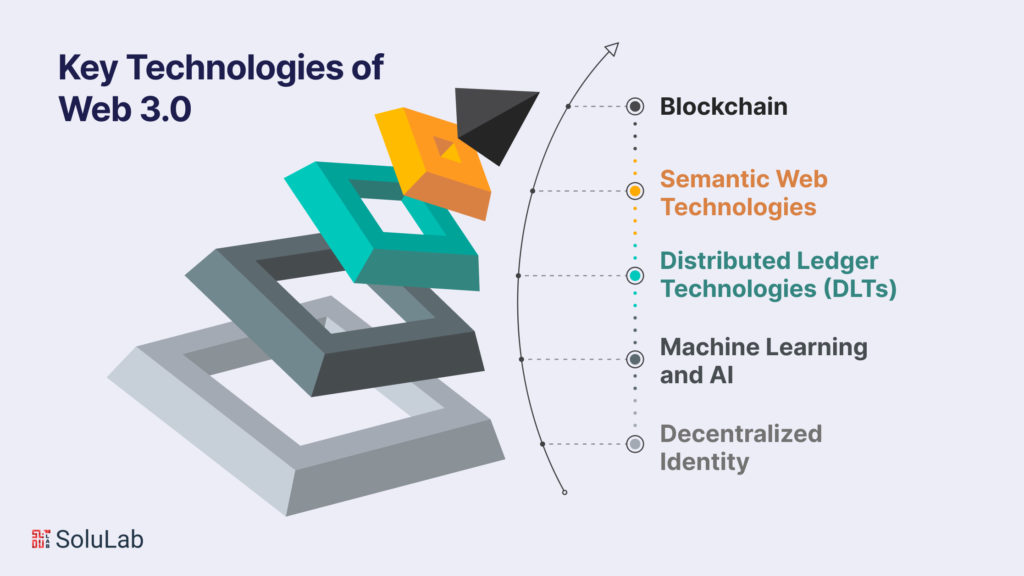
Key Technologies of Web 3.0

Key Technologies of Web 3.0

Web 3.0 integrates several key technologies and tools that are instrumental in realizing its vision. These technologies include:

  • Blockchain

Blockchain technology is at the core of Web 3.0’s decentralization. It provides a transparent and secure way to record transactions and manage data without relying on centralized intermediaries. Smart contracts, built on blockchain platforms like Ethereum, enable trustless, automated agreements and transactions.

  •  Semantic Web Technologies

Semantic web technologies, such as Resource Description Framework (RDF) and Web Ontology Language (OWL), enable the creation of structured data that computers can understand and process. This semantic data forms the basis for more intelligent and context-aware applications.

  •  Distributed Ledger Technologies (DLTs)

In addition to blockchain, other distributed ledger technologies play a role in Web 3.0. Directed Acyclic Graphs (DAGs) and Holochain, for example, provide alternative approaches to creating decentralized networks and applications.

CTA1

  • Machine Learning and AI

Web 3.0 leverages machine learning and artificial intelligence to make sense of the vast amount of data generated on the internet. These technologies enable content recommendation, user behavior analysis, and predictive analytics to enhance the user experience.

  • Decentralized Identity

Web 3.0 introduces the idea of decentralized identity, where people have control over their digital identities. Decentralized identity systems, often based on blockchain, enable users to manage and verify their identity without relying on centralized authorities.

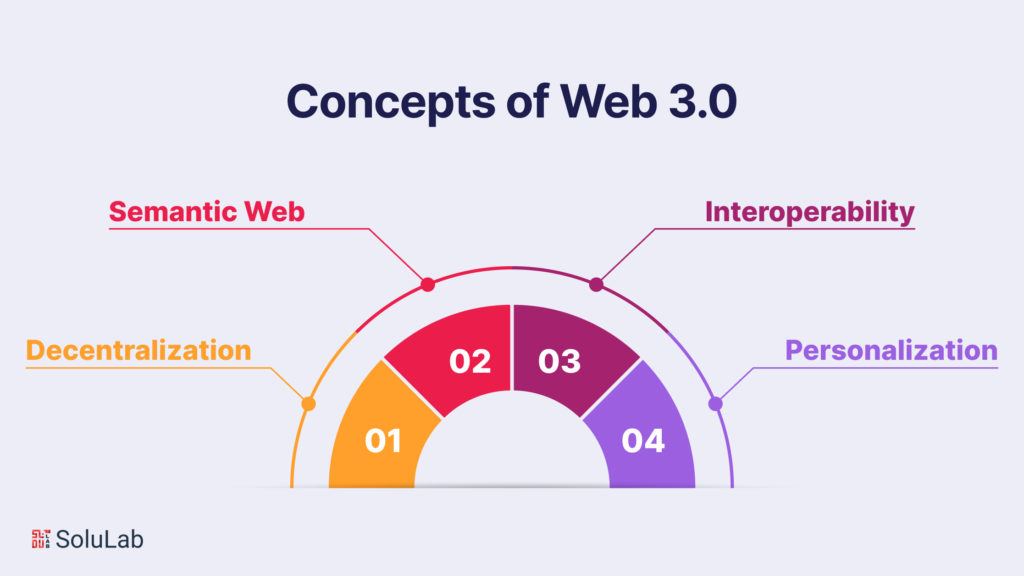
Key Concepts of Web 3.0

Key Concepts of Web 3.0

Web 3.0 integrates several key concepts and technologies that set it apart from its predecessors:

  • Decentralization

One of the fundamental tenets of Web 3.0 is decentralization. Traditional web systems rely on central servers and intermediaries, but Web 3.0 leverages blockchain and distributed ledger technologies to create a more peer-to-peer and trustless ecosystem. This decentralization reduces the control of a few powerful entities and promotes a fairer, more open digital landscape.

  • Semantic Web

Web 3.0 technologies focus on making data and information machine-understandable. This involves the use of semantic markup, ontologies, and linked data to enable better context and meaning extraction from content. This enables more intelligent search engines, recommendation systems, and data analysis.

  • Interoperability

Web 3.0 development trends emphasizes interoperability between various applications and platforms. This is achieved through open standards and protocols that allow different systems to seamlessly communicate and share data. As a result, users can have a unified experience across the web.

  • Personalization

Web 3.0 aims to provide highly personalized experiences for users. By leveraging artificial intelligence and machine learning, it can understand user preferences and behaviors to deliver content, services, and recommendations tailored to individual needs.

The Rise of Web 3.0

The concept of Web 3.0 has been in development for over a decade, and during this time, various projects have laid the groundwork for its emergence. Some early projects that contributed to the rise of Web 3.0 include:

  • Ethereum: Ethereum, a blockchain platform, introduced smart contracts and decentralized applications (DApps). It played a significant role in popularizing the idea of decentralization and programmable money, which are central to the Web 3.0 vision.
  • IPFS (InterPlanetary File System): IPFS is a distributed file system designed to create a more resilient and efficient web. It enables content to be stored and distributed in a decentralized manner, reducing reliance on centralized servers.
  • Solid Project: The Solid project, led by Tim Berners-Lee, the inventor of the World Wide Web, aims to give individuals more control over their data. It enables users to store their data in “pods” and choose how and with whom to share it.

The Growth of Web 3.0 Applications

Web 3.0 technologies have led to the development of a wide range of applications that offer innovative solutions in various industries. These applications leverage decentralization, data intelligence, and interoperability to enhance user experiences. Some examples of Web 3.0 applications include

The growth of Web 3.0 applications has indeed been a transformative force in the digital landscape. Leveraging decentralized technologies and semantic understanding, Web 3.0 applications are reshaping various industries, most notably in decentralized finance (DeFi). As of September 2021, the total value locked in DeFi protocols had surpassed $100 billion, showcasing the rapid adoption and substantial investment in these applications. 

Non-Fungible Tokens (NFTs) have also witnessed explosive growth, with notable sales, such as Beeple’s “Everydays: The First 5000 Days” artwork selling for a staggering $69.3 million in March 2021. These unique digital assets have opened new revenue streams for creators, artists, and game developers. The rise of Web 3.0 social networks, focusing on decentralized identity, data ownership, privacy, and security, is gaining traction as users increasingly seek control over their personal data. 

Projects like Mastodon and Solid Social have garnered substantial interest as they represent a move away from centralized social media platforms. Furthermore, the integration of Web 3.0 technologies with the Internet of Things (IoT) promises enhanced security and interoperability, with global IoT spending projected to reach $1.1 trillion by 2023. In healthcare and education, Web 3.0 applications are poised to streamline processes and improve patient care and personalized learning experiences. 

In brief, the Web 3.0 paradigm is redefining the digital landscape by empowering individuals, enhancing security, and fostering innovation, and its impact is becoming increasingly tangible with each passing day.

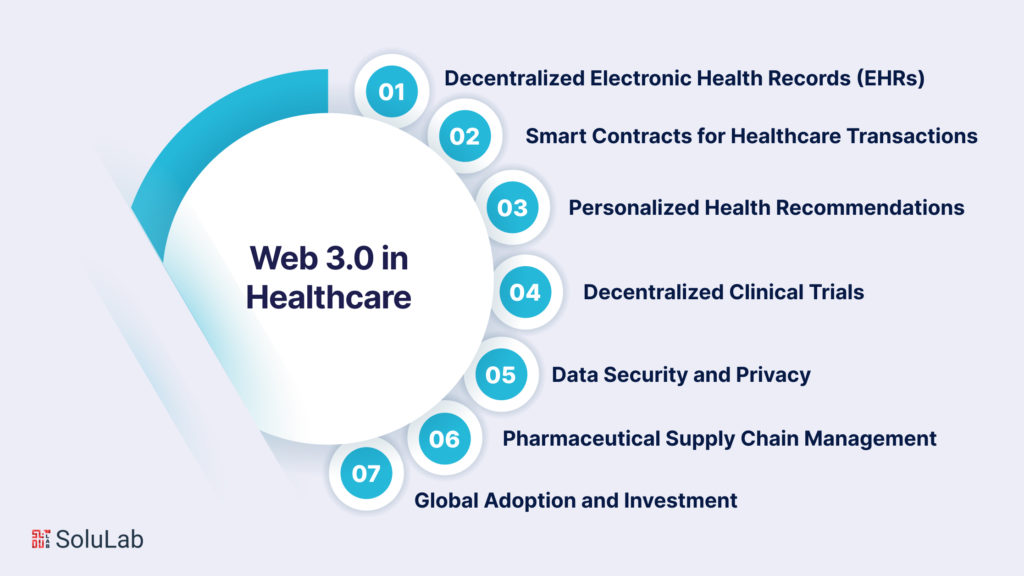
Web 3.0 in Healthcare

Web 3.0 in Healthcare

In the healthcare sector, Web 3.0 technologies promise transformative changes. Electronic Health Records (EHRs) can be securely stored and shared among healthcare providers and patients. Smart contracts can automate insurance claims and streamline healthcare payments. Additionally, personalized health recommendations based on user data become more accurate with machine learning and semantic web technologies.

The integration of Web 3.0 technology in healthcare represents a significant leap forward in the digital transformation of the medical industry. With its focus on decentralization, semantic understanding, and data interoperability, Web 3.0 promises to revolutionize patient care, data management, and the entire healthcare ecosystem.

  • Decentralized Electronic Health Records (EHRs)

Web 3.0 brings decentralization to electronic health records (EHRs), ensuring that patients have control over their health data. In a decentralized healthcare system, patients can securely access, manage, and share their medical records using blockchain technology. This eliminates the need for centralized data repositories and mitigates the risks associated with data breaches and unauthorized access. Decentralized EHRs also facilitate seamless sharing of health information among healthcare providers, leading to more comprehensive and efficient patient care.

Read Our Blog: Top 10 Web3 Development Companies

  • Smart Contracts for Healthcare Transactions

Smart contracts, a cornerstone of Web 3.0, are revolutionizing healthcare transactions. They enable automated and secure processes in areas like insurance claims, medical billing, and laboratory billing services where accuracy and compliance are essential. For instance, when an insurance claim is submitted, a smart contract can automatically verify the claim’s validity, process payments, and update the patient’s medical records. This reduces administrative overhead, minimizes errors, and accelerates the payment process, benefiting both patients and healthcare providers.

  • Personalized Health Recommendations

Web 3.0’s semantic web capabilities, combined with machine learning and artificial intelligence, empower healthcare providers to offer highly personalized recommendations and treatment plans. By analyzing a patient’s medical history, genetic information, lifestyle, and preferences, these systems can provide tailored guidance for preventive care, medication management, and lifestyle improvements. The result is a more patient-centric approach to healthcare that can lead to better outcomes and reduced costs.

  • Decentralized Clinical Trials

Web 3.0 technology is disrupting the traditional clinical trial process. Decentralized clinical trials leverage blockchain and smart contracts to enhance the transparency and integrity of trial data. Patients can securely contribute their health data and monitor the progress of clinical trials while maintaining control over their information. This innovation increases patient engagement, accelerates trial recruitment, and minimizes data manipulation risks.

Read Also: Top 25 Blockchain-Based Gaming Companies

  • Data Security and Privacy

In an era of increasing data breaches and privacy concerns, Web 3.0’s emphasis on security and data ownership is particularly relevant in healthcare. With decentralized identity solutions and encrypted communication, patients can have greater control over their personal health information. Blockchain ensures that medical data is tamper-proof, while semantic web technologies enable secure sharing and interoperability without compromising patient privacy.

  • Pharmaceutical Supply Chain Management

Web 3.0 technology also enhances the pharmaceutical supply chain, ensuring the authenticity and transparency of medications from production to consumption. Blockchain-based solutions can track and verify the origins of pharmaceutical products, reducing the risk of counterfeit drugs and enhancing drug safety.

  • Global Adoption and Investment

The adoption of Web 3.0 in healthcare is gaining momentum globally. By 2023, it is estimated that the global healthcare blockchain market will reach $1.6 billion. This significant investment reflects the industry’s recognition of the potential of decentralized technologies to streamline operations, improve data security, and enhance patient care.

Read Our Press Release: SoluLab Bridging the Gap Between Technology And Innovation

The Web 3.0 Ecosystem

The Web 3.0 ecosystem is a dynamic and rapidly evolving landscape. It encompasses a variety of stakeholders, technologies, and services, all working together to bring the vision of Web 3.0 to life. 

The Web 3.0 ecosystem represents a dynamic and rapidly evolving landscape that encompasses a wide range of stakeholders, technologies, and services, all working together to bring the vision of a decentralized and intelligent internet to life. Within this ecosystem, various elements collaborate to enable a new era of digital innovation and user empowerment.

Some key elements of this ecosystem include:

  • Web 3.0 Development Companies

Numerous companies specialize in Web 3.0 development. They offer expertise in blockchain, smart contract development, decentralized applications, and other technologies crucial to the Web 3.0 vision. These companies play a pivotal role in building the infrastructure and applications needed for the decentralized web.

  • Web 3.0 Platforms

Web 3.0 platforms provide the foundation for developing and deploying decentralized applications. Ethereum, Polkadot, and Cardano are among the prominent blockchain platforms that support the creation of DApps, while other platforms focus on specific niches or innovative features.

  • Web 3.0 Development Agencies

Web 3.0 development agencies offer a wide range of services, including consulting, application development, and smart contract creation. They help businesses and organizations navigate the complexities of Web 3.0 and bring their ideas to fruition.

  • Web 3.0 Development Services

These services encompass everything from blockchain development to data integration, semantic web implementation, and decentralized identity solutions. They are essential for building the infrastructure and applications that make Web 3.0 a reality.

Read Our Blog Post: Top Blockchain Technology Companies

  • Web 3.0 Development Solutions

Web 3.0 development solutions consist of software and tools that simplify the creation of decentralized applications. These include development frameworks, libraries, and development environments that enable developers to work efficiently in the Web 3.0 landscape.

The benefits of this ecosystem are becoming increasingly evident, as it fosters a more inclusive, secure, and personalized digital experience. Web 3.0 holds the potential to democratize access to digital assets, enhance data privacy and security, and open up new frontiers of innovation and collaboration. It empowers individuals and businesses to participate in the decentralized digital landscape, paving the way for a more open, intelligent, and interconnected internet. As the ecosystem continues to expand and mature, its influence will undoubtedly reshape the digital world, providing new opportunities and capabilities for a wide range of stakeholders.

CTA2

Conclusion

In conclusion, the Web 3.0 ecosystem represents a pivotal moment in the evolution of the internet, marked by a shift towards decentralization, semantic understanding, and user-centric experiences. It offers a promising vision of a digital world where individuals have greater control over their data, transactions are trustless and automated, and personalization is at the forefront of online interactions. The adoption of Web 3.0 technologies, from blockchain to smart contracts and the semantic web, continues to gain momentum across various industries, including finance, art, healthcare, and education. As this ecosystem evolves and matures, it holds the potential to reshape the digital landscape, offering a more inclusive, secure, and intelligent internet experience for users and businesses alike.

The ongoing growth and development within the Web 3.0 ecosystem underscore the increasing recognition of the importance of decentralization, interoperability, and data security in the digital age. It not only empowers individuals but also fuels innovation, collaboration, and the creation of transformative applications and services that promise to redefine the way we interact with the digital world. As we navigate this decentralized digital frontier, it becomes clear that Web 3.0 is not just a technological evolution; it represents a fundamental shift in the way we approach the internet, and its potential for positive change is both exciting and transformative.

SoluLab, a prominent web3 development company, empowers enterprises to tap into the potential of Web3 with their premium development offerings. They utilize cutting-edge technologies to craft distinctive and advantageous solutions, drawing upon their proficiency in blockchain, smart contracts, and decentralized finance protocols. 

SoluLab’s comprehensive Web3 Development Services equip clients to spearhead the creation of innovative decentralized applications, positioning them at the forefront of the constantly evolving Web3 landscape. Businesses now have the opportunity to enlist the services of SoluLab’s top-tier web3 developers to embark on a journey of constructing state-of-the-art solutions that propel growth and success. Get in touch with SoluLab today to explore their engagement models for recruiting freelance web3 developers or securing web3 development services.

FAQs

1. What is Web 3.0, and how does it differ from the previous web iterations (Web 1.0 and Web 2.0)?

Web 3.0 represents the next phase of the internet characterized by decentralization, semantic understanding, and data interoperability. It differs from Web 1.0, which was a static and informational web, and Web 2.0, which introduced interactivity and user-generated content. Web 3.0 integrates blockchain, smart contracts, and AI for a more intelligent, decentralized, and personalized digital experience.

2. What are some key technologies powering the Web 3.0 ecosystem?

Web 3.0 leverages technologies such as blockchain, smart contracts, semantic web technologies, artificial intelligence (AI), and decentralized identity solutions. These technologies enable decentralized applications, secure data management, and personalized user experiences.

3. How is Web 3.0 impacting the financial sector?

Web 3.0 is revolutionizing finance through Decentralized Finance (DeFi). DeFi platforms use blockchain and smart contracts to provide financial services without intermediaries, such as decentralized exchanges, lending and borrowing, and stablecoins. These innovations offer greater accessibility and transparency in the financial world.

4. What role do Non-Fungible Tokens (NFTs) play in the Web 3.0 ecosystem?

NFTs are new age digital assets representing ownership of digital or physical assets. They find applications in art, gaming, collectibles, and more. NFTs enable creators to monetize their work and provide a sense of true ownership in the digital realm.

5. How does Web 3.0 improve data security and privacy in healthcare?

Web 3.0 introduces decentralized electronic health records (EHRs) that give patients control over their health data. Blockchain ensures secure and tamper-proof data storage, while semantic web technologies enable secure sharing and interoperability without compromising patient privacy.

6. What is the significance of smart contracts in Web 3.0?

Smart contracts as the name suggests are self-executing agreements with the terms directly written into code. They automate various processes, reducing the need for intermediaries and improving efficiency. In Web 3.0, smart contracts are used in various sectors, from finance to healthcare, to facilitate trustless transactions.

7. How is Web 3.0 fostering innovation and collaboration within its ecosystem?

Web 3.0 encourages collaboration among development companies, platforms, agencies, services, and solutions. These entities work together to create a more inclusive, secure, and personalized digital experience. This collaborative approach drives innovation and the development of decentralized applications across various industries.

Blockchain Technology as a Platform for Digitization

Blockchain Technology as a Platform for Digitization

Blockchain technology has emerged as a groundbreaking innovation, reshaping the way we manage digital transactions and data. In this introduction, we’ll explore the fundamentals of blockchain technology, its inner workings, and its far-reaching applications in the modern digital landscape.

At its core, a blockchain is a decentralized and distributed digital ledger. It comprises a chain of blocks, with each block containing a record of multiple transactions. This technology is characterized by its transparency, security, and immutability. Unlike centralized databases, blockchain operates on a network of computers (nodes), enabling every participant to view and validate transactions. Once data is recorded in a block and added to the chain, it becomes exceedingly challenging to alter, ensuring the integrity of the information.

In the digital age, blockchain technology has emerged as a game-changer, offering transparency, security, and efficiency in various domains. From blockchain platforms to development services and consulting, the blockchain ecosystem continues to expand, presenting abundant opportunities for businesses and developers alike. Blockchain technology has given rise to a plethora of companies specializing in various aspects of this revolutionary tech. These companies range from blockchain platform developers to blockchain development service providers. 

How Does Blockchain Work?

How Does Blockchain Work?

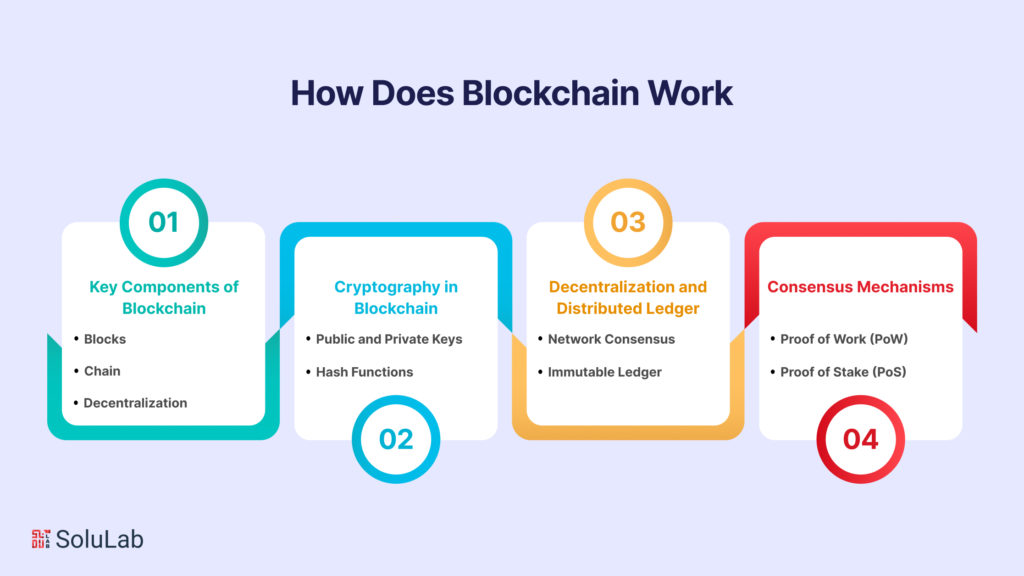
Blockchain technology has garnered significant attention for its potential to revolutionize various industries, from finance to supply chain management. Understanding how blockchain works is essential to grasp its transformative power. This article delves into the key components of blockchain, cryptography’s role, decentralization, and consensus mechanisms.

Key Components of Blockchain

At its core, a blockchain is a distributed and immutable ledger in blockchain that records transactions across a network of computers. Its key components include:

  • Blocks

These are containers that store data about transactions. Each block contains a group of transactions and has a unique identifier called a “hash.”

  • Chain

Blocks are linked together in chronological order, forming a chain. The previous block’s hash is included in each subsequent block, creating a secure connection.

  • Decentralization

Blockchain operates on a decentralized network of computers (nodes). Each node has a copy of the entire blockchain, ensuring redundancy and security.

Cryptography in Blockchain

Blockchain relies heavily on cryptographic techniques to secure data and ensure privacy. Key cryptographic aspects include:

Read Our Blog: Top Blockchain Technology Companies in 2024

  • Public and Private Keys

Users have a pair of cryptographic keys—a public key for identification and a private key for digital signatures. Transactions are signed with the private key and verified with the public key.

  • Hash Functions

Transactions and blocks are transformed into fixed-length alphanumeric strings using cryptographic hash functions. Even minor changes in data result in significantly different hash values, enhancing security.

Decentralization and Distributed Ledger

Decentralization is a fundamental principle of blockchain technology. Unlike traditional centralized systems, blockchain operates on a distributed ledger:

  • Network Consensus

Transactions are validated through a consensus mechanism, typically requiring a majority of nodes to agree on their validity.

  • Immutable Ledger

Once a block is added to the blockchain, it becomes virtually impossible to alter past transactions due to cryptographic integrity and the consensus mechanism.

Read Also: Top 10 Blockchain Development Companies in 2024

Consensus Mechanisms (e.g., Proof of Work, Proof of Stake)

Consensus mechanisms are pivotal to blockchain’s functionality. They ensure agreement among network participants regarding transaction validity. Two prominent mechanisms are:

  • Proof of Work (PoW)

PoW requires miners to solve complex mathematical puzzles to add new blocks to the chain. This process demands significant computational power and energy but is highly secure.

  • Proof of Stake (PoS)

PoS relies on validators who are chosen to create new blocks based on the number of coins they hold and are willing to “stake” as collateral. PoS is more energy-efficient than PoW.

What are the Fundamental Components and Characteristics of a Blockchain Network?

What are the Fundamental Components and Characteristics of a Blockchain Network

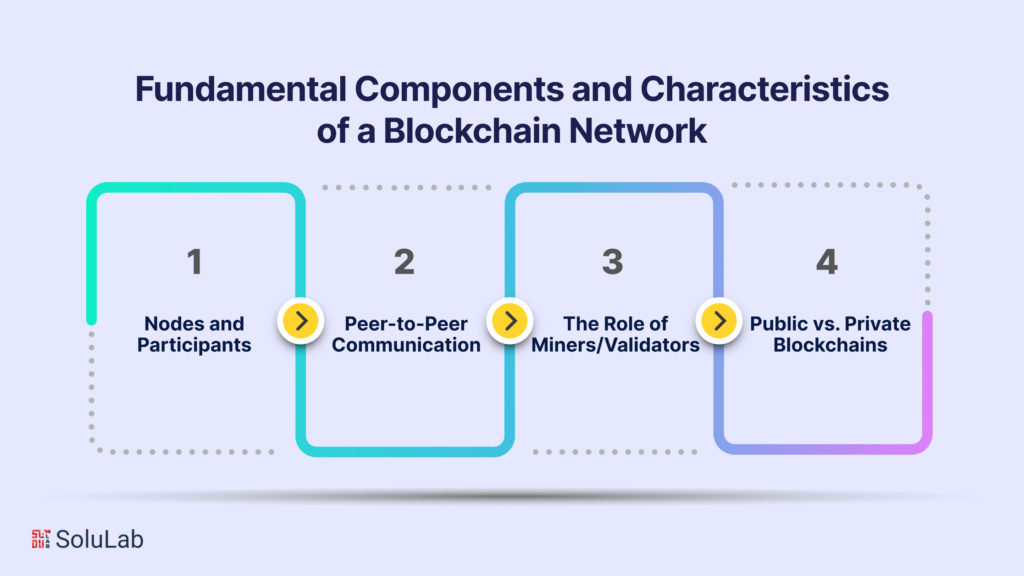
Blockchain technology is at the forefront of digital innovation, offering a secure and transparent way to record transactions and data. To comprehend blockchain fully, it’s essential to delve into the intricacies of its network. In this discussion, we will explore the various facets of a blockchain network, including nodes and participants, peer-to-peer communication, the role of miners/validators, and the distinction between public and private blockchains.

Nodes and Participants

  • At the core of a blockchain network are its nodes and participants. Nodes are individual computers or devices connected to the network. They play a crucial role in maintaining the decentralized nature of the blockchain. 
  • Participants can be individuals, organizations, or entities that engage with the blockchain by creating, validating, or storing transactions. These participants collectively form the network’s ecosystem.

Read Our Blog Post: Best Companies to Hire Blockchain Developers in 2024

Peer-to-Peer Communication

  • Blockchain operates on a peer-to-peer (P2P) network, where nodes communicate directly with each other without the need for intermediaries. This decentralized structure enhances security and eliminates single points of failure. 
  • When a participant initiates a transaction or updates the blockchain, the information is broadcast to all nodes in the network. This ensures that all nodes have a consistent and up-to-date copy of the blockchain.

The Role of Miners/Validators

  • In public blockchain networks, miners or validators play a critical role in maintaining the integrity of the blockchain. Miners validate transactions by solving complex mathematical puzzles through a process known as consensus (e.g., Proof of Work or Proof of Stake).
  • Once a transaction is verified, it is added to a new block, which is then appended to the existing blockchain. Miners are incentivized with rewards, such as cryptocurrencies, for their computational efforts.

Public vs. Private Blockchains

Blockchain networks can be categorized as either public or private, each with distinct characteristics:

  • Public Blockchains

These are open and permissionless networks accessible to anyone. They are decentralized, transparent, and often used for cryptocurrencies like Bitcoin and Ethereum. Public blockchains are maintained by a global network of miners.

Read Also: What Are The Benefits of Hiring a Blockchain Developer?

  • Private Blockchains

In contrast, private blockchains are restricted to specific participants or organizations. They are permissions, meaning that only authorized entities can validate transactions and access the blockchain. Private blockchains are commonly used for enterprise applications, supply chain management, and consortiums.

Understanding the blockchain network’s structure, participants, and communication mechanisms is crucial for grasping how blockchain technology works. It forms the foundation for various applications, including secure digital transactions, supply chain traceability, and even the creation of decentralized applications (DApps). As blockchain technology continues to evolve, it opens up new avenues for innovation, leading to exciting developments and trends in the field. 

Companies and developers are actively engaged in blockchain development, offering services and solutions to harness the full potential of this transformative technology. Blockchain consulting services can assist businesses in navigating the complexities of blockchain adoption and integration, ensuring they remain at the forefront of digital transformation.

What are the Applications of Blockchain Technology?

What are the Applications of Blockchain Technology?

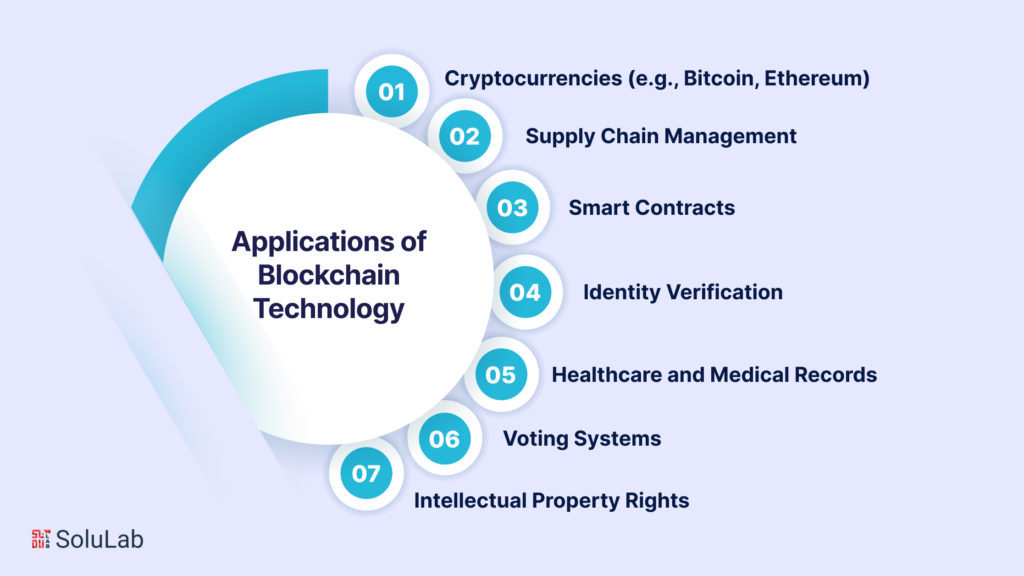
Blockchain technology, often referred to as the backbone of cryptocurrencies like Bitcoin and Ethereum, is a revolutionary innovation that has found applications far beyond the realm of digital currencies. It is a distributed ledger system that provides transparency, security, and immutability to transactions. Let’s explore various applications of blockchain technology:

  • Cryptocurrencies (e.g., Bitcoin, Ethereum)

Blockchain’s most well-known application is in the creation and management of cryptocurrencies. It serves as a decentralized ledger that records all transactions. Users can conduct peer-to-peer transactions without the need for intermediaries like banks.

  • Supply Chain Management

Blockchain technology is transforming supply chain management by providing end-to-end visibility and transparency. It allows tracking of products from their origin through every touchpoint in the supply chain. This reduces fraud, ensures the authenticity of products, and enhances efficiency.

Read Our Blog: What Are The Top 10 Companies To Hire Blockchain Developers from

  • Smart Contracts

Smart contracts are self-executing contracts with the terms of the agreement directly written into code. They automatically execute when predefined conditions are met. Blockchain’s security and trustworthiness make it an ideal platform for deploying smart contracts, which find applications in legal agreements, insurance, and more.

  • Identity Verification

Blockchain can be used for secure and tamper-proof identity verification. Individuals can have control over their data and selectively share it with trusted entities, reducing the risk of identity theft and fraud.

  • Healthcare and Medical Records

Blockchain ensures the integrity and confidentiality of medical records. It enables patients to grant access to their medical data securely, streamlining the sharing of information among healthcare providers while maintaining privacy.

  • Voting Systems

Blockchain-based voting systems offer secure and transparent elections. Each vote is recorded as a transaction, making it nearly impossible to tamper with results. This application enhances trust in the democratic process.

Read Also: Investing in Blockchain Development: A Strategic Guide for Businesses

  • Intellectual Property Rights

Blockchain can be used to prove ownership and protect intellectual property rights. Artists, writers, and creators can timestamp their work on the blockchain, providing undeniable proof of creation and ownership.

As blockchain technology continues to evolve, it opens up new possibilities across various industries. Companies and organizations are exploring innovative ways to leverage blockchain for increased efficiency, security, and transparency in their operations. The trends in blockchain point to a future where blockchain’s impact will be even more significant, ushering in a new era of digital transformation.

What are the Latest Trends in Blockchain Technology?

What are the Latest Trends in Blockchain Technology?

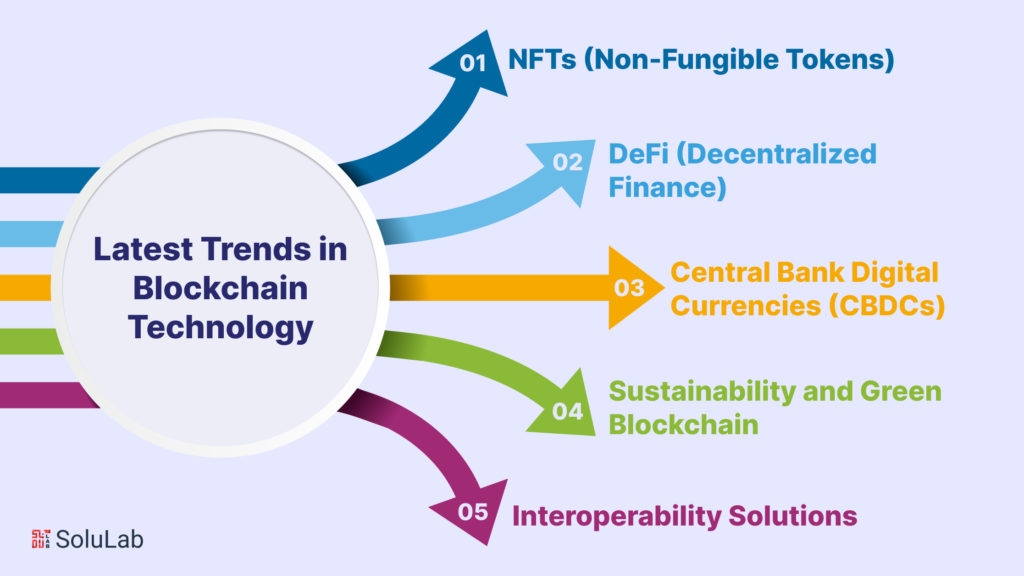
Blockchain technology, initially introduced as the underlying technology for cryptocurrencies, has evolved significantly in recent years. Today, it extends far beyond digital currencies, with various trends shaping its trajectory.

NFTs (Non-Fungible Tokens)

  • Non-Fungible Tokens, or NFTs, have taken the digital art and collectibles world by storm. NFTs are unique digital assets that represent ownership of digital or physical items. They utilize blockchain technology to establish ownership and provenance, making them highly valuable in the world of art, music, gaming, and even virtual real estate.
  • NFTs have introduced a new paradigm for ownership and authenticity verification, challenging traditional copyright and intellectual property norms. Artists, musicians, and creators are leveraging NFTs to monetize their digital works directly, eliminating intermediaries.

DeFi (Decentralized Finance)

  • Decentralized Finance, or DeFi, is revolutionizing the traditional financial sector. Built on blockchain networks, DeFi applications provide open and permissionless access to financial services like lending, borrowing, trading, and yield farming. DeFi platforms eliminate intermediaries like banks, enabling users to have more control over their assets.
  • The DeFi trend has seen exponential growth, attracting both users and developers. However, it also comes with challenges, such as security vulnerabilities and regulatory concerns, that need to be addressed for long-term sustainability.

Central Bank Digital Currencies (CBDCs)

  • Central Bank Digital Currencies are digital versions of fiat currencies issued by central banks. These CBDCs aim to combine the advantages of blockchain technology with the stability of traditional currencies. Governments and central banks worldwide are exploring the potential of CBDCs to modernize payment systems, enhance financial inclusion, and combat illicit activities.
  • CBDCs represent a significant shift in the financial landscape and could impact the adoption and use of cryptocurrencies like Bitcoin and stablecoins.

Read Our Blog Post: Top 20 Supply Chain Startups That Are Using Blockchain Technology

Sustainability and Green Blockchain

  • Sustainability is a growing concern in the blockchain space. The energy-intensive nature of some blockchain networks, particularly Proof of Work (PoW), has raised environmental concerns. As a result, there’s a growing trend towards developing and adopting more eco-friendly consensus mechanisms, such as Proof of Stake (PoS).
  • Green blockchain initiatives aim to reduce the carbon footprint of blockchain technology while maintaining its security and decentralization benefits. These efforts align with broader global sustainability goals.

Interoperability Solutions

  • Interoperability is a critical challenge in the blockchain industry. Different blockchain networks often operate in isolation, limiting the flow of assets and data between them. Interoperability solutions seek to bridge these gaps, enabling seamless communication and value transfer between disparate blockchain networks.
  • Projects and protocols dedicated to interoperability, like Polkadot and Cosmos, are gaining traction. They facilitate cross-chain communication and the creation of interconnected blockchain ecosystems.

How is SoluLab Pioneering the Digital Revolution Through its Blockchain Development Expertise?

Blockchain technology, often referred to as the backbone of cryptocurrencies like Bitcoin, has transcended its initial purpose. It is now a transformative force driving innovation across various industries. In this era of digitalization, understanding how blockchain works, its applications, and leveraging it effectively are paramount. SoluLab, a leader in blockchain development and consulting, is at the forefront of this revolution.

At its core, a blockchain is a decentralized and immutable digital ledger that records transactions across a network of computers. It operates on a peer-to-peer basis, utilizing complex cryptography to secure data. Each “block” in the chain contains a set of transactions, and they are linked in chronological order, ensuring transparency and security.

Blockchain Development with SoluLab

  • Blockchain Platforms

SoluLab leverages leading blockchain platforms like Ethereum and Hyperledger to create scalable and secure solutions. These platforms provide the foundation for building decentralized applications (DApps) and enterprise-grade blockchain networks.

  • Role of Blockchain Development Companies

SoluLab plays a pivotal role in guiding organizations through their blockchain journey. They offer consultation, development, and implementation services to ensure seamless integration into existing systems.

  • Blockchain Development Services

SoluLab offers end-to-end blockchain development services, including smart contract development, decentralized application development, blockchain consulting, and blockchain integration into existing systems.

In conclusion, blockchain technology is reshaping industries, and SoluLab is your trusted partner in harnessing its power. With their expertise in blockchain development and consulting services, they pave the way for organizations to unlock the full potential of this transformative technology.

Conclusion

In conclusion, SoluLab stands as a beacon of innovation and expertise in the realm of blockchain technology. As we’ve explored the intricacies of what blockchain is and how it works, it becomes evident that this revolutionary technology has become the cornerstone of digital transformation. SoluLab’s commitment to excellence and its status among leading blockchain companies are testament to its prowess in developing blockchain solutions.

With an in-depth understanding of blockchain technology, SoluLab not only explains the nuances of this groundbreaking technology but also empowers businesses with cutting-edge blockchain development services. In a landscape where blockchain trends continue to evolve, SoluLab remains at the forefront, ready to adapt and harness blockchain’s potential to drive digital transformation.

For those seeking to harness the power of blockchain, SoluLab is the go-to blockchain development company. The ability to hire top blockchain developers and access comprehensive blockchain consulting services sets SoluLab apart. In an era where blockchain is more than just a buzzword, SoluLab paves the way for businesses to unlock the full spectrum of opportunities presented by blockchain technology, ushering in a new era of innovation and efficiency.

FAQs

1. What is a Blockchain?

A blockchain is a distributed and decentralized digital ledger technology that securely records transactions across multiple computers. It consists of a chain of blocks, each containing a batch of transactions, and is designed to be transparent, immutable, and resistant to tampering.

2. How Does Blockchain Work?

Blockchain works through a network of nodes (computers) that validate and record transactions into blocks. Once verified, these blocks are linked in chronological order, forming a chain. Consensus algorithms ensure agreement among nodes, and cryptographic techniques secure the data.

3. What Are Some Applications for Blockchain Technology?

Blockchain technology has diverse applications, including cryptocurrency transactions (e.g., Bitcoin), supply chain management, identity verification, voting systems, healthcare record management, and smart contracts in various industries.

4. What Are the Key Trends in Blockchain Technology?

Current trends in blockchain technology include the rise of decentralized finance (DeFi) platforms, non-fungible tokens (NFTs), central bank digital currencies (CBDCs), and sustainability efforts to reduce blockchain’s energy consumption.

5. How Can I Develop Blockchain Solutions?

To develop blockchain solutions, you can either hire top blockchain developers or engage with blockchain development companies. It involves designing and implementing smart contracts, choosing the right blockchain platform, and ensuring security and scalability.

The Impact of the Metaverse on Education and Learning

The Impact of the Metaverse on Education and Learning

The digital age has ushered in a wave of technological innovations that are transforming the way we live, work, and interact with the world around us. One of the most exciting and potentially revolutionary concepts to emerge in recent years is the Metaverse. A term that was once confined to the realms of science fiction and virtual gaming has now become a tangible and increasingly significant part of our digital reality.

The Metaverse, often described as a virtual, interconnected universe, has the power to change not only how we socialize and entertain ourselves but also how we educate and learn. In this blog, we will embark on an exploration of the Metaverse learning’s profound impact on education and learning.

So, let’s get started!

Understanding the Metaverse

Before we delve into its implications for education, it’s essential to grasp what the Metaverse is. In essence, the Metaverse is a digital universe, an expansive, interconnected realm where users can interact with each other and computer-generated environments. It blurs the lines between the physical and digital worlds, offering diverse experiences that can include social interactions, gaming, commerce, and, intriguingly, education.

Imagine a world where students can explore ancient civilizations in a virtual history class, collaborate on scientific experiments with peers from across the globe, or even conduct job interviews in a completely immersive virtual environment. This is the promise of the Metaverse in Education.

The Current Educational Landscape

To appreciate the potential impact of the Metaverse development, it’s essential to consider the current state of education. Traditional education methods have evolved over the centuries but remain largely classroom-centered, with students and teachers physically present. The internet and online learning platforms have brought about significant changes, offering flexibility and access to a wealth of resources.

However, challenges persist. Some students face barriers to access, and the one-size-fits-all approach to education doesn’t cater to individual learning styles. This is where the Metaverse comes into play, offering innovative solutions to these longstanding issues.

CTA1

The Potential of the Metaverse in Education

The concept of the Metaverse, a virtual, interconnected universe, has taken the world by storm, capturing the imagination of innovators and educators alike. Beyond its applications in gaming and entertainment, the Metaverse holds immense potential for the realm of education. In this section, we will delve deeper into the possibilities it offers and how it might reshape the way we teach and learn.

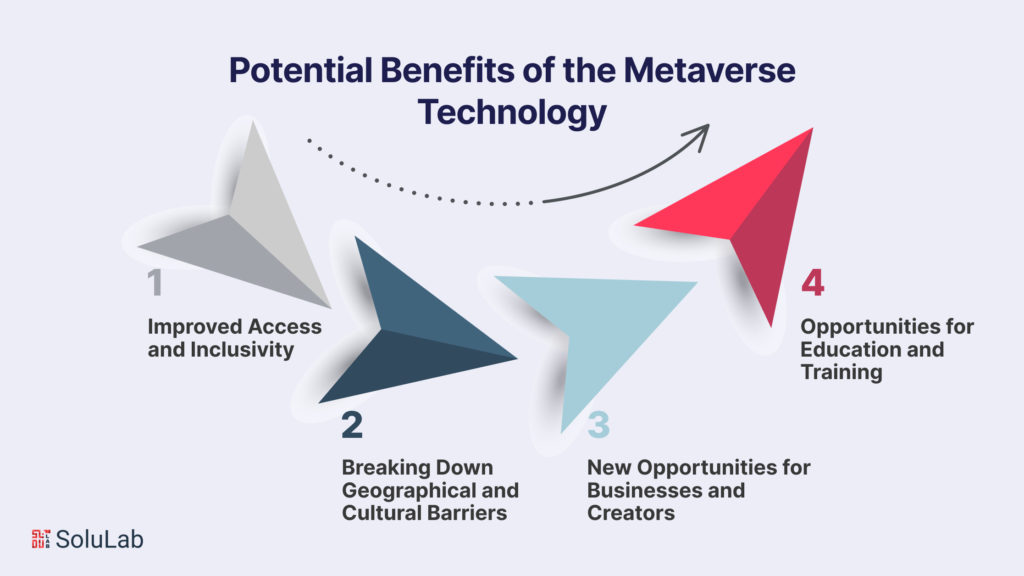
  • Immersive and Interactive Learning: The Metaverse provides an unprecedented level of immersion. Students can virtually step into historical events, explore complex scientific concepts, or even practice language skills in virtual environments. This immersive learning can make educational content more engaging and memorable.
  • Accessibility and Inclusivity: The Metaverse has the potential to bridge the digital divide. With the right infrastructure, students from all backgrounds can access the same high-quality educational experiences, creating a more inclusive learning environment.

Read Our Blog: Is Metaverse the Future of Digital Connection?

  • Personalized Learning Journeys: In the Metaverse, learning can be tailored to the individual. Smart algorithms can adapt content and experiences to match each student’s pace and preferences, making education more effective and enjoyable.
  • Collaboration and Social Learning: Just as in the physical world, students can collaborate and learn from one another. The Metaverse enables social interactions and group projects, enhancing the social aspects of learning.

The potential is vast, and as the technology matures, we are likely to see even more innovative applications in education.

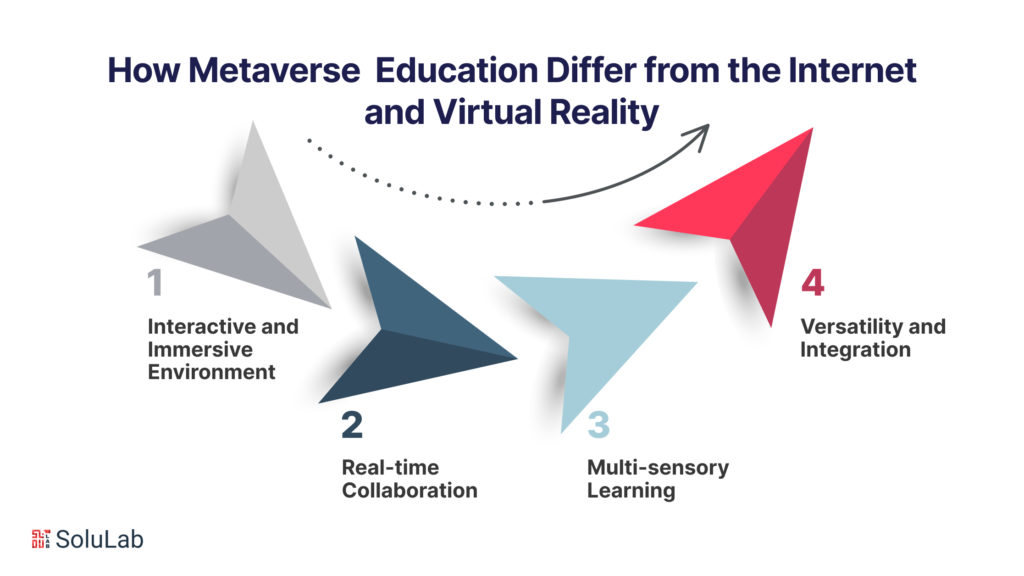
How Does the Metaverse in Education Differ from the Internet and Virtual Reality?

How Does the Metaverse in Education Differ from the Internet and Virtual Reality?

The integration of the Metaverse into education represents a significant departure from both the traditional Internet and virtual reality (VR). The Metaverse creates interactive and immersive environments where students can engage with one another and computer-generated worlds. It goes beyond the traditional internet by offering real-time interactions, socialization, and a sense of presence, similar to in-person experiences. In education, this translates to dynamic, 3D learning spaces and experiences that closely resemble real-world interactions, with the involvement of Metaverse development companies providing cutting-edge technological advancements. While there are similarities, there are also crucial differences that set the Metaverse apart. Let’s explore these distinctions:

Interactive and Immersive Environments

  • Metaverse: The Metaverse creates interactive and immersive environments where students can engage with one another and computer-generated worlds. It goes beyond the traditional internet by offering real-time interactions, socialization, and a sense of presence, similar to in-person experiences. In education, this translates to dynamic, 3D learning spaces and experiences that closely resemble real-world interactions.
  • Internet: The traditional internet primarily offers static web pages and resources. While it supports e-learning platforms, communication tools, and content sharing, the experience is generally two-dimensional and lacks the depth and immersion that the Metaverse provides.
  • Virtual Reality (VR): VR, on the other hand, is immersive but often isolating. It transports users to entirely virtual environments, but these are usually solitary experiences, making collaborative learning and social interaction more challenging.

Real-time Collaboration

  • Metaverse: The Metaverse enables real-time collaboration and communication within a virtual space. In educational settings, this means students and teachers can interact with each other, engage in discussions, and participate in group activities just as they would in a physical classroom.
  • Internet: While the Internet offers communication tools like email, chat, and video conferencing, these are typically separate from the learning content and often asynchronous. They lack the seamless integration and real-time interactivity that the Metaverse provides.
  • Virtual Reality (VR): VR experiences often lack real-time collaboration features, making them less suitable for synchronous group learning, discussions, and teamwork.

Read Also: Top 15 Metaverse Startups

Multi-sensory Learning

  • Metaverse: The Metaverse offers multi-sensory learning experiences by allowing students to engage with content through sight, sound, and sometimes touch. This enhances the retention and understanding of complex subjects.
  • Internet: The Internet primarily relies on text, images, and videos, offering a limited range of sensory input compared to the Metaverse.
  • Virtual Reality (VR): VR provides immersive sensory experiences, primarily focusing on sight and sound. However, it may lack the same depth of interactivity and the social aspects found in the Virtual Reality Metaverse.

Versatility and Integration

  • Metaverse: The Metaverse is versatile, as it integrates various technologies, including AR and VR, to provide a broad range of educational experiences. It supports diverse learning styles and can cater to a wide array of subjects and disciplines.
  • Internet: The Internet relies on external tools and platforms for specific learning needs, making it less seamless for educators and learners.
  • Virtual Reality (VR): VR is specialized for immersive experiences but may not have the same versatility for a wide range of educational applications as the Metaverse.

In brief, the Metaverse in education stands out by offering interactive, immersive, and real-time learning experiences with an emphasis on collaboration and multi-sensory engagement. While the traditional internet and VR have their respective strengths, the Metaverse combines elements of both to create a transformative educational environment that provides students with a truly unique and holistic learning experience.

Benefits of the Metaverse in Education

Benefits of the Metaverse in Education

Technology has played a vital role in reshaping education, from virtual cloud-based classrooms and webinars to self-paced learning environments, microlearning applications, and now, with the integration of AR and VR, the introduction of immersive learning experiences. In this section, we’ll focus on the Metaverse’s impact on education and explore its key benefits in the educational sector.

  • Flexible Learning with Interactive Curricula

Explaining concepts interactively in a virtual environment simplifies understanding. For instance, comprehending the solar ecosystem becomes much easier when one can virtually traverse the galaxy, witnessing planet placements and orbits. 

Similarly, understanding rocket launches can be made more accessible by virtually experiencing the process from a space launch station. A virtual 3D classroom setup allows students to observe every detail, from pre-launch preparations to final assembly and technical aspects. Professions demanding practical skills, such as medical surgeries and astrophysics experiments, can be effectively practiced when education converges with the Metaverse.

  • Gamified Learning for Engagement

Gamification keeps learners motivated and engaged. The Metaverse in education can support focused learning by rewarding learners with badges and recognition for completing tasks.

For example, students can explore various geographical areas within the Metaverse to understand their features and environments. They can then create avatars based on the culture of their chosen location and even design the area according to their preferences.

Check Our Blog Post: Metaverse AI: Integrating Artificial Intelligence into Virtual Worlds

  • Interactive Teaching Methods

Effective teaching is essential to making learning interesting. The Metaverse offers numerous opportunities for educators to experiment and engage their students. Realistic social interactions in immersive scenarios enhance collaboration and problem-solving skills. 

Avatars can be used to explain concepts through role-playing techniques, bringing real-life situations into the educational experience. Creating different scenarios within the Metaverse facilitates hands-on, realistic learning experiences.

  • Easy and Rapid Information Discovery

The Metaverse, when used in education, widens access to knowledge. Courses, once created, can be accessed by multiple learners, saving time and resources.

Personalized search results and advanced social collaboration tools enable individualized learning paths that are easily comprehensible and accessible.

Application of Metaverse Technology in Education

Application of Metaverse Technology in Education

As the Metaverse continues to evolve, it’s making its presence felt in the field of education. With various top Metaverse platforms gaining traction, the possibilities for enhancing the learning experience are growing rapidly. Let’s explore some of the most promising use cases of the Metaverse technology in education.

  • Virtual Classrooms

Metaverse platforms offer an immersive alternative to traditional classrooms. Students and teachers can interact within a virtual environment, attending classes as avatars. This concept brings a new level of engagement, enabling students to explore and interact with the subject matter. Leading platforms such as “Metaverse” and “Decentraland” are increasingly used to create virtual classrooms and lecture halls.

  • Field Trips and Experiential Learning

The Metaverse opens up new horizons for experiential learning. Students can take virtual field trips to historical sites, explore ecosystems, or even journey to outer space. Platforms like “Roblox” and “Minecraft” provide tools for educators to create immersive, educational experiences.

  • Career and Technical Training

Metaverse technology can be particularly beneficial for technical and vocational training. Simulated environments, resembling real-world workplaces, enable students to gain practical experience. For example, medical students can practice surgeries, and aviation students can learn to operate aircraft. Platforms like “Second Life” and “Sansar” have been used to create such training simulations.

Read Also: How Will Metaverse Change the World? A New Era of Connectivity and Innovation!

  • Language Learning

Learning a new language becomes more engaging and effective in the Metaverse. Students can interact with native speakers in virtual environments, participate in role-playing scenarios, and practice language skills in realistic settings. “AltspaceVR” and “VRChat” are platforms that facilitate language exchange and practice.

  • Collaborative Projects

Metaverse platforms foster collaboration among students and educators, no matter where they are located. Group projects, workshops, and discussions become more dynamic and interactive. “High Fidelity” and “Engage” are platforms that promote collaborative learning experiences.

  • Customized Learning Paths

One of the most significant advantages of Metaverse technology is the ability to provide personalized learning experiences. Advanced AI algorithms can tailor educational content and experiences to individual preferences and learning styles. Leading platforms, such as “Facebook Horizon” and “Rec Room,” use Artificial Intelligence (AI) to adapt content to each learner’s unique needs.

  • Gamified Education

Gamification is an effective way to keep students engaged and motivated. The Metaverse supports the integration of gamification elements, offering rewards, badges, and competitive elements to encourage active learning. “VRChat” and “Mozilla Hubs” enable the gamification of educational content.

Incorporating Metaverse technology in education is a game-changer, offering a wide array of opportunities for creating immersive, engaging, and personalized learning experiences. As the Metaverse continues to expand and innovate, we can expect even more creative applications that revolutionize the way we teach and learn. These top Metaverse platforms, each with its unique features and capabilities, are at the forefront of this educational transformation.

Features of Metaverse in Education

Features of Metaverse in Education

We have been emphasizing that Metaverse learning represents a distinct world offering experiences similar to the real world. However, there are key differences when comparing it to conventional classroom settings and remote learning. Let’s delve into these distinctions.

Learner’s Time and Location

  • Traditional learning necessitates both teacher and learner to be physically present at the same time and location. Remote learning provides flexibility in learning from different places, but it doesn’t grant the same flexibility regarding time for learners and teachers.
  • In contrast, the Metaverse offers complete flexibility. Learners can engage from anywhere, at any time, using smart wearable devices and robust internet connectivity. This empowers teachers to innovate teaching methods for both synchronous and asynchronous learning.

Learner Identity

  • Conventional and screen-based classrooms can only identify learners based on their real identities, limiting the scope for creative expression.
  • The Metaverse allows individuals to create avatars, representing themselves in imaginative, immersive ways, irrespective of background, race, or appearance.

Read Our Blog: Metaverse NFT – Foundation Of Next Blockchain Revolution!

Interaction Among Learners

  • In a traditional classroom, learners interact with teachers and peers in person, which can be challenging in remote or screen-based learning, leading to social isolation and limitations in collaboration.
  • The Metaverse overcomes these limitations by enabling learner avatars to interact with teacher and peer avatars, facilitating real-time feedback, socialization, expert assistance in concept comprehension, personalized support, and more.

Learning Scenarios

  • Conventional learning environments provide limited practical learning opportunities, such as labs and role-playing.
  • Screen-based learning primarily supports theoretical learning methods, lacking the engagement of hands-on experiences.
  • In contrast, the Metaverse can create realistic scenarios, allowing learners to actively participate in real-world situations, and providing practical and safe learning environments.

Learning Resources and Activities

  • Conventional and screen-based learning often rely on static learning materials like textbooks, images, videos, and similar resources.
  • The Metaverse equips learners with dynamic learning scenarios, offering the resources required to create and learn through hands-on activities and participation.

Check Our Blog Post: Metaverse Use Cases and Benefits

Learning Assessment

  • Conventional and screen-based learning frequently rely on summative assessments in the form of tests and scores, making real-time, impactful feedback a challenge.
  • The Metaverse in education facilitates both formative and summative assessments through learning analytics, providing comprehensive assessments and immediate feedback, thus contributing to more effective learner growth.

Future Trends and Developments of Metaverse in Education

Future Trends and Developments of Metaverse in Education

As the Metaverse continues to gain prominence in education, it’s essential to look ahead at the future-based developments that promise to reshape the landscape further. Let’s explore the potential trends, with a focus on the integration of augmented reality (AR) and the evolution of virtual reality and augmented reality in education.

  • Enhanced Personalization

Future Metaverse applications in education will prioritize even greater personalization. Advanced AI algorithms will adapt content to the specific needs, preferences, and learning styles of individual students, providing tailored educational experiences.

  • Immersive Learning Ecosystems

The Metaverse will increasingly become an immersive learning ecosystem. It will encompass a wide range of educational content, resources, and activities, enabling students to explore, interact, and learn in virtual environments.

  • Integration of Augmented Reality (AR)

AR technology will play a pivotal role in the Metaverse’s educational future. AR devices will seamlessly blend digital content with the real world, enabling students to access information, engage in interactive learning, and gain real-time insights through smart glasses or augmented reality applications.

  • Expanded Accessibility

The Metaverse will bridge geographical and socioeconomic gaps in education. It will provide access to high-quality educational experiences, connecting students and educators worldwide. The use of low-cost devices and platforms will make the Metaverse accessible to a broader audience.

Read Our Blog: Tech Stack of a Metaverse Developer

  • Gamification and Engagement

Gamification will continue to be a significant trend, making learning more engaging and interactive. Virtual badges, achievements, and competitive elements will motivate students to remain focused and complete educational tasks in the Metaverse.

  • Enhanced Social Interaction

Future Metaverse platforms will focus on further enhancing social interaction in virtual spaces. Students will collaborate, communicate, and learn with peers from diverse backgrounds, fostering cross-cultural interactions and global perspectives.

  • Integration with Traditional Education

The future of the Metaverse in education will involve greater integration with traditional educational institutions. Universities, schools, and training centers will incorporate Metaverse technologies into their curricula, offering blended learning experiences.

Read Also: Web 3 vs Metaverse: What’s The Difference

  • Learning Analytics and Real-time Feedback

Advanced learning analytics tools will provide in-depth insights into student progress. Educators can track student performance, identify areas for improvement, and provide real-time feedback to enhance the learning experience.

  • Seamless AR and VR Integration

The lines between virtual reality (VR) and augmented reality (AR) will blur as they converge into Mixed Reality (MR). This integration will allow for more seamless transitions between fully immersive virtual environments (VR) and augmented real-world experiences (AR).

  • Lifelong Learning and Professional Development

Metaverse technology will extend beyond K-12 and higher education, offering a platform for lifelong learning and continuous professional development. Professionals in various fields can engage in immersive training and skill development experiences.

Thus, the future based on Metaverse in Education is bright and dynamic. It will offer unparalleled personalization, immersive learning environments, and seamless integration of Augmented Reality (AR) and VR technologies. These trends will not only transform how we teach and learn but also open up new horizons for education in the digital age. As the Metaverse evolves, educators, students, and institutions must adapt to harness its full potential for the betterment of education worldwide.

CTA2

Conclusion

The Metaverse is on the verge of revolutionizing education and learning, offering a rich tapestry of opportunities for students and educators alike. As we’ve explored throughout this blog, the Metaverse provides immersive, interactive, and personalized learning experiences that surpass what the traditional internet and virtual reality can offer. The potential for bridging geographical divides, enhancing collaboration, and providing multi-sensory education is a tantalizing prospect. However, it’s not without its challenges. Privacy concerns, equitable access, and integration with traditional education systems must be carefully addressed as we journey into this new frontier. As we step into the Metaverse’s educational realm, the key to its success lies in collaboration, innovation, and the dedication of Metaverse development companies to shape the future of education.

SoluLab, a leading Metaverse development company, plays a pivotal role in crafting the future of the Metaverse. With expertise in a multitude of technologies, SoluLab is also a renowned Metaverse game development company that can bring your immersive experiences to life. We offer the capability to hire Metaverse developers who are dedicated to shaping your vision, ensuring that your Metaverse projects are built to the highest standards. Our comprehensive range of Metaverse development services encompasses design, development, and deployment, making them a one-stop solution for all your Metaverse needs. SoluLab is committed to pushing the boundaries of innovation in the Metaverse and continues to lead the way in creating transformative educational experiences.

FAQs

1. What is the Metaverse, and how can it benefit education?

The Metaverse is a virtual, interconnected universe that offers immersive, interactive learning experiences. It benefits education by providing personalized, multi-sensory, and real-time collaborative learning, transcending traditional Internet and VR limitations. SoluLab, a leading Metaverse Development Company, helps in realizing the potential of the Metaverse for education by offering innovative solutions and experiences.

2. What are the challenges of integrating the Metaverse into education?

Challenges include privacy concerns, equitable access, and the integration of the Metaverse with traditional education systems. SoluLab, as an experienced Metaverse Development Company, addresses these challenges by developing secure and accessible solutions that seamlessly blend with existing educational structures.

3. How can I hire dedicated Metaverse developers for my educational project?

SoluLab offers the opportunity to hire Metaverse developers who are experts in Metaverse development. They can work on your educational project, ensuring that it meets your unique requirements and delivers the desired learning experiences.

4. Can the Metaverse be used for creating educational games?

Yes, the Metaverse is an ideal platform for creating immersive educational games. SoluLab, a Metaverse game development company, specializes in designing and developing educational games that engage students and enhance learning.

5. What services does SoluLab offer for Metaverse development in education?

SoluLab provides a wide range of Metaverse development services, including design, development, and deployment. We create customized Metaverse solutions for educational institutions, ensuring that students and educators can make the most of this innovative technology.

10 Ways Generative AI is Revolutionizing Healthcare

10 Ways Generative AI is Revolutionizing Healthcare

In recent years, the healthcare industry has witnessed a significant transformation due to the emergence of innovative technologies. One such groundbreaking technology that has revolutionized healthcare is Generative Artificial Intelligence (AI). Generative AI applications have introduced a new era of possibilities and advancements, enabling healthcare professionals to streamline processes, enhance patient care, and improve overall outcomes. With the application of Generative AI, the healthcare sector has experienced a paradigm shift, leading to improved diagnostics, personalized treatment plans, and optimized drug development processes. In this blog, we will explore 10 key ways in which Generative AI is reshaping and revolutionizing the healthcare landscape.

Advanced Diagnostics and Imaging Techniques
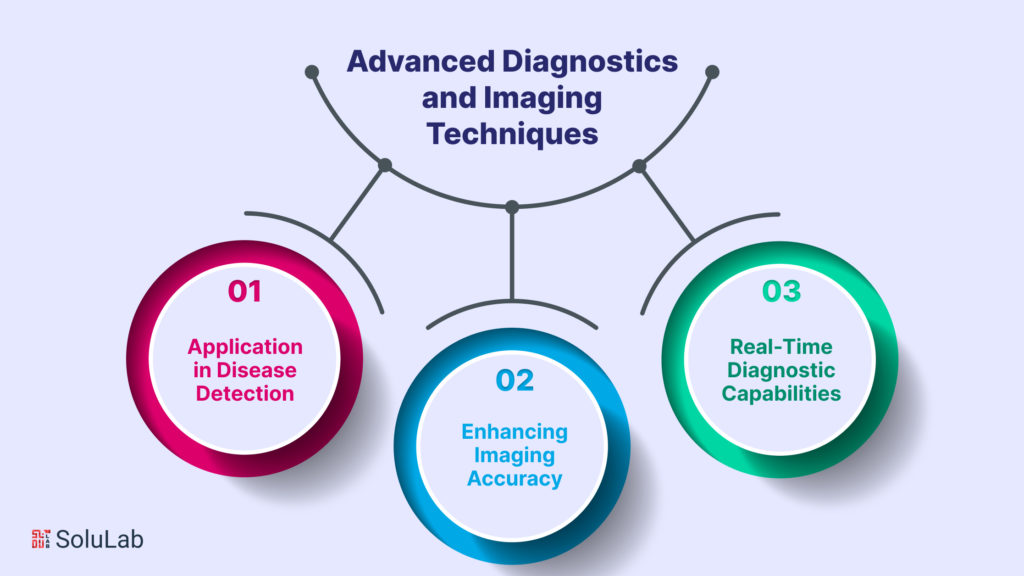
Advanced Diagnostics and Imaging Techniques

With the aid of Generative Artificial Intelligence AI applications, healthcare providers can now delve into a realm of advanced diagnostics and imaging techniques. Leveraging Generative Artificial Intelligence (AI) models, medical professionals can enhance disease detection, improve imaging accuracy, and enable real-time diagnostic capabilities for improved patient care and treatment outcomes.

  • Application in Disease Detection

Generative AI applications in diagnostics enable healthcare professionals to detect diseases with greater precision and accuracy. By analyzing medical images and data, Generative AI can identify subtle patterns and indicators that may not be apparent to the human eye, facilitating early disease detection and proactive intervention.

  • Enhancing Imaging Accuracy

The integration of Generative AI models in imaging technologies has significantly improved imaging accuracy and quality. Through advanced image processing algorithms and pattern recognition capabilities, Generative AI enhances the clarity and detail of medical images, enabling healthcare providers to make accurate and informed diagnostic decisions.
CTA1

  • Real-Time Diagnostic Capabilities

Generative AI-powered diagnostic tools offer real-time capabilities, allowing healthcare professionals to access immediate diagnostic insights and recommendations. By leveraging Generative AI models, healthcare providers can expedite the diagnostic process, reduce waiting times, and deliver prompt and effective medical interventions, thereby improving patient outcomes and satisfaction.

Personalized Treatment Plans

Generative AI plays a crucial role in shaping personalized treatment plans for patients. By utilizing Generative AI tools, healthcare providers can tailor medication regimens, design customized therapy protocols, and recommend lifestyle modifications based on individual patient needs and medical history. This personalized approach to treatment fosters better patient engagement and overall healthcare experiences.

  • Tailoring Medication Regimens

Generative AI facilitates the customization of medication regimens based on patient-specific data and treatment requirements. By analyzing patient health records, medical history, and genetic predispositions, Generative AI models assist healthcare providers in developing personalized medication plans that address individual health needs and optimize treatment outcomes.

  • Customized Therapy Protocols

Generative AI-powered therapy protocols enable healthcare professionals to design customized treatment plans that align with the unique needs and preferences of each patient. By integrating patient data and therapeutic insights, Generative AI models recommend tailored therapy approaches, rehabilitation strategies, and lifestyle modifications, fostering patient engagement and adherence to treatment regimens.

  • Lifestyle Modification Recommendations

Generative AI applications offer comprehensive lifestyle modification recommendations based on patient health data and behavioral patterns. By analyzing patient behavior, dietary habits, and activity levels, Generative AI models provide personalized lifestyle modification suggestions, wellness strategies, and preventive measures that promote healthy living and disease prevention.

Read Also: How Healthcare Startups in the USA Leverage Generative AI to Cut 40% Costs? 

Drug Discovery and Development Processes

In the realm of drug discovery and development, Generative AI has emerged as a powerful tool. By leveraging AI-driven predictive modeling, healthcare professionals can identify potential drug candidates more efficiently, accelerate clinical trial processes, and enhance the efficacy and safety of new pharmaceutical interventions. Generative AI models have the potential to revolutionize the drug development landscape and bring about significant advancements in patient care.

  • Predictive Modeling for Drug Identification

Generative AI facilitates predictive modeling for efficient drug identification and development. By analyzing molecular structures, biochemical interactions, and pharmacological data, Generative AI models accelerate the drug discovery process, optimize compound selection, and improve the efficacy and safety of pharmaceutical products, leading to the development of novel treatments and therapies for various medical conditions.

  • Accelerating Clinical Trial Processes

Generative AI-powered clinical trial processes streamline the evaluation and validation of pharmaceutical products and treatments. By integrating data analysis tools and predictive modeling techniques, Generative AI expedites clinical trial phases, enhances participant recruitment and selection, and ensures accurate data interpretation, contributing to the timely approval and market launch of innovative drugs and therapies.

  • Improving Drug Efficacy and Safety

Generative AI plays a crucial role in enhancing drug efficacy and safety by optimizing drug formulation and dosage specifications. By conducting comprehensive data analysis and clinical simulations, Generative AI models predict the potential outcomes and adverse effects of pharmaceutical interventions, enabling healthcare professionals to design and administer safe and effective drug treatments that minimize risks and maximize patient well-being.

Precision Medicine and Genomic Analysis

Genomic analysis and precision medicine have been significantly enhanced with the integration of Generative AI technologies. Through the identification of genetic markers and the implementation of personalized disease risk assessments, healthcare providers can develop targeted treatment approaches for various health conditions. Generative AI’s role in precision medicine continues to expand, offering promising avenues for personalized healthcare solutions.

  • Genetic Marker Identification

Generative AI facilitates the identification of genetic markers and biomarkers associated with various health conditions and diseases. By analyzing genomic data and conducting in-depth genetic profiling, Generative AI models identify specific genetic variations and mutations that may contribute to disease susceptibility or therapeutic responses, enabling healthcare professionals to develop targeted interventions and personalized treatment approaches.

Read Blog Also : Influence of AI on Mobile Application Development 

  • Personalized Disease Risk Assessments

Generative AI-powered disease risk assessments provide comprehensive evaluations of individual health risks and predispositions. By integrating genetic data, medical histories, and lifestyle factors, Generative AI models assess patients’ susceptibility to specific diseases and health complications, allowing healthcare providers to offer personalized preventive measures, health management strategies, and early intervention plans that mitigate health risks and promote overall well-being.

  • Targeted Treatment Approaches

Generative AI supports the development of targeted treatment approaches that address the unique genetic characteristics and biological profiles of individual patients. By leveraging genetic insights and disease-specific data, Generative AI models recommend tailored therapeutic interventions, precision medicine strategies, and genetic-based treatments that optimize treatment efficacy and minimize adverse effects, leading to improved patient outcomes and satisfaction.

Virtual Health Assistants and Patient Support

Virtual health assistants and patient support systems have been transformed by the capabilities of Generative AI. By incorporating AI-powered symptom analysis and remote consultation services, healthcare providers can deliver comprehensive patient education and support. These virtual health assistants serve as a vital bridge between patients and healthcare professionals, offering timely assistance and guidance for various healthcare concerns.

  • Remote Consultation Services

Generative AI-powered virtual health assistants enable remote consultation services and telehealth solutions for patients and healthcare providers. By integrating natural language processing and machine learning capabilities, Generative AI models facilitate interactive virtual consultations, medical guidance, and patient education, enhancing the accessibility and convenience of healthcare services and fostering continuous patient engagement and support.

Read Blog Post: Strategies for Leveraging Generative AI in E-Commerce

  • AI-Powered Symptom Analysis

Generative AI-driven symptom analysis tools offer accurate and reliable assessments of patient symptoms and health conditions. By analyzing patient-reported data and medical histories, Generative AI models generate comprehensive symptom evaluations, differential diagnoses, and treatment recommendations, empowering patients to make informed healthcare decisions and enabling healthcare providers to deliver timely and effective medical interventions.

  • Patient Education and Support Systems

Generative AI applications support the development of patient education and support systems that provide comprehensive health information and wellness resources. By utilizing interactive learning modules and personalized health content, Generative AI models facilitate patient education, self-care management, and preventive health initiatives, promoting patient empowerment, health literacy, and active participation in healthcare decision-making processes.

Enhanced Medical Research and Data Analysis
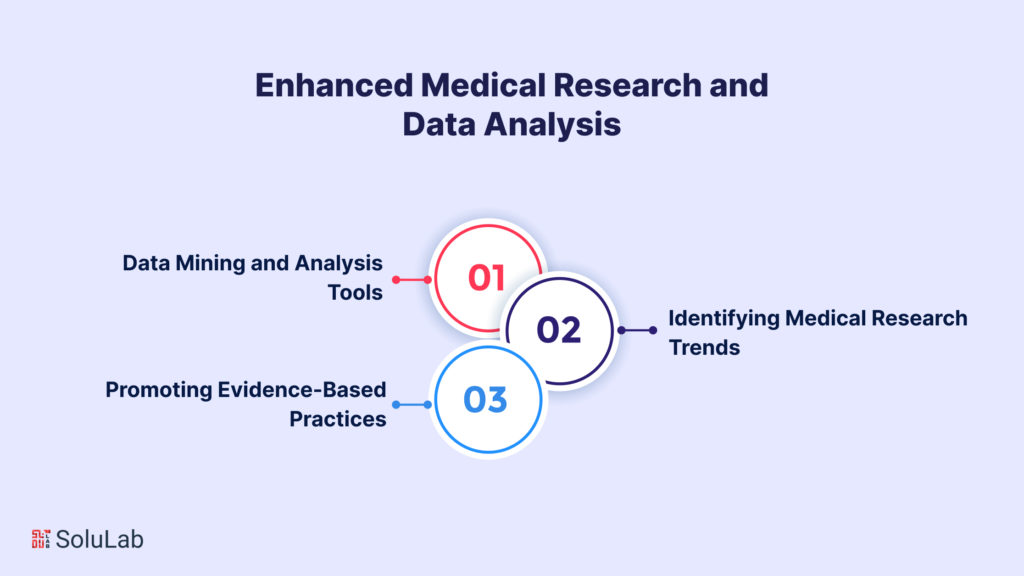
Enhanced Medical Research and Data Analysis

Generative AI has significantly bolstered medical research and data analysis capabilities. By utilizing advanced data mining and analysis tools, healthcare organizations can identify emerging medical research trends and promote evidence-based practices. Generative AI applications enable healthcare professionals to gain deeper insights from vast datasets, paving the way for informed decision-making and enhanced research outcomes.

  • Data Mining and Analysis Tools

Generative AI-powered data mining and analysis tools enable comprehensive exploration and extraction of valuable insights from large-scale healthcare datasets and research repositories. By utilizing machine learning algorithms and predictive analytics, Generative AI models uncover hidden patterns, correlations, and trends within complex healthcare data, facilitating evidence-based research, clinical studies, and medical discoveries that drive advancements in patient care, disease management, and healthcare innovation.

  • Identifying Medical Research Trends

Generative AI models play a crucial role in identifying emerging medical research trends and research priorities within the healthcare industry. By analyzing scientific literature, clinical trials, and research publications, Generative AI applications highlight key areas of research interest, innovative technologies, and novel treatment modalities, providing valuable guidance and strategic direction for healthcare organizations, research institutions, and medical professionals involved in cutting-edge research and development initiatives.

  • Promoting Evidence-Based Practices

Generative AI promotes evidence-based practices and informed decision-making processes within the healthcare ecosystem. By evaluating clinical evidence, treatment outcomes, and real-world data, Generative AI models generate evidence-based guidelines, clinical recommendations, and best practice protocols that guide healthcare professionals in delivering high-quality, patient-centered care, fostering standardized treatment approaches, and ensuring optimal healthcare delivery across diverse clinical settings and specialties.

Streamlined Administrative Processes and Operational Efficiency

With the integration of Generative AI, healthcare institutions can streamline administrative processes and optimize operational efficiency. By automating workflow management and optimizing resource allocation, healthcare providers can ensure smoother operations and improved resource utilization. Moreover, Generative AI emphasizes the importance of data security and compliance, facilitating a secure and efficient healthcare ecosystem.

  • Automating Workflow Management

Generative AI-driven workflow management solutions streamline administrative processes and operational workflows within healthcare organizations and medical facilities. By automating routine tasks, appointment scheduling, and administrative procedures, Generative AI models optimize resource utilization, minimize operational inefficiencies, and enhance productivity. In mental health practices, for example, an AI therapy notes generator enables faster and more structured clinical note-taking without compromising quality.

  • Optimizing Resource Allocation

Generative AI supports the optimization of resource allocation and resource utilization strategies in healthcare settings. By analyzing resource demands, patient needs, and operational requirements, Generative AI models facilitate efficient resource planning, staff scheduling, and inventory management, enabling healthcare organizations to allocate resources effectively, reduce wastage, and enhance cost-effectiveness, leading to improved operational efficiency and financial sustainability within the healthcare sector.

  • Ensuring Data Security and Compliance

Generative AI applications ensure robust data security and compliance measures to safeguard sensitive healthcare information and protect patient privacy. By implementing advanced encryption protocols, data anonymization techniques, and regulatory compliance frameworks, Generative AI models establish secure data management practices, data governance standards, and data protection policies that adhere to industry regulations, compliance guidelines, and ethical data handling practices, fostering a secure and trustworthy healthcare environment for all stakeholders and ensuring data integrity and confidentiality at every stage of healthcare operations and service delivery.

Predictive Analytics and Early Disease Detection
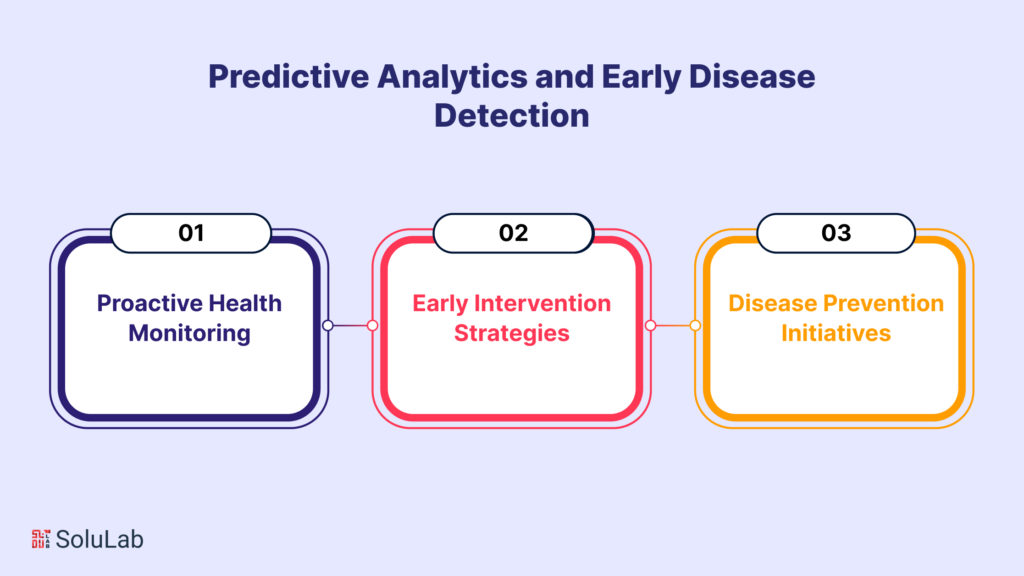
Predictive Analytics and Early Disease Detection

Predictive analytics powered by Generative AI has empowered healthcare providers to engage in proactive health monitoring and early disease detection. By implementing early intervention strategies and disease prevention initiatives, healthcare professionals can mitigate potential health risks and promote proactive healthcare management. Generative AI’s role in predictive analytics is instrumental in enabling timely and effective healthcare interventions.

  • Proactive Health Monitoring

Generative AI-powered predictive analytics enable proactive health monitoring and early detection of potential health risks and medical conditions. By analyzing patient data, vital signs, and health metrics, Generative AI models can identify subtle changes and anomalies in patient health patterns, facilitating timely interventions, personalized health monitoring plans, and preventive care strategies that promote proactive wellness management and disease prevention initiatives, leading to improved health outcomes and enhanced patient well-being.

  • Early Intervention Strategies

Generative AI supports the development of early intervention strategies and preventive healthcare measures that aim to mitigate health risks and prevent the onset of chronic diseases. By leveraging predictive modeling and risk assessment algorithms, Generative AI models can identify high-risk populations, vulnerable patient groups, and individuals predisposed to specific health conditions, enabling healthcare providers to implement targeted interventions, preventive screenings, and wellness programs that promote early detection, disease prevention, and health promotion, fostering a culture of proactive healthcare and wellness management among diverse patient communities and population groups.

Read the Blog Post: Generative AI and Human-AI Collaboration

  • Disease Prevention Initiatives

Generative AI-driven disease prevention initiatives and public health campaigns play a vital role in promoting community health and fostering population wellness. By analyzing epidemiological data, disease patterns, and public health trends, Generative AI models can identify prevalent health concerns, community health disparities, and population-specific health challenges, facilitating the implementation of preventive measures, health education programs, and community outreach initiatives that raise awareness, promote healthy lifestyles, and address public health priorities, leading to improved health outcomes, reduced disease burden, and enhanced community well-being.

Robotic Surgery and Precision Procedures

Generative AI plays a vital role in facilitating robotic surgery and precision procedures. With AI-assisted surgical technologies and precision instrumentation, healthcare providers can perform minimally invasive surgical techniques with enhanced precision and control. Generative AI’s contribution to robotic surgery has transformed the landscape of surgical interventions, promoting safer and more efficient procedures for patients.

  • AI-Assisted Surgical Technologies

Generative AI-driven robotic surgery and AI-assisted technologies have transformed the landscape of modern surgical procedures and minimally invasive interventions. By integrating advanced robotics, machine learning algorithms, and surgical automation systems, Generative AI models enable precise, controlled surgical interventions, complex procedures, and intricate medical techniques that enhance surgical accuracy, improve patient safety, and optimize surgical outcomes, offering healthcare professionals advanced tools and technologies that redefine surgical precision and revolutionize the field of surgical medicine and healthcare delivery.

Read Also: Leveraging Generative AI for Data Analysis and Modeling

  • Minimally Invasive Surgical Techniques

Generative AI supports the development and implementation of minimally invasive surgical techniques and advanced medical procedures that minimize patient discomfort, reduce surgical risks, and promote faster recovery times. By leveraging robotic-assisted technologies, image-guided navigation systems, and real-time surgical visualization tools, Generative AI models enable healthcare professionals to perform complex surgeries, intricate interventions, and delicate procedures with greater precision, dexterity, and control, offering patients minimally invasive treatment options, less invasive alternatives, and advanced surgical therapies that enhance patient comfort, improve clinical outcomes, and redefine the standards of surgical excellence in modern healthcare practice.

  • Precision Instrumentation and Control

Generative AI-driven precision instrumentation and surgical control systems enhance the capabilities of healthcare professionals and surgical teams in delivering high-precision medical interventions and specialized surgical procedures. By integrating advanced robotics, AI-driven control mechanisms, and real-time feedback loops, Generative AI models enable precise instrument manipulation, accurate tissue handling, and controlled surgical maneuvers that optimize surgical performance, reduce the risk of surgical errors, and ensure exceptional surgical precision and accuracy, empowering healthcare providers with innovative surgical tools and technologies that elevate the standards of surgical care and redefine the future of surgical excellence in healthcare practice.

Read more : Generative AI for Enterprises

Remote Patient Monitoring and Telemedicine Solutions

Remote patient monitoring and telemedicine solutions have been significantly enhanced with the integration of Generative AI technologies. Through the deployment of virtual health monitoring devices and secure telehealth consultation platforms, healthcare providers can ensure secure data transmission and privacy protection for remote patient interactions. Generative AI’s role in remote patient monitoring has led to a more accessible and efficient healthcare system, enabling patients to receive quality care from the comfort of their homes.

  • Virtual Health Monitoring Devices

Generative AI-powered remote patient monitoring solutions and virtual health monitoring devices have transformed the landscape of remote healthcare delivery and patient care management. By integrating advanced sensor technologies, wearable devices, and data analytics platforms, Generative AI models enable real-time health monitoring, remote patient tracking, and virtual care management, empowering healthcare providers to monitor patient health metrics, vital signs, and medical data from a distance, facilitating timely interventions, remote consultations, and personalized care plans that enhance patient engagement, improve clinical outcomes, and redefine the standards of remote healthcare delivery and telemedicine practice.

  • Telehealth Consultation Platforms

Generative AI supports the development and implementation of telehealth consultation platforms and virtual healthcare delivery systems that facilitate seamless communication, remote consultations, and virtual care interactions between patients and healthcare providers. By leveraging advanced communication technologies, video conferencing tools, and secure data transmission channels, Generative AI models enable real-time telehealth consultations, remote medical assessments, and virtual healthcare interactions, enabling healthcare professionals to offer personalized care, expert medical advice, and comprehensive treatment recommendations to patients in remote locations, fostering patient convenience, enhancing care accessibility, and redefining the dynamics of virtual healthcare delivery and telemedicine practice.

  • Secure Data Transmission and Privacy Protection

Generative AI-driven secure data transmission protocols and privacy protection measures play a critical role in safeguarding patient information, maintaining data confidentiality, and ensuring regulatory compliance in remote healthcare settings. By integrating advanced encryption algorithms, data security protocols, and privacy-enhancing technologies, Generative AI models enable secure data transmission, protected data storage, and confidential information sharing, empowering healthcare providers to uphold patient privacy, comply with data protection regulations, and safeguard sensitive medical data during remote consultations, virtual care interactions, and telehealth engagements, establishing a secure and trusted virtual healthcare environment that prioritizes patient confidentiality, data security, and ethical data handling practices in telemedicine and remote patient care settings.
CTA2

Conclusion

In conclusion, the transformative impact of Generative AI in the healthcare sector cannot be overstated. From advanced diagnostics to remote patient monitoring, Generative AI has redefined the standards of patient care, operational efficiency, and medical research. Its role in fostering personalized treatment plans, streamlining administrative processes, and enhancing medical research capabilities has revolutionized the way healthcare services are delivered and managed.

SoluLab, as a leading Generative AI development company, remains committed to harnessing the power of Generative AI to drive innovation and excellence in healthcare. Our Generative AI consulting services, AI development solutions, and the expertise of our dedicated developers are geared towards leveraging Generative AI for the betterment of healthcare practices and patient outcomes.

As the Generative AI revolution continues to unfold, its potential to enhance healthcare services, improve patient experiences, and drive meaningful outcomes will remain at the forefront of transformative change in the healthcare industry. With the support of pioneering Generative AI models, tools, and applications, healthcare providers and organizations can embrace the future of healthcare delivery, ushering in an era of personalized, data-driven, and patient-centric care. Contact SoluLab today to discover how our expertise can shape this transformative journey.

FAQs

 1. How is Generative AI transforming the healthcare industry?

Generative AI is revolutionizing the healthcare industry by enabling advanced diagnostics, personalized treatment plans, streamlined administrative processes, and more. Its applications range from enhancing imaging accuracy to improving drug discovery and development processes, ultimately leading to better patient care and outcomes.

2. What are the key benefits of integrating Generative AI in healthcare practices?

The key benefits of integrating Generative AI in healthcare practices include improved diagnostic accuracy, personalized treatment approaches, streamlined operational efficiency, enhanced research capabilities, and proactive health monitoring. By leveraging Generative AI, healthcare providers can deliver more effective and tailored care to patients, leading to better overall healthcare experiences.

3. How can healthcare organizations leverage Generative AI for improved patient care and outcomes?

Healthcare organizations can leverage Generative AI to enhance patient care and outcomes through various means, such as implementing virtual health assistants for remote consultation, utilizing predictive analytics for early disease detection, and adopting robotic surgery for precision procedures. By leveraging Generative AI tools and models, healthcare providers can offer more efficient and effective healthcare services to their patients.

4.What are the challenges associated with the adoption of Generative AI in healthcare settings?

The adoption of Generative AI in healthcare settings may come with challenges, such as data security and privacy concerns, regulatory compliance issues, integration complexities, and the need for specialized expertise. Overcoming these challenges requires careful planning, robust security measures, and collaboration with experienced Generative AI development companies like SoluLab, which specialize in providing tailored Generative AI solutions for the healthcare sector.

5. What role does SoluLab play in providing Generative AI development and consulting services for the healthcare sector?

SoluLab plays a critical role in providing Generative AI development and consulting services for the healthcare sector. With a focus on leveraging cutting-edge Generative AI technologies, SoluLab offers comprehensive AI development services, including the development of custom Generative AI models, consulting on Generative AI use cases, and providing dedicated Generative AI developers with expertise in healthcare-specific applications.

6. How does Generative AI contribute to personalized treatment plans and precision medicine in healthcare?

Generative AI contributes to personalized treatment plans and precision medicine in healthcare by facilitating the identification of genetic markers, enabling tailored medication regimens, and supporting customized therapy protocols. By leveraging Generative AI, healthcare providers can deliver more targeted and effective treatment approaches, leading to improved patient outcomes and better management of various health conditions.

7. What are the security and privacy considerations when implementing Generative AI solutions in the healthcare domain?

When implementing Generative AI solutions in the healthcare domain, security and privacy considerations are crucial. Healthcare organizations must ensure compliance with data protection regulations, implement robust encryption and data security measures, and prioritize patient privacy at every step. By working with experienced Generative AI development companies like SoluLab, healthcare providers can ensure the implementation of secure and privacy-conscious Generative AI solutions tailored to their specific needs.

 

Is Metaverse the Future of Digital Connection?


Is Metaverse the Future of Digital Connection?

In the fast-paced world of technology and interconnectedness, a new frontier has emerged, promising to revolutionize the way we connect and interact in the digital realm. This groundbreaking concept, known as the Metaverse, is capturing the imaginations of tech enthusiasts and visionaries alike. As we journey further into the digital age, it’s becoming increasingly clear that the Metaverse development is the future of digital connection. In this blog, we’ll delve into what the Metaverse is, how it’s shaping our digital landscape, and why it holds the key to a more immersive, interconnected world.

So, without any further ado, let’s get started!

The Emergence of the Metaverse

The concept of the Metaverse isn’t a recent development; it has been simmering in the world of technology and science fiction for several decades. However, what sets the present moment apart is the remarkable emergence of the Metaverse development into the mainstream consciousness and the substantial investments being made to make it a reality.

Historical Context and Development

The idea of a Metaverse has its roots in science fiction, notably in Neal Stephenson’s 1992 novel “Snow Crash.” In this futuristic vision, Stephenson introduced the concept of a virtual reality-based, shared digital universe. While Stephenson’s Metaverse was fictional, it planted a seed in the minds of technologists and futurists.

Over the years, this concept evolved alongside advances in technology. It was popularized in movies like “The Matrix” and “Ready Player One,” fueling the imagination of creators and technophiles. Still, it remained largely theoretical until recent years.

Read Our Blog: 10 Real-World Use Cases of the Metaverse in 2023

Major Tech Companies Investing in the Metaverse

Today, we’re witnessing a significant transformation. Major technology companies, including Facebook (now Meta), Microsoft, Google, and others, have made substantial commitments to bring the Metaverse to life. Meta’s CEO, Mark Zuckerberg, has been particularly vocal about his vision for the Metaverse, stating that it will be the successor to the internet as we know it.

These tech giants are investing billions in developing the necessary infrastructure, hardware, software, and platforms to enable the Metaverse development companies. They are collaborating with experts in virtual reality, augmented reality, and artificial intelligence to turn this ambitious concept into a concrete reality.

How the Metaverse Has Gained Prominence?

Several factors have contributed to the Metaverse’s rapid emergence and growing prominence. First and foremost is the exponential growth in computational power, making it possible to render complex and immersive virtual environments in real time. High-speed internet connectivity has become more widespread, allowing for seamless interactions in these digital realms.

The COVID-19 pandemic accelerated the need for remote work, remote learning, and virtual gatherings, highlighting the limitations of traditional digital communication. The Metaverse, with its potential for more immersive, personal, and dynamic interactions, became an appealing solution.

In brief, the Metaverse AI integration has emerged from the realm of science fiction and theoretical discussions into a tangible focus on technological development. The convergence of powerful computing, advanced networking, and the changing landscape of digital communication has propelled the Metaverse into the mainstream, where it is reshaping the way we envision the future of digital connection.

What the Metaverse Offers?

What the Metaverse Offers?

The Metaverse is more than just a buzzword; it represents a transformative shift in the way we connect and interact in the digital world. It offers a wealth of possibilities that go far beyond our current understanding of digital communication. Let’s explore what the Metaverse has in store for us.

  • Immersive Experiences and Digital Interactions

At its core, the Metaverse promises immersive experiences. Imagine putting on a virtual reality headset and stepping into a lifelike digital world where you can interact with others as if they were physically present. Whether it’s attending a concert, exploring a museum, or simply hanging out with friends, the Metaverse allows you to do it in a way that feels almost as real as the physical world.

This immersion extends beyond visual experiences. It encompasses other senses, such as touch and sound, through haptic feedback devices and advanced audio systems. As technology continues to advance, the sensory richness of the Metaverse will become even more compelling.

  • Beyond Virtual Reality: Exploring Augmented Reality

While virtual reality is a significant component of the Metaverse, augmented reality plays an equally vital role. Augmented reality enhances the physical world with digital overlays, adding a layer of interactivity and information to our surroundings. This means that the Metaverse doesn’t just exist in a virtual space; it can seamlessly integrate with the real world.

For instance, you might use AR glasses to see real-time information about the people you meet or the places you visit. Augmented reality empowers users to navigate and interact with both the digital and physical realms, blurring the lines between them.

Read Also: How Will Metaverse Change the World? A New Era of Connectivity and Innovation!

  • Integration of Gaming, Social Media, and More

The Metaverse is not limited to a single application or platform. It is a vast interconnected network of spaces and experiences, spanning everything from gaming and social media to e-commerce and education. This integration means that you can seamlessly transition between various activities within the Metaverse.

For instance, you might start your day with a virtual workout, attend a virtual meeting with colleagues, and then relax by joining friends in a virtual world for gaming or socializing. The Metaverse enables a diverse range of activities and interests, making it a versatile platform for both work and play.

  • Boundless Creative and Collaborative Opportunities

One of the most exciting aspects of the Metaverse is the creative freedom it offers. Users can create, design, and personalize their digital spaces and avatars, fostering a sense of ownership and identity. Whether you’re an artist, developer, educator, or entrepreneur, the Metaverse provides a canvas for innovation.

Collaboration takes on a new dimension in the Metaverse as well. Teams can work together in virtual environments that mimic physical offices, making remote work more engaging and productive. The Metaverse encourages creative problem-solving and collaboration in ways that extend beyond the limitations of traditional video conferencing or chat applications.

Digital Connection Reinvented

The Metaverse Artificial Intelligence is not merely a technological concept; it’s a profound shift in how we connect and communicate in the digital realm. In this section, we’ll explore how the Metaverse is reinventing digital connections, offering us experiences that go beyond the limits of traditional online interaction.

  • Virtual Social Interactions in the Metaverse

One of the most significant transformations the Metaverse offers is in the realm of social interaction. In traditional online communication, interactions often feel distant, lacking the nuance of in-person conversation. The Metaverse seeks to change that by creating immersive digital environments that mimic real-world social interactions.

Imagine attending a virtual social gathering with friends or family who live far away. In the Virtual Reality Metaverse, you can share the same virtual space, interact with one another’s avatars, and even replicate the physical gestures and expressions that make face-to-face interactions so meaningful. This level of immersion can bring loved ones closer, even when they’re physically separated.

Moreover, social interactions in the Metaverse aren’t constrained by geographic borders. You can connect with people from all around the world, breaking down the barriers of distance and making global connections easier and more meaningful than ever before.

CTA1

  • Transforming Remote Work and Education

The Metaverse has the potential to revolutionize the way we work and learn. Remote work and online education have become increasingly prevalent, but they often lack the collaboration and engagement found in physical settings. The Metaverse, with its virtual office spaces and interactive classrooms, can change this.

For remote work, employees can meet in a virtual office that mimics a physical workspace, making meetings and collaborations more personal and engaging. Colleagues can gather around a virtual whiteboard to brainstorm, just as they would in a traditional conference room.

In education, students can attend classes in a virtual environment that replicates the dynamics of a real classroom. Educators can use interactive tools and simulations to make learning more engaging. The Metaverse can bridge the gap between the convenience of online learning and the immersive experiences of in-person education.

  • Enhanced Communication and Personalization

The Metaverse is designed to enhance communication. In addition to voice and text, it offers rich visual and sensory cues that mimic face-to-face conversations. Avatars can express emotions, and users can use spatial audio to have more natural conversations.

Moreover, the Metaverse fosters personalization. Users can customize their avatars, surroundings, and experiences to reflect their individuality. This personal touch adds a layer of richness to digital interactions, making them more meaningful and authentic.

In the Metaverse, your digital presence is an extension of your identity, giving you the freedom to express yourself as you choose. Whether you’re meeting friends, colleagues, or strangers, you can tailor your digital presence to create the connection you desire.

Read Our Blog Post: Top 15 Metaverse Startups to Watch out in 2023

  • Experiencing Global Events and Spaces Virtually

The Metaverse allows us to experience global events and spaces in a new way. From attending virtual concerts to exploring iconic landmarks from your living room, the Metaverse opens up a world of experiences that were previously inaccessible.

For instance, you can attend a live concert by your favorite artist, sharing the experience with friends who may be thousands of miles away. Museums and art galleries can be explored in detail, with interactive exhibits and the ability to learn about art and history in an engaging way.

In essence, the Metaverse breaks down the barriers to experiencing the world’s wonders, no matter where you are located. It allows for shared experiences and exploration that are as close to being there in person as technology can currently offer.

Potential Benefits of the Metaverse Technology

Potential Benefits of the Metaverse Technology

The Metaverse is more than just a digital playground; it holds the potential to offer numerous advantages that can reshape the way we live, work, and connect. In this section, we’ll explore some of the potential benefits that the Metaverse brings to the table.

  • Improved Access and Inclusivity

One of the most promising aspects of the Metaverse is its ability to enhance access and inclusivity. In traditional digital communication, barriers can exist due to factors like geographical distance, physical disabilities, or socioeconomic limitations. The Metaverse, by its very nature, seeks to break down these barriers.

For individuals with physical disabilities, the top Metaverse platforms provide a level playing field. Virtual environments can be designed to be accessible to all, and avatars can represent people in a way that transcends physical limitations. This inclusivity promotes diversity and equal participation in digital spaces.

Additionally, the Metaverse has the potential to bridge the digital divide by making advanced technology and experiences more accessible to a broader range of people. As technology becomes more affordable and user-friendly, more individuals from diverse backgrounds can participate in the Metaverse.

  • Breaking Down Geographical and Cultural Barriers

Geographical and cultural barriers that often limit our interactions can be overcome in the Metaverse. In this digital realm, you can connect with people from different parts of the world without the need for travel. The physical distance between individuals becomes irrelevant, allowing for global collaboration, friendships, and connections to flourish.

Moreover, the Metaverse is a platform for cross-cultural interactions and understanding. It offers an opportunity for individuals to engage with different cultures, languages, and perspectives, promoting global tolerance and empathy. As more people share experiences within the Metaverse, it has the potential to foster a more interconnected and culturally diverse world.

  • New Opportunities for Businesses and Creators

The business world stands to gain significantly from the Metaverse. It provides a new frontier for commerce, marketing, and customer engagement. Businesses can set up virtual storefronts and immersive shopping experiences, creating innovative ways to connect with customers.

Entrepreneurs and content creators can thrive in the Metaverse. Artists, musicians, game developers, and other creatives can reach global audiences without the need for physical distribution. Virtual events, exhibitions, and performances open up new revenue streams and allow creators to interact directly with their fans.

Furthermore, the Metaverse offers unique marketing and branding opportunities. Companies can create engaging and interactive campaigns within the Metaverse, creating a more immersive and memorable brand experience. It’s a new way for businesses to connect with their audience and remain relevant in a rapidly evolving digital landscape.

Read Also: Metaverse Vs Virtual Reality

  • Opportunities for Education and Training

The Metaverse development has vast potential in the field of education and training. It offers a platform for immersive learning experiences that can benefit students, professionals, and organizations.

For students, the Metaverse can provide interactive and engaging virtual classrooms, making learning more enjoyable and effective. Students can explore historical landmarks, engage in scientific simulations, and connect with educators and peers from around the world.

In the corporate world, the Metaverse can be used for employee training, virtual meetings, and collaboration. It offers a dynamic and cost-effective way to provide professional development and enhance team productivity. The Metaverse can simulate real-world scenarios and offer practical training that is often challenging to achieve in a physical setting.

In essence, the Metaverse development has the potential to bring about a wide range of benefits, including improved access and inclusivity, the breaking down of geographical and cultural barriers, new opportunities for businesses and creators, and innovative solutions for education and training. As it continues to evolve, the Metaverse may become a catalyst for positive changes in various aspects of our lives.

The Future of Metaverse in the Digital World

The Future of Metaverse in the Digital World

As we stand on the cusp of the Metaverse’s integration into our lives, it’s crucial to consider how we can navigate this uncharted territory with responsibility and thoughtfulness. Here’s how individuals, businesses, and society as a whole can play their part in shaping the future based on Metaverse.

How Individuals Can Embrace the Metaverse

Embracing the Metaverse as an individual means approaching it with both curiosity and caution. Here are some key considerations:

  • Digital Citizenship: Learn and practice good digital citizenship. Respect others’ digital spaces, just as you would in the physical world.
  • Privacy Awareness: Be vigilant about your digital privacy. Understand the data you’re sharing and who has access to it.
  • Setting Boundaries: In the immersive world of the Metaverse, it’s important to set boundaries to prevent digital burnout and addiction. Balance your online and offline life.
  • Lifelong Learning: Continuously educate yourself about the Metaverse’s developments and its ethical implications.

Business Opportunities and Ethical Considerations

For businesses, the Metaverse presents a wealth of opportunities, but they should navigate with ethical responsibility:

  • Inclusivity: Ensure your Metaverse initiatives are accessible and inclusive to all potential users, including those with disabilities.
  • Data Ethics: Establish transparent data collection and usage policies, respecting user privacy and consent.
  • Authentic Engagement: Create genuine and immersive experiences in the Metaverse that align with your brand’s values, avoiding exploitative or harmful practices.
  • Ethical Marketing: Engage in responsible marketing practices within the Metaverse, adhering to established ethical guidelines.

Society’s Role in Shaping the Metaverse

As society adapts to the Metaverse, several factors should guide our collective approach:

  • Regulation and Oversight: Policymakers and governments should develop regulatory frameworks that protect users’ rights and ensure a fair and ethical Metaverse.
  • Education and Digital Literacy: Promote digital literacy programs to empower individuals to navigate the Metaverse safely and responsibly.
  • Ethical Design: Encourage the development of the Metaverse to align with ethical standards and respect for diverse cultures and values.
  • Global Collaboration: Foster international cooperation in shaping the Metaverse, addressing its cross-border implications.

Thus, the Metaverse is a digital frontier that offers incredible potential for connection and innovation. However, its responsible and ethical development is essential to ensure it benefits everyone. By taking a collective approach and considering the ethical and societal implications, we can collectively shape a Metaverse that enhances our lives and brings us closer while respecting the values that matter most.

CTA2

Final Words

In conclusion, the Metaverse is not just a technological concept but a profound shift in the way we connect and interact in the digital realm. It offers a transformative vision of a world where geographical distances matter less, inclusivity and accessibility are paramount, and creativity knows no bounds. From immersive social interactions that bridge physical gaps to reimagining the way we work and learn, the Metaverse has the potential to revolutionize our digital lives. As it continues to evolve, it becomes increasingly important for individuals, businesses, and society as a whole to navigate this uncharted territory with a balance of curiosity and caution, emphasizing ethical considerations and digital responsibility.

The journey into the Metaverse is an exciting one, filled with possibilities and opportunities for growth and connection. While challenges and concerns undoubtedly accompany this evolution, the potential benefits of the Metaverse are too significant to ignore. It’s up to all of us to shape the Metaverse responsibly and ensure that it becomes a force for positive change in our ever-connected, digital world. As we step into this new era, let’s remain vigilant, empathetic, and forward-thinking, working together to unlock the full potential of the Metaverse as the future of digital connection.

SoluLab, a Metaverse development company, with extensive experience in technology and digital innovation, is well-equipped to contribute significantly to the development of Metaverse technology. Whether it’s designing immersive Metaverse experiences, crafting secure and privacy-centric platforms, or aiding businesses in seizing the abundant opportunities in this evolving digital landscape, SoluLab is ready to provide creative and pragmatic Metaverse development services. With a forward-thinking approach and a strong commitment to responsible development, SoluLab can be your trusted partner to hire Metaverse developers for your business and in navigating the Metaverse’s potential. Contact us today to explore how we can assist you in embracing the future of digital connection.

FAQs

1. What is the Metaverse, and how does it differ from virtual reality (VR)?

The Metaverse is a collective virtual shared space that encompasses various digital environments, including VR. While VR focuses on immersive experiences in a virtual world, the Metaverse is a broader concept that includes augmented reality, social media integration, and online gaming, creating a more interconnected digital universe.

2. How can the Metaverse enhance remote work and education?

The Metaverse can create virtual office spaces for remote work, mimicking physical offices for more engaging meetings and collaboration. In education, it offers immersive virtual classrooms and practical training, making learning more enjoyable and effective.

3. What ethical concerns are associated with the Metaverse?

Ethical concerns include issues related to privacy and data security, digital addiction, and economic disparities in accessing the Metaverse. Ensuring responsible use, data protection and equitable access are key considerations.

4. How can businesses benefit from the Metaverse?

Businesses can benefit from the Metaverse development through innovative marketing and branding opportunities, virtual storefronts, and unique customer engagement experiences. It also opens up new revenue streams and global outreach for creators and entrepreneurs.

5. How can SoluLab assist in harnessing the potential of the Metaverse for my business or project?

SoluLab, with its extensive experience and forward-thinking approach, can provide a range of services tailored to your specific needs. From developing immersive Metaverse experiences to creating secure and privacy-conscious platforms, we can be your trusted partner in navigating the Metaverse’s vast potential and to hire dedicated developers. Our expertise can help you seize the opportunities presented by this emerging digital landscape, whether it’s for interactive marketing campaigns, virtual storefronts, or innovative customer engagement. To explore how SoluLab can assist you in shaping your Metaverse journey, contact SoluLab today for a consultation.

Play-to-Earn Games: Revolutionizing the Gaming Industry with Blockchain

Blockchain P2E Games

In the gaming world, a revolutionary concept has emerged – play-to-earn games. These virtual experiences have started to reshape how we view and participate in the gaming industry, thanks to the power of blockchain technology. In this blog, we will delve into the concept of play-to-earn games and how blockchain is playing a pivotal role in this transformation.

Play-to-Earn Games: A New Paradigm

Play-to-earn games, often abbreviated as P2E, represent a paradigm shift in the gaming industry. Unlike traditional video games, where players invest time and skill solely for entertainment, play-to-earn games allow participants to accumulate in-game assets that have real-world value. These assets can be traded, sold, or even used as collateral, creating economic opportunities for players.

The defining characteristics of play-to-earn games include decentralized ownership of assets, blockchain-based scarcity, and transparent, trustless ecosystems. Players in P2E games not only enjoy the immersive experience but also have the chance to earn a living through their gaming endeavors.

Read Blog Post: Top 25 Blockchain-Based Gaming Companies

Gaming has come a long way since the days of Pong and Space Invaders. In the early years, video games were perceived as pure entertainment, with no tangible value beyond the screen. Over time, competitive gaming, or esports, emerged, offering professional players the chance to earn money through tournaments and sponsorships.

However, the transformation truly began with the rise of virtual economies within video games. Games like World of Warcraft introduced the concept of virtual currencies and in-game trading. Players began to realize the potential for making a profit within these virtual worlds.

The term “play-to-earn” may have only recently gained prominence, but its roots trace back to the early 2010s. It was in this era that blockchain technology, primarily associated with cryptocurrencies like Bitcoin, was applied to gaming. Games like CryptoKitties and Decentraland pioneered the idea of blockchain-based assets and ownership.

One of the pioneering play-to-earn games, Axie Infinity, launched in 2018 and set the stage for this revolutionary concept. Axie Infinity allowed players to own, breed, and trade digital creatures called Axies, with the potential to earn real income in the form of cryptocurrency. The success of Axie Infinity paved the way for a new era in gaming, as more developers and players recognized the economic possibilities that play-to-earn offered.

Understanding Blockchain Technology

Blockchain technology, which underpins play-to-earn games, is a distributed ledger that records transactions across a network of computers. It’s designed to be transparent, immutable, secure, and decentralized. Each record, or block, is linked to the previous one, creating a chain of blocks.

Blockchain technology is the backbone of play-to-earn games, enabling them to function as they do. It ensures that in-game assets are truly owned by the players and not controlled by centralized game developers or publishers. The transparent nature of the blockchain also guarantees that all transactions and asset scarcity are publicly verifiable, enhancing trust within the ecosystem.

Benefits of Blockchain in Gaming

Benefits of Blockchain in Gaming

Blockchain technology offers a plethora of benefits in the context of gaming, which are driving the play-to-earn revolution:

  • Ownership and Scarcity

In traditional games, items and currency often exist solely within the game’s servers. Players may invest significant time and money into acquiring virtual assets, only to find them disappear when a game shuts down. In play-to-earn games, assets are recorded on the blockchain, granting players true ownership. This means they can buy, sell, trade, or even use these assets as collateral in decentralized finance (DeFi) applications.

Blockchain also introduces scarcity by limiting the supply of certain in-game assets, mimicking the scarcity of physical items. This scarcity enhances the value of these assets, as players understand that there is a finite number available, creating a sense of rarity and exclusivity.

CTA1

  • Transparency and Security

The blockchain ledger is transparent and secure, ensuring that all transactions are recorded and publicly accessible. This transparency minimizes fraudulent activities and cheating within games, fostering a fair and secure environment for players. Since blockchain transactions are immutable, they cannot be altered, providing a high level of security for player assets.

  • Cross-Game Interoperability

One of the most groundbreaking aspects of blockchain in gaming is cross-game interoperability. Players can use assets acquired in one blockchain-based game in another. For example, an armor set earned in one game can be used in another game developed by a different studio. This interoperability unlocks new possibilities for gamers and developers alike, as they can leverage a wide range of assets across different virtual worlds.

Notable Blockchain Gaming Projects

Notable Blockchain Gaming Projects

Several blockchain-based games and platforms have gained attention for their innovative use of blockchain technology. Here are a few notable examples:

  • Axie Infinity

As mentioned earlier, Axie Infinity is a blockchain-based game where players collect, breed, and battle fantasy creatures called Axies. These creatures are NFTs (non-fungible tokens) that can be bought and sold in a marketplace. Axie Infinity has seen remarkable growth, with players earning cryptocurrency for their in-game activities.

  • Decentraland

Decentraland is a virtual world built on the Ethereum blockchain, allowing players to buy, sell, and build on virtual land parcels. The ownership and transactions of these virtual properties are secured on the blockchain. Decentraland represents a metaverse, a concept that envisions interconnected virtual worlds.

  • The Sandbox

The Sandbox is a user-generated content platform that lets players create, own, and monetize their gaming experiences and assets. These user-generated assets are represented as NFTs on the blockchain, and creators can sell them in a marketplace.

  •  CryptoKitties

CryptoKitties, one of the earliest blockchain games, introduced the concept of collectible, breedable, and tradeable digital cats. Each CryptoKitty is an NFT, allowing players to own and trade these unique digital pets.

Economic and Social Impact

One of the most remarkable aspects of play-to-earn games is the economic empowerment they offer to players. Unlike traditional games, where players often invest time and money for purely entertainment purposes, play-to-earn games enable participants to monetize their gaming skills.

These games have the potential to transform the lives of players, especially in regions where traditional job opportunities may be limited. In countries with economic disparities, play-to-earn games have opened doors to financial independence. Players can earn a living wage by participating in these virtual worlds, making it possible to support themselves and their families through gaming.

For instance, in the Philippines, where the cost of living is high and job opportunities can be scarce, many players have turned to games like Axie Infinity to make a decent income. They earn cryptocurrency by breeding and battling Axies, which they can then convert into real-world money.

Check Out Our Blog: Top Blockchain Technology Companies in 2025

Redefining the Gaming Experience

Play-to-earn games offer a unique gaming experience that sets them apart from traditional titles. In these games, the player’s investment of time and skill translates into tangible rewards, creating a sense of accomplishment beyond the virtual realm.

Players not only immerse themselves in captivating gameplay but also have a vested interest in their in-game activities. Every move, every strategy, and every decision can affect their earnings. This dynamic makes the gaming experience more engaging, as players are directly linked to the outcomes of their in-game actions.

As a result, play-to-earn games often foster dedicated communities, with players supporting and learning from one another. The social aspects of gaming have never been more pronounced, as players share tips, strategies, and stories about their experiences.

Social and Cultural Implications

The rise of play-to-earn games has social and cultural implications that extend beyond gaming. These games have introduced a new way of earning income and have disrupted traditional notions of work and leisure.

Read Also: Top 10 Real World Applications of Blockchain Technology

In some cultures, the concept of making money through gaming has met with skepticism or misunderstanding. However, as these games gain traction and visibility, societal perceptions are evolving. The success stories of players who have achieved financial stability and success through play-to-earn games are changing the narrative, legitimizing gaming as a viable career.

Additionally, the communities within play-to-earn games have transcended geographical boundaries. Players from diverse backgrounds and locations come together, share experiences, and collaborate, demonstrating the unifying power of gaming. This inclusivity has the potential to foster greater understanding and global cooperation.

Challenges and Concerns

Challenges and Concerns

  • Scalability

The adoption of blockchain technology in gaming is not without its challenges. Scalability is one of the primary concerns. Many blockchain networks face limitations in terms of transaction speed and capacity. This can lead to slow or congested gameplay experiences in some blockchain-based games. Developers are actively working on solutions, such as layer-2 scaling solutions, to mitigate this issue and ensure seamless gameplay.

  • Environmental Concerns

Another concern is the environmental impact of blockchain networks. Most blockchain networks, including Bitcoin and Ethereum, rely on a proof-of-work (PoW) consensus mechanism that consumes a substantial amount of energy. This has led to concerns about the carbon footprint of blockchain technology. To address this, some projects are transitioning to more energy-efficient consensus mechanisms, like proof-of-stake (PoS).

  • Regulatory and Legal Challenges

The regulatory landscape for blockchain gaming is still evolving. Different countries have varying approaches to regulating cryptocurrencies and virtual assets, which can create legal uncertainties for developers and players. The industry is in the early stages of addressing these regulatory challenges, but it’s essential for the long-term success of play-to-earn games.

Play-to-Earn and the Future of Gaming

The growth of play-to-earn games has been nothing short of phenomenal. The success of games like Axie Infinity and the increasing popularity of metaverse concepts indicate a bright future for this gaming paradigm. The number of players and investors entering the space continues to rise, with NFTs from blockchain games frequently making headlines.

Market statistics reveal a steady upward trajectory, with the global blockchain gaming market estimated to reach significant values in the coming years. New players are eager to explore the potential of play-to-earn, and the competition among blockchain game developers is intensifying.

Technological Innovations

The rapid pace of technological innovation is another key driver of the play-to-earn revolution. Developers are continually pushing the boundaries of what’s possible, creating immersive virtual worlds and innovative gameplay experiences. The integration of augmented reality (AR) and virtual reality (VR) with blockchain gaming is on the horizon, promising even more immersive and engaging experiences.

Predictive algorithms and artificial intelligence are also being used to create more dynamic and responsive in-game environments, where the player’s choices have far-reaching consequences. These innovations are set to redefine how we engage with play-to-earn games.

Predictions and Speculations

While predicting the future of any industry is always challenging, several trends and possibilities are worth considering:

1. The Metaverse Revolution: The concept of the metaverse, an interconnected network of virtual worlds, could become a reality. The metaverse would offer limitless possibilities for players to explore, interact, and earn across different virtual landscapes.

2. Mainstream Adoption: As blockchain technology becomes more accessible and user-friendly, play-to-earn games may experience mainstream adoption. Traditional game developers may also integrate blockchain features into their titles.

3. Regulatory Clarity: Governments and regulatory bodies are expected to provide clearer guidelines for blockchain gaming, addressing legal concerns and ensuring a secure environment for players and investors.

4. Diverse Revenue Streams: Play-to-earn games might introduce new and diverse revenue streams, including NFT-based virtual real estate, streaming opportunities, and sponsored content within virtual worlds.

CTA2

Conclusion

In summary, play-to-earn games are transforming the gaming industry by offering players real-world value for their in-game achievements. The integration of blockchain technology ensures true ownership, scarcity, transparency, and security, unlocking opportunities for players and reshaping the gaming experience.

The play-to-earn revolution is dynamic and continually evolving. As technology advances and the community grows, we can expect even more innovation in the years to come.

SoluLab offers comprehensive blockchain game development services, enabling the creation of immersive gaming experiences using blockchain technology. Our expert blockchain developers specialize in decentralized application development across various blockchain protocols, including Ethereum, Polygon, Binance, Hyperledger, Solana, Polkadot, and more. Whether you’re looking to build blockchain-based games or decentralized applications, we provide the expertise you need. Contact SoluLab today to explore the endless possibilities of blockchain gaming.

FAQs

1. What are play-to-earn games, and how do they work?

Play-to-earn games are video games that allow players to earn real-world value through in-game activities. These games are often built on blockchain technology, which ensures true ownership of in-game assets. Players can collect, trade, or sell these assets, turning their gaming skills into financial opportunities.

2. What is the role of blockchain in play-to-earn games?

Blockchain technology underpins play-to-earn games by providing a transparent, secure, and decentralized infrastructure. It enables true ownership of in-game assets, scarcity through blockchain-based tokens, and trustless transactions. Blockchain ensures that players have full control of their virtual assets and the ability to monetize them.

3. Can you give examples of successful play-to-earn games?

Yes, there are notable play-to-earn games such as Axie Infinity, Decentraland, The Sandbox, and CryptoKitties. Axie Infinity, for instance, allows players to collect, breed, and battle fantasy creatures called Axies, which are tokenized on the blockchain. Players earn cryptocurrency by participating in these activities.

4. What challenges do play-to-earn games and blockchain technology face?

Play-to-earn games encounter challenges related to scalability, environmental concerns due to the energy consumption of blockchain networks, and regulatory and legal uncertainties. Developers are actively working on addressing these issues to ensure a sustainable and secure environment for players.

5. How can I get started with play-to-earn games and blockchain gaming?

To get started, you’ll need to set up a digital wallet compatible with the blockchain used by the game. Next, explore different play-to-earn games and choose one that interests you. Acquire the necessary in-game assets, learn the gameplay, and start earning. Keep in mind that, like any investment, it’s essential to do your research and understand the game’s mechanics before getting involved.

Security in DeFi: How to Protect Your Assets


Security in DeFi: How to Protect Your Assets

The rise of decentralized finance (DeFi) has revolutionized the financial landscape, offering innovative opportunities for users to engage in a wide array of financial activities without the need for traditional intermediaries. While DeFi presents a promising and accessible platform for users to participate in decentralized financial transactions, the security of DeFi assets remains a critical concern. With the growing adoption of DeFi protocols, ensuring robust security measures and protocols is paramount to safeguarding user assets and maintaining the trust and integrity of the DeFi ecosystem. This comprehensive guide delves into the intricacies of DeFi security, exploring the best practices, security measures, and compliance protocols essential for protecting DeFi assets and fostering a secure and resilient DeFi landscape. From understanding the importance of DeFi security to exploring future trends and innovations, this guide provides valuable insights into the critical aspects of DeFi security and the strategies necessary to protect assets within the dynamic world of decentralized finance.

What is DeFi Security?

Understanding the fundamental concepts and principles of securing assets in the decentralized finance (DeFi) space, this section provides a comprehensive overview of the critical components that constitute DeFi security and its significance in the evolving financial landscape.

Understanding the Importance of DeFi Security

Decentralized finance (DeFi) has gained significant traction in recent years, revolutionizing the traditional financial landscape by providing innovative and decentralized alternatives to conventional banking and investment services. With the increasing adoption of DeFi platforms and protocols, ensuring robust security measures has become imperative. DeFi security plays a critical role in fostering trust and confidence among users, investors, and stakeholders within the DeFi ecosystem. By prioritizing security, DeFi platforms can safeguard user assets, mitigate risks of potential vulnerabilities, and foster a secure and reliable environment for decentralized financial transactions.

Overview of Decentralized Finance (DeFi)

Decentralized finance (DeFi) refers to the movement aimed at creating an open and permissionless financial system using blockchain technology. DeFi platforms facilitate various financial services such as lending, borrowing, trading, and asset management without the need for intermediaries. These platforms utilize smart contracts and decentralized applications (DApps) to enable users to engage in financial activities directly without relying on traditional financial institutions. The DeFi ecosystem offers greater financial inclusivity, transparency, and accessibility, empowering users to have full control over their assets and investments.

The Need for Robust Security Measures in DeFi

As the DeFi landscape continues to expand, the need for robust security measures has become increasingly evident. The decentralized nature of DeFi platforms presents unique security challenges that require comprehensive solutions to protect user funds, data, and privacy. With the rise of various DeFi protocols, applications, and platforms, ensuring the security and safety of user assets has become a top priority. Implementing stringent security measures—including encryption, multi-factor authentication, and password protection—helps mitigate the risks associated with potential vulnerabilities, hacks, and data breaches, fostering a secure and resilient DeFi ecosystem for all participants.”

DeFi Security Measures: Best Practices and Protocols

DeFi Security Measures: Best Practices and Protocols

Exploring the various measures and protocols essential for ensuring the security of DeFi platforms, this section delves into the industry’s best practices and protocols that underpin a robust and resilient security framework in the DeFi ecosystem.

  • Exploring Key DeFi Security Protocols

In the context of the dynamic and evolving DeFi landscape, implementing robust security protocols is essential to safeguard user assets and maintain the integrity of the DeFi ecosystem. Various DeFi security protocols are designed to address potential vulnerabilities and security threats, offering a layered approach to fortify the overall security posture of DeFi platforms. These security protocols often include multi-layer authentication mechanisms, encryption techniques, and decentralized identity management systems to enhance the security and privacy of user transactions and data within the DeFi space.

  • Best Practices for Ensuring DeFi Security

Ensuring DeFi security involves adopting best practices that prioritize the protection of user assets and data. Several key best practices contribute to enhancing the security of DeFi platforms and protocols. Implementing robust authentication mechanisms, such as multi-factor authentication (MFA) and biometric security measures, strengthens user account security and prevents unauthorized access. Additionally, regular security audits, code reviews, and penetration testing are essential for identifying and addressing potential vulnerabilities and weaknesses within DeFi protocols and smart contracts. By following these best practices, DeFi platforms can bolster their security measures and create a more secure and reliable environment for users to engage in decentralized financial activities.

CTA1

  • Importance of Audits and Code Reviews in DeFi

Conducting comprehensive security audits and code reviews is critical to identifying and addressing potential vulnerabilities within DeFi platforms and protocols. Security audits help assess the overall security posture of DeFi platforms, identify potential loopholes or weaknesses, and recommend necessary security enhancements. Through thorough code reviews, DeFi developers and security experts can identify and rectify any coding errors, bugs, or vulnerabilities that may compromise the security and functionality of DeFi smart contracts and applications. By prioritizing regular security audits and code reviews, DeFi platforms can maintain a robust security posture and instill trust and confidence among users and investors.

Risks and Vulnerabilities in DeFi

Identifying the inherent risks and vulnerabilities associated with decentralized finance (DeFi), this section highlights the potential threats and challenges that users and platforms may encounter, shedding light on the critical areas where security breaches may occur.

  • Identifying Common Risks and Vulnerabilities in DeFi

Despite the numerous advantages and opportunities presented by DeFi, the ecosystem is susceptible to various risks and vulnerabilities that can compromise user funds and data. Identifying common risks and vulnerabilities is crucial in developing effective risk mitigation strategies and enhancing the security of DeFi Derivatives. Some of the common risks and vulnerabilities in DeFi include smart contract vulnerabilities, flash loan attacks, price oracle manipulation, and decentralized exchange (DEX) vulnerabilities. By understanding these risks, DeFi platforms can implement proactive security measures to protect user assets and prevent potential security breaches.

  • Analyzing the Impact of Security Breaches in DeFi

Security breaches in the DeFi landscape can have far-reaching consequences, affecting user trust, platform credibility, and overall market stability. A security breach can lead to the loss of user funds, sensitive data exposure, and compromised transactional integrity, resulting in significant financial losses and reputational damage for affected users and platforms. The impact of security breaches extends beyond financial implications, as it can erode user confidence and hinder the adoption and growth of the DeFi ecosystem. By analyzing the potential impact of security breaches, DeFi platforms can prioritize the implementation of robust security measures and risk mitigation strategies to minimize the likelihood and impact of security incidents.

  • Understanding Smart Contract Risks in DeFi Platforms

Smart contracts serve as the backbone of DeFi platforms, enabling the automation of various financial transactions and operations. However, smart contracts are not immune to risks and vulnerabilities, making them susceptible to potential security threats and attacks. Understanding smart contract risks in DeFi platforms involves recognizing potential coding errors, bugs, and vulnerabilities that can compromise the functionality and security of smart contracts. Vulnerabilities such as reentrancy attacks, integer overflow, and unauthorized access can expose DeFi platforms to various security risks, leading to potential financial losses and operational disruptions. By prioritizing smart contract security and conducting thorough code reviews, DeFi platforms can mitigate smart contract risks and create a secure and reliable environment for decentralized financial activities.

Safeguarding DeFi Assets: Wallet and Asset Protection

Focusing on the protection of assets within the DeFi space, this section delves into the intricacies of safeguarding DeFi assets through effective wallet selection, management, and advanced security measures, emphasizing the importance of protecting private keys and employing multi-signature wallets.

  • Securing DeFi Assets: Wallet Selection and Safety Measures

Safeguarding DeFi assets is paramount to maintaining the security and integrity of the DeFi ecosystem. Users must prioritize selecting secure and reputable wallets that offer robust security features and encryption protocols to protect their digital assets. Hardware wallets, cold storage solutions, and secure mobile wallets are popular options that provide enhanced security and protection for DeFi assets. By choosing secure wallets and implementing stringent safety measures, users can minimize the risks of unauthorized access, theft, and asset compromise, fostering a secure and reliable environment for managing and storing their DeFi assets.

  • Importance of Private Key Management in DeFi

Private key management is a crucial aspect of DeFi security that directly impacts the safety and accessibility of user assets. Safeguarding private keys is essential to prevent unauthorized access and protect user funds from potential security breaches and theft. DeFi users must adopt robust private key management practices, such as secure storage, encryption, and multi-signature authentication, to ensure the confidentiality and integrity of their private keys. By prioritizing private key management, users can maintain full control over their DeFi assets and prevent potential security risks and compromises associated with unauthorized access and key exposure.

Read Also: 9 Best Defi Staking Platforms in 2024

  • Exploring Multi-Signature Wallets for DeFi Security

Multi-signature wallets offer an additional layer of security and protection for DeFi assets, enabling users to secure their digital assets through a collaborative authentication process. Multi-signature wallets require multiple private key signatures to authorize transactions, enhancing the security and integrity of DeFi asset management. By leveraging multi-signature wallet solutions, users can prevent single points of failure, reduce the risks of unauthorized transactions, and protect their assets from potential security threats and breaches. Implementing multi-signature wallets is a proactive security measure that strengthens the overall security posture of DeFi asset management and fosters a secure and trusted environment for decentralized financial transactions.

DeFi Platform Security: Protecting User Funds and Information

Emphasizing the security of user funds and information on DeFi platforms, this section delves into the critical aspects of data privacy and security features, highlighting the measures necessary for mitigating the risks of hacks and data breaches within DeFi platforms.

  • Ensuring User Fund Security on DeFi Platforms

DeFi platforms must prioritize user fund security to instill trust and confidence among users and investors. Implementing robust security measures, such as secure authentication protocols, data encryption, and transaction monitoring, helps protect user funds from potential security breaches and unauthorized access. DeFi platforms must employ secure and reliable infrastructure, comprehensive security protocols, and advanced encryption technologies to safeguard user funds and ensure the integrity of financial transactions within the DeFi ecosystem. By prioritizing user fund security, DeFi platforms can create a safe and reliable environment for users to participate in decentralized financial activities with peace of mind and confidence.

  • Data Privacy Measures for DeFi Platform Users

Data privacy is a critical component of DeFi platform security that emphasizes the protection and confidentiality of user information and sensitive data. DeFi platforms must implement stringent data privacy measures, such as data encryption, access controls, and privacy policies, to safeguard user information from unauthorized access and data breaches. By prioritizing data privacy, DeFi platforms can enhance user trust and confidence, comply with regulatory standards, and foster a transparent and secure environment for users to engage in decentralized financial transactions and activities. Protecting user data privacy is essential in building a secure and trustworthy DeFi ecosystem that prioritizes user confidentiality and security.

Read Blog Post: The Role of Decentralized Exchanges (DEXs) in DeFi

  • Mitigating Risks of Hacks and Data Breaches in DeFi Platforms

Mitigating the risks of hacks and data breaches is a top priority for DeFi platforms seeking to create a secure and resilient environment for users and investors. DeFi platforms must implement robust security measures, proactive threat detection systems, and incident response protocols to prevent, detect, and respond to potential security incidents and breaches effectively. By prioritizing risk mitigation strategies and adopting comprehensive security measures, DeFi platforms can minimize the risks of hacks and data breaches, protect user data and assets, and maintain the overall security and integrity of the DeFi ecosystem. Proactive risk mitigation is essential in establishing a secure and reliable DeFi platform that prioritizes user safety and trust.

DeFi Exchange Security: Trading Safely in the DeFi Space

DeFi Exchange Security: Trading Safely in the DeFi Space

Addressing the security concerns associated with trading and asset exchange within the DeFi space, this section provides insights into the security features and strategies implemented by DeFi exchanges to ensure safe and secure transactions and swaps.

  • Security Features in DeFi Exchanges: An Overview

DeFi exchanges play a crucial role in enabling users to trade and exchange digital assets within the DeFi ecosystem. Implementing robust security features is essential for ensuring the safety and integrity of DeFi exchanges, protecting user funds, and maintaining a secure trading environment. Security features such as secure authentication, encrypted data transmission, and transaction monitoring help mitigate the risks of unauthorized access, data breaches, and fraudulent activities on DeFi exchanges. By implementing comprehensive security features, DeFi exchanges can foster user trust, enhance platform credibility, and create a safe and secure environment for users to trade and exchange digital assets with confidence and peace of mind.

  • Tips for Secure Trading and Asset Exchange in DeFi

Secure trading and asset exchange in the DeFi space require users to adopt proactive security measures and best practices that prioritize the protection and integrity of their digital assets. Users must prioritize secure authentication practices, conduct thorough due diligence on DeFi projects and platforms, and utilize secure wallets and authentication methods to protect their assets from potential security risks and vulnerabilities. By following secure trading tips and best practices, users can mitigate the risks of unauthorized access, fraudulent transactions, and asset compromise, fostering a secure and reliable trading environment within the DeFi ecosystem. Proactive security measures are essential in empowering users to trade and exchange digital assets with confidence and trust in the DeFi space.

  • Ensuring the Safety of Transactions and Swaps in DeFi

The safety of transactions and swaps is paramount in maintaining the integrity and reliability of DeFi exchanges and platforms. DeFi users must prioritize secure transaction practices, conduct comprehensive risk assessments, and leverage secure and reputable DeFi platforms to facilitate seamless and secure asset transactions and swaps. Implementing secure transaction protocols, such as encrypted data transmission, multi-factor authentication, and secure wallet integrations, helps protect user assets and transactional integrity from potential security threats and vulnerabilities. By prioritizing transaction safety, DeFi users can engage in secure and reliable asset transactions and swaps within the DeFi ecosystem, fostering a trusted and resilient trading environment for all participants.

DeFi Audits and Compliance: Ensuring Regulatory Standards

Exploring the critical role of audits and compliance in maintaining regulatory standards within the DeFi landscape, this section emphasizes the importance of adhering to legal frameworks and regulatory requirements, ensuring the security and compliance of DeFi platforms.

  • Importance of Regulatory Compliance in DeFi

Regulatory compliance is a crucial aspect of DeFi security that emphasizes the adherence to legal frameworks, industry standards, and regulatory guidelines to ensure the legality and legitimacy of DeFi operations. DeFi platforms must prioritize regulatory compliance by implementing comprehensive compliance programs, conducting regular audits, and adhering to regulatory standards to prevent legal implications and regulatory penalties. By prioritizing regulatory compliance, DeFi platforms can foster trust and credibility among users and investors, comply with legal requirements, and create a secure and transparent environment for decentralized financial activities and transactions. Adherence to regulatory standards is essential in building a reputable and compliant DeFi ecosystem that upholds industry best practices and legal requirements.

Read Our Blog: 7 Best Defi Trading Platforms in 2024

  • Role of DeFi Audits in Maintaining Security and Compliance

DeFi audits play a pivotal role in ensuring the security, reliability, and compliance of DeFi platforms and protocols. Regular audits help identify potential security vulnerabilities, assess platform integrity, and verify compliance with regulatory standards and industry best practices. DeFi platforms must conduct comprehensive audits, security assessments, and code reviews to mitigate the risks of security breaches, unauthorized access, and non-compliance with legal requirements. By engaging in regular audits, DeFi platforms can proactively identify and address potential security risks, strengthen platform security and compliance, and build a trustworthy and resilient DeFi ecosystem for all participants. Regular audits are essential in maintaining the security and compliance of DeFi platforms and protocols, fostering trust and confidence among users and investors.

  • Adhering to Legal Frameworks in the DeFi Landscape

Adhering to legal frameworks is critical for DeFi platforms to maintain the integrity, legality, and credibility of their operations within the DeFi landscape. DeFi platforms must prioritize legal compliance by understanding and adhering to legal requirements, regulatory guidelines, and industry standards to prevent legal implications and regulatory penalties. By engaging legal advisors, compliance experts, and industry professionals, DeFi platforms can navigate complex legal frameworks, ensure adherence to regulatory standards, and build a compliant and secure environment for decentralized financial activities and transactions. Adherence to legal frameworks is essential in establishing a reputable and trustworthy DeFi landscape that upholds legal requirements and industry best practices, fostering a secure and compliant environment for all participants in the DeFi space.

Case Studies: Successful DeFi Security Implementations

Analyzing successful implementations of DeFi security measures, this section presents case studies highlighting exemplary practices and strategies employed by leading DeFi projects to ensure robust security measures, providing valuable insights into effective DeFi security implementations.

  • Analyzing Case Studies of DeFi Platforms with Robust Security

Analyzing case studies of successful DeFi platforms with robust security implementations provides valuable insights into the best practices, strategies, and technologies that contribute to the security and reliability of decentralized financial activities. Case studies highlight successful DeFi platforms that have prioritized security, compliance, and user trust, demonstrating effective security measures, compliance programs, and risk mitigation strategies. By analyzing case studies, DeFi platforms can learn from successful implementations, identify key security challenges and solutions, and implement industry best practices to strengthen their security posture and build a secure and trusted DeFi ecosystem for all participants. Learning from successful case studies is essential in fostering a secure and resilient DeFi landscape that prioritizes user safety, trust, and compliance.

Read Blog Post: List of Top 10 Defi Savings Accounts

  • Learning from Successful DeFi Security Implementations

Learning from successful DeFi security implementations allows DeFi platforms to leverage industry insights, best practices, and successful strategies to enhance their security posture and compliance programs. Successful DeFi security implementations emphasize the importance of proactive security measures, comprehensive risk assessments, and regulatory compliance in creating a secure and reliable DeFi ecosystem. By adopting successful security strategies and practices, DeFi platforms can mitigate the risks of security breaches, unauthorized access, and non-compliance with regulatory standards, fostering a secure and compliant environment for decentralized financial activities and transactions. Learning from successful DeFi security implementations is essential in empowering DeFi platforms to strengthen their security posture, prioritize user trust and safety, and build a resilient and trusted DeFi landscape for all participants.

  • Exploring Best Practices from Leading DeFi Projects

Exploring best practices from leading DeFi projects provides valuable insights into the strategies, technologies, and approaches that contribute to the success and security of decentralized financial activities. Leading DeFi projects prioritize security, compliance, and user trust by implementing robust security measures, comprehensive compliance programs, and proactive risk mitigation strategies. By exploring best practices from leading DeFi projects, DeFi platforms can learn from successful implementations, identify key security challenges and solutions, and implement industry best practices to strengthen their security posture and build a secure and trusted DeFi ecosystem for all participants. Exploring best practices from leading DeFi projects is essential in fostering a secure and resilient DeFi landscape that prioritizes user safety, trust, and compliance.

Future of DeFi Security: Trends and Innovations

Future of DeFi Security: Trends and Innovations

Discussing the future trends and innovative developments in DeFi security, this section explores the emerging advancements and technologies shaping the future of DeFi security, providing valuable foresights into the evolving landscape of security measures within the DeFi ecosystem.

  • Emerging Trends in DeFi Security Measures

The future of DeFi security is shaped by emerging trends and innovations that aim to enhance the security, reliability, and compliance of decentralized financial activities and transactions. Emerging trends in DeFi security emphasize the adoption of advanced security protocols, technologies, and compliance frameworks to mitigate the risks of security breaches, unauthorized access, and non-compliance with regulatory standards. By embracing emerging trends, DeFi platforms can proactively address security challenges, implement innovative security solutions, and build a secure and trusted DeFi ecosystem for all participants. Embracing emerging trends in DeFi security is essential in fostering a secure and resilient DeFi landscape that prioritizes user safety, trust, and compliance, laying the foundation for a secure and innovative future of decentralized finance.

Read Our Blog Post: Top 10 Decentralized Crypto Exchanges to Consider in 2024

  • Advancements in DeFi Security Protocols and Technologies

Advancements in DeFi security protocols and technologies drive the evolution and innovation of security measures, compliance programs, and risk mitigation strategies within the DeFi landscape. Advancements in DeFi security protocols leverage cutting-edge technologies, such as blockchain, encryption, and authentication methods, to strengthen the security and reliability of decentralized financial activities and transactions. By adopting advanced security protocols and technologies, DeFi platforms can enhance their security posture, prevent security breaches, and ensure compliance with regulatory standards, fostering a secure and trusted DeFi ecosystem for all participants. Embracing advancements in DeFi security protocols and technologies is essential in building a resilient and innovative DeFi landscape that prioritizes user safety, trust, and compliance.

  • Predictions for the Future of DeFi Security

Predictions for the future of DeFi security highlight the evolution and transformation of security measures, compliance programs, and risk mitigation strategies within the DeFi landscape. Predictions emphasize the continued adoption of advanced security technologies, the development of comprehensive compliance frameworks, and the integration of innovative security solutions to strengthen the security and reliability of decentralized financial activities and transactions. By embracing predictions for the future of DeFi security, DeFi platforms can proactively address security challenges, implement effective security strategies, and foster a secure and trusted DeFi ecosystem for all participants. Embracing predictions for the future of DeFi security is essential in laying the groundwork for a secure, innovative, and resilient DeFi landscape that prioritizes user safety, trust, and compliance.

CTA2

Conclusion

In the rapidly evolving landscape of decentralized finance (DeFi), ensuring robust security measures is paramount to maintaining the trust and confidence of users and investors. By implementing comprehensive security protocols, users can safeguard their assets and information from potential threats and vulnerabilities. The critical understanding of DeFi security and its implications on the wider financial ecosystem serves as a crucial foundation for the successful adoption and integration of DeFi applications. As the DeFi space continues to witness exponential growth and innovation, the need for advanced security solutions and compliance measures becomes increasingly pronounced.

At SoluLab, we recognize the significance of DeFi security in fostering a secure and reliable financial ecosystem. Our expertise in DeFi development and our comprehensive range of DeFi development services are designed to provide tailored solutions that meet the unique security requirements of each project. With a commitment to excellence and a focus on delivering industry-leading DeFi exchange development solutions, SoluLab remains dedicated to shaping the future of DeFi applications and fostering a secure environment for the global DeFi community.

As the DeFi industry continues to expand and diversify, the integration of advanced security features and protocols will play a pivotal role in ensuring the safety and integrity of DeFi platforms and exchanges. With a focus on continuous innovation and technological advancement, SoluLab remains at the forefront of the DeFi development landscape, providing comprehensive security solutions and robust development services to propel the growth and adoption of decentralized finance applications worldwide. Contact SoluLab today to fortify your DeFi journey with cutting-edge solutions.

FAQs

1. What are the key security challenges in decentralized finance (DeFi) platforms?

The key security challenges in DeFi platforms primarily revolve around smart contract vulnerabilities, data breaches, and hacking incidents that can result in the loss of user funds and sensitive information.

2. How can users ensure the safety of their assets while using DeFi applications?

Users can ensure the safety of their assets while using DeFi applications by implementing robust security practices such as utilizing hardware wallets, practicing secure key management, and being cautious of phishing attempts and fraudulent activities.

3. What are the best practices for securing DeFi wallets and managing private keys?

Best practices for securing DeFi wallets and managing private keys include using hardware wallets, opting for multi-signature solutions, and employing encryption techniques to protect private keys from unauthorized access.

4. How do DeFi security audits contribute to maintaining regulatory compliance?

DeFi security audits contribute to maintaining regulatory compliance by identifying potential security loopholes, ensuring adherence to industry best practices, and implementing necessary measures to safeguard user funds and information.

5. What are some common risks associated with trading on DeFi exchanges, and how can users mitigate these risks?

Common risks associated with trading on DeFi exchanges include hacking incidents, unauthorized access to user funds, and potential vulnerabilities in the trading infrastructure. Users can mitigate these risks by utilizing secure wallet solutions, implementing multi-factor authentication, and conducting due diligence on the platforms they choose to use.

6. What measures can DeFi projects implement to protect user funds and personal information?

DeFi projects can implement various measures to protect user funds and personal information, including robust encryption protocols, data protection mechanisms, and compliance with data privacy regulations to ensure the security and confidentiality of user data.

7. What role do smart contracts play in enhancing the security of DeFi protocols, and what are some potential vulnerabilities to watch out for?

Smart contracts play a vital role in enhancing the security of DeFi protocols by automating various processes and transactions. However, they can also introduce potential vulnerabilities, such as coding errors and exploits, which can be mitigated through rigorous code audits, security testing, and continuous monitoring of the smart contract infrastructure.


Boost Your ROI Using Machine Learning: A Step-by-Step Guide

Boost Your ROI Using Machine Learning: A Step-by-Step Guide

Return on Investment (ROI) is the bedrock of sound financial decision-making in the business world. Simply put, ROI measures the profitability of investments by evaluating the return, typically in monetary terms, generated from a specific investment relative to its cost. ROI is expressed as a percentage and is a powerful metric for assessing the effectiveness of various strategies, projects, or initiatives.

ROI = (Net Profit / Investment Cost) x 100

Understanding ROI is crucial because it provides valuable insights into the success or failure of investments. A positive ROI indicates that an investment has generated more revenue than its initial cost, while a negative ROI suggests the opposite. In essence, ROI with machine learning guides businesses in allocating resources wisely, ensuring that investments contribute positively to the bottom line.

Importance of Maximizing ROI

In the fiercely competitive business landscape, the efficient allocation of resources is paramount. Maximizing ROI is the key to achieving this efficiency. When businesses prioritize projects or initiatives with higher ROI potential, they ensure that every dollar invested has the potential to yield the greatest return. This, in turn, leads to increased profitability and sustainable growth.

Maximizing ROI offers several significant advantages:

  • Resource Optimization: Businesses can allocate resources such as time, capital, and manpower more effectively by focusing on initiatives with higher ROI.
  • Risk Mitigation: By analyzing the potential ROI of an investment, businesses can assess and mitigate risks associated with each opportunity.
  • Decision Clarity: ROI provides a clear and objective basis for decision-making, allowing stakeholders to evaluate projects objectively.
  • Sustainable Growth: Consistently optimizing the best ROI business ensures long-term growth and sustainability.

CTA1

Machine Learning’s Role

Machine learning, a subset of Artificial Intelligence, has emerged as a transformative technology in recent years. Its ability to analyze vast datasets, recognize patterns, and make predictions has made it a game-changer across various industries. Now, businesses are harnessing the power of machine learning to boost Business ROI with Machine Learning.

Machine learning enables businesses to make data-driven decisions, optimize operations, and predict market trends accurately. It has the potential to significantly impact ROI by automating processes, improving customer experiences, and identifying new revenue streams.

Understanding Machine Learning

Understanding Machine Learning

Machine learning is a branch of artificial intelligence (AI) that focuses on developing algorithms and models that allow computers to learn from data. Unlike traditional programming, where explicit instructions are provided, machine learning algorithms learn patterns and make predictions or decisions based on data inputs. This ability to learn from data is what makes machine learning so powerful and versatile.

Machine learning algorithms can be broadly categorized into three types:

  • Supervised Learning: In supervised learning, algorithms are trained on labeled data, where the correct output is provided. The algorithm learns to make predictions based on this labeled data.
  • Unsupervised Learning: Unsupervised learning algorithms work with unlabeled data and aim to find patterns, clusters, or relationships within the data without explicit guidance.
  • Reinforcement Learning: Reinforcement learning involves training algorithms to make sequential decisions by interacting with an environment. The algorithm learns through trial and error, receiving rewards for good decisions and penalties for poor ones.

Machine Learning’s Applications in Business

Machine Learning's Applications in Business

Machine learning’s applications in business are wide-ranging and impactful. Here are a few examples:

  • Customer Analytics: Machine learning helps businesses understand customer behavior, predict preferences, and personalize marketing strategies.
  • Supply Chain Optimization: Machine learning can optimize supply chain operations by predicting demand, reducing inventory costs, and enhancing logistics.
  • Fraud Detection: Financial institutions employ machine learning to detect fraudulent transactions in real-time, protecting both customers and the institution.
  • Predictive Maintenance: Industries such as manufacturing and aviation use machine learning to predict when equipment needs maintenance, reducing downtime and costs.

Data Gathering and Preprocessing

Before delving into machine learning models and strategies, it’s imperative to recognize that the quality of your data is the linchpin of success. The old adage “garbage in, garbage out” aptly applies here. In the context of machine learning, this means that the accuracy and effectiveness of your models are directly linked to the quality of the data they’re trained on.

High-quality data is:

  • Accurate: Data should be free from errors, duplications, and inconsistencies. Accuracy ensures the reliability of the insights generated by machine learning models.
  • Relevant: Data should be directly related to the problem you’re trying to solve. Extraneous or irrelevant data can introduce noise and hinder model performance.
  • Complete: Missing data can be a significant roadblock. Completeness ensures that all necessary information is available for analysis.
  • Consistent: Data should be structured uniformly to facilitate analysis. Consistency across data sources is essential for drawing meaningful conclusions.

Collecting and Preparing Data

  • Data Collection: The process of collecting data can vary widely depending on your business and industry. It might involve customer surveys, sensor data, website logs, or any other relevant sources. It’s crucial to establish a robust data collection process to ensure a consistent inflow of data.
  • Data Preprocessing: Once data is collected, it often requires preprocessing. This involves cleaning, transforming, and structuring the data to make it suitable for machine learning. Common preprocessing steps include handling missing values, dealing with outliers, and encoding categorical variables.
  • Feature Engineering: Feature engineering is the process of creating new features or selecting relevant ones to improve model performance. This step can significantly impact the success of your machine-learning project. For instance, in a retail setting, you might engineer features like customer purchase history or seasonal trends to enhance sales predictions.

Data Quality

The emphasis on data quality cannot be overstated. In machine learning, even state-of-the-art algorithms can only work with the data they’re given. Thus, meticulous data gathering and preprocessing set the stage for success. Without a solid foundation of clean, relevant, and complete data, the subsequent steps in your machine-learning journey will be compromised.

Moreover, it’s crucial to understand that data quality is an ongoing concern. As your business evolves, so do the data requirements. Regularly monitoring and maintaining data quality ensures that your machine-learning models continue to provide reliable results.

Data quality assurance involves not only addressing issues in historical data but also establishing processes to maintain data quality in the future. This may involve data governance frameworks, data validation checks, and data stewardship roles within your organization.

By placing data quality at the forefront of your machine learning initiatives, you set the stage for accurate, actionable insights that can drive ROI optimization.

Choosing the Right Machine Learning Model

Choosing the Right Machine Learning Model

Now that we’ve laid the groundwork with high-quality data, let’s turn our attention to machine learning algorithms. These algorithms are the workhorses of predictive analytics and are used to make sense of data and generate valuable insights. There are various machine learning algorithms, each suited to different types of tasks.

Some of the most common machine learning algorithms include:

  • Linear Regression: This algorithm is used for predicting continuous numeric values, making it suitable for tasks like sales forecasting or price prediction.
  • Logistic Regression: Logistic regression is employed for binary classification problems, such as customer churn prediction.
  • Random Forest: A powerful ensemble learning technique, Random Forest is useful for both classification and regression tasks and is known for its robustness and accuracy.
  • K-Means Clustering: This unsupervised learning algorithm is used for grouping similar data points together, making it valuable for customer segmentation or anomaly detection.
  • Neural Networks: Deep learning neural networks, including convolutional neural networks (CNNs) and recurrent neural networks (RNNs), excel in tasks like image recognition and natural language processing.

Selecting the Appropriate Model

The choice of machine learning model should align with your specific ROI optimization goal. For instance:

  • Regression Models: If your goal is to predict a numeric value, such as estimating the lifetime value of a customer or forecasting product demand, regression models like linear regression or random forest regression might be suitable.
  • Classification Models: For tasks like customer churn prediction or fraud detection, where the goal is to classify data into different categories, algorithms like logistic regression or decision trees can be effective.
  • Clustering Models: If you aim to segment your customer base for targeted marketing, K-means clustering or hierarchical clustering can be instrumental.
  • Deep Learning Models: In scenarios where data is unstructured, such as image analysis or natural language processing, deep learning models like convolutional neural networks (CNNs) and recurrent neural networks (RNNs) offer state-of-the-art solutions.

Complexity vs. Interpretability

Choosing the right model also involves considering the trade-offs between model complexity and interpretability. Some models, like deep neural networks, are highly complex and often described as “black boxes” because it’s challenging to understand how they arrive at their predictions. While they can achieve remarkable accuracy, they may lack transparency, which can be a concern in regulated industries or situations where interpretability is essential.

On the other hand, simpler models like linear regression or decision trees are more interpretable. You can readily examine the model’s coefficients or decision rules to understand why a specific prediction was made. However, they may not capture complex relationships in the data as effectively as more complex models.

The choice between model complexity and interpretability should be guided by your business’s needs and regulatory requirements. Sometimes, a hybrid approach, combining the strengths of different models, is the optimal solution.
Training and Testing the Model

With quality data in hand and a clear understanding of the machine learning model to use, the next crucial step is training the model. This is where the magic happens as the algorithm learns from the data to make predictions or decisions.

  • Training Data: To train a machine learning model, you need a dataset that includes both input features and corresponding target values. The algorithm learns from this historical data, identifying patterns and relationships.
  • Model Learning: During training, the model adjusts its internal parameters to minimize the difference between its predictions and the actual target values. This process is known as optimization or learning.
  • Generalization: The ultimate goal of training is for the model to generalize well to new, unseen data. In other words, it should make accurate predictions on data it hasn’t encountered before.

Data Splitting

To ensure that the trained model generalizes well, it’s essential to split your dataset into two distinct subsets:

  • Training Set: This portion of the data, typically around 70-80% of the dataset, is used to train the machine learning model. The model learns patterns and relationships from this data.
  • Testing Set: The remaining 20-30% of the data is reserved for testing. The model has not seen this data during training. It is used to assess the model’s performance and evaluate how well it generalizes to new, unseen data.

The separation between the training and testing sets is crucial to avoid a common pitfall known as overfitting. Overfitting occurs when a model learns the training data too well, capturing noise and random variations rather than genuine patterns. Such a model will perform poorly on new data because it has essentially memorized the training set.

Model Evaluation

Evaluating a machine learning model’s performance is a critical step in the process. Various evaluation metrics are used depending on the nature of the problem (classification, regression, etc.). Some commonly used metrics include:

  • Classification Metrics: For tasks like customer churn prediction or fraud detection, metrics such as accuracy, precision, recall, F1-score, and ROC-AUC are valuable for assessing the model’s performance.
  • Regression Metrics: In regression tasks, metrics like Mean Absolute Error (MAE), Mean Squared Error (MSE), Root Mean Squared Error (RMSE), and R-squared (R²) help gauge how well the model predicts numeric values.

During the evaluation phase, you may also employ techniques like cross-validation, which involves splitting the data into multiple subsets to obtain a more robust assessment of the model’s performance.

Model evaluation doesn’t stop at the initial training phase. It’s an ongoing process as your business evolves and the data landscape changes. Regularly re-evaluating and retraining your model ensures that it continues to provide accurate predictions, contributing to sustained ROI optimization.

Implementing the Model in Your Business

Implementing the Model in Your Business

Once you have a well-trained machine learning model, the next challenge is seamlessly integrating it into your business operations. The implementation phase involves bridging the gap between data science and practical application.

  • Model Deployment: Deploying a model means making it accessible for use in real-world scenarios. Depending on your business needs, deployment can take various forms, such as embedding the model into a mobile app, a website, or an existing software system.
  • Scalability: Consider the scalability of your solution. Can the deployed model handle increased loads and growing datasets? Scalability ensures that your model can accommodate your business’s future needs.
  • Automation: For maximum impact, strive for automation. Implement processes that enable your machine learning model to make real-time predictions or decisions without manual intervention.

Challenges and Solutions

The implementation phase often comes with its unique set of challenges:

  • Data Drift: Over time, the distribution of incoming data may change, leading to data drift. This can negatively impact model performance. Implementing strategies to monitor and adapt to data drift is crucial.
  • Model Monitoring: Continuously monitor the model’s performance in real-world scenarios. If it begins to underperform, have mechanisms in place to trigger retraining or alerts.
  • Data Security and Privacy: Safeguard sensitive data used by the model, ensuring compliance with data protection regulations and minimizing the risk of breaches.

Addressing these challenges requires a combination of technical expertise, data governance, and collaboration between data scientists and business stakeholders.

Real-time Decision-Making

One of the significant advantages of implementing machine learning models in business operations is the ability to make real-time decisions. Whether it’s personalizing product recommendations for online shoppers or optimizing inventory levels, real-time decision-making can lead to immediate improvements in ROI.

Real-time decision-making powered by machine learning is a game-changer because it allows businesses to respond swiftly to changing conditions, adapt to customer preferences, and seize opportunities as they arise.

Continuous Monitoring

After deploying a machine learning model into your business operations, it’s crucial to recognize that the work is far from over. In fact, it’s just the beginning. The performance of your model in real-world scenarios needs ongoing, vigilant monitoring.

  • Performance Metrics: Define key performance metrics specific to your business goals and monitor them regularly. These metrics could include accuracy, revenue generated, customer retention rates, or any other relevant KPIs.
  • Anomaly Detection: Implement anomaly detection mechanisms to identify unusual patterns or deviations in model behavior. This can help catch issues early, preventing potential revenue loss or customer dissatisfaction.
  • Feedback Loops: Establish feedback loops with the end-users or teams interacting with the model. Their insights and observations can provide valuable input for model improvement.

Fine-Tuning Strategies

As your machine learning model operates in the real world, you’ll likely encounter situations where its performance starts to degrade or deviate from your desired ROI optimization goals. In such cases, fine-tuning becomes essential.

  • Retraining: Periodically retrain your machine learning model with updated data. This helps the model adapt to changing conditions and maintain accuracy.
  • Hyperparameter Tuning: Fine-tune hyperparameters like learning rates or regularization strengths to optimize the model’s performance.
  • Feature Engineering: Revisit feature engineering techniques to ensure that the model is working with the most relevant and predictive features.
  • Algorithm Selection: In some cases, you may discover that a different machine learning algorithm or model architecture performs better as your business evolves. Be open to exploring alternative approaches.
  • Ensemble Methods: Ensemble methods, which combine predictions from multiple models, can often lead to improved accuracy and robustness.
  • Feedback Incorporation: Utilize feedback from end-users or domain experts to improve model predictions. This iterative feedback loop can uncover nuances that were not initially captured.
  • Data Quality Control: Maintain data quality standards rigorously. Data drift, erroneous inputs, or changes in data sources can impact model performance. Implement processes to detect and address data issues promptly.

Evolving Machine Learning Landscape

Evolving Machine Learning Landscape

The world of machine learning is dynamic and ever-evolving. New algorithms, tools, and techniques emerge regularly. Staying up-to-date with the latest developments is crucial for maintaining the competitiveness and effectiveness of your machine learning initiatives.

  • Continuous Learning: Encourage your data science and machine learning teams to engage in continuous learning. Attend conferences, workshops, and online courses to keep skills sharp and knowledge current.
  • Experimentation: Be open to experimentation. Test new approaches and technologies to see if they can offer better ROI optimization solutions.
  • Collaboration: Foster collaboration between data scientists, domain experts, and business stakeholders. The synergy of expertise from different domains can lead to innovative solutions.
  • Ethical Considerations: Be aware of ethical considerations in machine learning, such as bias and fairness. Ensure that your models are not inadvertently perpetuating discrimination or inequity.
  • Regulatory Compliance: Stay informed about evolving regulations related to data privacy and machine learning. Compliance with data protection laws is critical to avoid legal issues and maintain trust with customers.

CTA2

Concluding Remarks

In summary, monitoring and fine-tuning your machine-learning model is not a one-time task but an ongoing process. By continually assessing and improving your model’s performance, you can ensure that it continues to contribute to ROI optimization and business success.

SoluLab is a leading software development company specializing in innovative technologies like machine learning. They help businesses harness data-driven insights to maximize profitability and make informed decisions, aligning perfectly with the principles outlined in the guide on boosting ROI using machine learning. SoluLab, with its extensive expertise in machine learning development services, is the trusted partner for enhancing ROI through cutting-edge solutions in the ever-evolving tech landscape.

Partner with SoluLab to leverage their machine learning capabilities and propel your business towards greater success.

FAQs

1. What is the primary role of machine learning in boosting ROI?

The primary role of machine learning in boosting ROI is to leverage data-driven insights and predictive analytics to optimize business processes. Machine learning models can analyze large datasets, identify patterns, and make accurate predictions, which enables businesses to allocate resources more efficiently, make informed decisions, and identify new revenue opportunities.

2. How do I ensure the quality of data for my machine learning project?

Ensuring data quality is paramount for a successful machine learning project. To achieve this, establish data collection processes that minimize errors, validate data for accuracy, and address missing values. Regularly perform data cleaning and preprocessing to maintain data integrity. Additionally, implement data governance practices to uphold data quality standards over time.

3. What is the significance of model evaluation in machine learning for ROI optimization?

Model evaluation is critical because it assesses how well your machine-learning model performs in real-world scenarios. It provides an objective measure of accuracy and helps identify potential issues like overfitting. Accurate model evaluation ensures that the predictions made by the model contribute positively to ROI optimization, guiding business decisions effectively.

4. How can businesses adapt machine learning models to changing conditions?

Businesses can adapt machine learning models to changing conditions through continuous monitoring and fine-tuning. Regularly retrain models with updated data to keep them aligned with evolving trends. Implement strategies such as hyperparameter tuning, feature engineering, and feedback loops to improve model performance. Be agile in responding to data drift and emerging challenges.

5. What ethical considerations should businesses be aware of when using machine learning for ROI optimization?

Businesses should be vigilant about ethical considerations in machine learning. Avoid bias in data and models that could lead to discriminatory outcomes. Ensure transparency in model predictions, especially in regulated industries. Safeguard customer privacy and comply with data protection laws. Ethical machine learning practices not only protect the business from reputational risks but also uphold trust with customers and stakeholders.


WhatsApp Telegram