Key Takeaways
- Oracles bring off-chain data, prices, property valuations, and proof-of-reserve onto the blockchain so tokenized assets can settle, price, and report accurately.
- A smart contract has no native way to know what a building is worth or whether a bond just paid a coupon. Oracles are the only bridge for that.
- Decentralized oracle networks are generally safer than a single data feed, since one compromised source can’t quietly corrupt the whole system.
- Integration isn’t a one-time task. Oracle infrastructure needs monitoring, fallback sources, and periodic audits for as long as the token exists.
- Picking the wrong oracle provider is one of the more common reasons tokenized asset platforms run into pricing disputes or failed audits later.
A tokenized commercial property is only as trustworthy as the number sitting behind it. Where does that valuation come from, who updates it, and what happens if the feed goes stale for a week?
That’s the problem oracle integration for real-world asset data solves. Without it, a blockchain has no idea what’s happening in the outside world, and a real-world asset tokenization platform that can’t reflect real prices or real events isn’t much use to anyone holding the token.
More than 560 million individuals globally are currently engaged with blockchain technology, reflecting its integration into mainstream digital ecosystems.
Continue reading this blog to learn everything about how to integrate oracles for real-world asset tokenization.
What Are Oracles in Real-World Asset Tokenization?
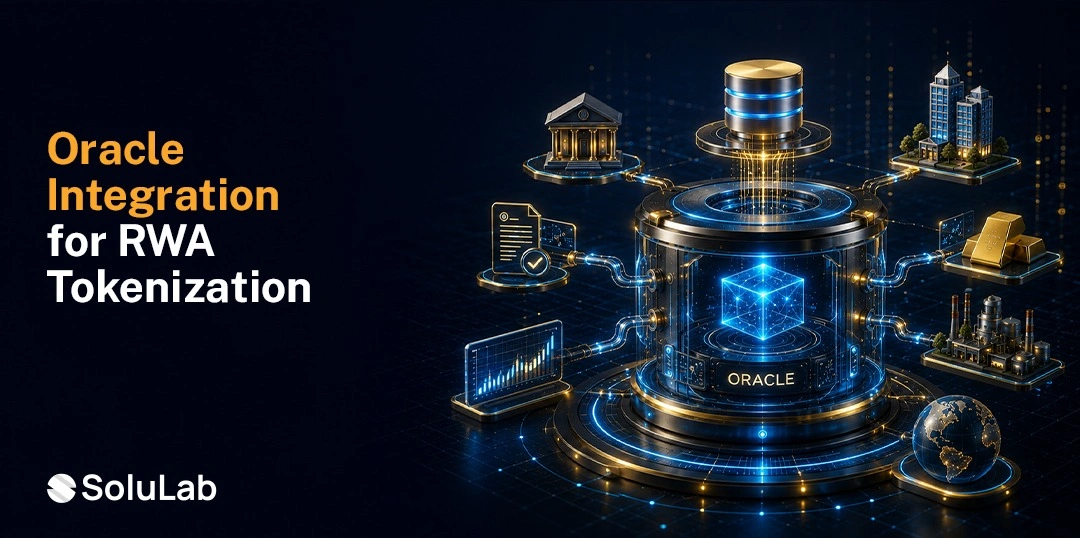
An oracle is a service that feeds external, off-chain data into a blockchain so smart contracts can act on it. Blockchains are deliberately closed systems. They can verify what happened on-chain with total certainty, but past that boundary they know nothing: not a stock price, not a property appraisal, not whether a loan repayment actually hit a bank account. Oracles exist purely to close that gap.
For tokenized real-world assets, that usually means pricing data, proof-of-reserve attestations, or event data like coupon payments and redemption triggers. Get the oracle wrong, and everything built on top of it– valuations, liquidations, redemptions- inherits that error. There’s no separate layer to catch it.
How Do Oracles Work in RWA Tokenization?
Most oracle setups follow a similar pattern: a data source, an off-chain node that fetches and verifies it, and a smart contract that receives the data and reacts. Chainlink RWA oracles, for instance, aggregate data from several independent nodes and only publish a value once enough of them agree, which cuts down the odds of one bad data point moving the whole system.
Decentralized oracle networks that RWA platforms rely on take this further by spreading trust across many independent operators instead of one company’s server.
Why Do Tokenized RWAs Need Oracle Integration?
Gartner’s 2026 predictions note that stablecoins, deposit tokens, and tokenized real-world assets are moving into mainstream enterprise use, but warn that fragmented standards and a lack of interoperability across blockchain infrastructures will hold back growth unless the underlying data layer keeps pace. Oracle integration is a big part of what “keeping pace” actually looks like in practice.
RWA tokenization platforms without reliable oracles run into problems fast. Token prices drift from reality. Automated redemptions trigger on stale data. Investors lose confidence the moment a valuation looks obviously wrong, and once that happens, it’s hard to earn back. Off-chain data oracle blockchain infrastructure isn’t a nice-to-have here; it’s what makes the tokenized version of an asset behave anything like the real one.
What Types of Oracles Are Used for RWA Tokenization?
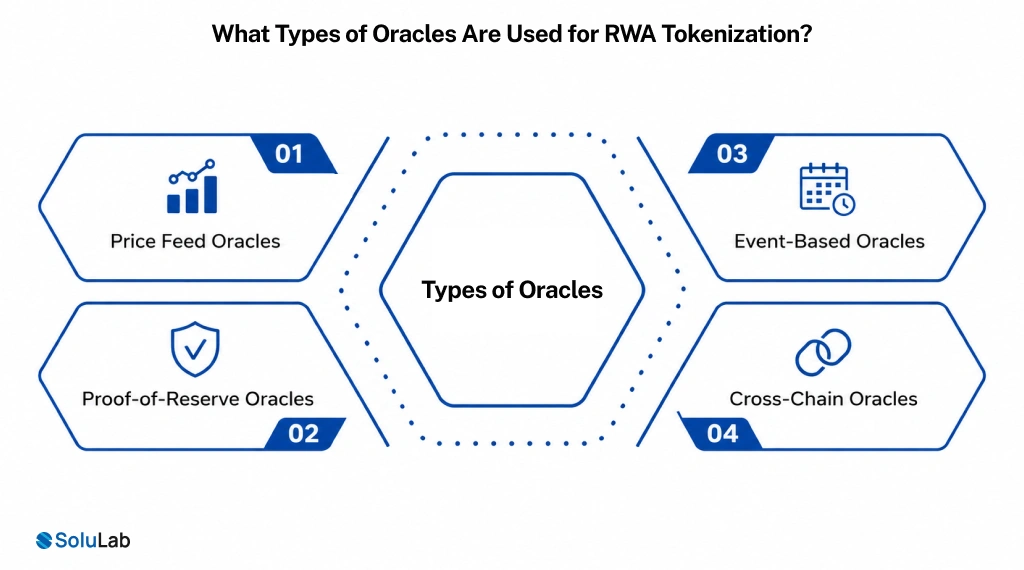
Not every oracle does the same job, and picking the wrong type for the asset class is a common early mistake.
1. Price Feed Oracles
These are what tokenized securities, commodities, and anything with a liquid reference price lean on for real-time valuation, pulling from exchanges, index providers, or licensed data vendors. Price feed oracles that tokenized assets rely on are the most mature category by far, simply because DeFi has been stress-testing them for years already.
2. Proof-of-Reserve Oracles
Gold sitting in a vault, cash sitting in a bank account, whatever’s backing the token, proof-of-reserve oracles confirm it’s actually there and matches what’s been minted on-chain. Custodians usually feed this through a verified attestation process, not a raw API call, since regulators tend to want a human sign-off somewhere in that chain.
3. Event-Based Oracles
A bond coupon payment. A property sale closing. A loan default. Event-based oracles watch for exactly these kinds of discrete occurrences and trigger the right smart contract logic the moment they happen, rather than polling continuously.
4. Cross-Chain Oracles
Some tokenized assets need to settle or reference data across more than one blockchain. Cross-chain oracles carry that data between networks, and doing it without breaking the audit trail is the hard part most teams underestimate.
What Data Can Oracles Bring On-Chain for Tokenized Assets?
The type of data an oracle delivers depends entirely on what’s being tokenized, and getting this list right upfront saves a lot of rework later.
- Asset valuations and market pricing
- Interest and coupon payment confirmations
- Custodial proof-of-reserve attestations
- Legal or title-related status changes
- Currency exchange rates for cross-border deals
- Regulatory or compliance status updates
How to Integrate Oracles for Real-World Asset Tokenization?
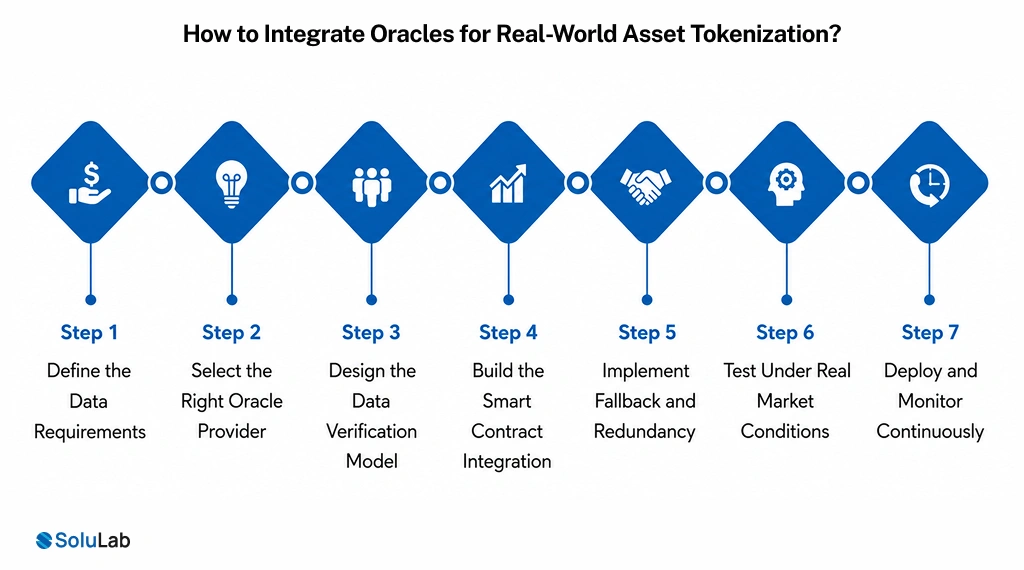
Getting oracle infrastructure right takes more planning than most teams expect going in, mostly because the data layer has to hold up under conditions the smart contract itself can’t verify. Here’s the sequence that tends to work.
Step 1: Define the Data Requirements
Figure out exactly what data the token needs, how often it needs updating, and how much deviation is acceptable before it counts as an error.
- List every data point required
- Set update frequency per data type
- Define acceptable deviation thresholds
Step 2: Select the Right Oracle Provider
Compare established networks against the specific asset class involved, since not every oracle provider covers every data type well.
- Shortlist providers covering the asset type
- Compare decentralization and node count
- Check historical uptime and incident record
Step 3: Design the Data Verification Model
Decide how many independent sources need to agree before data gets accepted, and what happens if they don’t.
- Set minimum node consensus threshold
- Define dispute resolution process
- Plan for outlier data rejection
Step 4: Build the Smart Contract Integration
This is where the oracle data actually meets the token logic, and it’s usually the part of smart contract development that needs the most careful testing.
- Write oracle data consumer contracts
- Add data freshness validation checks
- Test contract response to bad data
Step 5: Implement Fallback and Redundancy
A single oracle source, however reliable, is still a single point of failure until there’s a backup in place.
- Configure secondary data sources
- Build automatic failover logic
- Set alerts for feed discrepancies
Step 6: Test Under Real Market Conditions
Simulate volatile pricing, delayed feeds, and node disagreement before anything goes live, not after.
- Run stress tests with volatile data
- Simulate oracle downtime scenarios
- Validate contract behavior under stress
Step 7: Deploy and Monitor Continuously
Launch with monitoring already running, since oracle failures tend to show up quietly before they show up loudly.
- Deploy with real-time monitoring active
- Track feed accuracy against benchmarks
- Schedule periodic oracle audits
How to Choose the Right Oracle Provider for RWA Tokenization?
The oracle market has matured a lot, but that also means there’s more to compare than there used to be. A few things matter more than brand recognition.
1. Track Record With Real-World Assets
Some oracle networks are built primarily for crypto price feeds and have only recently expanded into RWA data. Ask directly which tokenized asset deployments a provider has actually supported. A roadmap slide doesn’t count.
2. Decentralization and Node Diversity
More independent, geographically distributed nodes generally mean less risk that one compromised source skews the data, and this is worth checking closely rather than taking on faith.
3. Data Source Transparency
A provider should be able to name exactly where its data comes from and how it’s verified. Vague answers here are a warning sign, not a formality to skip past.
4. Custom Oracle Development Support
Standard price feeds cover a lot of ground, but some assets- private credit, niche commodities- need custom oracle development for RWA that a generic off-the-shelf feed simply won’t handle. If a project’s needs go beyond standard feeds, bringing in a team that offers blockchain consulting early tends to save months of rework down the line.
5. Security Audit History
Check whether the provider’s oracle contracts have been independently audited, and how they responded to any past incidents. A clean incident history matters less than how transparently a provider handled the messy ones.
What Are Common Challenges in RWA Oracle Integration?
Even well-planned Oracle integrations run into friction. A Deloitte survey found that 64% of financial institutions had delayed tokenization initiatives over regulatory uncertainty, and unreliable or unverifiable data feeds are frequently part of that hesitation, since regulators want to see a defensible source of truth before signing off.
- Data source reliability. Off-chain sources can go down, lag, or get manipulated, and the smart contract has no independent way to catch that on its own.
- Latency mismatches. Fast-moving markets need fast oracle updates, and a delayed feed can trigger incorrect liquidations or redemptions.
- Cost of decentralization. More nodes and more verification steps mean more gas costs, which adds up fast on high-frequency data feeds.
- Regulatory acceptance. Some regulators haven’t yet defined what counts as an acceptable oracle source for a regulated security, leaving teams to make a judgment call.
- Legacy system integration. Pulling data out of older custodian or bank systems that were never built with an API in mind is still a real, unglamorous engineering problem.
Best Practices for Oracle Integration in Tokenized Asset Platforms
A handful of habits separate oracle setups that hold up under stress from ones that don’t.
- Use decentralized oracle networks over single data sources wherever the budget allows
- Build data freshness checks directly into the smart contract, not just the front end
- Keep at least one independent fallback feed running for every critical data point
- Document the oracle architecture clearly, before auditors or regulators ask for it
- Re-test oracle behavior after every major smart contract upgrade, not just at launch
- Treat oracle monitoring as an ongoing cost of doing business, not a one-time setup task
Global spending on blockchain solutions has climbed toward the $19 billion mark according to Statista-sourced industry data, and a growing share of that is going into the data infrastructure, oracles included, that makes tokenized assets trustworthy enough for institutional money to actually show up.
Conclusion
Oracle integration doesn’t get the same attention as token design or smart contract architecture, but it’s usually the piece that decides whether a tokenized asset behaves like the real thing or drifts away from it. A reliable RWA data feed integration setup, tested, redundant, and properly monitored, is what lets investors trust the number they’re looking at.
SoluLab, an asset tokenization development company, can help your business design and build the oracle infrastructure a tokenized asset platform actually needs to hold up in production.
Book a free consultation to scope out the RWA oracle infrastructure your project needs.
FAQs
Neha is a curious content writer with a knack for breaking down complex technologies into meaningful, reader-friendly insights. With experience in blockchain, digital assets, and enterprise tech, she focuses on creating content that informs, connects, and supports strategic decision-making.