Key Takeaways
- Education asset tokenization converts real academic and financial assets, such as degrees, tuition receivables, and course licenses, into blockchain-based digital tokens that can be verified, transferred, or traded.
- It solves three long-standing problems at once: credential fraud, slow verification, and limited liquidity for education-related investments.
- A working platform needs four layers: asset digitization, smart contract logic, custody and compliance, and a distribution or marketplace layer.
- Universities, edtech companies, and even student-loan investors are already piloting tokenized models, though regulatory clarity still varies by country.
- Institutions weighing this shift should start with a narrow, well-defined pilot, such as tokenized certificates, before expanding into tuition-backed or IP-based tokens.
A college transcript still gets verified almost the way it did thirty years ago. A phone call. A fax, sometimes. A PDF that a registrar’s office has to manually cross-check against its own records before anyone can trust it.
Meanwhile, tuition receivables, course IP, and alumni endowment funds sit around as illiquid, paper-bound assets that rarely move without lawyers and a few weeks of waiting. Asset tokenization in the education sector changes that math.
It turns these academic and financial assets into digital tokens on a blockchain, each one traceable, verifiable, and, where regulation allows it, tradable.
This isn’t a hypothetical trend anymore. Blockchain-based credentialing has moved out of research papers and into production systems at institutions like MIT, and financial firms are now applying the same tokenization logic used for real estate and bonds to education-linked assets.
Below, we’ll walk through what education tokenization actually means, how the mechanics work under the hood, why the shift matters to institutions and investors, and what a real deployment involves, including the parts that go wrong.
What Is Education Asset Tokenization?
Education asset tokenization is the process of representing an education-related asset, digital or physical, as a unique token on a blockchain. That asset could be a degree, a professional certification, a piece of course content, a tuition payment plan, or a share in a scholarship fund.
Each token carries metadata: who issued it, when, and under what terms. It’s also cryptographically signed, which makes forging one nearly impossible without leaving a trace. That’s a meaningful difference from just digitizing a PDF diploma.
A PDF can be copied. Edited. Passed off as legitimate with a little effort. A token, once minted on a blockchain, is immutable, and anyone with access to the ledger can verify it independently, without ever having to call the registrar.

How This Differs From Traditional Data Tokenization
Two ideas get conflated here often enough that it’s worth separating them.
- Traditional data tokenization, the kind used in payment security, replaces sensitive information like a credit card number with a non-sensitive placeholder, purely to protect data.
- Education Asset Tokenization is closer to real-world asset tokenization: it represents actual ownership, achievement, or economic value on-chain, not a masked data field sitting in a payment processor’s vault. Same blockchain toolkit, different job. One protects data. The other moves value.
How Education Asset Tokenization Works?
Building a functioning system involves a handful of moving parts working in sequence, and the order matters more than most teams expect going in.
- Asset identification and digitization. The institution decides what qualifies for tokenization, whether that’s a diploma, a micro-credential, or a tuition-backed note, and converts the relevant record into a structured digital format.
- Token creation (minting). A smart contract mints a unique token representing that asset. For credentials, this is usually a non-fungible token (NFT) or a verifiable credential standard like W3C Verifiable Credentials. Financial assets tend to use fungible or semi-fungible tokens instead, since they represent fractional value rather than a single unique item.
- On-chain verification and issuance. The token gets signed by the issuing authority’s private key and recorded on a public or permissioned blockchain. Ethereum, Polygon, and Hyperledger Fabric show up most often in production systems today.
- Wallet assignment. The token lands in the owner’s digital wallet, whether that’s a student, a graduate, or an institutional investor holding a fractional share of a tuition fund.
- Verification or trading. Employers, other institutions, or secondary-market buyers can verify authenticity instantly through the blockchain, or, if the token represents a tradable financial interest, buy and sell it through a compliant marketplace.
Smart Contracts Do the Heavy Lifting
Smart contracts are what turn this from a digital filing cabinet into something genuinely useful. A contract can automatically enforce rules on its own, releasing a scholarship token only once attendance criteria are met, or unlocking a tuition-bond payout on a fixed schedule, without a person sitting there processing each transaction by hand.
It’s the same self-executing logic that already runs across asset tokenization platforms in real estate and commodities, just applied to rules that make sense for education.
Why Education Asset Tokenization Matters
The case for tokenization in education comes down to three pressures institutions are already living with: fraud, friction, and capital that can’t move.
- Credential fraud is a persistent, expensive problem, and it hasn’t gone away just because more hiring happens online. Research on academic hiring has found that a significant share of applicants misrepresent their qualifications in some way, and plenty of employers admit they don’t consistently verify degrees before making an offer, mostly because manual verification eats time and budget.
- A Deloitte-cited analysis of blockchain-based credential verification found that automating the process can cut verification time and administrative cost by roughly half compared with manual registrar checks. Institutions stop fielding one-off verification requests and instead point everyone to a system that checks itself.
- Deloitte’s own production work backs this up. Its Excelsior Pass project, built for New York State, issued more than 11 million blockchain-based digital credentials for identity and health verification. That’s not a pilot running in a lab somewhere. That’s proof the underlying approach holds up at population scale.
- There’s pressure building from the finance side too. Gartner’s most recent technology predictions note that stablecoins, deposit tokens, and tokenized real-world assets are moving out of experimental status and into mainstream financial infrastructure, pushed along by demand for programmable transactions that settle automatically instead of sitting in someone’s inbox.
- Education is a natural extension of that shift. Tuition financing, student-loan portfolios, and endowment funds are exactly the kind of illiquid, paper-heavy assets tokenization was built to unlock.
- Then there’s the scale argument. Statista’s market forecast puts global online education revenue at roughly 199 billion U.S. dollars in 2026, with well over a billion learners expected worldwide by the early 2030s.
- Spread that across thousands of institutions and platforms, each with its own verification standards, and it’s easy to see where a shared, tamper-resistant credentialing layer would do the most good.
A Quick Comparison: Traditional vs. Tokenized Education Assets
| Factor | Traditional System | Tokenized System |
| Credential verification | Manual, days to weeks | Instant, self-verifying |
| Fraud resistance | Low to moderate | High (cryptographically signed) |
| Asset liquidity | Illiquid, hard to transfer | Fractional, tradable where regulated |
| Cross-border recognition | Inconsistent | Standardized via shared ledger |
| Administrative cost | High (manual processing) | Lower after initial setup |
Types of Tokenized Education Assets
Institutions don’t all tokenize the same things, and separating the categories matters, since each one carries its own technical and regulatory baggage.
- Academic credentials. Degrees, diplomas, and micro-credentials issued as verifiable, tamper-proof Educational Tokens.
- Course licenses and IP. Rights to course content, curricula, or research output represented as tokens that can be licensed or resold.
- Tuition and student-loan receivables. Future tuition payments or loan portfolios tokenized and sold in fractions to investors, not unlike how real estate income streams get tokenized.
- Scholarship and endowment shares. Fractional interests in a scholarship fund, so smaller donors can participate and actually track where their money goes.
- Certification and continuing-education credits. Professional development hours or CEUs recorded as portable, verifiable tokens that follow a learner from one employer to the next.
That’s the broader idea behind tokenized education assets: almost anything with defined value and clear ownership in the education world can, in principle, be represented and moved as a token.
Types of Tokenized Education Assets
Institutions don’t all tokenize the same things, and separating the categories matters, since each one carries its own technical and regulatory baggage.
- Academic credentials. Degrees, diplomas, and micro-credentials issued as verifiable, tamper-proof Educational Tokens.
- Course licenses and IP. Rights to course content, curricula, or research output represented as tokens that can be licensed or resold.
- Tuition and student-loan receivables. Future tuition payments or loan portfolios tokenized and sold in fractions to investors, not unlike how real estate income streams get tokenized.
- Scholarship and endowment shares. Fractional interests in a scholarship fund, so smaller donors can participate and actually track where their money goes.
- Certification and continuing-education credits. Professional development hours or CEUs recorded as portable, verifiable tokens that follow a learner from one employer to the next.
That’s the broader idea behind tokenized education assets: almost anything with defined value and clear ownership in the education world can, in principle, be represented and moved as a token.
Building an Education Tokenization Platform: What It Actually Takes
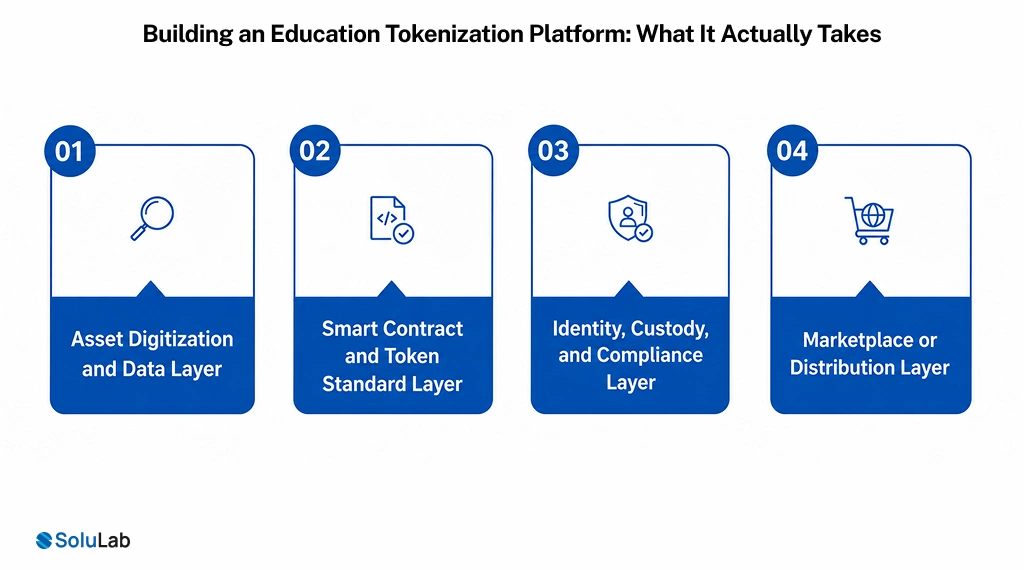
An Education Tokenization Platform is not just a blockchain wrapped around a school database, whatever the pitch decks say. In our experience building tokenization systems across a few different industries, four layers consistently have to work together for a platform to survive contact with production.
1. Asset Digitization and Data Layer
This layer converts institutional records, transcripts, tuition ledgers, and IP registries into a clean, structured format a smart contract can actually reference. Data quality problems here don’t show up right away. They surface weeks later as disputed or invalid tokens, which is exactly why this step is the most underestimated part of the build.
2. Smart Contract and Token Standard Layer
This layer defines how tokens get minted, transferred, and governed. The choice between NFT-style tokens for unique credentials and fungible or semi-fungible tokens for fractional financial assets shapes nearly every decision that follows, right down to which blockchain the team ends up building on.
3. Identity, Custody, and Compliance Layer
Wallets need to tie back to verified identities without dumping sensitive personal data onto a public ledger for anyone to see. Privacy-preserving techniques like zero-knowledge proofs earn their keep here.
Compliance also means securities law review the moment a token starts representing a financial interest, and this is precisely where a seasoned blockchain consulting services partner earns its fee. Get this layer wrong, and you’re not looking at technical debt. You’re looking at legal exposure.
4. Marketplace or Distribution Layer
Tokens need somewhere to actually live: a verification portal for credentials, or a regulated marketplace for tradable financial tokens. This is also where the platform ties back into everything else already running: student information systems, LMS platforms, or an institution’s existing eLearning app development stack.
Challenges and Trade-Offs Worth Naming Honestly
No honest overview skips the friction points. There are real ones here, and they’re worth sitting with before anyone commits budget.
- Regulatory treatment of tokenized financial assets still varies widely by country, and in a few places it hasn’t been settled at all. A tuition-bond token that reads as a straightforward digital certificate in one market might qualify as a regulated security somewhere else, and that single distinction changes the entire compliance posture of the platform.
- Interoperability is the other sticking point people underestimate. A credential minted on one institution’s chosen blockchain doesn’t automatically verify cleanly against another institution’s system unless both sides have agreed on shared standards. That gap is part of why efforts like the Digital Credentials Consortium exist in the first place.
- And there’s an adoption curve nobody gets to skip. Registrars, HR departments, financial aid offices- they’re all used to their current workflows, and a tokenized system only pays off once enough employers and partner institutions actually check the blockchain record instead of defaulting back to a phone call.
- Institutions that treat this as a single department’s side project, rather than a change-management effort that touches the whole organization, tend to see adoption crawl no matter how good the technology is.
Real-World and Emerging Use Cases
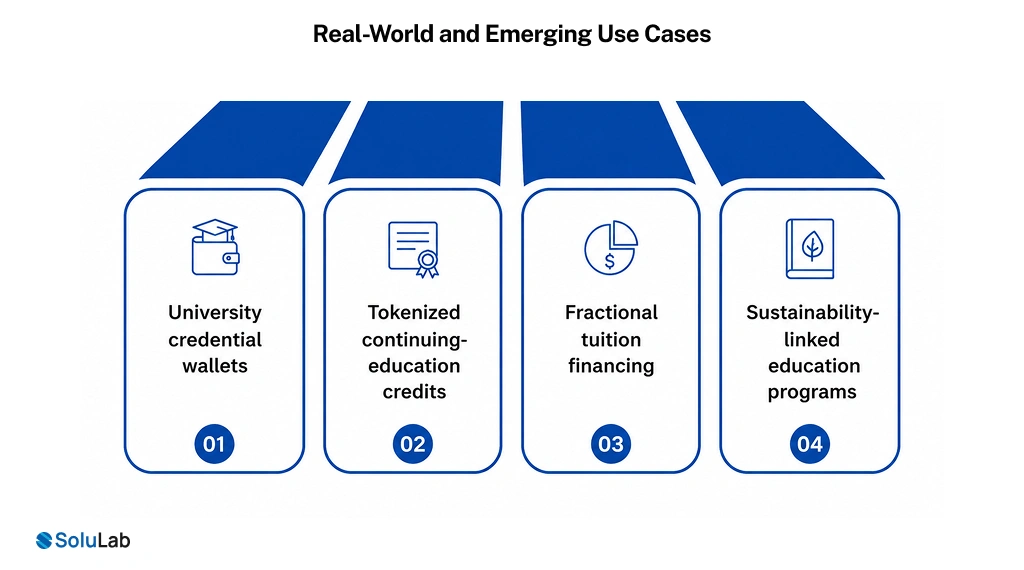
A few patterns are already showing up in the market, beyond the well-known MIT digital diploma work.
- University credential wallets, where graduates hold a portable, verifiable record of every credential they’ve earned, shareable with an employer in seconds instead of weeks.
- Tokenized continuing-education credits for licensed professionals in nursing, engineering, and finance, who need to prove ongoing compliance across multiple regulatory bodies at once.
- Fractional tuition financing, where investors fund a cohort’s tuition in exchange for a token representing a share of future repayment, an approach that mirrors real-world asset tokenization already used in other lending markets.
- Sustainability-linked education programs, where institutions issue tokens tied to environmental coursework or research output, are close cousins of a carbon credit education platform that rewards verified environmental learning outcomes with tradable credits.
These examples all share the same thread underneath them: the token is only as good as the trust and standards behind it. That’s exactly why the platform layer, not the token itself, is where most of the real engineering work actually happens.
Conclusion
Education asset tokenization doesn’t replace how institutions teach or credential learners. It replaces the slow, manual, fraud-prone systems sitting underneath those processes.
The gap between those two outcomes usually comes down to how the platform gets architected. The data layer, the token standard, the compliance model, and the distribution channel all need to work together from day one, not get bolted on afterward.
SoluLab, as a tokenization platform development company, works with universities, edtech platforms, and financial institutions to design and build tokenization systems that hold up under real regulatory and operational scrutiny, not just in a demo environment.
FAQs
Neha is a curious content writer with a knack for breaking down complex technologies into meaningful, reader-friendly insights. With experience in blockchain, digital assets, and enterprise tech, she focuses on creating content that informs, connects, and supports strategic decision-making.