Key Takeaways
- DYNK turns NFTs into functional access keys, not static collectibles. Ownership of the NFT directly controls access to a dedicated Solana wallet, its token balances, and everything it accumulates over time.
- Wallet access is enforced at the smart contract level, not through a separate private key or off-chain database; the NFT itself is the credential.
- Seven interconnected systems had to work together: NFT-to-wallet binding, NFT-gated access, a token allocation engine, a private exchange, an auction engine, real-time portfolio visibility, and modular upgradeable contracts.
- Solana was chosen for throughput, cost, and finality. High-frequency actions like order placement and bidding need a chain that stays fast and cheap under repeated use.
- A private exchange and auction engine was built in-house rather than integrated from an external DEX, giving the platform full control over matching, settlement, and ownership transfer.
- Ownership transfer is complete, not partial; selling a DYNK wallet-NFT moves the entire wallet and its holdings to the buyer, unlike a typical NFT sale that transfers only the token itself.
What if owning an NFT meant owning an entire crypto wallet?
Not the metadata. Not a JPEG with a certificate of authenticity bolted on. The actual wallet, its token balances, its transaction history, and its accumulated assets are bound to a single NFT, so that whoever holds the token holds everything inside it.
That’s the question DYNK’s founding team brought to SoluLab, and it’s the question this case study answers: how do you engineer a system where an NFT stops being a static collectible and becomes a functional, transferable ownership key for a live blockchain wallet?
The short answer is Solana, a purpose-built Anchor smart contract architecture, and a full private exchange and auction engine layered on top. The longer answer, the one that actually matters if you’re evaluating this kind of build for your own product, is below.
The Problem: NFTs that Stop Mattering After the Mint
NFTs solved a real problem when they arrived: provable, unique digital ownership. But for most projects, that’s where the utility stops. An NFT represents a collectible, a membership pass, or a piece of art, and that’s it. It doesn’t control anything. It doesn’t grow. It doesn’t do anything after the purchase transaction confirms.
This creates a predictable pattern that’s played out across thousands of NFT projects:
- Digital assets stay fragmented. A holder’s tokens, collectibles, and rewards live in separate wallets with no unified view.
- Transfers are incomplete. Selling an NFT moves the token. It doesn’t transfer the assets, permissions, or value associated with it; those remain in place or require separate manual transactions.
- Utility decays after the mint. Whatever excitement exists at launch fades because the NFT itself doesn’t produce anything or grow in function over time.
- Ownership doesn’t compound. A collectible bought on day one is worth exactly as much utility on day 500; nothing has accrued to it.
DYNK’s founding thesis rejected this pattern outright: NFTs should be keys, not trophies. If an NFT is going to represent ownership of something, it should represent ownership of something that actually functions, a wallet that holds real, growing value, that transfers completely and cleanly when the NFT changes hands.
That’s a fundamentally different engineering problem than “mint an NFT and attach a JPEG.” It required rethinking what an NFT does at the smart contract level, not just what it represents.
The Core Requirements SoluLab Had to Solve
Before writing a line of code, SoluLab mapped out seven non-negotiable requirements. Each one represents a distinct technical system, and, critically, a gap in any single layer would have broken the whole ownership model. A crypto wallet that’s cryptographically bound to an NFT but doesn’t transfer cleanly on resale isn’t a solution. An exchange that works but can’t settle auctions atomically isn’t either.
1. NFT-to-wallet binding. The platform required a tamper-proof, on-chain mechanism that cryptographically links each NFT to a dedicated wallet, verifiable by anyone, enforced by a smart contract, and automatically transferable when the NFT changes hands, with no manual steps.
2. Wallet access controlled entirely by NFT ownership. Traditional wallets are gated by private keys. DYNK needed the smart contract itself, not a user’s credentials, to act as the gatekeeper. Lose the NFT, lose the wallet. Own the NFT, own the wallet. No exceptions, no backdoors.
3. A token ecosystem with real portfolio growth mechanics. Wallets couldn’t be empty shells. The system needed to seed each wallet with ecosystem tokens at creation and support ongoing accumulation, so an NFT’s underlying value could actually grow over time instead of staying fixed at mint price.
4. A private exchange with order matching and settlement. Not a bolt-on link to a public DEX solution, a purpose-built trading environment with order books, matching logic, escrow, and settlement workflows, contained entirely within the ecosystem.
5. Auction-based ownership transfer. Selling a DYNK wallet needed to be more than a buy-now button. The platform required reserve pricing, competitive bidding, asset locking during live auctions, and automated settlement that transfers the entire wallet, not just the NFT, to the winning bidder.
6. Real-time portfolio and transaction visibility. Users needed to see their holdings, exchange positions, and auction activity update live, without refreshing or polling, which meant an event-driven backend and a persistent connection layer.
7. A scalable, modular smart contract architecture. Every operation, binding, transfer, auction settlement, and exchange execution needed to run through Solana smart contracts, structured so the platform could add new features later without rebuilding the core logic.
Any one of these is a meaningful engineering challenge on its own. Together, they demanded an architecture where the blockchain layer, the application layer, and the real-time layer all had to move in lockstep.
Why Solana was the Foundation, Not an Afterthought?
Choosing the base chain wasn’t incidental; it shaped what was actually possible to build. A platform combining wallet ownership, token transfers, NFT operations, and live exchange trading needs a chain that can handle frequent, cheap, fast transactions without forcing users to think about gas costs every time they check a balance.
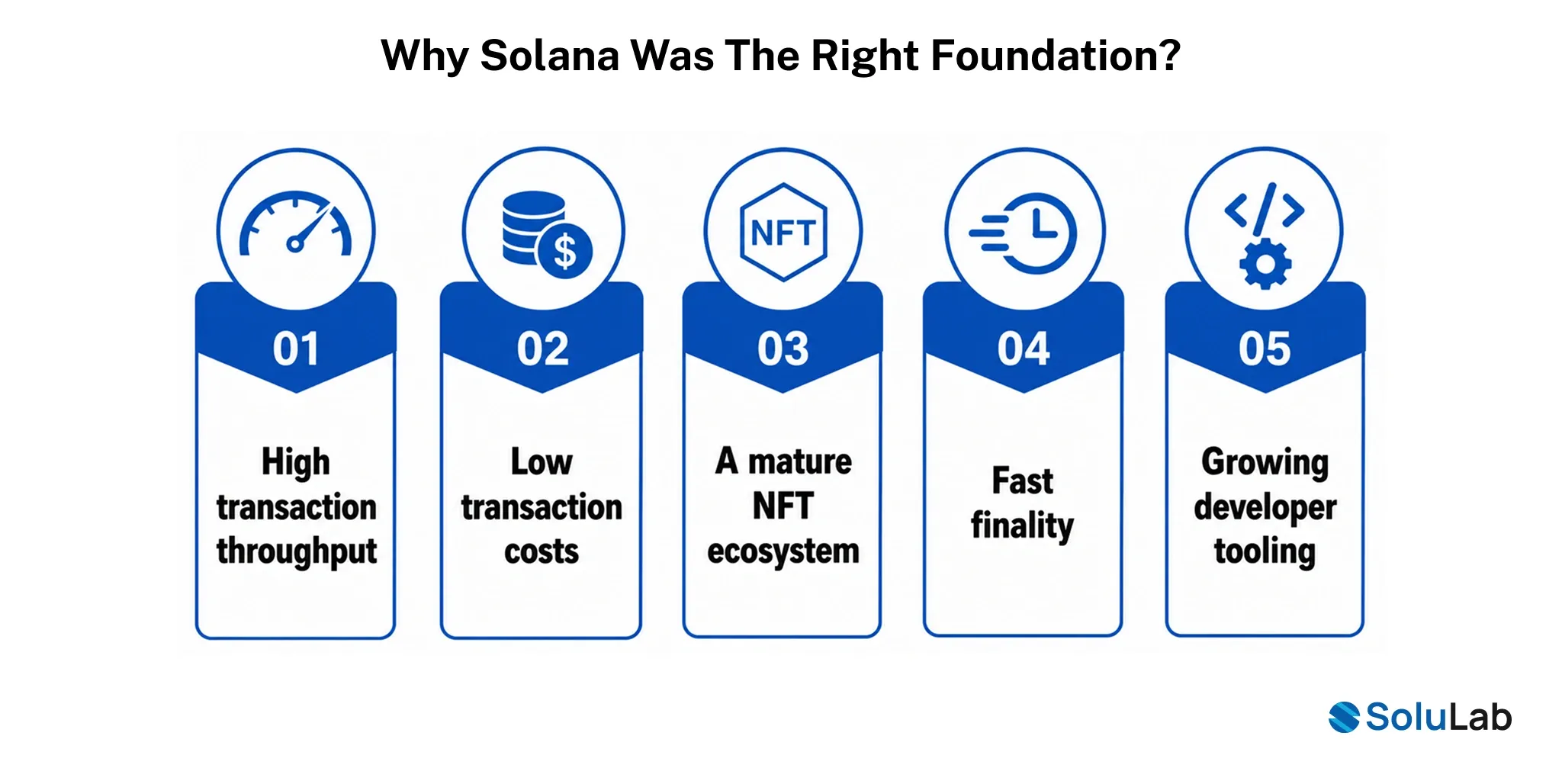
Solana blockchain’s core advantages made it the practical choice:
- High transaction throughput — necessary for an exchange with active order matching and frequent settlement.
- Low transaction costs — critical when routine actions (checking balances, placing orders, bidding) all touch the chain.
- A mature NFT ecosystem via Metaplex, rather than building NFT standards from scratch.
- Fast finality — the published results cite sub-400ms finality, which matters directly for a “real-time” portfolio experience; a wallet dashboard that lags behind the chain by several seconds isn’t really real-time.
- Growing developer tooling, particularly the Anchor framework, which reduces the amount of boilerplate and attack surface in Solana development compared to writing raw Solana programs.
Ethereum-based alternatives would have meant either accepting materially higher per-transaction costs, a real problem for an exchange where users place and cancel orders frequently, or building complex layer-2 workarounds to get comparable speed and cost. Solana’s design meant those trade-offs weren’t necessary from day one.
How SoluLab Engineered the Ownership Model?
NFT-controlled wallet ownership
At the center of DYNK is a wallet ownership model where each NFT is linked to a dedicated wallet on Solana, and ownership of the NFT, not a separate private key, determines who can access it. This is where the platform diverges most from a conventional crypto wallet: there’s no seed phrase to separately protect, no credential to separately lose. The NFT is the credential.
Practically, this points to an architecture built around Program Derived Addresses (PDAs) — wallet accounts whose authority is controlled by the Anchor program logic rather than by a standalone keypair held by the user. The smart contract checks NFT ownership at the point of any wallet interaction and either authorizes or denies the action accordingly. Users interact with all of this through a dashboard that reflects the true on-chain state, not a cached approximation of it.
Tokenized asset management
Wallets needed to hold real, growing value, not sit empty after mint. SoluLab built a token allocation and distribution system that seeds each wallet with ecosystem tokens at creation and remains open to receiving additional digital assets over time.
Users track balances and portfolio activity through a single dashboard instead of stitching together views across multiple wallets, which was one of the core frustrations the web3 wallet platform set out to solve in the first place.
Private exchange infrastructure
To give the token ecosystem actual liquidity, SoluLab built a private exchange rather than routing users to an external DEX. This included:
- Order placement and an order book
- A matching engine to pair buy and sell orders
- Escrow management to hold assets safely during a trade
- Automated settlement once a match clears
- Real-time market updates and transaction tracking
Building an internal matching engine is a materially harder problem than integrating a public DEX; it means the platform owns the correctness of every trade, not just the interface around it. That trade-off bought DYNK a self-contained, controlled trading environment instead of dependency on external liquidity infrastructure.
NFT wallet auctions
Because a simple buy-now transaction doesn’t capture competitive price discovery, DYNK’s transfer mechanism is built around structured auctions: reserve pricing, competitive bidding, asset locking for the duration of the auction (so a wallet can’t be transferred out from under an active bid), automated refunds for losing bidders, and validated on-chain settlement for the winner.
The published results cite 100% automated auction settlement, meaning the entire lifecycle, from bid acceptance to final ownership transfer, executes through smart contract logic without manual intervention. That’s a meaningfully different bar than “an auction UI with a manual payout step,” and it’s only achievable because the wallet-transfer logic and the auction logic were built to interlock at the contract level.
Portfolio transfer functionality
This is the feature that makes DYNK’s core thesis real. Traditional NFT transfers move a token and its metadata, nothing else. When a DYNK wallet-NFT changes hands, the new owner gets the wallet, its token balances, and everything it has accumulated since mint. The seller exists completely. The buyer inherits everything. There’s no secondary step where the buyer has to “claim” assets separately or trust the seller to hand over anything outside the chain.
The Technology Stack Behind DYNK
SoluLab’s public case study lists three layers of the stack. Based on the architecture described above, here’s the full picture, including the components that are implied by the requirements, even where they weren’t explicitly named in the published materials.
Blockchain layer
- Solana — base layer 1 for all wallet, token, exchange, and auction logic
- Rust — the underlying language for Solana program development
- Anchor Framework — reduces boilerplate and standardizes account validation for Solana smart contracts
- Metaplex NFT Standards — NFT minting and metadata standards
- Solana Program Library (SPL) — token account standards underlying the ecosystem tokens
Wallet and on-chain data layer
- Program Derived Addresses (PDAs) — the likely mechanism for NFT-gated wallet accounts
- Solana RPC infrastructure (e.g., a dedicated provider rather than public endpoints) — needed for the throughput a live exchange and dashboard require
- On-chain event indexing — translating raw program events into the state the dashboard displays in real time
Application layer
- React Native — frontend framework for the dashboard, exchange, and auction interfaces
- Node.js — backend runtime
- PostgreSQL — primary relational database for off-chain application state
- Redis — caching and fast-access session/state data
Real-time and infrastructure layer
- Kafka — event streaming across backend services
- WebSocket — persistent connections powering live portfolio, exchange, and auction updates without polling
This combination is what allows the platform to hit the kind of performance the results emphasize: near-instant dashboard updates, an exchange with no manual polling, and auction settlement that completes automatically rather than waiting on a human in the loop.
Worth flagging: the RPC provider, indexing method, and matching-engine implementation language aren’t named in SoluLab’s published case study. The items above reflect the standard, proven approach for this category of Solana build rather than confirmed specifics of DYNK’s internal implementation. If you’re evaluating a similar build, these are the right questions to ask a vendor directly.
Results Achieved
According to SoluLab’s published case study, the completed platform delivered:
- Sub-400ms transaction finality
- Near-zero dashboard latency
- 100% automated auction settlement
- Seven independently upgradeable smart contract modules
- Real-time exchange updates with zero polling
- Roughly 99% lower transaction costs compared to Ethereum
The modular, upgradeable contract architecture is worth calling out specifically: building auction logic, exchange logic, wallet-binding logic, and token logic as separate, independently upgradeable modules means the platform can extend functionality later — new asset types, new trading mechanisms, new auction formats — without a full redeployment of the core system. That’s a meaningfully different engineering posture than a single monolithic program, and it’s the kind of decision that pays off months after launch rather than on day one.
What this Build Demonstrates about NFT Utility?
DYNK is a useful case study beyond its own product because it answers a question a lot of Web3 teams are quietly asking: can an NFT be made to do more than represent ownership of a static asset?
The answer this build demonstrates is yes, but only if the NFT-to-asset relationship is enforced at the smart contract layer, not bolted on through an off-chain database or a centralized backend that could be changed independently of the token. The moment wallet access, token balances, or transfer rights live anywhere other than verifiable on-chain logic, the “NFT as ownership key” promise breaks down into a claim the platform makes rather than a guarantee the blockchain enforces.
That’s the real engineering lesson here: the hard part of a project like this isn’t any single feature; wallets, exchanges, and auctions all exist elsewhere individually. The hard part is making all of them respect one shared, cryptographically enforced rule: whoever holds the NFT holds everything behind it, with no exceptions and no manual steps.
Want to Build Something Similar? SoluLab is Ready!
DYNK shows what’s possible when NFT ownership is treated as an access-control mechanism rather than a static record, but the pattern extends well beyond wallets. The same architecture principles apply to tokenized asset platforms, membership systems tied to real utility, and marketplaces where ownership needs to transfer completely, not partially.
If you’re exploring an NFT platform, a token ecosystem, a blockchain wallet, or a private exchange of your own, it’s worth talking to a team that has already solved these specific problems, smart contract-enforced ownership, real-time settlement, and modular architecture built to extend rather than rebuild.
Schedule a Blockchain Strategy Call to talk through what a similar build would take for your product.
FAQs
Shipra Garg is a tech-focused content strategist and copywriter specializing in Web3, blockchain, and artificial intelligence. She has worked with startups and enterprise teams to craft high-conversion content that bridges deep tech with business impact. Her work translates complex innovations into clear, credible, and engaging narratives that drive growth and build trust in emerging tech markets.
![How to Create a Token on Solana? [7 Easy Steps]](https://www.solulab.com/wp-content/uploads/2024/12/Token-on-Solana.webp)