Key Takeaways
- The Markets in Crypto-Assets (MiCA) regulation brings structure, clarity, and EU-wide market access for token launches
- Global crypto regulations 2027 remain fragmented, with varying levels of flexibility and uncertainty
- Choosing a token launch jurisdiction now directly impacts compliance, architecture, and scalability
- MiCA is ideal for institutional credibility and long-term growth
- Other regions offer faster experimentation, but require careful planning as you scale
There was a time when launching a crypto token felt like releasing software. You built it, deployed it, and let the market decide its fate.
By 2027, that mindset no longer holds.
A token launch today is closer to launching a regulated financial product than a piece of code. The difference is subtle at first, but it becomes painfully obvious once you start navigating jurisdictions, compliance layers, and investor expectations for token development.
The rise of MiCA crypto regulation in Europe and the rapid evolution of global crypto regulations in 2027 have reshaped how founders think about token launches. The question is no longer about technology or tokenomics alone.
It is about choosing the right token launch jurisdiction before anything else.
Why Regulation Has Become the First Design Decision?
Most founders still treat regulation as a checkpoint, something to deal with after the product is ready.
That approach is becoming expensive.
In today’s blockchain regulatory landscape 2027, regulation influences:
- how your token is classified
- who can access it
- how it can be traded
- whether exchanges will list it
- how investors perceive it
In other words, regulation is no longer external to your product. It is part of your product design.
This is especially visible in regions adopting structured blockchain technology frameworks like the European Union’s Markets in Crypto-Assets (MiCA) regulation, where compliance is not a layer you add later. It is something you architect from the beginning.
The shift is subtle but critical.
Teams that recognize this early build systems that scale.
Teams that ignore it end up rebuilding everything under regulatory pressure.
Understanding MiCA – Europe’s Attempt to Standardize Crypto
The Markets in Crypto-Assets (MiCA) regulation is not just another policy update. It is the first large-scale attempt to bring consistency to EU crypto regulation across multiple countries.
Instead of fragmented national rules, MiCA creates a unified framework for:
- issuing crypto-assets
- operating as crypto-asset service providers (CASPs)
- offering regulated crypto-asset services across the EU
What makes the MiCA framework significant in Europe is not just its scope, but its intent.
It is designed to remove ambiguity.
Under EU crypto rules, a token issuer is expected to:
- clearly define the nature of the asset
- publish a compliant whitepaper
- meet transparency and disclosure standards
- operate within defined governance structures
This clarity comes with effort.
But it also brings something the crypto industry has historically lacked – predictability.
And for founders thinking about where to launch a crypto token, predictability is quickly becoming more valuable than flexibility.
MiCA vs Global Crypto Regulations: What Actually Differs?
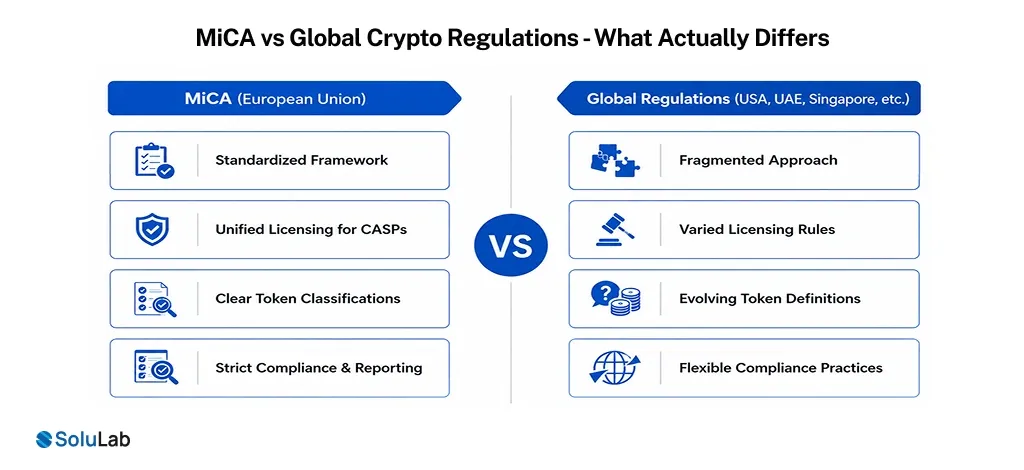
At a surface level, comparing MiCA vs crypto regulations across regions feels like comparing strict versus flexible systems.
In reality, the difference runs deeper. It is about how regulation is designed.
The MiCA crypto regulation approach is structured from the ground up. It defines categories, responsibilities, and operating rules before problems emerge. This creates a system where founders know what is expected even before they launch.
In contrast, most global crypto regulations 2027 outside Europe are still evolving. They react to market behavior rather than shaping it in advance. This leads to a different kind of uncertainty. Not the absence of rules, but the constant shifting of them.
For example:
- In the EU, the classification of tokens is predefined under the EU crypto regulations MiCA
- In other regions, classification may change based on enforcement actions or interpretations
- In MiCA, compliance requirements are documented and standardized
- Elsewhere, they are often inferred through legal guidance and precedent
This is why a simple crypto regulation comparison based on strictness misses the point.
The real distinction is this:
MiCA reduces ambiguity but increases upfront responsibility.
Other jurisdictions reduce initial friction but increase long-term unpredictability.

Global Crypto Regulations in 2027: A Multi-Speed Landscape
Outside Europe, the regulatory environment is not unified. It is layered, regional, and often strategic.
United States
The crypto regulations in USA 2027 continue to be shaped by multiple authorities. Instead of a single framework, there is an overlap of regulatory bodies interpreting crypto differently.
For founders, this creates a situation where:
- compliance depends on how a token is interpreted
- legal positioning becomes as important as technical design
- enforcement can redefine expectations overnight
This makes the US a high-opportunity but high-complexity market when evaluating legal requirements for token launch.
Middle East
Jurisdictions like the UAE have taken a more deliberate approach.
They are building regulatory environments that are:
- structured but not restrictive
- innovation-friendly but monitored
- designed to attract global Web3 companies
These regions are increasingly relevant when deciding where to launch a crypto token, especially for projects that want clarity without the rigidity of Europe.
Asia
Markets such as Singapore and Hong Kong operate with strong compliance expectations but controlled access.
They prioritize:
- financial stability
- licensing discipline
- institutional participation
This creates a high-trust environment, but not necessarily an easy one to enter.
Offshore Jurisdictions
While still present in conversations, offshore regions are losing strategic value.
They may offer:
- faster incorporation
- lower immediate compliance overhead
But they lack:
- investor confidence
- regulatory durability
- long-term scalability
In the blockchain regulatory landscape 2027, offshore-first strategies are increasingly seen as short-term decisions.

Choosing the Right Token Launch Jurisdiction
By this point, the question is no longer theoretical.
It becomes a strategic decision tied to how your business will operate over time.
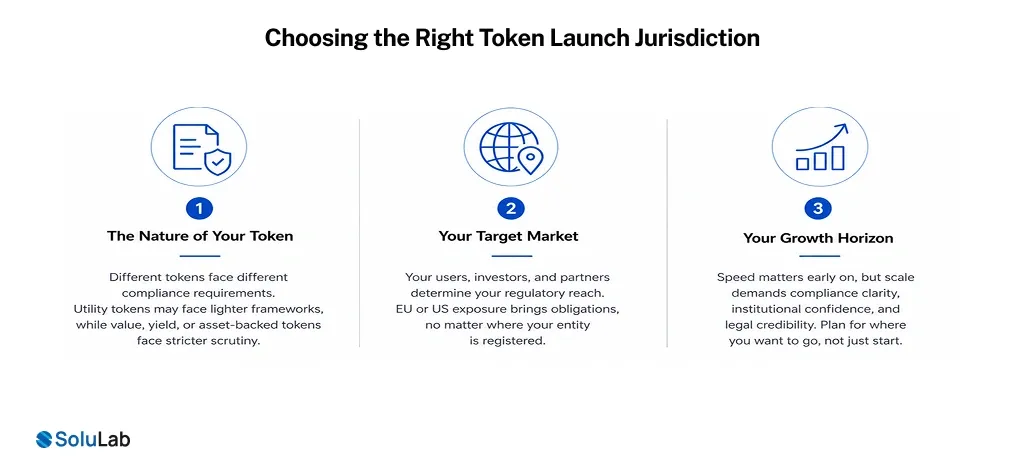
Choosing a token launch jurisdiction requires aligning three layers.
1. The Nature of Your Token
Different tokens face different token compliance requirements.
A utility token with limited financial exposure may navigate lighter frameworks.
A token tied to value, yield, or assets will face stricter scrutiny under most crypto compliance regulations.
Understanding this early shapes everything that follows.
Read more: Security Tokens vs Utility Tokens vs NFTs
2. Your Target Market
If your users, investors, or partners are based in Europe, EU crypto regulation becomes unavoidable.
Launching elsewhere does not remove that obligation. It only delays it.
Similarly, targeting US users brings its own complexity, regardless of where your entity is registered.
3. Your Growth Horizon
This is where most decisions break down.
Early-stage teams often prioritize speed. They look for jurisdictions that allow quick deployment and minimal friction.
But scaling introduces new realities:
- exchange listings require compliance clarity
- institutional capital demands regulatory confidence
- partnerships depend on legal credibility
This is why many teams revisit their initial jurisdiction choice within a few years.
A more durable approach is to align jurisdiction with long-term intent from the start.
Because in 2027, choosing where to launch is not just about entry. It is about where you can continue to operate without rebuilding your entire system.
How Regulation Shapes Your Token Architecture?
One of the most underestimated aspects of crypto compliance regulations is how deeply they influence system design.
Regulation is not just a legal wrapper. It determines what your blockchain platform must do at a functional level.
Under frameworks like MiCA crypto regulation, your architecture needs to support:
- identity verification and KYC flows
- transaction traceability
- audit-ready data storage
- governance controls for token issuance and circulation
- reporting pipelines for regulators
This turns your token platform into something closer to financial infrastructure than a decentralized experiment.
In contrast, launching in a more flexible jurisdiction might allow you to defer some of these components. But that deferral often becomes technical debt.
As your platform grows, you will need to retrofit:
- compliance modules
- monitoring systems
- reporting layers
And retrofitting is always harder than designing correctly from the beginning.
This is why asset tokenization services and modern token platforms are increasingly built with compliance as a core architectural layer, not an optional add-on.
Risk and Compliance Reality in 2027
The perception that regulation is something you can navigate later is fading.
In 2027, regulatory risk is operational risk.
Projects face real consequences when token compliance requirements are not met:
- exchanges may refuse listings
- banking partners may withdraw support
- jurisdictions may impose restrictions or penalties
- investors may avoid participation entirely
What makes this more complex is that risk is not always immediate. It accumulates.
A token launched in a loosely regulated environment may operate smoothly in its early phase. But as it scales, enters new markets, or seeks institutional capital, regulatory gaps become visible.
This is where MiCA compliance offers a different value proposition.
It does not eliminate risk. But it makes risk more predictable.
You know what is required.
You know how to meet it.
And more importantly, external stakeholders know it too.
That shared understanding is what builds trust in regulated crypto-asset services.
Build vs Partner: The Execution Layer Most Teams Miss
Designing a compliant token ecosystem requires coordination across multiple domains:
- legal structuring
- technical architecture
- compliance systems
- operational workflows
Most blockchain consulting teams are strong in one or two of these areas. Very few are strong in all.
This creates a practical decision point.
Building Internally
Some teams choose to build everything in-house.
This works when:
- the team has deep regulatory expertise
- timelines are flexible
- budgets allow for iteration
But even then, integration becomes complex. Aligning legal interpretation with system design is not straightforward.
Partnering with Specialists
An increasing number of teams are working with a cryptocurrency development company or infrastructure partner.
The advantage is not just speed. It is alignment.
Experienced partners bring:
- pre-validated architectural patterns
- familiarity with EU crypto regulations, MiCA, and other frameworks
- an understanding of how compliance maps to system components
This is where firms like SoluLab typically operate. Not as execution vendors, but as partners who help translate regulatory requirements into working systems.
Because at this stage, the challenge is not building a token.
It is building a token that can operate within a regulated environment.
Where Should You Launch Your Token in 2027?
After comparing MiCA vs crypto regulations and understanding the broader landscape, the decision becomes clearer when framed correctly.
There is no universally “best” jurisdiction. There is only alignment.
When MiCA Makes Sense
Launching under European Union’s Markets in Crypto-Assets (MiCA) regulation is a strong choice if:
- you are targeting European users or institutions
- your token has financial characteristics
- long-term credibility matters more than short-term speed
- you want access to a unified market through passporting
In these cases, the structure of EU crypto rules becomes an advantage for tokenization platform development rather than a constraint.
When Other Jurisdictions Make Sense
Alternative regions may be more suitable if:
- your product is still evolving
- you need faster experimentation cycles
- your initial market is outside Europe
- you are comfortable navigating evolving global crypto regulations 2027
These environments offer flexibility, but require careful planning as you scale.
The Emerging Hybrid Approach
Many blockchain projects are no longer choosing a single jurisdiction.
Instead, they are:
- structuring entities across multiple regions
- aligning token issuance with one regulatory framework
- operating services across others
This reflects a more mature understanding of the blockchain regulatory landscape in 2027.
It is not about avoiding regulation.
It is about designing around it.

Conclusion
Launching a token in 2027 is not just a technical milestone or a fundraising event.
It is a regulatory decision that shapes your product, your architecture, and your ability to scale.
The comparison between MiCA vs crypto regulations highlights a broader shift in the industry.
Clarity is becoming more valuable than flexibility.
Structure is becoming more valuable than speed.
The teams that succeed will not be the ones that avoid regulation.
They will be the ones who understand it early and build with it in mind.
Because in a regulated world, the question is no longer where you can launch.
It is where you can continue to operate, grow, and be trusted.
FAQs
Shipra Garg is a tech-focused content strategist and copywriter specializing in Web3, blockchain, and artificial intelligence. She has worked with startups and enterprise teams to craft high-conversion content that bridges deep tech with business impact. Her work translates complex innovations into clear, credible, and engaging narratives that drive growth and build trust in emerging tech markets.
![How to Successfully Launch a Crypto Token in the UAE [2026]?](https://www.solulab.com/wp-content/uploads/2026/02/Launch-a-Crypto-Token-in-the-UAE-1.webp)