The UAE has become the world’s fastest-growing hub for crypto token launches, and the number tells a real story.
| UAE ranked 5th globally and 1st in MENA for cryptocurrency adoption in 2025, according to the World Crypto Rankings 2025 report by Bybit and DL Research. The UAE now has over 500,000 daily active crypto traders, and approximately one in four adults holds or trades cryptocurrencies. |
The data matters, as a large, active, and educated user base, combined with institutional inflows, creates the ideal conditions for token launches. Your token will find buyers, liquidity, and regulatory clarity. This guide walks you through launching a crypto token in the UAE. Whether you’re building a utility token, governance token, stablecoin, or real-world asset token, the UAE offers both speed and credibility.
Key Takeaways
- The problem: 70%+ token launches fail due to poor regulatory planning, weak tokenomics, and low market trust—especially in compliance-heavy regions like the UAE.
- The solution: A UAE-ready crypto token launch needs compliant structuring, audited smart contracts, and go-to-market precision.
- How SoluLab helps: SoluLab delivers end-to-end crypto token development in the UAE—covering compliance, tokenomics, audits, and launch strategy—so your token is built to scale, not stall.
How to Launch a Crypto Token in the UAE Without Regulatory Delays?
The UAE’s regulatory structure is unique: Three parallel regulators, three distinct pathways, one clear objective, bring responsible crypto innovation to market.
| Regulatory Body | Jurisdiction | What It Governs | Approval Timeline | Capital Requirement | Best Suited For | Key Notes |
| VARA (Virtual Assets Regulatory Authority) | Dubai | Utility tokens, RWA tokens, non-AED stablecoins | 3–6 months (fastest) | AED 1.5M | Startups, community-driven projects, global token launches | High approval rate (70%+) when structured correctly |
| ADGM (Abu Dhabi Global Market) | Abu Dhabi | Complex tokens, institutional-grade crypto products | 6–12 months | AED 1.5M–3M | Enterprise tokens, asset-backed models, institutional structures | Highest global regulatory credibility |
| CBUAE with SCA | UAE (Federal) | AED-pegged payment tokens, security tokens | 9–15 months (most restrictive) | AED 15M+ | Large institutions, central bank initiatives, equity-linked tokens | Narrow scope; most startups do not qualify |
Why Token Classification Matters?
Before you approach any regulator, you need to classify your token correctly. The UAE uses a four-axis classification system:
| Token Type | Description | Primary Regulator | License Required | Capital Requirements | Key Notes |
| Utility Tokens | Provide access, voting rights, or service utility (no profit expectation) | VARA | No (distribution via licensed intermediary required) | Low | Fastest regulatory pathway |
| Payment Tokens | Used for transactions; pegged to fiat or a basket of assets | VARA Category 1 or CBUAE | Yes | High | Suitable for payments and stablecoin models |
| Security Tokens | Represent equity, debt, or investment returns | SCA (mainland) + DIFC | Yes | High | Prospectus mandatory |
| Asset-Referenced Tokens (RWA) | Backed by real-world assets (real estate, commodities, funds) | VARA ARVA Framework or ADGM | Yes (VARA / ADGM) | Varies by asset backing | Strong institutional appeal |
As most successful tokens launched in the UAE in 2025 chose VARA Category 2 (utility tokens), because:
- Fastest approval around 4–8 weeks vs. 6–12 months
- No license fee for token issuance
- No capital reserve requirements
- Clear whitepaper standards
- Distribution through licensed exchanges, which already exist: Binance Dubai, OKX, etc.
So, you must clearly demonstrate that your token provides genuine utility like voting, access, and governance, not investment returns or speculative appreciation.
Which Regulators Matter For A Crypto Token Launch in the UAE?
If you’re planning to launch anything token-related in the UAE, this is usually the first real decision you have to make. And honestly, it’s the one that decides how fast you move, how much you spend, and how painful the next 6–12 months are going to be.
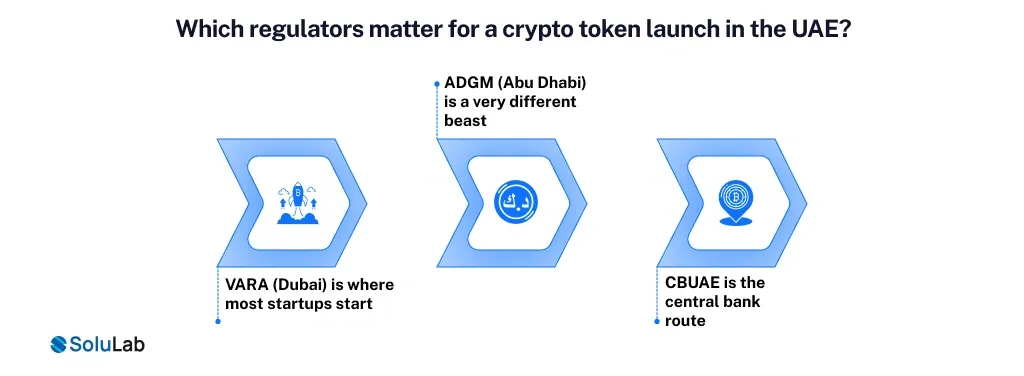
Most early-stage teams end up looking at VARA in Dubai, while more institutional setups lean toward ADGM in Abu Dhabi, and a very small group even qualifies for the Central Bank route (CBUAE). They all exist for different reasons, and choosing the wrong one early almost always means rework later.
#1. VARA (Dubai) is Where Most Startups Start
If you’re building a utility token, a governance token, an RWA-backed stablecoin model, or even a non-AED stablecoin, VARA is usually the fastest and most flexible option. It works well if you want to use the UAE as a base but still target users globally.
Now, within VARA, things split into two tracks.
| Criteria | VARA Category 1 Tokens | VARA Category 2 Tokens |
| Token Types | Fiat-referenced tokens, asset-backed tokens | Utility, governance, community tokens |
| License Required | Yes | No |
| Capital Requirement | ~AED 1.5M in reserves | No fixed minimum |
| Approval Timeline | 3–6 months | 4–8 weeks |
| Whitepaper Depth | Detailed (tokenomics, risks, governance, reserves, redemption logic) | Simpler (utility, tokenomics, risks, governance) |
| Year-1 Cost Range | AED 350K–830K | AED 230K–500K |
| Audit & Compliance | Mandatory | Mandatory |
| Distribution Rules | Direct issuance allowed under license | Must distribute via VARA-licensed exchange or broker (e.g., Binance Dubai, OKX) |
| Best Fit For | Stablecoins, serious asset-backed models needing high credibility | Most startups and early-stage token projects |
The reality is, most founders targeting the UAE with a utility token choose Category 2. It’s quicker, cheaper, and clearer. The important part is making sure your token actually does something, like access, governance, voting, because VARA does look past marketing language.
2. ADGM (Abu Dhabi) is a very different beast.
This path is built for teams that already know they’re going institutional. If your token structure is complex, involves multiple assets, or is designed for funds, enterprises, or serious cross-border use, ADGM starts to make sense.
The flagship license here is the FRT (Fiat-Referenced Token) license. It’s not cheap. The license alone costs about USD 140K in year one, and you’re expected to maintain AED 1.5M–2M in reserves. Timelines are longer too, 6 to 12 months is normal.
Regulators here go deeper. They don’t just skim documents; they dig into governance, financial controls, risk models, and operational processes. When you add up legal work, compliance systems, and audits, most teams spend close to AED 1M to AED 1.3M in the first year. The upside is credibility. ADGM is globally respected, especially by institutional investors and Tier-1 exchanges. If that’s your audience, the extra time and cost can be worth it.
3. CBUAE is the central bank route
If you’re issuing a Dirham-pegged stablecoin and plan to serve UAE residents directly, this is the regulator you deal with. But the bar is very high.
You’re looking at AED 15M+ in capital, 100% AED reserves locked in UAE bank escrow, and monthly external audits. Timelines stretch from 9 to 15 months, and realistically, this path only works for banks, government-backed initiatives, or very well-capitalized institutions. For most founders, this isn’t a realistic option. And that’s okay. It exists for a specific class of issuers, not for startups trying to find product-market fit.
What Governance Steps Ensure Your Crypto Token Development Services Pass Regulators?
One thing founders underestimate early is this: regulators don’t just look at your token. They look at who’s behind it, how decisions are made, and whether the company can behave responsibly once real money starts moving. A clean structure buys you speed later. A messy one slows everything down.
Where to Incorporate in Dubai?
1. Dubai VARA Free Zone
Most Web3 teams start here, and for good reason. If you’re launching a global token, a utility or community-driven model, or testing market fit, VARA is flexible and founder-friendly. Setup is quick, usually 2–3 weeks, and costs are reasonable, around AED 8K–15K. The environment is supportive, and honestly, over 80% of early-stage Web3 startups in the UAE choose this route.
2. ADGM (Abu Dhabi)
This is a different mindset. ADGM is built for enterprises and institutions. If your token structure is complex, asset-backed, or designed for serious institutional capital, this is where credibility matters more than speed. Setup takes a bit longer, costs slightly more, and the regulator looks deeper, but the tradeoff is global trust. Funds, banks, and large enterprises are comfortable here.
3. Mainland UAE (SCA oversight)
This path usually shows up only when a token clearly falls under securities rules. It’s workable, but more rigid, and compliance expectations are higher from day one. Most startups don’t start here unless they have to.
The People Regulators Expect to See
Once licensing comes into play, roles stop being optional. VARA wants to know there’s real accountability inside the company.
- Directors set direction, answer regulator questions, and carry legal responsibility. Background checks matter here with a clean history, no shortcuts.
- Compliance Officer handles day-to-day compliance and reports to the board, not the founder. Independence is key.
- MLRO (Money Laundering Reporting Officer) is the single point of contact for suspicious activity reporting. This role has to be clear and clean.
Founders sometimes try to combine roles early to save costs. That almost always backfires during review.
The Policies That Quietly Decide Your Approval Speed
VARA doesn’t just ask if you have policies, it asks how they work in practice. These seven come up again and again:
- How you manage treasury and reserves, and who can move funds
- How token supply changes are approved (minting, burning, emissions)
- How conflicts of interest are disclosed and handled
- How can you prevent market abuse like insider trading or manipulation
- What happens if there’s a hack or security breach
- How token pricing and valuation are determined
- Which decisions need board approval versus day-to-day management calls
None of this needs to be fancy. It just needs to be real, documented, and consistent. The founders who move fastest aren’t the ones who rush paperwork. They’re the ones who set this up cleanly once, so regulators don’t keep coming back with questions later.
Key Steps to Launch Crypto Token Safely Without Compromising on Security
This part is where most projects quietly fail. Not because the idea is bad, but because the code doesn’t stand up once real money, real users, and real regulators get involved. In the UAE, your smart contract audit is proof that your system works the way you claim it does. If the logic is messy, you risk exploits. If the audits are weak, VARA pushes back on the whitepaper. Simple as that.
We usually see a clean build take about 8–10 weeks, if things are done properly and not rushed.
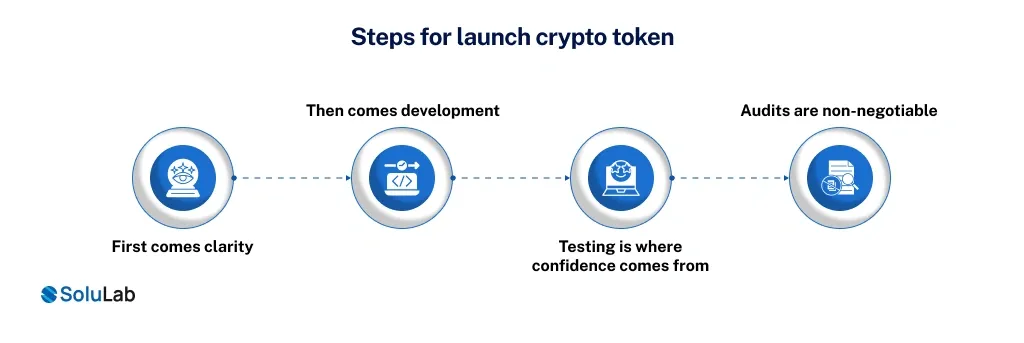
1. First comes clarity.
You spend the early weeks writing things down before touching code. Supply rules, emissions, vesting, burns, who can do what, and, more importantly, who can’t. Every function a user might call is listed. Edge cases matter here, like what happens during congestion, upgrades, or if something breaks mid-transaction. This is boring work, but it saves months later.
2. Then comes development.
Most UAE-facing projects stick to EVM chains because regulators and auditors are comfortable there. Ethereum, Polygon, sometimes Arbitrum. We don’t reinvent the basics, because OpenZeppelin libraries exist for a reason. The token follows ERC-20 standards, with only the features you actually need layered on top, and Admin actions are protected with multi-sig, events are logged cleanly, and nothing critical sits behind a single key.
3. Testing is where confidence comes from.
Every function gets tested, not just happy paths but bad inputs too. Tokens are run through real-world flows like DEX trades, staking contracts, and bridge interactions. Before mainnet, everything is pushed through public testnets to see how it behaves under pressure.
4. Audits are non-negotiable.
VARA expects independent eyes on the code, which is usually two rounds. The first audit costs somewhere between AED 100K–250K and takes a couple of weeks. You fix what’s flagged, especially anything critical or high risk, then go back for confirmation. Medium issues are okay if you explain how they’re handled. Anything serious left unresolved is a hard stop.
What regulators really care about is control and safety:
- No hidden backdoors
- No single person can freeze funds or drain reserves
- Multi-sig admin access (usually 3-of-5)
- Keys stored offline, not on laptops
- A real incident response plan, not a paragraph copied from GitHub
Most serious teams also run a bug bounty on platforms like Immunefi. It’s cheaper to pay researchers AED 50K–100K a year than clean up after an exploit. At the end of this process, you don’t just have working code. You have something that auditors can sign off on, regulators can trust, and users won’t lose sleep over. That’s the difference between shipping fast and shipping something that actually lasts.
How a Crypto Token Development Company Ensures Regulator-Friendly Tokenomics?
This is usually where things get real. Tokenomics isn’t just about making numbers look attractive on a pitch deck. It’s where economics meets compliance, and regulators pay close attention here. Get it right, and things move smoothly. Get it wrong, and the questions start piling up.
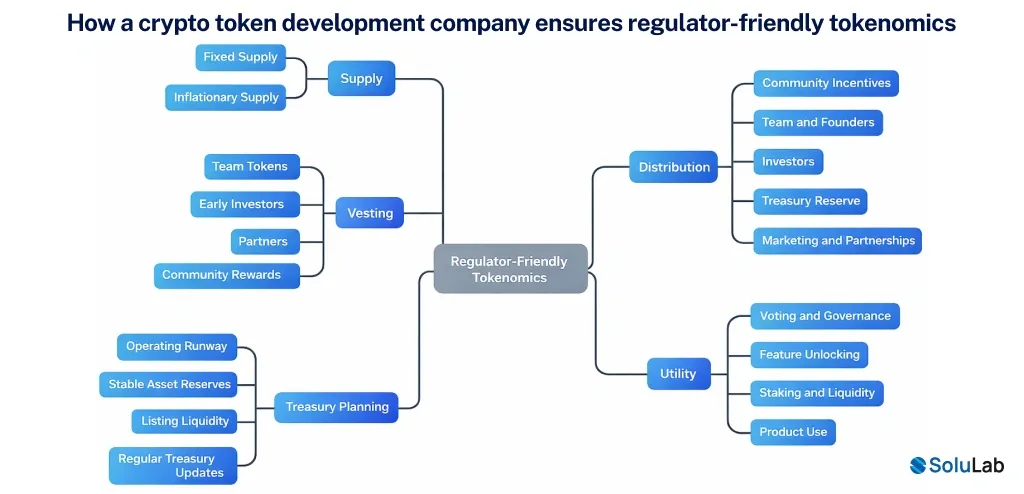
1. Start with the supply. Keep it simple, clear, and honest.
Regulators want to know exactly how many tokens exist and how that number changes over time. Fixed supply or inflationary is fine, but it has to be obvious which one you’ve chosen and why. No hidden mints, no vague language, no “we’ll decide later.”
Then comes distribution, which should always add up cleanly to 100%. No clever math or grey areas. A typical, regulator-friendly split looks something like this:
- Community incentives: ~40%
- Team and founders: ~20% (locked, not liquid)
- Investors: ~20%
- Treasury reserve: ~15%
- Marketing and partnerships: ~5%
What matters isn’t the exact percentages, but how clearly you explain who gets what, when they get it, and under what conditions. A simple unlock schedule does more for trust than any hype ever will.
2. Vesting is non-negotiable.
VARA looks closely at this, and for good reason. If founders or early investors can dump tokens early, retail users take the hit. The patterns they’re comfortable with are pretty standard:
- Team tokens locked for 4 years, with a 1-year cliff
- Early investors locked for 2 years, with a 6-month cliff
- Partners unlocked gradually, often tied to milestones
- Community rewards gated with KYC and anti-bot checks
This isn’t about control. It’s about showing you’re not planning an exit on day one.
3. Utility has to be real, not just a label.
This is where many projects quietly fail review. If your token promises fixed returns, profit sharing, or price appreciation as the main benefit, it starts looking like a security very quickly.
What regulators are actually comfortable with is simpler:
- Tokens used for voting and governance
- Tokens that unlock features or reduce platform fees
- Tokens earned through real activity, like staking or liquidity
- Tokens that are actually used inside the product, not just traded
If the only reason to hold the token is “number goes up,” expect pushback.
4. Treasury planning shows whether you’re serious.
Regulators want to see that you can survive market cycles. That usually means keeping 18–24 months of operating runway, holding reserves in stable assets, and setting aside liquidity specifically for listings and market stability.
Good teams also publish regular treasury updates. Nothing fancy, just what you hold, how fast you’re spending, and how long your runway lasts if nothing changes. That transparency matters more than most founders expect.
From VARA’s side, this all signals one thing – you’re building something meant to last, not something that collapses the moment markets turn. And that, more than anything else, is what keeps approvals moving.
How do Crypto Token Development Services In The UAE Handle Primary Distribution?
How you put tokens into the market matters more than most founders expect. It’s not just a launch moment; it’s where regulators, users, and future investors all form their first opinion. Do it clean, and you move fast. Do it wrong, and everything slows down.
| Distribution Type | How It Works | Best Use Case | Typical Timeline |
| Private Round | Accredited investors only, KYC required, usually via SAFT | Early capital, strategic investors | 2–4 weeks |
| Community Sale | KYC/AML, allowlisted users, per-wallet caps | Controlled public access | 1–2 weeks |
| Fair Launch / Airdrop | Small token amounts, identity checks to block bots | Bootstrapping users & liquidity | ~1 week |
Across all of this, one rule doesn’t change: every message needs a risk disclaimer. Tokens can drop hard, sometimes to zero, and regulators expect users to be told that upfront.
When it comes to pricing, teams usually keep it simple:
- Fixed price works when demand is uncertain
- Dutch auctions help the market find a fair price
- Bonding curves support ongoing fundraising and liquidity
- Tiered pricing rewards early supporters without overcomplicating things
There’s no perfect model. The right one depends on who you’re selling to, how fast you want to move, and how much regulatory exposure you’re willing to carry.
Best Practices for Crypto Token Launch in the UAE to Ensure Market-Ready Liquidity
Liquidity is what keeps a token alive once it’s out in the open. You can have a solid product and clean compliance, but if people can’t buy or sell without chaos, momentum dies fast. Most teams learn this the hard way.
Market makers are usually the first real decision. Their job isn’t hype, it’s boring but critical work – keeping buy and sell orders live all day, tightening spreads, and stopping the chart from breaking when someone exits early. The good ones don’t promise miracles; they promise discipline.
When choosing one, founders usually look at three things: who they’ve worked with before, whether they understand UAE exchanges, and how transparent they are with numbers. Fees typically sit around 0.5–2% of the raise, and most agreements run 6–12 months. A realistic setup might target AED 500K–1M daily volume, keep spreads under 1%, and deploy around 5–10% of the raise as working capital. Nothing fancy, just controlled.
On the exchange side, sequencing matters more than logos.
| Phase | Where | Why |
| Phase 1 | Binance Dubai, OKX | VARA-aligned, faster approvals |
| Phase 2 | Regional exchanges (ME & Asia) | Easier approvals after local traction |
| Phase 3 | Tier-1 global exchanges | Requires history, volume, credibility |
After a few weeks of stable trading, you move outward to regional exchanges across the Middle East or Asia. By then, you’ve got real volume, a price history, and fewer questions to answer. Only after that does it make sense to talk to global Tier-1 exchanges. Jumping there too early, without proof, almost always ends in a rejection email.
At the same time, most teams run DEX liquidity in parallel, not as a replacement. DEX pools help with reach and flexibility, but they’re noisier and less trusted by regulators. A typical flow looks like this:
- Day 1: DEX pool goes live
- Week 1: CEX applications submitted
- Week 4–6: First CEX trading
- Month 2+: Regional expansion and additional pools
Nothing here is about shortcuts. It’s about moving in the right order, building trust step by step, and making sure liquidity supports the project instead of becoming the reason it stalls.
Which Channels Boost Your Crypto Token Launch While Staying Within UAE Rules?
If you’re marketing a token in the UAE, you have to slow down a bit. Not because growth isn’t welcome, but because regulators care a lot about how you talk, not just what you build. Cross the line, and you’re looking at penalties, campaign shutdowns, or worse – license issues.
VARA’s rule is simple:
If money is involved, you don’t promote without approval. That said, you’re not blocked. You just need to be smart about it.
| Allowed Without Pre-Approval | Not Allowed (Auto-Violation) |
| Educational blogs and explainers | Paid ads without VARA approval |
| Free webinars and AMAs | Influencer promotions without disclosure |
| Organic social posts (X, LinkedIn, Telegram) | Guaranteed returns or yield promises |
| Community building on Discord/Telegram | Testimonials or profit screenshots |
| Technical documentation & GitHub | Time-pressure language (“Act now”) |
| Conference talks & panels | Targeting minors or unsophisticated users |
| Independent media coverage | Comparisons to pump-and-dump gains |
If it smells like hype, it’s probably a problem.
How pre-approval actually works?
You draft the campaign, send it to your compliance officer, they file it with VARA, and you wait. Reviews usually take 10–15 business days, but planning-wise, assume 3–4 weeks. Which is why marketing should be planned early, not right before launch.
A simple, compliant way to grow:
Phase 1 – Before launch:
- Organic content only. Blogs, webinars, andcommunity.
- It has low cost and high trust.
Phase 2 – Launch week:
- Pre-approved ads with clear risk disclosures.
- No hype or shortcuts.
Phase 3 – After launch:
- Deep dives, case studies, and developer-focused content.
- Long-term credibility beats short-term noise.
The teams that win here aren’t louder. They’re just cleaner, clearer, and patient.
How Can You Launch Your Crypto Token in the UAE Within 180 Days?
Think of this less like a checklist and more like how teams really move from idea to live trading without blowing timelines or trust. It’s structured, yes, but flexible where it needs to be because no launch goes exactly as planned.
| Phase | Timeline | What Happens in Reality | Go / No-Go Check |
| Phase 1: Groundwork | Weeks 0–4 | Entity gets registered, crypto-native legal counsel comes in, token structure is locked, AML policies start forming, and early banking talks begin. This is where you prevent future delays. | Entity live, legal engaged, token specs finalized |
| Phase 2: Build & Validate | Weeks 5–12 | Smart contracts are built and tested, the first audit is submitted, the whitepaper takes shape, and banking partners move from interest to intent. | Audit issues manageable, whitepaper regulator-ready |
| Phase 3: Licensing | Weeks 13–20 | Regulatory filings go in, early users test the platform, and market-maker discussions turn into signed agreements. | License approved or Category 2 path confirmed |
| Phase 4: Pre-Launch | Weeks 21–26 | Licensing clarity arrives, exchange listings are locked, liquidity pools are prepared, and marketing only starts once approvals are clear. | All systems ready for issuance and trading |
| Phase 5: Launch | Weeks 27–30 | Tokens are minted and distributed, trading goes live, and monitoring dashboards stay active around the clock. | Healthy volume and stable liquidity |
| Phase 6: Scale | Weeks 31–52 | Liquidity is optimized, more exchanges come online, governance activates, and regulator communication stays ongoing. | Sustained volume and positive regulatory signals |
This timeline isn’t about speed alone. It’s about not having to restart at week 12 because something small was skipped at week 2.
Conclusion
Launching a crypto token in the UAE doesn’t have to be a gamble. The rules are clear, and the fastest-scaling projects are the ones that get regulatory classification right from day one, bake security into smart contracts, design tokenomics for real utility, and move compliance, development, and marketing in parallel.
SoluLab, as a crypto token development company, has guided 7+ token launches to successful VARA approvals, saving founders time, money, and headaches. Work with us and get audit-ready smart contracts, VARA-compliant marketing, institutional liquidity access, and post-launch support, all designed to launch fast and scale safely.
Engage regulators early, so you can avoid costly delays.
FAQs
With over 3 years of experience, I specialize in breaking down complex Web3 and crypto concepts into clear, actionable content. From deep-dive technical explainers to project documentation, I help brands educate and engage their audience through well-researched, developer-friendly writing.