GPT, Llama, open-source, closed-source: if you’re feeling lost in the acronyms, you’re not alone. As language models get more capable, knowing the real difference between platforms like Meta’s Llama and OpenAI’s GPT matters more than ever.
Open-source versus closed-source AI isn’t just a technical decision. It shapes your cost, your control, your flexibility, and how fast you can actually ship something new. Llama hands you the freedom to tinker under the hood. GPT hands you a polished, plug-and-play experience instead. Neither wins outright, and what works for one use case can flop for another.
If you’ve ever wondered whether to go open-source or stick with a commercial model, this is for you. We’ll break it down across performance, cost, efficiency, and real use cases, so by the end you’ll know exactly which one fits what you’re building.
What is the Llama?
LLaMA ( Large Language Model Meta AI) is Meta’s (formerly Facebook) advanced AI model, trained on a massive amount of text to understand and generate language that reads like a human wrote it. Just like ChatGPT, LLaMA handles tasks like answering questions, drafting content, summarizing articles, even translating between languages.
Here’s the best part: Meta built LLaMA3 to be open and accessible, so researchers and developers can build their own agentic AI tools on top of it.
Meta’s LLaMA has already been downloaded over 1.2 billion times, a clear sign of how widely developers and SMBs have adopted it. Here’s what makes it stand out:
- High performance with fewer parameters: It’s efficient by design, offering strong results without leaning too hard on resources.
- Multilingual support: LLaMA reads and writes in multiple languages, not just English.
- Trained on diverse datasets: That range helps it handle a wide variety of topics and contexts.
- Customizable: Developers can fine-tune it for specific tasks or industries.
- Open-source access: Meta lets researchers access and experiment with the model directly.
- Fast and efficient inference: Built to deliver quick responses without demanding heavy computing power.
What is GPT?
GPT stands for Generative Pre-trained Transformer, OpenAI’s model built to understand and generate text that reads naturally. Trained on massive amounts of data, it handles everything from blog writing to answering questions, drafting emails, coding, or just chatting for fun.
Read Also: Build Your Own GPT Model In 5 Easy Steps
Here’s what GPT brings to the table:
- Natural language understanding: It grasps the context behind your questions and answers accordingly.
- Text generation: Ask it for essays, summaries, poems, or anything in between.
- Multilingual support: GPT reads and responds in many languages beyond English.
- Code writing: It writes and explains code across different programming languages.
- Conversational ability: It genuinely feels like chatting with a real person.
- Context awareness: It tracks parts of your conversation to keep things flowing naturally.
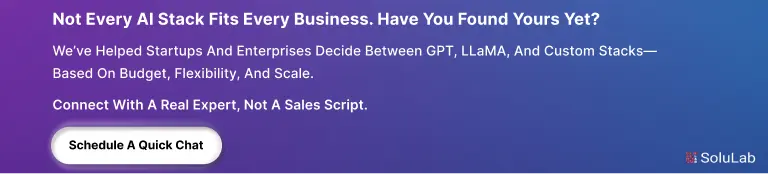
Llama vs GPT: Quick Comparison
Despite both using natural language processing, Llama and GPT diverge in plenty of ways. Here are the main distinctions worth knowing.
1. Architecture and Model Size
Architecture and model size set these two apart right away. The latest GPT is a transformer-based model running billions of parameters through a deep architecture, and that scale is what lets it generate text that actually holds together.
Llama, by contrast, runs anywhere from 7 billion to 65 billion parameters. It holds up well on modest computational resources, which makes it a strong fit when you need fast deployment without much processing power to spare.
2. Training Data and Sources
GPT trains on a broad sweep of publicly available data, websites, books, articles, which makes it genuinely general-purpose. Llama takes a narrower path: Meta curated its dataset around high-quality, open-source text. So GPT casts a wider net, while Llama leans more academic and structured. That difference shows up in how each one handles different kinds of questions.
3. Performance in Natural Language Processing (NLP)
For NLP tasks like summarizing, translating, or answering questions, GPT usually performs better right out of the box. It’s polished, versatile, and handles a wide range of tones without much friction. Llama holds its own too, but often needs more fine-tuning to match GPT’s fluency, especially for casual or creative writing.
4. Efficiency and Computational Requirements
Llama was built to stay lightweight and efficient, so it runs on smaller devices without hogging resources. GPT is powerful, but the larger versions demand serious computing power. If your infrastructure is limited, Llama is probably the easier one to manage.
5. Cost and Accessibility
Most people access GPT through OpenAI’s paid plans or APIs, and costs add up fast at high volume. LLM models flips that: open-source and free to run, as long as you have the technical chops to set it up yourself. Budget-friendly, yes, but nowhere near as plug-and-play as GPT.
6. Use Cases and Applications
GPT shows up everywhere: chatbots, content writing, coding help, tutoring. It’s flexible and easy to wire into an app through its API. Llama fits better for custom enterprise solutions or researchers fine-tuning models for a specific use case. Powerful, sure, but it demands more hands-on setup to get there.
Read Also: How to Build a Multilingual Chatbot in 2025?
Pros and Cons of Llama
Every technology has trade-offs, and Llama is no exception. Let’s look at where it wins and where it falls short.
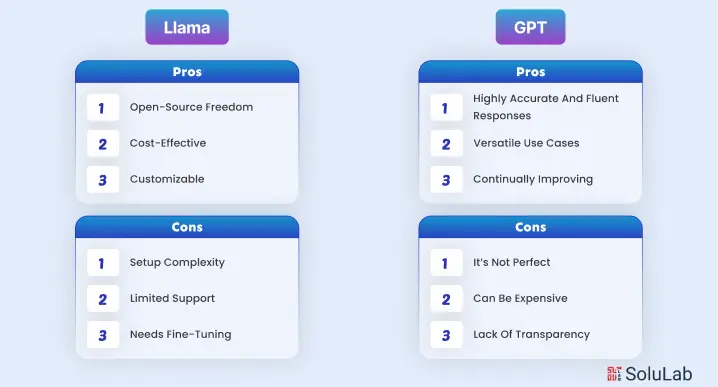
1. Open-Source Freedom: Access and modify the model however you want, which hands developers and researchers a lot more flexibility.
2. Cost-Effective: Since it’s open-source, you skip the subscription fees that come with GPT or other closed-source AI development.
3. Customizable: Fine-tune Llama on your own datasets to fit very specific tasks or industries.
4. Efficient Performance: Built lightweight, Llama runs on lower-end hardware where larger models like GPT-4 would struggle.
Cons of Llama
1. Setup Complexity: Not beginner-friendly. You’ll need real technical skill to run and fine-tune it properly.
2. Limited Support: Unlike GPT, there’s no dedicated customer support or built-in platform. Most help comes from the open-source community instead.
3. Needs Fine-Tuning: Out of the box, it’s not always as fluent or polished as GPT, especially for casual or creative writing.
Pros and Cons of GPT
GPT is a genuinely popular choice among AI language models. But put Meta’s Llama up against OpenAI’s GPT, and it’s clear both come with real pros and real drawbacks. Let’s look at a few.
- Highly accurate and fluent responses: GPT’s replies read naturally and track context well, which makes it strong for writing, chatting, and working through problems.
- Versatile use cases: Drafting emails, writing code, creating content, tutoring, GPT covers a lot of ground. It’s basically a smart assistant on call.
- Continually improving: Regular updates and fine-tuning mean GPT keeps getting sharper at understanding and generating text.
- Easy to integrate: Businesses can plug it into websites, apps, or customer service systems through OpenAI’s API with minimal setup.
Cons of GPT:
- It’s not perfect: GPT still gives incorrect or biased answers sometimes. Double-check the output, especially for anything sensitive.
- Can be expensive: Running advanced versions like GPT-4 regularly adds up fast, especially for startups and solo users.
- Lack of transparency: GPT is closed-source, so you never fully know how it was trained or what data shaped it.
- Resource-intensive: Larger models need serious infrastructure to run efficiently, which rules them out for on-device or low-power setups.
Future of AI-Language Models: What to Expect?
Expect these models to keep getting more human-like, not just in how they write, but in how they read context, emotion, and intent. Real-time translation with near-perfect accuracy might not be far off, and neither is learning software that actually feels tailor-made to the student.
Smaller, faster models that run natively on phones and laptops seem likely too, putting powerful AI tools within reach of more people. Privacy and ethics will probably get more attention as well, with models built to explain their own reasoning in plain terms.
We might even see deeper collaboration between humans and AI, writers, designers, and coders working alongside AI as genuine creative partners, often backed by an AI development company. Language models could stop being just tools and start becoming everyday collaborators, adding real value to both personal and professional life. And honestly, we’re still only scratching the surface.

Conclusion
Choosing between Llama and GPT really comes down to what you need. Want something ready-to-use, polished, with strong support and broad capabilities? GPT is the solid pick.
But if control, customization, and a cost-effective open-source model matter more to you, Llama is probably the better fit. Both have real strengths: GPT shines on performance and ease of use, Llama wins on flexibility and freedom.
As AI keeps advancing, expect both models to keep evolving in their own directions, giving users more options than ever. In the end, it comes down to what actually fits your setup.
SoluLab, a leading LLM development company in the USA, can help you build tools like these and scale your business faster. Contact us today to talk through your project.
FAQs
Shipra Garg is a tech-focused content strategist and copywriter specializing in Web3, blockchain, and artificial intelligence. She has worked with startups and enterprise teams to craft high-conversion content that bridges deep tech with business impact. Her work translates complex innovations into clear, credible, and engaging narratives that drive growth and build trust in emerging tech markets.