RWA tokenization in Dubai has become a market entry opportunity for firms that want to build regulated digital asset products early. In March 2025, Dubai Land Department launched the pilot phase of its Real Estate Tokenization Project. In May 2025, it launched Prypco Mint as the MENA region’s first licensed tokenized real estate platform. DLD also projects that tokenized real estate could reach 7% of Dubai’s property market by 2033, equal to AED 60 billion.
For founders, asset owners, and leadership teams, this creates a clear business signal. RWA Platform Development in Dubai is shaping a regulated market where early movers can define product standards, build investor trust, and secure long-term positioning. In this environment, execution quality, licensing readiness, and platform credibility will set the new standards.
This guide explores how to structure, license, and launch an RWA Tokenization Platform in the UAE in a way that supports long-term scale, trust, and enterprise adoption.
Key Takeaways
- RWA tokenization business in Dubai presents an opportunity for early movers in digital asset regulation.
- The Dubai Land Department’s initiatives signal growth potential in the tokenized real estate market.
- Start with a clear asset model and navigate compliance to ensure credibility and operational success.
- Selecting the right jurisdiction and understanding VARA’s licensing process is crucial for launching effectively.
- A successful platform should prioritize compliance, robust governance, and a phased approach to market entry.
Why is RWA Tokenization in Dubai Now a Strategic Move?
The RWA tokenization in Dubai offers a regulated route into private market infrastructure. It widened distribution, reduced ticket sizes, improved settlement design, and created new fee lines across issuance, servicing, custody, reporting, and secondary liquidity.
The commercial success of the RWA tokenization business in Dubai will not be dependent upon the issuing of a token, but on owning part of the operating stack.
How to Start RWA Tokenization Business: A Step-By-Step Guide
Building an RWA (Real-World Asset) tokenization platform isn’t just about technology; it’s about combining compliance, asset strategy, and scalable infrastructure. Here’s a practical step-by-step roadmap to help you get started:
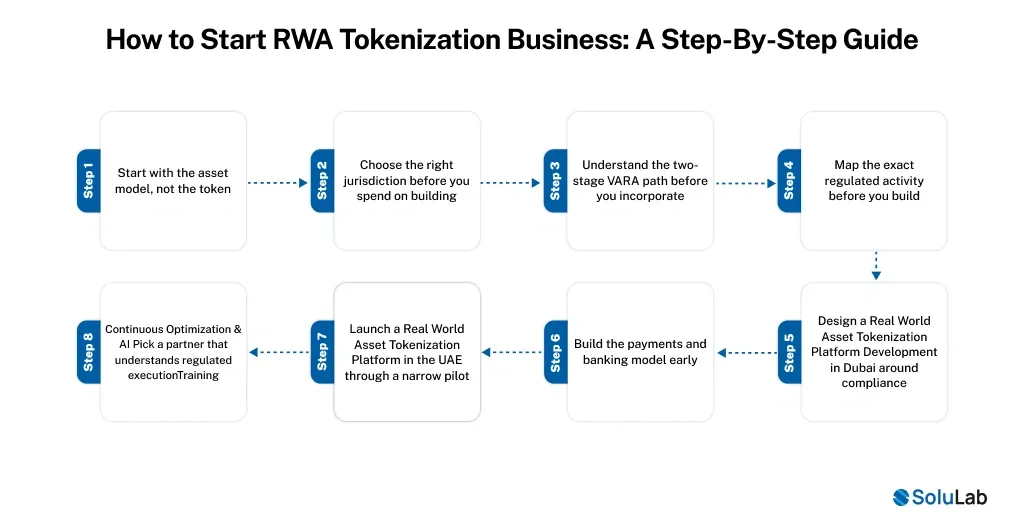
Step 1: Start with the asset model, not the token
To build a durable tokenization business in Dubai, a business needs to define the following before you incorporate.
- What asset will be tokenized?
- Who legally owns it today?
- What entity will issue the tokenized interest?
- Who will manage custody, payments, compliance, and post-issuance reporting?
That discipline is what separates a serious digital asset business in Dubai from a concept deck. A real estate sponsor, private credit platform, fund manager, commodities house, and treasury platform do not need the same structure. The success of top Dubai RWA tokenization companies will depend on how clearly it links the token to the underlying legal and operational reality. That is where credibility starts.
Step 2: Choose the right jurisdiction before you spend on building
For most founders, the first comparison starts between choosing VARA, DIFC, and ADGM for real-world asset platform development in Dubai.
VARA is the authority for virtual asset activities in the Dubai mainland and Dubai free zones, except DIFC. DIFC tokenization regulations follow the DFSA regime. ADGM follows FSRA rules and has separate guidance for virtual assets and digital securities.
If your token may be treated as a security, ADGM digital asset regulations explicitly say issuers should engage FSRA as early as possible. That means blockchain company formation in Dubai should never be separated from licence planning. The same rule applies to tokenization company registration in the UAE.
Step 3: Understand the two-stage VARA path before you incorporate
If you plan to operate in or from Dubai outside DIFC, VARA should be central to your strategy. VARA says new firms follow a two-stage process:
- Stage one is approval to incorporate.
- Stage two is the full VASP licence application.
At the first stage, applicants submit an Initial Disclosure Questionnaire through DET or a relevant Dubai free zone, provide a business plan and ownership details, pay initial fees, and then receive ATI if VARA is satisfied.
VARA’s application documentation goes far beyond a company profile. It includes a governance framework, UBO information, key personnel details, regulatory business plan, financial projections, proof of paid-up capital, succession plan, wind-down plan, insurance certificates, and more. Thus, the first rule is crucial to follow to launch a regulated RWA tokenization platform in the UAE.
Cost Discipline Is Important
VARA’s published fees start at AED 40,000 for advisory and transfer and settlement applications, while broker-dealer, custody, exchange, management and investment, lending and borrowing, and Category 1 issuance each carry AED 100,000 application fees. Annual supervision fees range from AED 80,000 to AED 200,000 per activity.

Step 4: Map the exact regulated activity before you build
A Dubai virtual asset service provider (VASP) is licensed by activity. VARA currently lists eight regulated activities: advisory, broker-dealer, custody, crypto exchange, lending and borrowing, management and investment, transfer and settlement, and Category 1 issuance.
A firm can aggregate several activities under one licence, but custody has special segregation requirements. Under the VARA crypto license in Dubai, custody is the one activity that must be housed separately.
A VA custodian must be a distinct legal entity with a standalone licence. VARA also says licensed VASPs cannot use the same activity licence for proprietary trading and would need separate treatment for that. This is why the wrong licensing map can break your group structure, operating budget, and product roadmap.
If your RWA tokenization platform in the UAE touches issuance, transfer, brokerage, custody, or investment activity, the regulator will assess substance. The licence scope must match the real workflow.
Step 5: Design a Real World Asset Tokenization Platform Development in Dubai around compliance
RWA tokenization platform development in Dubai should follow the legal workflow of the asset. They must connect issuance logic, investor or participant onboarding, wallet or custody controls, payment rails, transfer restrictions, reporting, and auditability into one controlled system.
Asset Tokenization Platform Development in Dubai involves six crucial layers. This includes six layers, including asset intake, identity and eligibility checks, Smart contract issuance, Wallet or custody design, transfer governance, reporting, and reconciliation. For regulated RWAs, the platform also needs off-chain legal records, permissions, document trails, and controlled redemption or payout flows.
SoluLab’s enterprise RWA guide describes the market in exactly these compliance-first layers, including blockchain, smart contract, compliance, custody, and application layers.
Decision-makers should ask whether the partner understands licensing perimeter, custody design, identity controls, reserve logic, and audit readiness.
Step 6: Build the payments and banking model early
To launch a successful RWA Tokenization Platform in Dubai, do not design it as though on-chain logic alone will carry the business.
For many regulated structures, the credibility of your fiat rails, custody controls, reconciliations, and investor protection framework will matter more than the chain itself. That is especially true if you want to serve regulated property, private market, or treasury-linked use cases.
Step 7: Launch a Real World Asset Tokenization Platform in the UAE through a narrow pilot
The smartest operators always start with one asset class, one legal wrapper, and one clean workflow. To launch a real-world asset tokenization platform in the UAE, the platform must have three things.
- First, your legal rights are enforceable.
- Second, your onboarding and transfer controls are reliable.
- Third, your reporting and servicing can scale without manual breakdown.
Only after that should you widen distribution, add asset classes, or introduce secondary market functionality where regulation permits.
Step 8: Pick a partner that understands regulated execution
Hiring a blockchain expert in Dubai brings delivery patterns, compliance-aware architecture, and launch discipline. RWA tokenization consulting in Dubai helps firms pressure-test jurisdiction, custody, workflow, and cost before they commit. When you evaluate an RWA tokenization development company in the UAE, look for proof in three areas.
- Can they structure compliant issuance logic?
- Can they integrate custody and fiat workflows?
- Can they support reporting, controls, and expansion after launch?
These are some crucial factors that separate real RWA tokenization development services from ordinary blockchain delivery.
Conclusion
To launch a Real World Asset Tokenization Platform in the UAE, businesses need the right asset model, the legal wrapper, the license path, and platform architecture. By making these four decisions right, RWA tokenization in Dubai can become a new operating line for property platforms, fintech firms, private market operators, and digital infrastructure businesses. If you get them wrong, the project becomes an expensive theatre. The market will only reward disciplined founders.
SoluLab is leading Tokenization Platform Development Company in Dubai with 11 years of experience, 1,500+ projects, 250+ staff members, and 500 happy clients. We build enterprise-grade RWA platforms covering asset structuring, token design, smart contracts, compliance-ready onboarding, and multi-chain integrations.
We recently delivered a gold and silver tokenization platform with 1:1 vault-backed reserves, proof-of-reserves visibility, redemption flows, wallet and exchange connectivity, KYC and AML controls, analytics dashboards, and a launch timeline of under six weeks.
Have the vision? We’ll build the platform. Launch your RWA tokenization business faster with our experts!
FAQs
Deepika is a content writer who blends storytelling with strategic thinking. She explores topics across digital innovation, emerging tech, and the evolving blockchain industry. She enjoys breaking down complex ideas into simple, engaging narratives in the growing global markets.