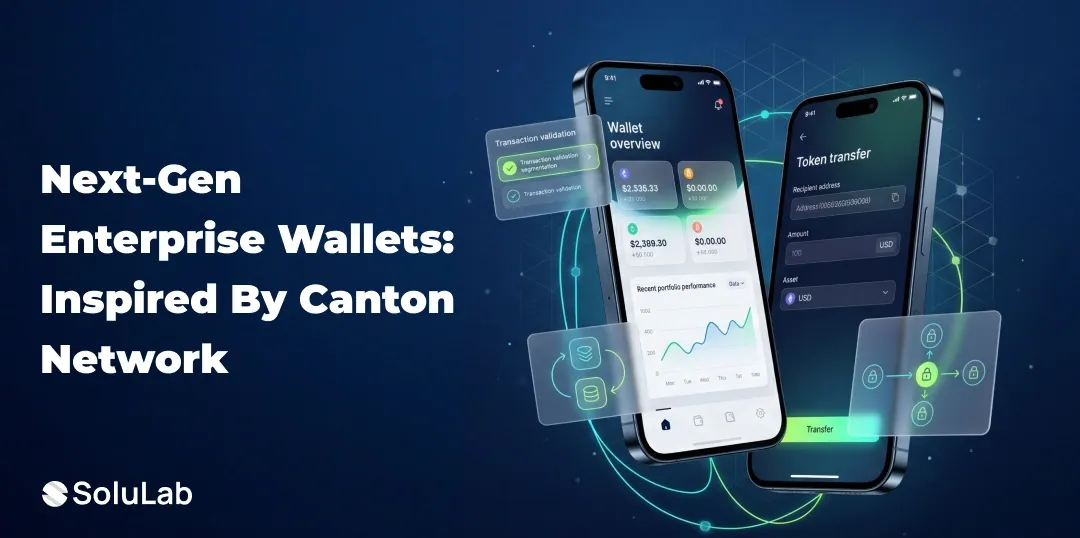
$350 billion, that’s how much in assets Canton Network processes every single day as of early 2026, with average daily users tripling in under twelve months. If that number doesn’t stop you mid-scroll, consider this:
- DTCC, the institution that settled $3.7 quadrillion in transactions last year, officially announced in December 2025 that it’s tokenizing U.S.
- Treasuries on Canton, backed by an SEC no-action letter.
- And Ledger, which secures an estimated $1 trillion in hardware-custodied assets with over 5 million monthly active users on Ledger Live, joined Canton as a Super Validator in February 2026.
This is not a pilot. This is the institutional financial system quietly choosing its blockchain development infrastructure, and the window to build wallet products on top of it is open right now, but it won’t stay that way.
The cost to build a wallet like Canton Network has never been more clearly justified by the market opportunity. This guide covers everything that goes into Canton Network wallet development, with architecture, feature scope, build phases, costs, and what it takes to ship something the market actually wants.
Key Takeaways
- The Problem
- Most crypto wallet solutions were not designed for Canton’s privacy-first, DAML-based environment. Founders who try to retrofit generic wallet infrastructure onto Canton end up with costly rebuilds, months of delays, and missed enterprise opportunities because the architecture is genuinely different from anything on public chains.
- The Solution
- A well-built Canton Network wallet development strategy starts with the right foundation – sub-transaction privacy, DAML contract management, proper key custody, and compliance-ready APIs. That’s why getting the architecture right at the start is the single biggest factor that separates shipped products from stalled ones.
- How SoluLab Can Help
- SoluLab provides end-to-end Canton wallet development services[covering everything from technical scoping and DAML engineering to security audits, deployment, and post-launch support, so you move faster without burning resources on guesswork or expensive rebuilds.
Why Is the Canton Network Wallet Dominating the Wallet Space?
The rise of the Canton network was not really a surprise for anyone watching institutional blockchain closely. Public chains are open by design, which is great for permissionless DeFi, but a hard blocker for banks and financial institutions that legally cannot expose transaction data to every node on a network. Digital Asset built Canton Network to solve that problem at the protocol level, not as a workaround.
Canton Network has $6 trillion in institutional assets processed, with 400+ institutions actively participating, including Bank of America, which has been running 24/7 on-chain Treasury trades since 2024. The DTCC partnership in December 2025, with an SEC no-action letter for a 3-year tokenization pilot, is as strong an institutional endorsement as you’ll see in blockchain infrastructure.
McKinsey estimates the tokenized asset market could reach $2 trillion by 2030, and the tokenization infrastructure market itself is projected to hit $18.8 billion by 2034 at a 19% CAGR. Forbes reported tokenized RWAs already at $24 billion in mid-2025 and accelerating. Canton sits at the center of all of this, and wallet infrastructure is the entry point for every single participant
And the demand from enterprise clients, who have real budgets, compliance requirements, and timelines, is driving serious attention toward teams who can actually deliver the best crypto wallets.
A quick look at what the competitive wallet landscape looks like right now:
- MetaMask, Trust Wallet, and Phantom — dominant in retail but built for open public chains. No DAML support, no sub-transaction privacy, no enterprise compliance layers
- Fireblocks and Copper — institutional leaders in custody, but fully custodial by design, which works against Canton’s self-sovereign philosophy
- The open gap — Canton Network’s self-custodial wallet solutions built for institutional workflows. That gap is real, and it is widening as more enterprises move to Canton
If you are evaluating the best wallets for Canton Network or thinking about building one yourself, you are looking at a market with genuine white space. The teams that get in now with the right architecture and the right partners are the ones that will own this vertical by the time the broader market catches up.
Choosing the right web3 wallet development company matters enormously at this stage. Not because the technology is inaccessible, but because Canton’s infrastructure, like DAML, sync domains, participant nodes, and the ledger API, requires specialists who have worked inside it before, not developers who are learning it on your budget.

Understanding the Architecture Behind Canton Network Wallet Development
Most wallet developers hit a wall here because they assume Canton is just another EVM-compatible chain with a different name. It is not, and that assumption costs teams months of rework.
Canton runs on DAML (Digital Asset Modeling Language), a smart contract language built specifically for multi-party financial workflows. Every contract in Canton is explicit about who can see it, who can act on it, and when those rights expire.
That is a fundamentally different programming model than Solidity or Rust, and it shows in every layer of the architecture.
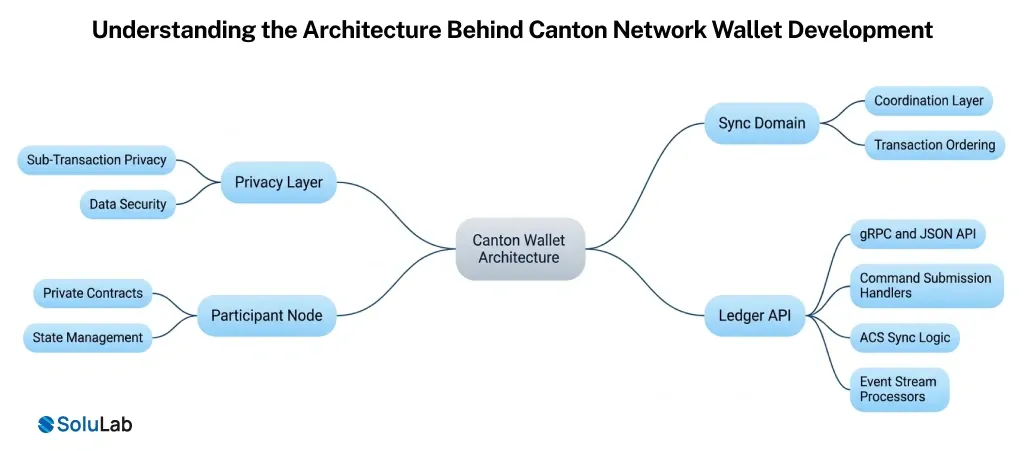
Here is how it breaks down in plain terms:
1. Privacy Layer
Canton’s core differentiator is sub-transaction privacy. Each participant node only stores contracts it is a party to. When you are building Canton Network wallet development systems, this privacy layer is not an add-on; it is the foundation that everything else sits on. Design it from day one.
2. Sync Domain
The sync domain is Canton’s coordination layer. It keeps all participant nodes in agreement on transaction ordering without sharing private data across nodes. Your wallet connects to this layer through a well-built Canton wallet API integration services layer, and the quality of that integration directly affects how reliable your wallet feels in production.
3. Participant Node
Each institution or user runs their own participant node, which stores private contracts and manages state. Your wallet is the interface layer on top of that node, like reading contracts, submitting transactions, and managing party identities. It is a more complex relationship than a standard RPC call to Ethereum.
4. Ledger API
The gRPC and JSON API interface between your wallet and the participant node. A significant portion of Canton wallet development projects involves building reliable command submission handlers, active contract set (ACS) sync logic, and event stream processors that stay consistent under load.
This is why team composition matters as much as the technical plan. A good DeFi wallet development company brings architects who have built Canton-native systems before, not just developers who are reading the documentation alongside you.
Core Architecture Modules Every Wallet Must Include in 2026
Well-funded projects still get this wrong. They pour resources into the frontend and overlook the backend modules that enterprise clients actually benchmark them on. Here is what a serious wallet needs in 2026:
1. Core Wallet Engine
The non-negotiables: DAML contract lifecycle management (create, exercise, archive), active contract set sync with caching, and multi-party workflow routing. Without these, you have a shell, not a wallet.
2. Identity & Key Management
Canton uses a party-based identity model, not wallet addresses. Your wallet manages party IDs and cryptographic signing keys, which means proper HSM (hardware security module) support for institutional clients and MPC (multi-party computation) wallet key management for high-value accounts. This is one of the most technically demanding features of the Canton Network wallet and the first thing enterprise clients ask about in technical due diligence.
3. Self-Custody Module
This connects directly to the philosophy behind Canton Network’s self-custodial wallet design, where users hold their own keys, and your platform provides the interface and workflows. For enterprise deployments, this typically means HSMs or secure enclaves. For broader consumer markets, it means robust seed phrase management with social recovery options.
If you are still evaluating which custody model fits your product, understanding the difference between a Custodial Vs Non-Custodial Wallet setup is essential before locking in architecture. Canton architecturally favors non-custodial, but enterprise clients often use a hybrid model with institution-controlled HSM backing.
4. Compliance & Reporting Module
For any institutional deployment, this is non-negotiable. Built-in KYC/AML hooks, configurable compliance rule sets, automated audit log generation, and transaction reporting APIs need to be native to the product, not bolted on after launch. These are among the core features of the Canton Network wallet that enterprise clients will evaluate before signing any contract.
5. Interoperability Bridge
Canton is designed for multi-domain operations. As of 2026, enterprise clients increasingly expect wallets to support assets and workflows moving across different Canton-connected networks. Build the interoperability layer from the start; retrofitting it later is expensive.
6. AI-Powered Intelligence Layer
Leading teams are integrating AI-integrated smart crypto wallet capabilities like transaction anomaly detection, fraud flagging, smart compliance alerts, and natural language transaction search. These features are becoming differentiators in competitive enterprise deals, not just nice-to-haves.
Step-by-Step Blueprint to Build a Canton Network Wallet
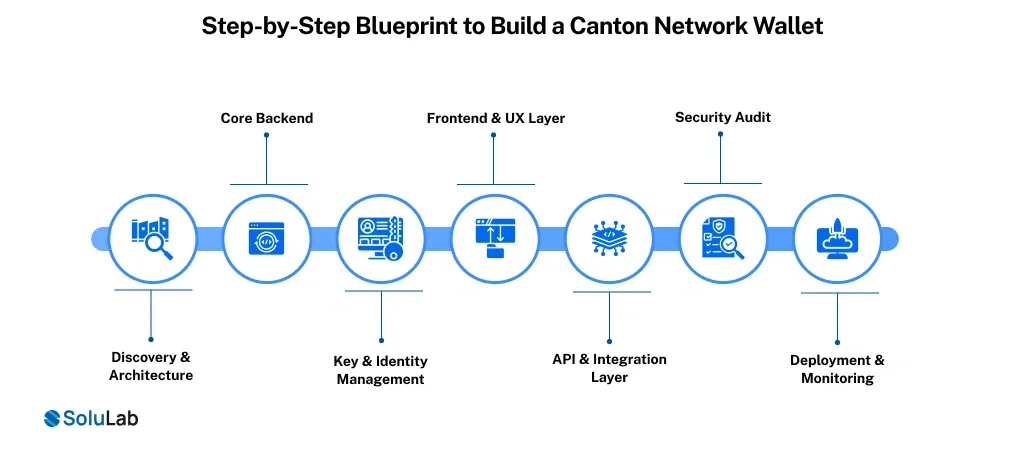
Building this well looks something like this. Timelines assume a senior team with Canton-specific experience.
Step 1 — Discovery & Architecture (2–4 weeks)
Define user profiles (retail, institutional, or hybrid), map DAML contract templates for your workflows, choose your sync domain setup, and decide between hosted and self-hosted participant nodes. Decisions made here cascade into every phase, after bad decisions here are the most expensive ones you make.
Step 2 — Core Backend (6–10 weeks)
Build Ledger API handlers, party management systems, command submission logic, and event stream processors. This is the operational backbone of your build Canton Network wallet solution, and it is where most of the real DAML expertise gets applied.
Step 3 — Key & Identity Management (3–5 weeks)
Key generation, secure storage, HSM integration, and party onboarding flows. This phase is where the Canton Network’s self-custodial wallet capability actually gets implemented, not designed.
Step 4 — Frontend & UX Layer (4–6 weeks)
Clean, fast, purpose-built for your target user. Enterprise clients want dashboards, approval workflows, and reporting views. When you launch your own Canton-ready wallet, this is what users experience first. Make sure it reflects the product’s quality, not just the brand.
Step 5 — API & Integration Layer (3–4 weeks)
Build your Canton wallet API integration services with REST endpoints, webhooks, exchange connectors, and third-party compliance tool integrations. This layer is also where you can begin monetizing the API as a separate product tier.
Step 6 — Security Audit (3–5 weeks)
DAML contract review, penetration testing, key management audit, and load testing under realistic institutional transaction volumes. Do not compress this phase, as a wallet that ships without a proper audit is a liability.
Step 7 — Deployment & Monitoring (2–3 weeks)
Production rollout, monitoring dashboards, alerting configurations, and documented incident response procedures.
Total timeline: 23–37 weeks for a production-ready, enterprise-grade wallet. MVP builds with a narrower scope can land closer to the 20-week mark with the right team.
Security, Compliance & Best Practices That Impact the Cost to Build a Canton Network Wallet
Security in Canton wallets goes deeper than most teams plan for in their initial scope. Here is what serious teams consistently get right and where most teams underinvest:
1. Key Storage
Private keys never go into application databases. HSMs, secure enclaves, or MPC vaults are the production standard. Access logs and key custody documentation should be part of your delivery specification from day one, not a post-launch cleanup task.
2. Access Control & Multi-Sig
Role-based access control for enterprise users. Multi-signature wallet authorization for high-value and time-sensitive transaction workflows. These are expected in any institutional deployment, not extras.
3. DAML Contract Review
Canton’s privacy model significantly reduces the attack surface compared to public chains, but DAML contracts still need formal review for authorization gaps and business logic errors. This requires DAML-specific auditors, not just general smart contract reviewers.
4. Transport Security
All communication between your wallet and participant nodes should use mTLS encryption. External API endpoints should be rate-limited, monitored, and behind authenticated access layers.
5. Regulatory Compliance by Jurisdiction
- EU institutional clients: GDPR and DORA compliance
- US clients: SOC 2 Type II and fintech licensing, depending on asset class
- Global deployments: modular compliance architecture configurable per jurisdiction
One thing that consistently surprises founders: the compliance layer often takes as long as the technical build for enterprise-focused wallets. Involve compliance advisors during development because some compliance requirements directly affect architecture decisions that are costly to change later.
Enterprise-Ready Monetization Features of a Self-Custodial Canton Network Wallet
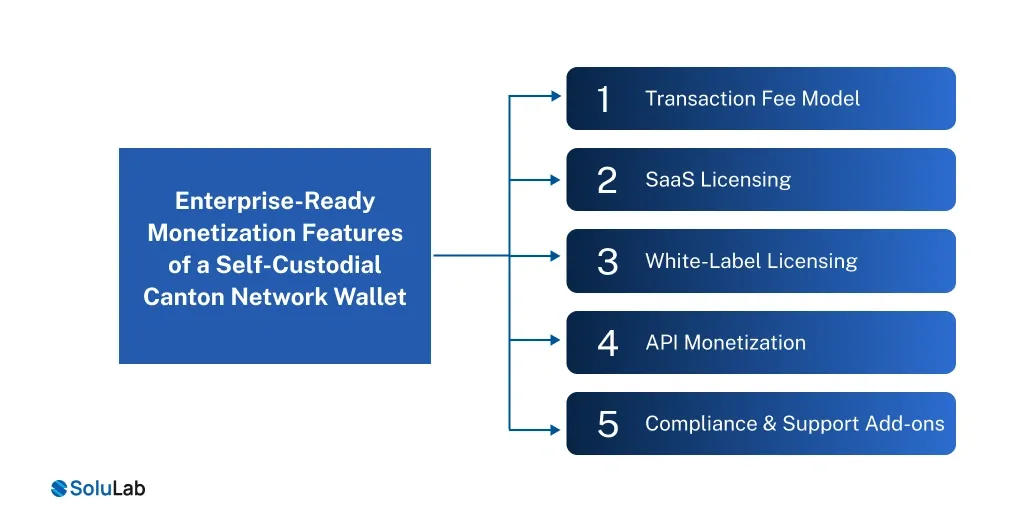
This is the part founders actually want to get to. How do you build a business around a Canton wallet?
Here are the Revenue Models That Work:
1. Transaction Fee Model
Basis-point fees on assets moved through your wallet. Works well for high-volume institutional deployments where even small per-transaction fees generate meaningful revenue at scale. The math works especially well in capital markets and settlement workflows.
2. SaaS Licensing
Monthly or annual license per organization. The most predictable revenue model if you are building a Crypto Wallet focused on enterprise B2B. Institutional clients often prefer it because it fits their budgeting cycle.
3. White-Label Licensing
Banks and fintechs deploy your wallet under their own brand. Your core build generates revenue across multiple clients without a full rebuild each time. This is one of the strongest arguments for investing in a robust build Canton Network wallet solution from day one. The better the core, the more clients you can license it to.
4. API Monetization
Your Canton wallet API integration services layer becomes a product in itself. Charge per API call, per integration tier, or as a premium enterprise add-on. This is increasingly common among platform-focused teams.
5. Compliance & Support Add-ons
Premium modules for advanced reporting, automated audit log export, and white-glove onboarding support are charged separately or bundled into enterprise tiers.
Enterprise Features to Include at Launch:
- Multi-organisation account management with permission hierarchies
- Granular transaction approval workflows are configurable per client
- Custom compliance rule builder for different regulatory environments
- Dedicated support SLAs with named account management
- On-premise deployment option for clients in regulated industries
On the question of cost to build a wallet like Canton Network, these monetization and feature choices directly define your build scope and your total investment. A basic MVP-level SaaS wallet is a very different build in timeline, complexity, and cost from a full white-label enterprise platform with compliance modules and HSM key management.
Most serious wallet builds land between $30,000 and $120,000, depending on scope, team composition, and jurisdiction-specific compliance work. If you want a granular breakdown of Cost to build crypto wallet at different scope levels, that conversation is worth having early before assumptions bake into your roadmap.
For context on the broader landscape, Crypto Wallet Solutions range from simple mobile wallets to full institutional custody platforms. Canton-grade enterprise wallets sit firmly at the high-value, high-margin end of that spectrum.
How SoluLab Can Help You Build a Wallet Like Canton Network?
We have worked on Canton wallet development projects across fintech, capital markets, and asset tokenisation, and what we have seen consistently is that teams do not fail because the technology is too hard. They fail because they underestimate the scope, skip architecture planning, or hire generalist developers for what is a genuinely specialist domain.
What SoluLab brings to the table:
- DAML-certified architects with hands-on Canton deployment experience across institutional and retail products
- Full-stack wallet engineers experienced in custody infrastructure, compliance modules, key management, and enterprise UX
- Security and audit partners covering DAML contract review, penetration testing, and key management assessments
- Post-launch support, including node operations, upgrade management, and ongoing monitoring
Whether you want to build a Canton Network wallet solution from scratch or need to extend existing infrastructure for Canton compatibility, we scope it properly, build it with the right team, and own the delivery with you, not hand it off halfway.
We have helped clients across North America, Europe, and Southeast Asia launch your own Canton-ready wallet with full clarity on timeline, risk, and cost, which most boutique dev shops simply cannot offer at this level of specialization.
If you are ready to develop a crypto wallet for the blockchain ecosystem, or want to understand how Canton stacks up against Best Crypto Wallets in the institutional space before committing to a direction, we are the right conversation to start with.

Conclusion
Canton Network is institutional-grade infrastructure, and wallets are the front door to everything being built on it. If you are a founder, CTO, or product leader thinking seriously about this space the opportunity is real, the timing is right, and the market gap for quality crypto wallet development is wider than most people realise from the outside.
But this is specialist terrain. The architecture is different from public chain development, the smart contract language requires dedicated expertise, and the compliance expectations from institutional clients are substantially higher than anything you find in retail crypto. Those realities are not obstacles, they are exactly what protect the competitive position of teams that get in and build well.
Partnering with a crypto wallet development company like SoluLab that has navigated these challenges in production is what separates shipping a product in six months from spending eighteen months debugging infrastructure that should have been designed correctly from the start.
The cost to build a wallet is a real investment. But so is the return. Enterprise clients do not negotiate hard on price when the product genuinely solves their compliance and custody problem. Build it right, and it becomes a moat.
And whether your next step is a discovery call, a technical review, or just wanting a real breakdown of Cost to build crypto wallet at different scope levels, we are here for that conversation.
FAQs
With over 3 years of experience, I specialize in breaking down complex Web3 and crypto concepts into clear, actionable content. From deep-dive technical explainers to project documentation, I help brands educate and engage their audience through well-researched, developer-friendly writing.