


If you step back and look at what’s actually happening on-chain, it’s hard not to feel the shift. Active Web3 wallets jumped from around 350 million to over 820 million in just a couple of years. The market crossed $19 billion by 2026, not because of hype, but because wallets have become the control layer of Web3.
But this is where most teams misjudge the problem. Building a Web3 wallet isn’t about ticking features off a list or copying what already exists. It’s about trust, scale, and making sure the wallet still works when you add chains, users, and real money into the mix.
This guide is written from that reality. We’ll walk through how Web3 wallets actually work, the real development process, costs, integrations, and what changes when you build a multichain Web3 wallet. If you’re serious about creating a wallet users stick with, this is where you start.
Key Takeaways
- The status quo: DIY or template-based wallets struggle to scale, integrate new chains, or meet evolving compliance needs.
- The solution: A 2026-ready Web3 wallet prioritizes multi-chain support, MPC/security modules, seamless UX, and extensible architecture.
- How SoluLab helps: SoluLab builds custom Web3 wallets from scratch, combining audited smart contracts, advanced security, and growth-focused features to help businesses launch faster and scale profitably.
What Is a Web3 Wallet?
Let me put this simply. A Web3 wallet isn’t just a place to store crypto; it’s your passport into the decentralized internet. Think of it as your bank, your identity, and your key to every dApp, DeFi protocol, NFT marketplace, and DAO all rolled into one interface.
Here’s how it works at the fundamental level. When you create a Web3 wallet, the software generates a pair of cryptographic keys using elliptic curve cryptography, the same standard governments and financial institutions trust worldwide. Your public key acts like an account number that others can use to send you assets. Your private key is your signature and proof of ownership.
The revolutionary part? These keys are generated on your device, not on some company’s server. That architectural choice eliminates the single point of failure that traditional finance has lived with forever, which is why companies scrambling to build a Web3 multi-chain wallet are seeing traction.
But let’s be clear about what makes this different from custodial exchange accounts. When you use a Web3 wallet, you control your private keys. No company can freeze your account. You don’t need permission to make transactions.
As Vitalik Buterin emphasized in his foundational blockchain self-custody principles, this is about giving individuals sovereignty over their digital property, and that’s not just philosophy, it’s architecture.
The term decentralized wallet emphasizes this non-custodial nature. In a proper Web3 wallet, no central authority touches your funds. You alone possess the private keys, and you alone bear responsibility for their security.
Why Businesses Are Investing in Web3 Wallet Development?
This isn’t speculative anymore. As Web3 wallet development has quietly moved from nice to have to operational infrastructure. Currently, Ethereum still leads, but Solana, BNB Chain, Polygon, and Avalanche gained traction because they’re faster and cheaper.
That’s great for users, but painful for businesses. Managing assets across five wallets doesn’t scale, which is why demand for crypto wallet development companies has surged.
Teams want one system that works across chains, not five half-solutions stitched together.
You can see this shift clearly at the enterprise level.
- JPMorgan’s Kinexys settles over $1.5 trillion a year on blockchain rails.
- BlackRock’s BUIDL fund manages billions in tokenized Treasuries.
They rely on secure, compliant Web3 wallet solutions just to function day to day.
What’s driving the move now:
- Cross-chain wallets let businesses move users and assets without forcing them onto exchanges.
- Multichain wallets make it easier to deploy capital across chains while keeping risk in check.
- Routing transactions through cheaper networks saves real money at scale.
- Enterprises need multisig, hardware wallets, and reporting built into the wallet from day one.
One more signal matters here. By 2026, over 70% of users prefer mobile-first hot wallets, while browser extensions keep shrinking in usage. That tells you exactly where serious teams are placing their bets when they build a Web3 wallet meant for real adoption.
How the Multichain Web3 Wallet is built step by step
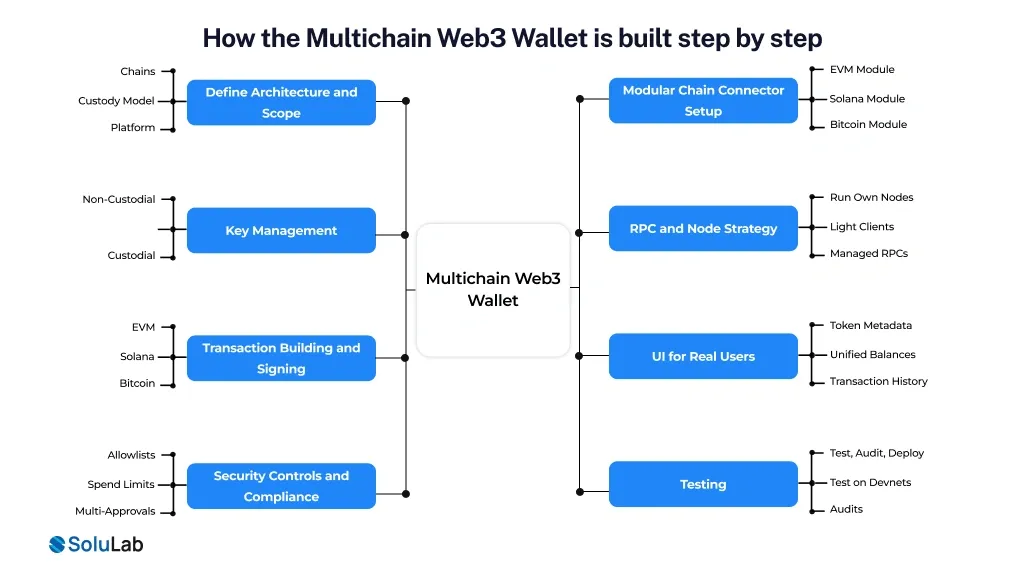
This is where wallet projects usually fail. Single-chain wallets are manageable. Multichain wallets turn into a mess unless the foundation is right.
Step 1: Define Architecture and Scope
Before code, make decisions you can’t undo later.
1. Chains
EVM chains (Ethereum, Polygon, BNB, Avalanche, Arbitrum, Optimism) are similar enough to share tooling. Solana, Cosmos, and Near are not. Each non-EVM chain needs its own signing flow and RPC logic.
2. Custody model
Non-custodial means keys live on the device. Custodial means keys live in HSMs or managed custody. This choice dictates everything: infra, security, compliance, and liability.
Reade more: custodial vs non custodial
3. Platform
Mobile-first is standard. Enterprises still want web dashboards. React Native or Flutter helps with speed, but you lose some native security control.
Step 2: Use a Modular Chain Connector Setup
Hard-coding chains into one codebase does not scale. Real wallets isolate each chain into its own module.
Typical setup:
- EVM module: Ethereum, Polygon, BNB, Avalanche via ethers.js or web3.js
- Solana module: @solana/web3.js for instructions and signing
- Bitcoin module: UTXO handling and fee logic
This isn’t optional. Teams using modular connectors cut integration complexity by 40–50% compared to monolithic designs.
Step 3: Key Management
More than 70% of users never transact after installing a wallet. Bad security UX is usually why.
Non-custodial:
- Generate entropy on-device
- BIP-39 seed derivation
- Encrypt locally (Keychain / Keystore)
- Private keys never touch servers
Custodial:
- Keys in HSMs or systems like AWS KMS or Fireblocks
- Multi-sig so one key can’t move funds
- MPC or threshold signatures for distributed control
Biometrics matter. Over 30% of wallet users rely on Face ID or fingerprint auth. If it’s not there, adoption drops.
Step 4: RPC and Node Strategy
Every wallet lives or dies by RPC reliability.
Options:
- Run your own nodes (secure, expensive)
- Light clients (middle ground)
- Managed RPCs (Infura, Alchemy, QuickNode)
Most production wallets use managed RPCs. Ethereum RPC traffic is up 19% YoY, Polygon 47% YoY.
Each chain behaves differently. Fees, nonces, confirmations, and stuck tx handling must be abstracted cleanly per chain.
Step 5: Transaction Building and Signing
Chains don’t agree on anything.
- EVM: Gas, nonce, EIP-1559
- Solana: Blockhash + instructions, no gas market
- Bitcoin: UTXOs, input selection, change outputs
Transactions must be built correctly, signed locally, broadcast, and tracked through confirmation or finality. Reorgs and failures need handling without confusing users.
Step 6: UI for Real Users, Not Demos
People want one screen, not five chains. You need:
- Token metadata (names, decimals, icons)
- Unified balances across chains
- Readable transaction history
Most modern wallets embed swaps using 1inch or LiFi so users don’t jump between dApps.
Step 7: Security Controls and Compliance
For serious use cases:
- Allowlists
- Spend limits
- Multi-approvals
- RBAC
- Audit logs
Enterprise wallets usually need KYC/AML. Frameworks like MiCA are already shaping how wallets are built.
Step 8: Test, Audit, Deploy
Audits aren’t optional. Firms like CertiK, Trail of Bits, or OpenZeppelin catch things internal teams miss.
Test on Goerli, Solana Devnet, etc. Expect RPC issues. 19% of first wallet launches hit RPC reliability problems that testing didn’t catch.
Read More: Build a Web3 Wallet That Meets CFTC Compliance Standards
What features should enterprises prioritize to Build a Web3 Wallet that scales securely?
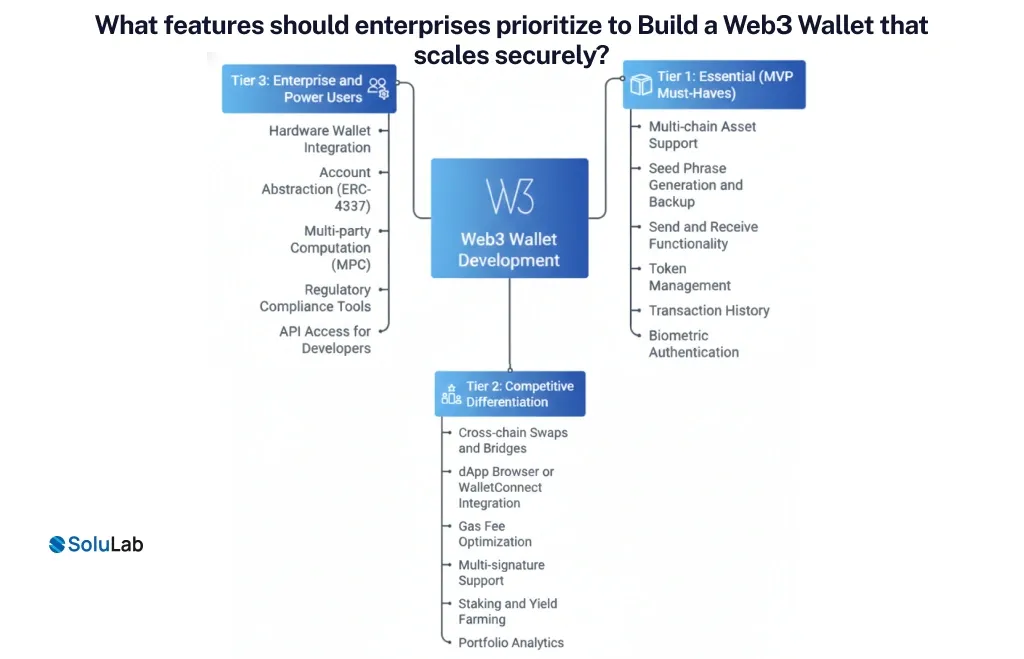
If you’re thinking about building a Web3 wallet yourself, this is how most teams break it down internally. Not as a wishlist, but as priorities. Some things you need just to be taken seriously. Others decide whether the wallet survives real usage.
Tier 1: Essential (MVP Must-Haves)
Multi-chain asset support:
Ethereum alone isn’t enough anymore. At minimum, users expect Ethereum, Polygon, BNB Chain, and Solana. If assets live on those chains, the wallet has to handle them cleanly.
Seed phrase generation and backup:
BIP-39 is standard. No debate there. What matters is how clearly users are guided to save it, because lost keys turn into lost trust.
Send and receive functionality:
This is where most early wallets fail. Transfers need to be fast, predictable, and hard to mess up. Wrong-chain sends should be blocked, not explained after the fact.
Token management:
Tokens and NFTs should appear automatically. ERC-20, ERC-721, and equivalents on other chains. No manual steps, no guessing.
Transaction history:
Users want to see what happened in plain language. Dates, amounts, status. Not explorer-level noise.
Biometric authentication:
Face ID, Touch ID, fingerprint. For a lot of users, this is the difference between daily use and uninstalling.
Tier 2: Competitive Differentiation
Cross-chain swaps and bridges:
If users have to leave the wallet to swap or bridge, many won’t come back. Native swaps keep volume inside your product.
dApp browser or WalletConnect integration:
Most serious users connect to dApps daily. This has to work smoothly or nothing else matters.
Gas fee optimization:
Support EIP-1559 and give simple choices. Users don’t want to think about gas, they just want control.
Multi-signature support:
Required for DAOs, teams, and treasury wallets. One key setups don’t scale.
Staking and yield farming:
For DeFi-focused wallets, this can’t be an external flow anymore. It needs to live inside the wallet.
Portfolio analytics:
Balances, basic performance, and simple P&L. Enough to understand what’s going on without opening five tabs.
Tier 3: Enterprise and Power Users
Hardware wallet integration:
Ledger, Trezor, and similar devices are expected for high-value accounts.
Account abstraction (ERC-4337):
Gasless transactions, recovery options, and custom rules. This is becoming practical, not experimental.
Multi-party computation (MPC):
No single point of failure. Especially important for institutions and custody setups.
Regulatory compliance tools:
KYC hooks, transaction monitoring, reporting exports. These aren’t optional in regulated environments.
API access for developers:
If you’re offering Web3 wallet development services, APIs, and SDKs are how your wallet actually gets adopted inside other platforms.
What is the true cost of launching a Multichain Web3 Wallet for long-term growth?
Let’s talk money, because this is where expectations usually break. The cost to develop a Web3 wallet isn’t fixed. It swings a lot depending on how much you’re trying to do, how many chains you touch, and how serious you are about security.
| Wallet Type | Estimated Cost | Timeline | Key Features | Typical Use Case |
| Basic Wallet (MVP) | $10,000 – $30,000 | 3-6 weeks | Single-chain (Ethereum), send/receive, seed phrase backup, mobile-only | Proof of concept or niche community wallet |
| Mid-Level Wallet | $25,000 – $60,000 | 1–4 months | Multi-chain (3–5 chains), WalletConnect, token swaps, transaction history, mobile + web | Startups launching DeFi or NFT platforms |
| Advanced Wallet with DeFi | $50,000 – $100,000+ | 6–12 months | Multi-chain (8+ chains), staking, yield farming, portfolio analytics, hardware wallet, multi-sig, enterprise security | Institutional or large-scale consumer wallets |
| White-Label Wallet | $6,000 – $20,000+ | 1–2 weeks | Pre-built wallet with custom branding | Fast launch with limited customization |
According to recent cost analysis, backend development (including blockchain integration) accounts for 20-25% of total cost, followed by security and compliance at 15-25%.
For multichain Web3 wallet development company engagements, multi-chain integration adds 30-40% to baseline development costs due to the complexity of managing different RPC providers, transaction formats, and consensus mechanisms.
Cost optimization strategies we use:
- Prioritize MVP features: Launch with core functionality, iterate based on user feedback.
- Use open-source libraries: ethers.js, web3.js, @solana/web3.js reduce reinventing the wheel.
- Outsource to experienced developers: Hiring a Web3 wallet development company like SoluLab with a proven track record saves time and avoids costly security mistakes.
- Choose cost-efficient blockchains: Polygon, Solana, and Arbitrum offer lower gas fees than the Ethereum mainnet, which matters for user experience.
Why SoluLab Might Be The Right Web3 Wallet Development Company For You?
If you’re not building in-house, your wallet partner matters more than the tech stack. Most firms can talk Web3 development, but very few have shipped wallets that hold real money, run across chains, and survive real usage.
This is where teams like Solulab stand out.
- Proven Web3 wallet builds that handle real users and real funds
- True multi-chain experience, not limited to Ethereum alone
- Security practices grounded in audits, key management, and real threat models
- Strong understanding of compliance and regulatory requirements
- Clear, upfront pricing with no hidden surprises
- Ongoing post-launch support, updates, and incident response
- A long-term infrastructure mindset, not a short-term demo build
If you want a Web3 wallet that’s built to last, not patched together, choosing the right team is the decision that saves you the most time, money, and risk later.

Conclusion
A Web3 wallet isn’t a side feature anymore; it’s infrastructure. With 820M of active wallets and real institutional money already on-chain, the question isn’t if wallets matter; it’s whether yours is built well enough to last.
The teams that win won’t chase features. They’ll focus on solid multi-chain support, real security, and a wallet that people actually enjoy using. Whether you’re running DeFi, NFTs, or managing treasury flows, the wallet is where users decide if they trust you or not.
Build it in-house or work with a Web3 wallet development company like SoluLab, but don’t delay. The tech is settling, expectations are rising, and the advantage goes to the teams that move before the next wave makes this table stakes.
FAQs
With over 3 years of experience, I specialize in breaking down complex Web3 and crypto concepts into clear, actionable content. From deep-dive technical explainers to project documentation, I help brands educate and engage their audience through well-researched, developer-friendly writing.


![How to Choose a Blockchain Development Company [2026 Edition]](https://www.solulab.com/wp-content/uploads/2026/09/Banner-Before-You-Hire-Check-These-Blockchain-Essentials.webp)