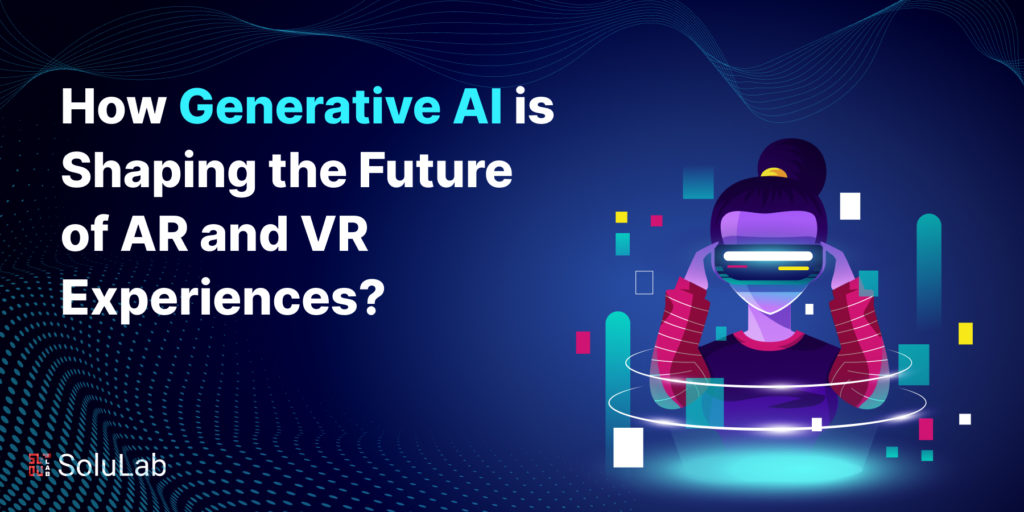
Augmented Reality (AR) and Virtual Reality (VR) have come a long way. What started as clunky headsets and gimmicky demos now changes how we work, play, and learn, blending digital content into the physical world in ways that actually hold up. You see them in games and film, sure. But also in operating rooms, on factory floors, and in classrooms. Here is the catch, though. An immersive experience only matters if it feels real, and building that kind of lifelike, responsive content by hand is brutally slow. That gap is exactly where Generative AI steps in.
Generative AI, a branch of Artificial Intelligence, has quietly become the engine behind a lot of what makes AR and VR feel alive. It generates content that is realistic, reacts to you, and adapts on the fly. This post walks through how it is reshaping AR and VR experiences, and where things could head next.
The Role of Generative AI in Augmented Reality (AR) and Virtual Reality (VR) Learning
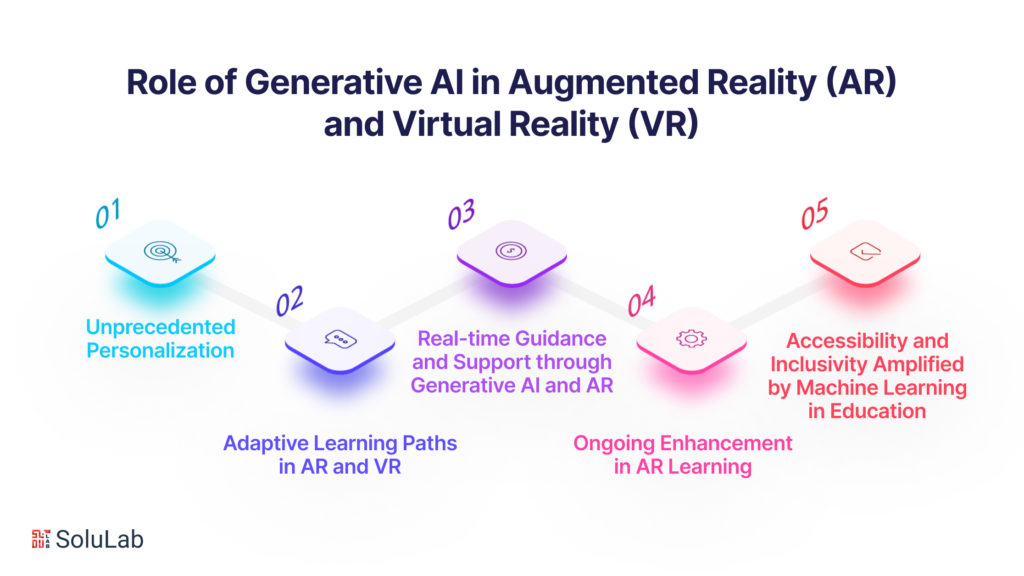
Before we get into what AR and VR can do for education, it helps to be clear about one thing. The augmented reality (AR) and virtual reality (VR) learning we are excited about does not happen on its own. Generative Artificial Intelligence (AI) is doing the heavy lifting behind the scenes, shaping how learning actually works inside these immersive spaces.
Strip away the jargon and it comes down to this. Generative AI uses neural networks to build content on the spot, matched to what a particular student needs right now. Drop that into AR and VR and you get something close to a tutor who never clocks out, one that shifts with each learner as they move through the environment.
Unprecedented Personalization
Generative AI trends push personalized learning well past what a classroom can manage. Think about how a textbook works. One book, one sequence, same for everyone. That is fine until you have thirty students who each learn differently, which is basically always.
Inside AR and VR, Generative AI rebuilds the material in real time. A student sees content pitched at what they already know and how they like to learn, so the session stays useful instead of drifting over their head or boring them stiff.
Picture a student inside an AR math lesson. The AI watches how they are doing as they work through the virtual space. Struggling with a concept? It spins up extra practice problems, or tries explaining it a different way, and keeps going until the idea lands. Moving fast? It raises the ceiling with harder topics before boredom sets in. The lesson bends to the student, not the other way around.
Adaptive Learning Paths in AR and VR
Generative AI lets teachers build adaptive learning paths right into AR and VR. It reads how students respond to quizzes, assignments, and their fiddling with virtual materials, then routes each person down a path that fits. The point is balance. Enough challenge to keep someone sharp, enough support that they do not give up halfway.
Take an AR or VR language app running on Generative AI. It gauges where a student sits on vocabulary and grammar inside the virtual space. Say their vocabulary is strong but grammar keeps tripping them up. The AI leans in on grammar, serving exercises and resources aimed straight at the weak spot. And as the student improves, the difficulty climbs with them, so the work never feels stale or pointless.
Real-time Guidance and Support through Generative AI and AR
Custom content is only half of it. Generative AI also answers back in the moment inside augmented reality (AR). No more waiting on a teacher to circle back and mark your work. You get guidance while you are still in the middle of it. That speeds up learning, and honestly it does something for confidence too, because you fix the mistake before it hardens into a habit.
Say a student is running a virtual experiment in an AR science class. The AI is watching the steps, and it catches a misconception or a slip in the procedure. Right away, it flags what went wrong and suggests a fix. Learn from the mistake, adjust, try again. That loop is a genuinely powerful teaching tool, and Generative AI and AR are what make it possible.
Ongoing Enhancement in AR Learning
Generative AI and Augmented Reality do not stop at tailoring content. They also improve the teaching materials themselves. As the system collects data on how students actually use different resources in AR, it tunes those resources to teach better.
Picture an online history course built inside an AR framework and powered by Generative AI. Students move through textbooks, videos, and interactive timelines, and the AI is quietly noting what they gravitate toward. If a group keeps reaching for video to grasp historical events, the AI makes more video modules. If interactive timelines are what click, it builds more of those. The materials keep reshaping around what works, so the course stays sharp instead of going stale.
Accessibility and Inclusivity Amplified by Machine Learning in Education
Here is one of the parts that matters most. Machine Learning makes learning reach more people. For students with different needs, including those with disabilities, Machine Learning algorithms can meet them where they are. That opens the door to a classroom where every student can take part and do well, not just keep up.
Take a visually impaired student working through a literature unit. With Machine Learning, the material can be reshaped to fit them. Machine Learning can turn text into audio so the student listens to the work instead of reading it. It can also describe the visual details in a text out loud, filling in what would otherwise be lost.
On top of that, Machine Learning can slow the reading down or speed it up to match the student, so nothing gets rushed. Add it all up and Machine Learning is reshaping education into something adaptive, personal, and open to far more learners. That helps students and teachers both, letting each person follow a path built around what they actually need. The result is a system that is fairer and works better for the wide range of learners sitting in any given room.
Defining Augmented Reality and Virtual Reality
Virtual Reality (VR) is a computer-generated, three-dimensional world you can step into and move around. Put on VR and you are not looking at the scene, you are in it, surrounded by the digital environment. You can grab objects, act on them, and change what happens around you. Most of the time this runs on headsets or goggles, which is what pulls you into the experience.
Now flip it around. Augmented Reality (AR) keeps the real world and adds to it. Computer-generated images sit on top of what you already see, layered over your view of the physical space around you. So instead of replacing reality, AR overlays digital information on it, and you take in both at once.
AR shows up in a few different forms:
- Location-based AR: This kind feeds you extra information based on where you physically are. There is real promise here, especially in fields like automotive and transportation.
- Projection-based AR: Here the software throws light onto a real object, turning it into an interactive surface you can work with right there in the moment.
- Superimposition-based AR: This one swaps out part or all of what you are looking at, replacing it with new elements to change your view. It fits well in fashion, architecture, and design.
Real-life Generative AI Use Cases in Enhancing Learning Experiences
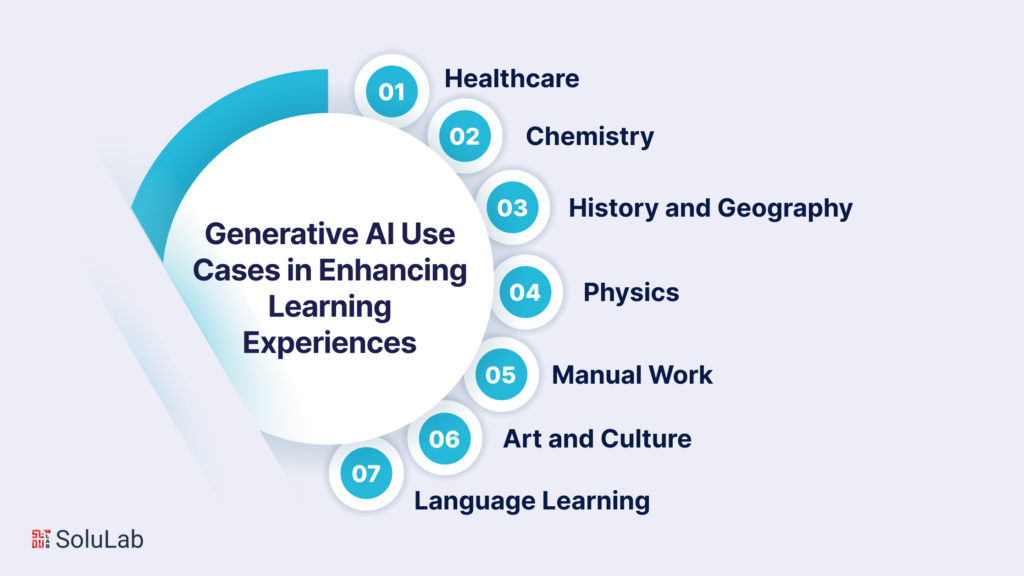
All of this lands better with examples. So here are some real Generative AI use cases that show how these tools help teachers get ideas across more clearly, and hold attention while they do it.
1. Healthcare: Learning medicine used to mean apprenticing in a hospital, hands on real patients. With Generative AI in healthcare education, students can run virtual surgeries and procedures and build real experience, with nobody at risk. Safer, and a lot more efficient.
2. Chemistry: Chemistry is hard to teach well. Generative AI hands students a lab where they can run experiments and mix substances and actually feel how the concepts work. Safer, and cheaper too, since the school is not restocking shelves of chemicals for every class.
3. History and Geography: Ancient civilizations can read as a wall of names and dates. Generative AI brings them off the page through augmented and virtual reality. A virtual field trip drops students into a distant place or a long-gone era in minutes, which makes the whole thing stick, and costs next to nothing to run.
4. Physics: Classical mechanics on a whiteboard is dry. With Generative AI, students step into a virtual space and put the theory to work. Explore the cosmos, ride along on an interstellar trip, whatever the topic calls for. Suddenly the hard stuff has something to grab onto.
5. Manual Work: Plenty of trades run on heavy machinery and tools, which does not translate to a normal classroom. Generative AI in VR lets students safely practice the real thing, driving a truck, running a construction task, or standing in for high-risk work like firefighting and coast guard operations.
6. Art and Culture: Generative AI, and superimposition-based AR in particular, can turn art and culture into something you step inside. With AR, students play with famous artists’ styles and dig into art history. AI and VR can take them to cultural events, or back in time to watch a historical performance unfold.
Related: Generative AI Art
7. Language Learning: You learn a language fastest by living in it, which usually means getting on a plane. Generative AI rewrites that. It can drop learners into a virtual version of a foreign country to practice with native speakers and poke around the local culture, no passport required.
These seven barely scratch the surface. There is also the prospect of virtual classrooms where students anywhere on the planet learn from the best teachers, though that one is still taking shape. Either way, the pattern is clear: put Generative AI to work and learning gets more immersive, more engaging, and open to more people, across just about every subject you can name.
How Generative AI Enhances Realism in AR and VR Environments?
Realism is where Generative AI earns its keep. It is reshaping Augmented Reality (AR) and Virtual Reality (VR) by making the worlds inside them far more believable. Used well, Generative AI makes AR and VR experiences feel convincing and lifelike in a way they simply did not before.
A lot of that comes down to Generative Adversarial Networks (GANs). A GAN runs two neural networks against each other, a generator and a discriminator. The generator makes synthetic content, say an image or a 3D model, and the discriminator judges whether it looks real. They go back and forth, round after round, and the generator keeps getting better until it turns out images and environments you would struggle to tell from the real thing.
In AR, that means digital elements sit convincingly in the real world. Point an AR app at your living room and it can drop in virtual furniture that looks so right you half forget it is not actually there.
In VR, Generative AI builds whole worlds you can believe in. Whether you are walking through a historical era, standing on a far-off planet, or running surgical training, AI and VR settings feel real because the AI fills them with detailed textures, terrain, and things you can interact with.
Bottom line, Generative AI is what turns AI and VR from a neat trick into a real tool, one that looks, feels, and reacts the way the world does. That is a win for entertainment and gaming, and it matters just as much in education, training, and design.
The Role of AR and VR in Training and Simulation
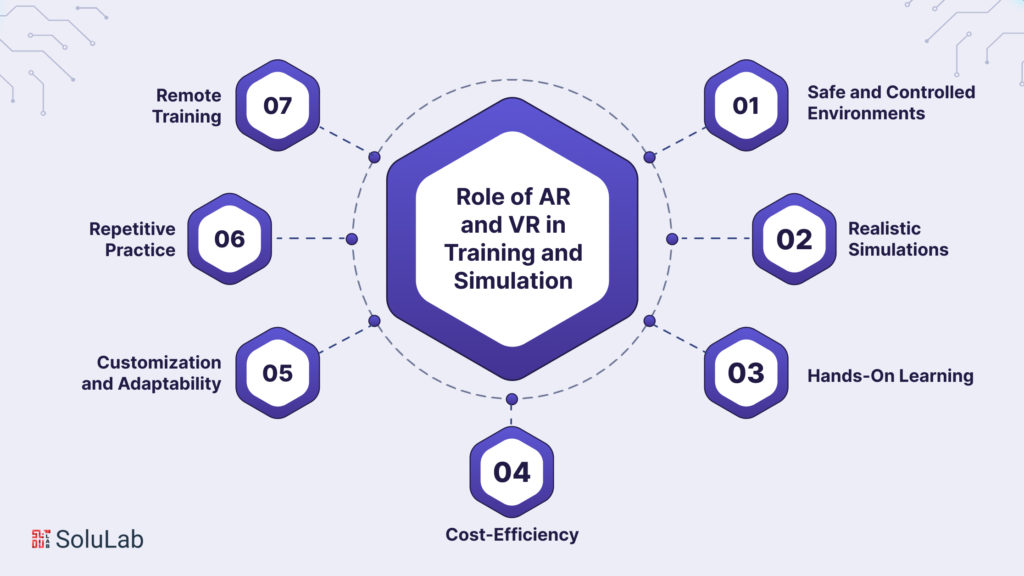
Augmented Reality (AR) and Virtual Reality (VR) have turned into serious tools for training and simulation. They give people a way to rehearse for the real thing that is genuinely effective, whether the setting is a job or a classroom.
A few things they do especially well:
- Safe and Controlled Environments: Training happens somewhere controlled, safe, and repeatable. A doctor, a pilot, or a soldier can drill a complex procedure or an emergency again and again with nothing real on the line.
- Realistic Simulations: VR shines here. Trainees drop into detailed virtual settings that mirror the real workplace, right down to the parts they can interact with. That realism is what builds muscle memory and real, usable skill.
- Hands-On Learning: AR and VR both let you do rather than watch. Trainees handle virtual objects, run tasks, and work with the simulated pieces around them, which keeps the learning active and makes it stick.
- Cost-Efficiency: Less physical gear, less equipment, fewer facilities. That cuts the cost of real-world training, which counts for a lot in fields where the resources are expensive or hard to come by.
- Customization and Adaptability: Simulations bend to the training you actually need. You can tune a program to different skill levels and different paces, so the experience fits the person going through it.
- Repetitive Practice: Run the procedure as many times as it takes to get good. That matters most where repetition is the whole point, like surgery or military drills.
- Remote Training: AR and VR let people train and work together from anywhere, geography aside. An expert on the other side of the world can guide and grade trainees, which makes hard-to-reach knowledge a lot easier to reach.
Short version: AR and VR have changed training and simulation for good, giving people learning environments that are realistic, safe, and easy on the budget. They get skills into people faster, and they flex to fit whoever is in the seat.
Concluding Remarks
Put generative AI in virtual reality and augmented reality together and you get technology that is moving to the front of the digital age. Generative AI has brought a new level of hyper-realism, personalization, and interactivity to AR and VR. Things that used to sit squarely in science fiction are now real, and they are already reshaping a long list of industries.
Look ahead and there is a lot on the table. AR and VR running on Generative AI could reshape education around learning that is personal and genuinely engaging, and do the same for training and simulation, offering practice that is realistic, affordable, and free of real risk. And it reaches well past the classroom, into healthcare, gaming, industry, and further out than that.
SoluLab worked on OmniSoft a ready-made solution you can shape to fit your own setup. We built something that covers what our clients keep asking for. Host conferences, seminars, and events in a metaverse, business meetings included. The tools and infrastructure are made to handle big teams, so you can stay focused on the work itself. We can help you move your physical board rooms, conference rooms, and offices online. And yes, we can throw in avatars of your favorite characters to keep it fun.
FAQs
Shipra Garg is a tech-focused content strategist and copywriter specializing in Web3, blockchain, and artificial intelligence. She has worked with startups and enterprise teams to craft high-conversion content that bridges deep tech with business impact. Her work translates complex innovations into clear, credible, and engaging narratives that drive growth and build trust in emerging tech markets.