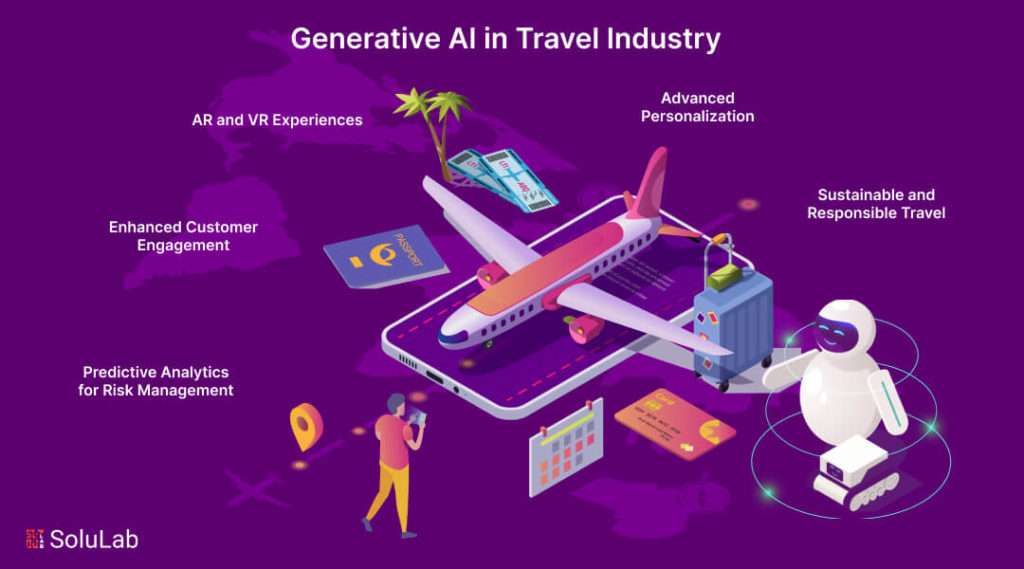
Travel has always been personal. Until recently, the technology behind it was not. Generative AI changes that, shaping trips around the person taking them, from the little-known spot a guidebook skips to an itinerary nobody else will get. Its models learn what you like and plan around it. Generative AI in travel works a bit like a digital concierge who has actually been paying attention: it picks up on what a traveler prefers and builds a trip that lands better than they expected, the kind you still talk about months later. Below, we look at the specific ways it is reshaping the travel business.
How is Generative AI Applied in the Travel and Hospitality Industry?
At its core, generative AI takes a short plain-language instruction and produces text or images from it. Because it works at scale, it can churn out things like email subject lines and social posts in seconds. Travel and hospitality companies have picked it up quickly over the last few years, and the reason is simple: travelers want trips that feel made for them, and immersive ones at that. According to a report by Allied Market Research, the global AI in travel market is projected to reach $9.46 billion by 2025, growing at a compound annual growth rate (CAGR) of 35.4% from 2018 to 2025. Two things drive that curve. People increasingly want custom itineraries, and the algorithms have become good enough to give them accurate, tailored suggestions.
Personalized recommendations are where the effect shows most clearly. Studies suggest 85% of travelers are more likely to book with brands that personalize the experience [SOURCE NEEDED]. So what do companies actually do? They run analytics and machine learning over large pools of traveler data, past bookings, stated preferences, social media activity, and use it to suggest hotels, activities and destinations that fit each person. The traveler gets a better trip. The business gets loyalty and more revenue. Generative AI is also being put to work on pricing and demand forecasting, and some studies indicate AI-driven revenue management can lift hotel revenue by up to 10% and improve profit margins by 2% to 5% [SOURCE NEEDED].
Generative AI Use Cases for the Travel and Tourism Sector
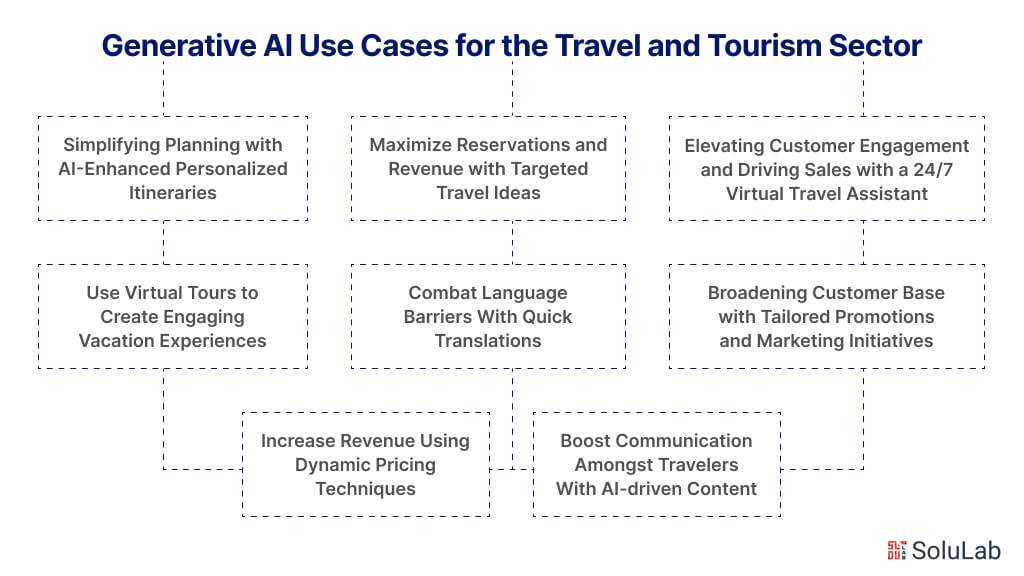
The use cases of Generative AI in travel that come up again and again: personalized trip suggestions, adaptive advertising, custom itineraries, AI booking assistants, customer support, dynamic tour pricing and guided tours. Here is how each one plays out.
1. Maximize Reservations and Revenue with Targeted Travel Ideas
This one starts with data. Rules-based Machine Learning [ML] algorithms sift through a customer’s past bookings, demographics, browsing habits and social media use. Out of that, travel companies spot how each person likes to vacation, and they can suggest destinations, activities and itineraries that actually fit. Say a customer keeps showing interest in eco-friendly places to stay near the beach. Generative AI can point them to coastal spots known for sustainable tourism, without anyone having to ask.
Why does this matter so much for travel brands? Because people book when they feel understood. When the suggestions reflect what a customer really wants, they are more likely to finish the booking, and conversions rise. A tailored journey also feels more special, which builds a good impression of the brand while someone is still searching and booking. Keep delivering that kind of relevance and customers start to feel attached. They come back for the next holiday.
2. Simplifying Planning with AI-Enhanced Personalized Itineraries
Nobody wants the same package tour as the family in the next row. Travelers today want plans built around their own interests. Generative AI meets that by putting together itineraries that shift with the person, weighing the best routes, places to stay, things to do and how to get around locally.
Generative AI for travel builds these itineraries by looking at the best flight connections, preferred accommodation, the activities someone wants and the local transport on offer. The result fits the traveler and also runs smoothly, with less wasted time. It can go further, too: which local dishes to try, a few useful phrases, what counts as polite in the culture. For travel firms, there is a business payoff as well. AI-built itineraries raise productivity and improve the customer experience at the same time. And here is the real point: they let a company offer deeply tailored service to huge numbers of people, something that would cost a fortune to do by hand.
3. Elevating Customer Engagement and Driving Sales with a 24/7 Virtual Travel Assistant
Virtual travel assistants powered by generative AI have quickly become one of the most effective tools travel companies have for engagement and sales. Research suggests 87% of customers are willing to use one to sort out their travel plans and save time and money [SOURCE NEEDED]. These travel chatbots run on generative AI in travel and tourism and do a lot, starting with suggesting tour packages that match a person’s preferences, behavior and budget.
They are also good at the upsell. An activity at the destination, a transfer from the airport: each is extra revenue. They never sleep, either, so a company does not need live agents on shift around the clock. Simple questions get answered on the spot, and the tricky ones go straight to the customer service team, which speeds up how cases get resolved. Because they speak many languages, they can talk to lots of customers at once in different languages and open the business up to a far wider global audience. These virtual assistants handle bookings at volume, make changes to existing reservations and push live flight updates, which is a level of convenience travelers notice.
4. Broadening Customer Base with Tailored Promotions and Marketing Initiatives
With Generative AI in Travel & Hospitality, companies can grow their customer base on purpose, using offers and campaigns shaped around what each person likes.
Generative AI for travel models work through large datasets, past bookings, search history, how often someone interacts, and build detailed customer profiles: favored destinations, activities, travel dates, type of accommodation and budget. With that in hand, a travel company can write offers and holiday suggestions that actually speak to each customer. People engage more. More of them convert.
Take a frequent business traveler. Generative AI can notice they often sit through long layovers and offer free or discounted lounge access with the booking. Their trip gets better, and the company earns more. Or a solo traveler who loves adventure: tempt them with an upgrade to a VIP adventure package, maybe a private hot air balloon ride. This kind of personal touch pushes up the average booking value, and it keeps people coming back.

5. Combat Language Barriers With Quick Translations
Instant translation apps and chatbots have changed what it is like to travel where English is not the first language. Tokyo’s crowds, Seoul’s side streets, Paris, Hanoi at rush hour. Tap a screen and the language gap mostly disappears.
Getting around a foreign city gets a lot less stressful. Asking for directions, reading a sign, making sense of local customs: all easy now. Type a question or snap a photo, and the translation comes back in real time.
Chatbots also help with bookings, answer common questions and offer support, whatever language the traveler is comfortable in. The net effect? Generative AI makes travel more accessible, so more trips end up memorable for the right reasons and a lot less stressful.
6. Increase Revenue Using Dynamic Pricing Techniques
AI-driven dynamic pricing is changing how travel gets priced, making it both flexible and personal. The system weighs market conditions, supply and demand, and outside factors like the weather or a local event, then adjusts prices in real time. What do travel companies get out of it?
- Increased Bookings: Prices move with demand and other signals, so flights and hotels fill up more fully. More bookings land at the right price point, and revenue goes up.
- Competitive Advantage: Real-time data lets companies keep their rates in line with the market. They are not overpriced or underpriced against competitors, which protects their position.
- Enhanced Customer Satisfaction: It also means better deals, especially off-peak. Drop prices when demand is soft and you pull in more customers who leave happier.
- Adaptability: Markets shift and so do customer tastes. Dynamic pricing shifts with them, so companies can react fast to swings in demand and keep prices relevant and appealing.
7. Boost Communication Amongst Travelers With AI-driven Content
Travel sells on words and pictures. Always has. Generative AI tools like DALL·E and Sora have changed how that content gets made, giving travel companies new ways to show off destinations and get people dreaming about a trip.
These tools produce high-quality images and video that give people a virtual preview of the experience. On social media or on a website, visuals like these do a lot of the work of pulling an audience in. AI can also write engaging stories about a place, weaving in history and local anecdotes for blogs, brochures and ads.
Then there is audio. AI-generated sound can drop a would-be traveler into a noisy market or a quiet beach before they have booked anything. By leveraging Generative AI, travel companies can turn out many content formats quickly and cheaply, for different audiences and in different languages. Engagement goes up, and so do the odds that a lead turns into a booking, which is where the revenue comes from.
8. Use Virtual Tours to Create Engaging Vacation Experiences
A Booking.com report found travelers are getting more involved with the Metaverse. In its survey on virtual reality (VR), 46% of respondents agreed they were more willing to visit new places after trying VR.
Generative AI can build realistic, detailed visuals, sound and even 3D models of a location from photos, video and other inputs. That makes virtual tours a strong marketing tool for travel agencies, a way to show what a trip could really be like.
Seeing a place first builds trust. People hesitate less before booking, and they end up more satisfied. Agencies can also pair the tour with a personal itinerary that highlights the experiences and sights that mean the most to that traveler, which deepens their connection to the destination before they even arrive.
How is Generative AI in the Travel Industry Being Utilized to Improve Business Operations?
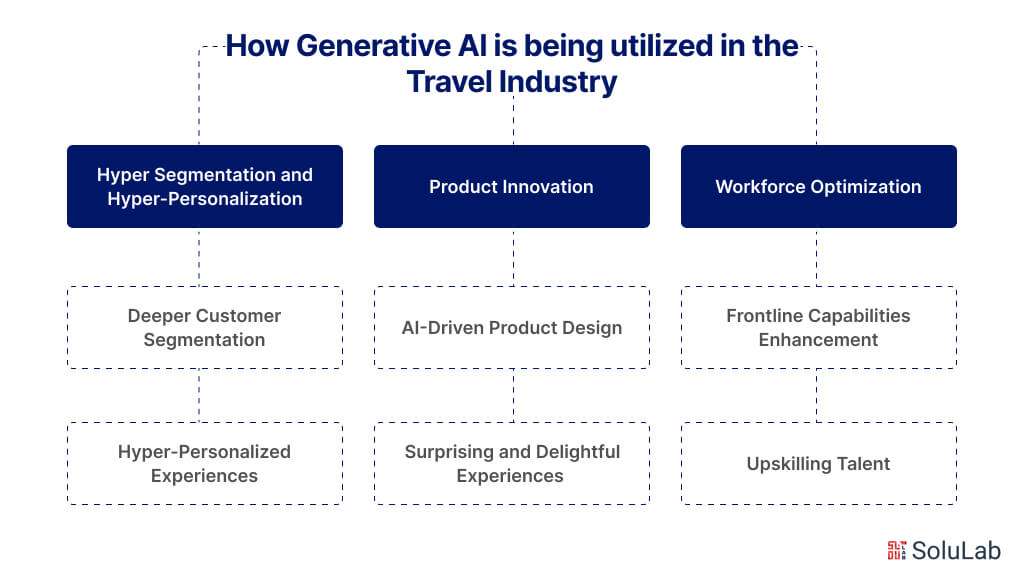
The customer-facing side gets the headlines. Behind the scenes, though, generative AI is changing how travel businesses run, making operations more efficient, keeping customers happier and opening room for new ideas. Here is where it is showing up:
1. Hyper Segmentation and Hyper-Personalization
- Deeper Customer Segmentation: With generative AI, travel companies can dig through huge amounts of customer data and carve out very fine, detailed segments. “Business” and “leisure” are no longer the only buckets. Now you can build hyper-segments around individual preferences, behavior and demographics.
- Hyper-Personalized Experiences: Once those segments exist, every interaction can be shaped to the person on the other end. That runs through the whole customer journey, from destination and activity suggestions to custom pricing and promotions. Generative AI models make it possible to deliver experiences that genuinely click with each customer, and that builds stronger engagement and loyalty.
2. Product Innovation
- AI-Driven Product Design: Generative AI tools like ChatGPT are kicking off a new wave of product ideas in travel. With AI and digitization in the mix, companies can rethink what they sell and design offerings that break out of the old templates.
- Surprising and Delightful Experiences: Built into products, generative AI lets travel companies create things that genuinely surprise customers. These tools can anticipate what someone needs, suggest what fits them and offer experiences that go past what they expected. In a crowded market, that is how a company stands out and builds a real relationship with its customers.
3. Workforce Optimization
- Frontline Capabilities Enhancement: Generative AI gives frontline staff better tools and sharper insight, so they make better calls. With real-time data analysis, predictive analytics and a personalized recommendations system, employees can give excellent service and fix problems faster.
- Upskilling Talent: Companies are also training their people to use generative AI well. Workshops and training programs teach staff to get real value out of AI tools, which makes them more efficient and productive, and often happier in the job. Put human experience and AI insight together and both the workforce and the operation perform better, for employees and customers alike.
Read Also: AI In Visa Applications and Approvals
Future of Generative AI in Transforming the Travel Industry
We are still early. Generative AI has a lot more to give the travel industry, with more new ideas, more personalization and more efficiency to come. Here is what the next stretch likely looks like:
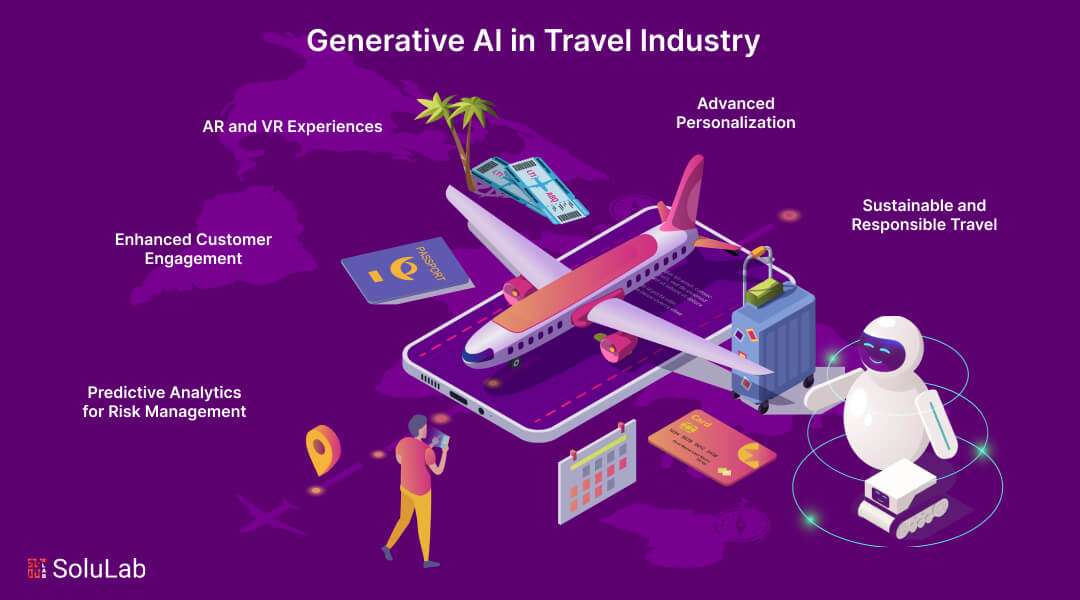
- Advanced Personalization: As the models get more sophisticated, personalization will go deeper still. By constantly reading large amounts of data, past interactions, live behavior, even biometric signals, AI systems will predict what travelers need and want with far more accuracy than today. And it will not stop at trip planning. Every stage of the journey will feel it, from in-flight entertainment picked for you to local experiences suggested just for you.
- Enhanced Customer Engagement: Expect generative AI to shape engagement across the whole travel lifecycle. Chatbots and virtual assistants will get more intuitive and more conversational, answering instantly and making personal suggestions in natural language. They will make booking simpler, sure. More interesting, they will travel with you, a trusted companion that sends live updates, local tips and suggestions based on what you like.
- Augmented Reality (AR) and Virtual Reality (VR) Experiences: Generative AI will meet AR and VR technologies to create immersive, interactive travel experiences. With AI-powered virtual assistants, travelers will wander destinations in virtual environments, look around a hotel room in 3D and even try out activities before they book. Planning gets richer, and people can preview and fine-tune their itineraries with a level of realism that simply was not possible before.
- Predictive Analytics for Risk Management: Generative AI will also help travel companies use predictive analytics to get ahead of risk and handle crises. By reading historical data, social media trends and world events as they happen, AI systems will flag likely risks and disruptions before they hit. That gives companies time to act early, reroute itineraries and keep travelers properly informed during an emergency, so people feel safer and calmer.
- Sustainable and Responsible Travel: More travelers care about sustainable and responsible travel, and generative AI can back that up. By analyzing environmental data, carbon footprints and traveler preferences, AI systems will help businesses run more sustainably. Suggesting eco-friendly places to stay, promoting responsible tourism activities: these nudges help travelers make greener choices and push the industry toward a more sustainable future.
So the ceiling here is high. As these technologies keep maturing, they will change every part of the travel experience, personalization, engagement, risk management, sustainability. Travel companies that adopt them early stay ahead, and they get to deliver the kind of trips people remember in a digital-first world.

Concluding Remarks
Generative AI is already rewriting the travel journey end to end. Hyper-personalized recommendations, smooth customer experiences, predictive analytics for risk, greener tourism: it touches all of it. And the next wave points to trips that are more immersive, more efficient and more sustainable for travelers everywhere.
If you run a travel business and want to put generative AI to work, the partner you choose matters. An experienced generative AI development company like SoluLab is a strong place to start. SoluLab’s team of skilled AI developers builds custom AI solutions around the specific needs of travel businesses. With deep experience in machine learning, natural language processing and data analytics, the team helps companies use generative AI to grow, keep customers happy and stay ahead of competitors. Whether you need AI-powered chatbots, predictive analytics tools or immersive AR/VR experiences, SoluLab brings the expertise and support to get the most out of generative AI in travel. Hire AI developers from SoluLab today and start building the AI-driven travel product your customers will actually use.
FAQs
Shipra Garg is a tech-focused content strategist and copywriter specializing in Web3, blockchain, and artificial intelligence. She has worked with startups and enterprise teams to craft high-conversion content that bridges deep tech with business impact. Her work translates complex innovations into clear, credible, and engaging narratives that drive growth and build trust in emerging tech markets.