Key Takeaways
- Generative AI cuts downtime, lifts productivity, and trims waste, because decisions stop being guesswork and start being data.
- Predictive maintenance catches a failing machine early, which is the difference between a scheduled fix and a dead line at 2 a.m.
- Production planning, inventory, supply chain. Generative AI tightens all three.
- Adoption works when you have clean data, a goal someone can measure, and AI that plugs into the systems your plant already runs on.
- Manufacturers already using generative AI pull ahead on cost, on decision speed, and on how well they absorb a bad week.
Ask a plant manager how to get more efficient and you will usually hear the same three answers: newer machines, more capacity, harder-working people. Fine answers. They also miss where the money actually leaks, which is unplanned downtime, scrapped material, a bottleneck nobody logged, and a forecast that was wrong by enough to matter.
According to the World Economic Forum, 33% of manufacturers cite the absence of a clear AI strategy and roadmap as a key obstacle to realizing AI value.
Generative AI development for manufacturing changes the shape of that problem. It predicts what is about to go wrong, reorganizes workflows around real constraints, and surfaces the inefficiencies that hide in between systems. You stop cleaning up after the failure and start seeing it coming.
AI-powered manufacturing solutions can reduce maintenance costs by up to 25% and unplanned downtime by up to 50%. Keep reading and I will walk through how Gen AI gets there, waste line by waste line.
Why Are Manufacturing Businesses Turning to Generative AI in 2026?
The short version: costs keep climbing, processes keep slipping, and supply chains keep behaving badly. Manufacturers are adopting generative AI because the old levers have been pulled already. Custom generative AI solutions in Manufacturing earn their keep on the boring stuff, predicting, sequencing, and catching waste before it becomes scrap.
- Rising operational costs: Labor, energy, raw materials. All three are more expensive than they were, and squeezing the production process is one of the few levers left that does not involve raising prices.
- Frequent equipment downtime: A machine dies mid-shift and the schedule behind it collapses. Maintenance bills climb, and the case for predicting failures instead of reacting to them gets easier to make every quarter.
- Growing demand for customization: Buyers want their version, not the standard one. That means more complex runs, without giving up speed, quality, or margin.
- Supply chain uncertainty: Between global disruptions, swinging demand, and suppliers who slip, forecasting has turned into a guessing game. Smarter planning and inventory math are the counterweight.
- Quality control challenges: Catching a defect late is expensive. Rework, wasted material, an unhappy customer, and sometimes all three on the same order.
- Data overload across systems: Plants produce an enormous amount of data every day. Very little of it is joined up, so the insight sits there, spread across systems that do not talk.
- Pressure to reduce waste and emissions: Sustainability targets are no longer a slide in the annual report. Less scrap, less energy per unit, better use of what you already bought.
How Does Generative AI Reduce Waste In Manufacturing?
It reads production data, flags the inefficiency before it compounds, reallocates resources, and tightens quality control. The result shows up in four places you can actually count: less material scrapped, less rework, less energy burned, fewer steps in the process that exist only because nobody questioned them.
According to Gartner, generative AI will improve manufacturing operations by improving decision speed and accuracy through AI-powered workforce assistance
- Less material scrapped per run
- Maintenance timed to actual wear
- Defects caught, and prevented
- Energy use tuned down
- Inventory and resources sized right
How to Implement Generative AI in the Manufacturing Industry?
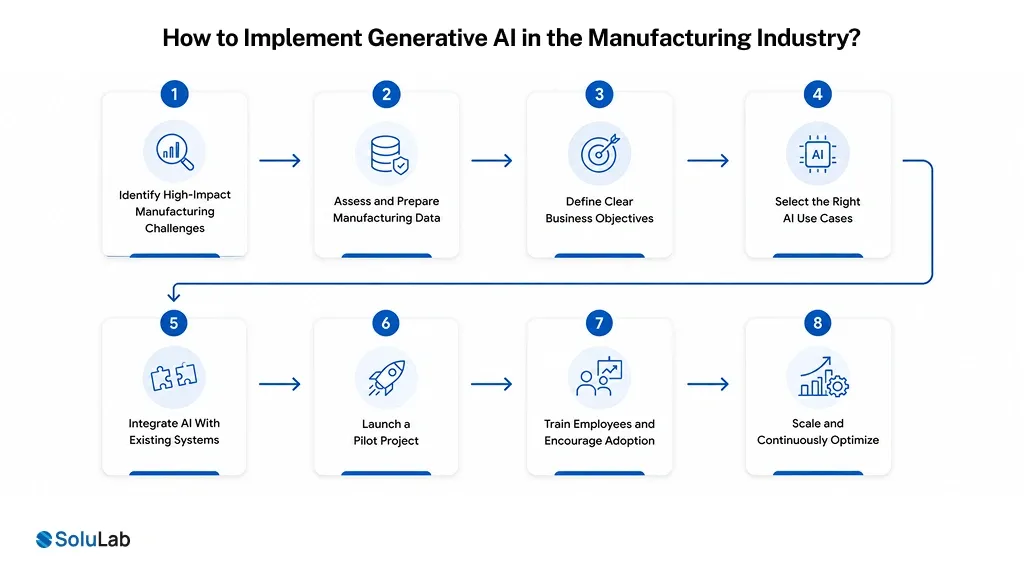
More manufacturers are bringing generative AI onto the floor to cut friction, decide faster, and stop repeating expensive mistakes. The ones who get ROI out of it are rarely the ones who moved fastest. They are the ones who followed an order of operations and made the AI fit the plant, rather than the other way around. Here is that order.
1. Identify High-Impact Manufacturing Challenges
Find the bottleneck that hurts. Not the one that is easiest to model, the one your operations team complains about, where generative AI integration can move a number someone already tracks: output, cost, or quality.
- Production bottlenecks and delays
- Machines that keep stopping
- High scrap and rework rates
2. Assess and Prepare Manufacturing Data
Garbage in, confident garbage out. Generative AI is only as good as the records behind it, so go through what you have and ask whether it is reachable, consistent, and organized enough to trust. In practice, this is the step where most projects stall for a month.
- Audit every data source you own
- Throw out the bad records
- Set data governance standards
3. Define Clear Business Objectives
Decide what winning looks like before you build anything. A metric you agreed on in advance keeps the project tied to the business instead of to whatever the model happens to be good at.
- Bring operating costs down, measurably
- Improve production planning accuracy
- Push overall equipment effectiveness higher
4. Select the Right AI Use Cases
Go for the quick win first. It is less risky, and a result you can point at buys you the budget and patience for the harder projects behind it.
- Predictive maintenance
- Automated quality inspection
- Supply chain demand forecasting
5. Integrate AI With Existing Systems
Wire Industrial AI solutions into what you already run: ERP, MES, the IoT layer on the floor. Data has to move both ways, or the model ends up guessing about a plant it cannot see.
- Connect ERP and MES platforms
- Share data in real time
- Keep the systems interoperable
6. Launch a Pilot Project
Run it small and run it contained. A pilot tells you what actually breaks, and you fix that before the rollout multiplies it.
- Test inside one facility
- Watch the metrics you picked
- Ask stakeholders what they think, often
7. Train Employees and Encourage Adoption
A tool nobody trusts is a tool nobody opens. Your people need the skills to use AI-powered solutions and a reason to believe it makes their shift easier, not stranger.
- Run real training programs
- Get engineering, ops, and IT in the same room
- Take adoption worries seriously, early
8. Scale and Continuously Optimize
Once the pilot holds up, push AI deployment outward and keep retraining the models on what the new sites teach you. That compounding is where AI-powered manufacturing stops being a project and starts being an advantage.
- Roll out across multiple facilities
- Keep watching how the AI performs
- Retrain models on fresh data
8 Powerful Generative AI Use Cases in Manufacturing You Need to Know
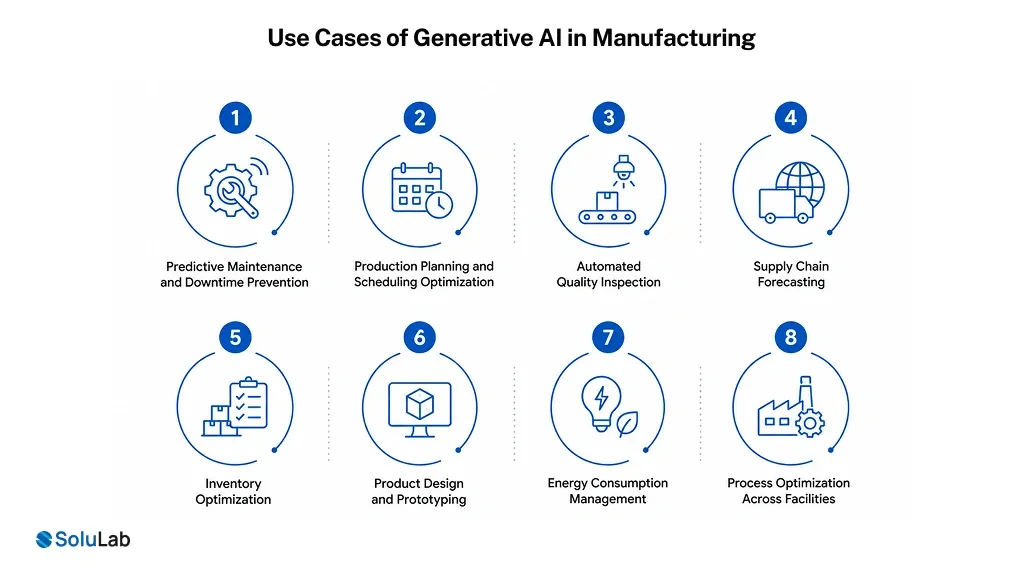
So where does it actually land? Manufacturers are putting generative AI to work for output, for waste, and for decisions that used to take a week of meetings. The eight below cover the production lifecycle end to end, from the maintenance shed to the QA bench.
1. Predictive Maintenance and Downtime Prevention
Machines tell you they are dying long before they die. Generative AI reads that equipment data, calls the failure early, and buys you a planned repair instead of an emergency one. Machines last longer too.
- Failures spotted early
- Fewer unplanned stoppages
- Better asset utilization
2. Production Planning and Scheduling Optimization
Feed it demand, inventory, and what your lines can genuinely handle, and generative AI builds a schedule that survives contact with the shop floor.
- Smarter schedules, built faster
- Resources assigned where they pay off
- Orders out the door sooner
3. Automated Quality Inspection
AI-driven inspection spots the defect and the drift while the part is still on the line. Quality goes up. The manual check burden goes down.
- Defects flagged in real time
- Fewer rejected units
- More accurate QA overall
4. Supply Chain Forecasting
Demand swings. Suppliers slip. Generative AI helps you see both coming far enough ahead that the response is a decision rather than a scramble.
- Sharper demand forecasts
- Fewer supply chain shocks
- Better inventory calls
5. Inventory Optimization
Pull in the history and the live numbers, and AI works out how much stock you actually need. Less cash sitting on a shelf.
- Lower holding costs
- Fewer stockouts
- A warehouse that runs cleaner
6. Product Design and Prototyping
It speeds up AI product development by throwing out design alternatives your team would not have had time to draw, then testing them virtually before anyone cuts metal.
- Shorter development cycles
- Cheaper prototyping
- More design options actually explored
7. Energy Consumption Management
Energy is one of the few costs a plant can shave without touching headcount. AI watches usage across facilities and tunes it, which shows up on the utility bill and in the emissions report.
- Less energy burned per unit
- Better sustainability numbers
- Smaller utility bills
8. Process Optimization Across Facilities
Run AI across industrial operations and the comparisons get interesting: why is plant three slower on the same product? Inefficiencies that were invisible inside one site become obvious across several, and the workflow keeps improving from there.
- Performance compared plant to plant
- Fewer bottlenecks in the process
- Efficiency gains that keep coming

What Manufacturing Systems Can Generative AI Integrate With?
No plant runs on one piece of software. Production, inventory, maintenance, operations, each has its own platform, and generative AI has to reach into all of them to pull live insight out, automate the handoffs, and make the decisions better across the whole stack.
With enterprise AI solutions, you add AI on top of the infrastructure you already paid for. Nothing gets ripped out.
Enterprise Resource Planning (ERP) Systems
Generative AI enhances ERP platforms by reading operational data, forecasting demand, and taking the repetitive business processes off someone’s desk.
- Financial planning on autopilot
- Inventory you can actually see
- Demand forecasts worth acting on
Manufacturing Execution Systems (MES)
Tie AI into MES and you get sharper production monitoring, scheduling that reacts, and processes that improve without a consultant in the building.
- Live production insight
- Workflows tuned automatically
- Tighter process efficiency
Supply Chain Management Systems
Generative AI for supply chain gives you warning before a disruption bites, keeps inventory levels honest, and makes supplier conversations less adversarial.
- Smarter inventory management
- Supply risk called in advance
- Logistics planned better
Computerized Maintenance Management Systems (CMMS)
Hook AI into the maintenance platform and it stops being a work order log. It starts predicting which asset goes next, and what to do about it now.
- Maintenance scheduled predictively
- Less equipment downtime
- Issues closed out faster
Product Lifecycle Management (PLM) Systems
For engineering teams, generative AI compresses the slow parts: design iterations, simulation runs, the search for an idea that works.
- Products developed faster
- Design optimization support
- Engineering workflows that move
Examples of Companies Using Generative AI in Manufacturing
This is not theoretical. Some of the largest manufacturers in the world are already running generative AI against production, downtime, quality, and efficiency. Three worth looking at:
1. Siemens Uses AI for Smart Manufacturing
Siemens has gone further than most, and the Siemens Industrial Copilot is the clearest example. Engineers use it to generate automation code, work through equipment faults, tune production, and run digital twin simulations. The point is less manual effort and fewer errors in the engineering work that used to eat entire weeks.
| Company | Challenge | AI Solution | Results |
| Siemens | Engineering complexity, workforce shortages, machine downtime | Siemens Industrial Copilot powered by generative AI | Faster code generation, improved troubleshooting, optimized production workflows, reduced engineering effort |
2. BMW Applies AI in Production Operations
BMW builds the factory twice: once virtually, once for real. AI-driven digital twins and simulated assembly lines let the team find the inefficiency, replan the workflow, and refine robot movement paths before a single bolt is installed. The same approach feeds their production quality and factory automation work across sites.
| Company | Challenge | AI Solution | Results |
| BMW | Production planning complexity and operational inefficiencies | AI-powered virtual factories and digital twin technology | Improved production planning, optimized assembly operations, reduced implementation risks, enhanced manufacturing efficiency |
3. How Schneider Electric Uses AI for Efficiency Gains
Schneider Electric runs AI through manufacturing and industrial operations alike, with energy management, predictive maintenance, and plain operational performance as the targets. Industrial data gets paired with AI-driven analytics to find where resources are being wasted and to make the sustainability story something other than a pledge. Lower operating costs, higher output, same plants.
| Company | Challenge | AI Solution | Results |
| Schneider Electric | Energy inefficiencies and operational complexity | AI-powered analytics and predictive optimization systems | Better energy efficiency, reduced operational waste, improved asset performance, enhanced sustainability outcomes |
Why Partner with SoluLab for Custom Generative AI Solutions in Manufacturing?
Off-the-shelf AI tools solve off-the-shelf problems. Your scrap rate is not one of those. SoluLab, an AI native company, builds generative AI around how your plant actually runs, so the productivity and waste numbers move somewhere you can see them.
- Predictive Maintenance Solutions
- AI-Powered Quality Inspection Systems
- Demand Forecasting Models
- Manufacturing Knowledge Management Systems
- Industrial Copilot Development
- Inventory Optimization Solutions
- Manufacturing Workflow Automation
- AI-Powered Defect Detection Systems
- ERP and MES AI Integration
- Manufacturing Data Analytics Platforms
Custom generative AI development is what our team does. That means solutions shaped around your production processes, your targets, and the technology stack you are not about to replace.
Strategy, use-case selection, deployment, then the tuning that follows. Our generative AI consulting services cover the whole arc, which is how you move fast without collecting the usual implementation scars.

Conclusion
Generative AI has stopped being an experiment for manufacturers and started being an edge. Predictive maintenance, quality control, supply chain, production planning: each one produces a number the finance team recognizes, which is usually the test that matters.
Production is only getting more complicated. The plants running on AI-driven insight will absorb that complexity at lower cost and answer the market quicker than the ones still reading last month’s report.
Ready to build? SoluLab, a leading generative AI development company in USA, can put together systems that scale with your operation instead of capping it.
FAQs
Neha is a curious content writer with a knack for breaking down complex technologies into meaningful, reader-friendly insights. With experience in blockchain, digital assets, and enterprise tech, she focuses on creating content that informs, connects, and supports strategic decision-making.