Key Takeaways
- Token usage directly impacts enterprise AI infrastructure cost and performance. Therefore, tokenization-first LLM development improves accuracy and prompt efficiency.
- Structured token pipelines support enterprise AI governance and compliance. Along with that, token-optimized LLM architecture enables scalable enterprise AI deployment.
- Enterprises now track AI cost per interaction as a business KPI. To make your system scalable, reach out to SoluLab’s tokenization platform development services.
Large Language Models (LLMs) are becoming a critical part of enterprise software stacks. Banks use them for document analysis, healthcare companies use them for clinical summaries, and customer support platforms rely on them for automated conversations.
- However, as enterprise adoption increases, organizations are noticing a major operational challenge: token usage directly affects cost, performance, and compliance visibility.
- According to industry reports from Microsoft and IBM, enterprise AI workloads are now being evaluated not only for model accuracy but also for token efficiency and context utilization.
This is where tokenization-first LLM development becomes important.
Instead of optimizing prompts after deployment, enterprises are designing LLM systems where token management, context control, and semantic structuring are handled at the architecture level.
Businesses working with an experienced AI development company such as SoluLab are adopting token-optimized LLM architecture as part of a structured enterprise LLM development framework.
Why Are Enterprises Rethinking LLM Cost Structures in 2026?
Enterprise leaders are increasingly reviewing the operational cost of generative AI systems. The main reason is simple: most LLM APIs charge based on tokens processed during input and output.
Technically speaking, tokens are small units of text processed by a model. A token can be a word, part of a word, punctuation, or even characters, depending on the tokenization method.
In English text, one word typically equals about 1.3 tokens, although this varies depending on the tokenizer and language.
Therefore, when enterprises process millions of prompts daily, inefficient token usage can quickly inflate costs.
1. Why Token Consumption Is Becoming a CFO-Level Concern?
Several factors are driving this discussion inside enterprises:
- Long prompts increase token usage unnecessarily
- Repeated context injection raises inference cost
- Inefficient data chunking wastes token capacity
- Multi-agent workflows duplicate token processing
Financial institutions and SaaS platforms with large AI workloads are particularly sensitive to this issue.
Additionally, generative AI systems often process customer history, documentation, and policy information, which can significantly increase token counts.
2. Example: Customer Support AI Systems
Consider a customer support platform handling 50,000 conversations per day.
If each prompt includes:
- conversation history
- product documentation
- company policy references
The token count can easily exceed 2,000 tokens per interaction.
LLM cost optimization for enterprises cuts token usage by 30–40%, directly lowering infrastructure costs.
3. Where Token Optimization Fits in an Enterprise LLM Strategy
Enterprises are therefore focusing on token usage optimization in large language models at three levels:
- Data preprocessing and token structuring
- Efficient context window management
- Optimized retrieval pipelines for knowledge systems
This approach allows organizations to maintain AI performance while keeping operational costs predictable.

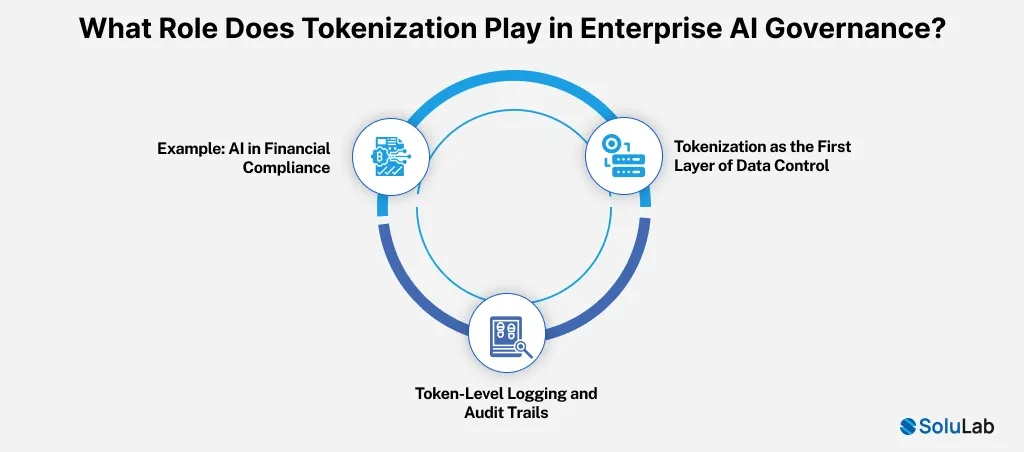
What Role Does Tokenization Play in Enterprise AI Governance?
As enterprises deploy AI across sensitive workflows, governance and compliance requirements are increasing.
Regulated sectors such as banking, insurance, and healthcare must ensure that AI systems maintain transparency, traceability, and privacy controls.
Tokenization plays a surprisingly important role in these governance frameworks.
1. Tokenization as the First Layer of Data Control
Before an LLM processes text, the input must be converted into tokens. During this stage, organizations can implement controls such as:
- sensitive data masking
- structured metadata tagging
- vocabulary normalization
- access-level filtering
Therefore, tokenization becomes an entry point for enforcing enterprise generative AI governance frameworks.
2. Token-Level Logging and Audit Trails
Many enterprises now require logging mechanisms that record:
- input prompts
- token counts
- model responses
- data source references
Token-level logs allow organizations to trace how an AI system generated a response.
This is particularly important in sectors where compliance audits are mandatory.
3. Example: AI in Financial Compliance
A financial services company using AI for regulatory analysis must maintain traceability of generated outputs.
If an AI system summarizes a compliance document incorrectly, auditors must be able to review:
- the exact input tokens
- the knowledge source used
- the generated token sequence
Token-aware logging helps maintain enterprise AI compliance and governance for LLMs.
How Does Tokenization-First Development Accelerate LLM Deployment?
Enterprises are now moving toward structured LLM architectures rather than isolated AI integrations.
A tokenization-first approach simplifies this process because it organizes data before the model processes it.
This reduces model confusion, improves retrieval accuracy, and reduces inference overhead.
1. Efficient Token Structuring Improves Model Accuracy
Modern LLMs rely on embeddings to understand semantic relationships between tokens.
Each token receives a numerical vector that represents how frequently it appears alongside other tokens.
When tokens are structured properly:
- semantic search becomes more accurate
- context relevance improves
- hallucination risks decrease
Therefore, token-aware preprocessing can improve model performance without additional training.
2. Optimizing Context Window Usage
Every LLM has a maximum token limit, often called a context window.
For example, if a model supports 8,000 tokens:
- input tokens
- retrieved knowledge tokens
- generated output tokens
must all fit within that limit. Poor context management can lead to:
- truncated responses
- loss of important information
- inconsistent answers
Tokenization-first architecture helps manage these limitations efficiently.
2. Example: Enterprise Knowledge Assistant
A company deploying an internal AI assistant for business and its employee knowledge access may store thousands of policy documents.
Instead of sending entire documents to the model, token-aware pipelines:
- split documents into structured chunks
- convert them into embeddings
- retrieve only the most relevant sections
This reduces token consumption while improving answer accuracy.
As a result, enterprises can achieve scalable enterprise LLM deployment without increasing compute costs.
5 Enterprise Trends Driving Tokenization-First LLM Adoption
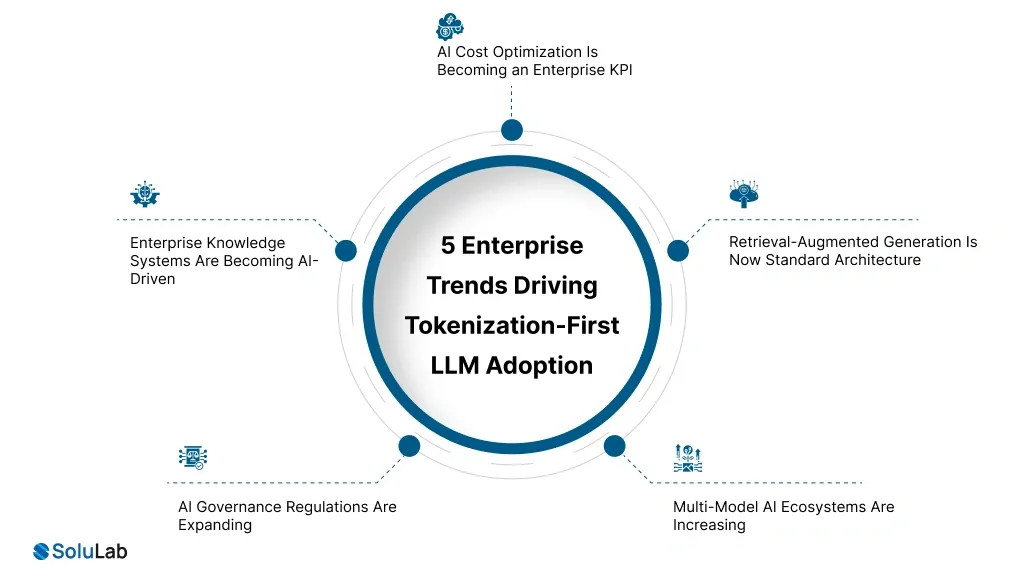
To be above the market, an enterprise must know the latest LLM-related trends. First- to adopt, second- to grow, third- future opportunities, these three are a must for every company
1. AI Cost Optimization Is Becoming an Enterprise KPI
Enterprises are now tracking AI cost per interaction in the same way they track cloud infrastructure spending.
Token optimization directly contributes to enterprise LLM cost reduction. LLM cost optimization for enterprises.
2. Retrieval-Augmented Generation Is Now Standard Architecture
Most enterprise AI systems rely on RAG pipelines.
Efficient token chunking and indexing significantly improve retrieval performance.
3. Multi-Model AI Ecosystems Are Increasing
Enterprises rarely rely on a single model anymore.
Organizations often use combinations of:
- proprietary models
- open-source LLMs
- specialized domain models
A standardized token-optimized LLM architecture helps maintain compatibility across systems.
4. AI Governance Regulations Are Expanding
Governments and regulators are introducing new frameworks for AI transparency and accountability.
Token-level monitoring helps organizations implement enterprise generative AI governance frameworks effectively.
5. Enterprise Knowledge Systems Are Becoming AI-Driven
Internal search, document analysis, and knowledge assistants are major enterprise AI use cases.
Token-efficient pipelines enable these systems to operate at scale.
What Does SoluLab, Tokenization-First LLM Development Framework Look Like?
Organizations adopting generative AI need structured implementation frameworks.
SoluLab provides custom enterprise LLM development services designed to improve cost efficiency, governance, and scalability.
1. Token Usage Audit and AI Cost Analysis
The first step evaluates:
- prompt structure
- token consumption patterns
- model usage costs
This helps identify inefficiencies in existing AI systems.
2. Token-Optimized LLM Architecture Design
SoluLab architects design pipelines that include:
- efficient prompt templates
- token-aware document chunking
- optimized embedding strategies
This ensures efficient token usage optimization in large language models.
3. Governance and Compliance Layer
Enterprises often require governance controls for AI systems.
SoluLab integrates:
- prompt logging
- data masking
- token-level monitoring
This supports enterprise AI compliance and governance for LLMs.
4. Scalable Enterprise Deployment
Finally, SoluLab enables scalable enterprise LLM deployment through:
- RAG architecture optimization
- vector database integration
- multi-model orchestration
These systems allow enterprises to run AI workloads across departments without excessive token costs.
You can be assured that the SoluLab LLM development framework focuses on token-aware AI architecture from the beginning. Hence, contact us today to discuss your innovative LLM +AI +Tokenization ideology.

FAQs
Deepika is a content writer who blends storytelling with strategic thinking. She explores topics across digital innovation, emerging tech, and the evolving blockchain industry. She enjoys breaking down complex ideas into simple, engaging narratives in the growing global markets.